
港股布局

Search documents
机构称港股处在布局区,聚焦恒生ETF(159920)、恒生国企ETF(159850)低位抢筹窗口
Mei Ri Jing Ji Xin Wen· 2025-12-08 06:18
Market Performance - The Hong Kong stock market indices collectively turned negative near midday, with the Hang Seng Index and the Hang Seng China Enterprises Index dropping by 1.1% and 1.15% respectively, with the Hang Seng Index losing nearly 300 points and falling below 26,000 points [1] - The Hang Seng Tech Index decreased by 0.24%, despite having previously surged by 0.8% during the session [1] - Major technology stocks showed weak performance, while Chinese brokerage and insurance stocks remained strong due to favorable industry news [1] Sector Analysis - Non-ferrous metal stocks, including copper, aluminum, and gold, exhibited collective weakness, while oil and banking stocks also faced downward pressure [1] - Popular ETFs, such as the Hang Seng ETF (159920) and the Hang Seng China Enterprises ETF (159850), continued to decline, each dropping over 1%, opening up low-position investment opportunities [1] Economic Insights - Huatai Securities noted that the recent acceleration in the appreciation of the RMB is a positive highlight in domestic economic and financial data [1] - The firm argued that the common belief that currency appreciation pressures export companies' stock prices is not supported by data; instead, moderate appreciation is beneficial for corporate performance amid current capital flow trends, a low real effective exchange rate, and inflation differentials between China and other countries [1] - The company reiterated that the Hong Kong stock market is in a positioning phase, suggesting short-term focus on liquidity turning points and sectors that have seen significant adjustments and diminishing negative pressures, particularly in technology and pharmaceuticals, while also identifying alpha opportunities in consumer goods [1]

港股速报 | 港股小幅高开 内资券商股全线上扬
Mei Ri Jing Ji Xin Wen· 2025-12-08 02:09
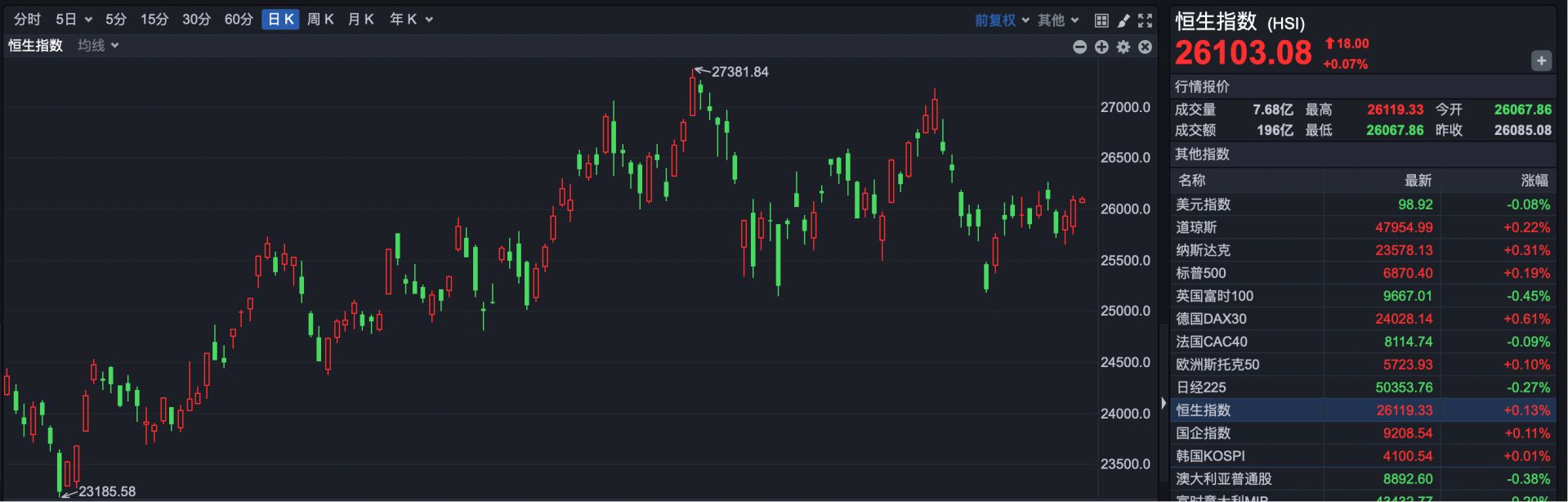
Core Viewpoint - The Hong Kong stock market showed a slight increase, with the Hang Seng Index rising by 0.07% to 26,103.08 points, reflecting a positive market sentiment influenced by recent developments in the securities industry [1][2]. Group 1: Securities Industry Developments - The Chairman of the China Securities Regulatory Commission, Wu Qing, emphasized the critical role of the securities industry during the "14th Five-Year Plan" period, outlining nine key requirements for the sector [2]. - Wu highlighted the securities industry as a major "service provider" for direct financing, an important "gatekeeper" for capital markets, and a professional "manager" of social wealth, indicating significant growth potential [2]. Group 2: Market Performance - Domestic brokerage stocks experienced a notable rise, with Hongye Futures (HK03678) increasing over 8%, and other firms like Guotai Junan (HK02611) and Huatai Securities (HK06886) rising more than 5% [2][4]. - The Hong Kong Securities ETF also saw an increase of over 3% in early trading [2]. Group 3: Sector Highlights - The Hang Seng Technology Index rose by 0.50% to 5,690.54 points, indicating a positive trend in technology stocks [3]. - Mixed performance was observed in the tech sector, with Baidu increasing over 4% and Meituan rising over 1%, while Lenovo saw a decline of 0.7% [6]. - Semiconductor stocks gained, with companies like SMIC and Hua Hong Semiconductor rising over 2% [6]. - The innovative drug sector showed strength, with Kangfang Biotech increasing over 2% [6]. - Domestic insurance stocks also performed well, with China Ping An and China Life both rising over 2% [6]. Group 4: Market Outlook - Huatai Securities noted that the recent appreciation of the RMB is a positive sign in domestic economic and financial data, suggesting that moderate appreciation could benefit corporate performance despite common beliefs about its negative impact on export companies [7]. - The firm indicated that the current market sentiment remains pessimistic, but it is viewed as a potential opportunity for investment, particularly in technology and pharmaceuticals, while also suggesting a focus on consumer goods for alpha opportunities [7].

华泰香港市场研究11月精华:三大均衡育新机
Xin Lang Cai Jing· 2025-12-06 01:24
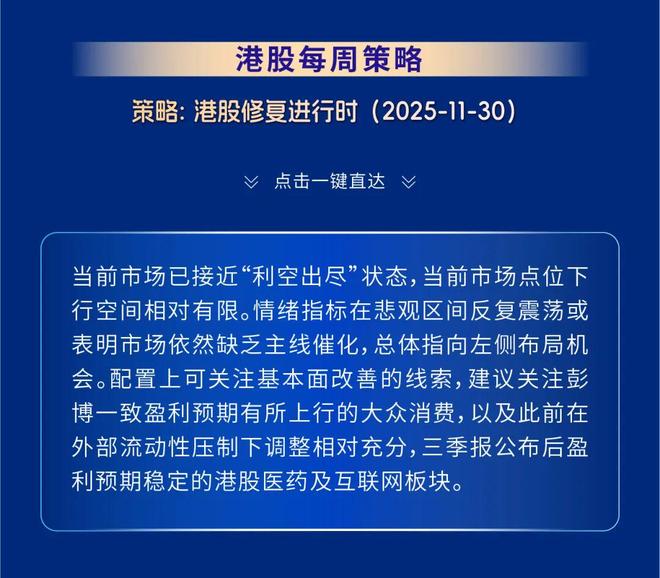
Group 1 - The Hong Kong stock market is entering a value investment phase, with current adjustments providing better cost-effectiveness compared to A-shares [2] - Short-term capital may continue to seek safety, with a focus on underperforming sectors such as consumer services, construction, textiles, and home appliances [2][3] - Certain industries like electronics, pharmaceuticals, automotive, and light manufacturing have experienced significant declines, presenting opportunities for recovery [2] Group 2 - The recent market volatility has highlighted the importance of balanced asset allocation, especially in the context of external disturbances affecting investor sentiment [4] - The Chinese AI industry is seen as a long-term theme supported by national planning, with technology stocks in Hong Kong still offering mid-term investment value [4] - The shift in market style from technology to defensive dividend sectors has been noted since mid-October, with various dividend-focused ETFs available in the Hong Kong market [6]
港股速报|两公司纳入港股通标的 机构:港股正进入“布局区”
Mei Ri Jing Ji Xin Wen· 2025-11-24 02:54
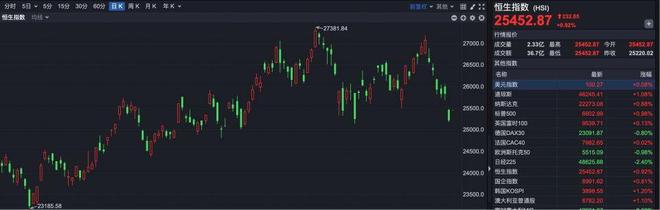
Market Overview - The Hong Kong stock market opened higher today, with the Hang Seng Index at 25,452.87 points, up 232.85 points, a rise of 0.92% [1] - The Hang Seng Tech Index reached 5,456.61 points, increasing by 61.12 points, or 1.13% [3] Company Updates - The Shenzhen Stock Exchange announced adjustments to the Hong Kong Stock Connect eligible securities list, effective from November 24, 2025, adding SANY Heavy Industry (HK06031) and Cambridge Technology (HK06166), both of which listed on the Hong Kong Stock Exchange on October 28 [5] - SANY Heavy Industry saw a slight increase of nearly 1%, while Cambridge Technology experienced a rise of over 6% during the morning session [6] Sector Performance - Technology stocks generally rose, with NetEase up over 3% and Baidu up over 2%. Major companies like Alibaba, Tencent, JD.com, Lenovo, Kuaishou, and Xiaomi all saw increases of over 1% [8] - Gold stocks were active, with China Gold International opening up 4%. The innovative drug sector also saw gains, with Hengrui Medicine rising over 3% [8] - Lithium battery stocks opened higher, with CATL increasing by over 3%. Automotive stocks were broadly up, with GAC Group rising over 9% [8] Future Outlook - Huatai Securities indicated that the sentiment indicator for Hong Kong stocks remains in a pessimistic range, suggesting that the market is entering a "layout zone" where left-side investors can gradually build positions [9] - The outlook for Hong Kong companies' fundamentals is not pessimistic, with a forecasted increase in non-financial profit growth for overseas Chinese stocks from 10% this year to around 15% by 2026 [9] - CITIC Securities noted that A-shares and Hong Kong stocks may experience a pattern similar to U.S. stocks, with "sharp declines followed by slow recoveries," presenting an opportunity for investors to reallocate towards A-shares and Hong Kong stocks as they prepare for 2026 [9]
华泰证券:港股正在进入布局区
Ge Long Hui· 2025-11-24 00:23
Group 1 - The core viewpoint is that recent market volatility is primarily driven by liquidity, sentiment, and risk appetite, but the overall outlook remains optimistic despite concerns about economic data diverging from the stock market [1] - The domestic asset revaluation theme remains unchanged, with a persistent demand for core assets, necessitating a more discerning allocation strategy as valuations shift towards earnings [1] - Hong Kong stocks have experienced an earlier and deeper adjustment compared to A-shares, indicating a potential for value at the current position [1] Group 2 - Short-term capital may continue to seek safety and shift between high and low sectors, with a recommendation to focus on consumer services, construction, textiles, and home appliances, which have underperformed this year [1] - In the third round of revaluation since August, certain industries have seen limited gains but significant recent declines, indicating a higher probability of being "wrongly punished," with a focus on electronics, pharmaceuticals, automotive, and light manufacturing [1] - The technology sector in Hong Kong has faced considerable pullbacks, and while sensitivity to positive catalysts has decreased amid falling risk appetite, there remains a revaluation opportunity once liquidity conditions improve [1]
美联储降息至3.75%-4.00%,港股或迎布局良机,如何布局?
Mei Ri Jing Ji Xin Wen· 2025-10-30 02:42
Core Viewpoint - The Federal Reserve has announced a 25 basis point interest rate cut, lowering the federal funds rate target range to 3.75%-4.00%, marking the second consecutive rate cut and the fifth since September 2024 [1] Group 1: Federal Reserve Actions - The Federal Reserve's cautious stance, as expressed by Powell, suggests a potential pause in rate cuts in December, indicating that the situation is "far from certain" [1] - Market reactions were significant, with traders reducing the December rate cut expectations to 65%, leading to a drop in U.S. stocks and a surge in U.S. Treasury yields [1] Group 2: Impact on Hong Kong Market - Continuous rate cuts by the Federal Reserve are generally favorable for the Hong Kong stock market, as lower interest rates alleviate liquidity pressures, particularly benefiting interest-sensitive sectors like technology and finance [1] - A potential soft landing for the U.S. economy could enhance global growth expectations, thereby boosting market sentiment in Hong Kong [1] Group 3: Investment Opportunities - Despite Powell's signals of a possible pause causing short-term volatility, the overall direction of the rate cut cycle remains unchanged, presenting a mid-to-long-term investment opportunity in Hong Kong stocks, which are currently valued at relatively low historical levels [1] - Investors are encouraged to focus on interest-sensitive, undervalued quality stocks, such as the Hong Kong Stock Connect Financial ETF (513190), while remaining cautious of volatility risks stemming from global economic uncertainties [1]