物理图灵测试

Search documents
2天20小时、零接管横穿美国,特斯拉FSD已通过“物理图灵测试”?
华尔街见闻· 2026-01-01 12:20
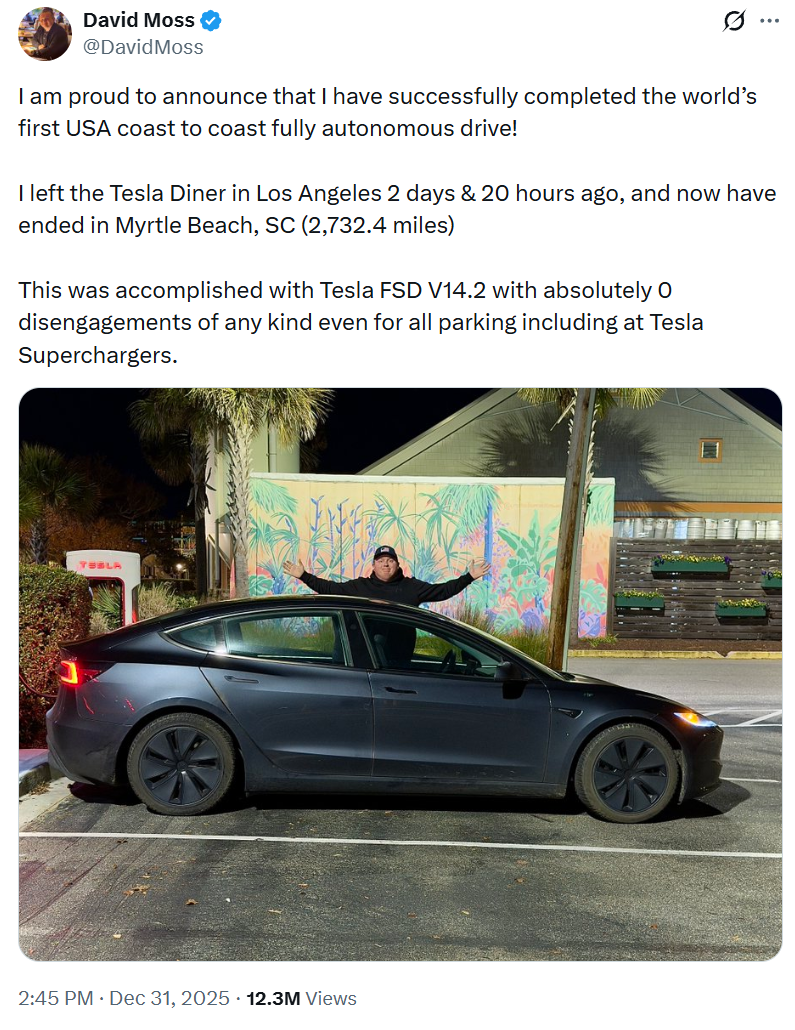
Core Viewpoint - The successful coast-to-coast journey of a Tesla Model 3 using FSD v14 demonstrates the potential for fully autonomous driving, raising the question of whether FSD can completely replace human drivers [4][9]. Group 1: Journey Details - A Tesla Model 3 equipped with FSD v14 completed a 2732-mile journey from Los Angeles to South Carolina in 2 days and 20 hours, relying entirely on FSD without any human intervention [1][5]. - The journey included diverse driving environments such as highways, city roads, and various traffic conditions, with the FSD handling all parking operations, including automatic parking at Tesla Superchargers [5][9]. Group 2: Significance of the Achievement - This journey marks a significant milestone in the autonomous driving industry, as it is the first instance of a vehicle completing a long-distance trip without any human takeover, which is seen as a key indicator of the maturity of autonomous driving technology [4][9]. - Elon Musk celebrated this achievement, noting that it aligns with his long-held vision of coast-to-coast autonomous driving since the introduction of Autopilot 2.0 in 2016 [7]. Group 3: Technological Insights - Nvidia's Jim Fan suggested that Tesla's FSD v14 may have passed the "Physical Turing Test," indicating that the system's driving behavior is indistinguishable from that of a cautious, experienced human driver [12]. - The transition from rule-based systems to end-to-end neural networks in FSD v14 is credited for its breakthrough performance, with Tesla's vehicles having accumulated nearly 7 billion miles of driving data, including 2.5 billion miles in urban environments [15]. Group 4: Future Implications - The ability of FSD to navigate complex urban scenarios, such as unprotected turns and unpredictable pedestrians, enhances the realism of "human-like driving" [15]. - The evolution of FSD is compared to the adoption of smartphones, suggesting that as machines learn to navigate the real world naturally, it could lead to a new era of understanding intentions rather than merely following commands [15].


2天20小时、零接管横穿美国,特斯拉FSD已通过“物理图灵测试”?
Hua Er Jie Jian Wen· 2026-01-01 03:29
Core Insights - Tesla's Full Self-Driving (FSD) system has achieved a significant milestone by completing a coast-to-coast journey across the United States without any human intervention, showcasing the system's capabilities in real-world conditions [1][4][13]. Group 1: Journey Details - A Tesla Model 3 equipped with FSD v14 completed a 2,732-mile journey from Los Angeles to Myrtle Beach, South Carolina, in 2 days and 20 hours, relying entirely on FSD [1][4]. - The journey included diverse driving environments such as highways, city streets, and complex scenarios like nighttime driving and multiple supercharger stops, with no need for human takeover [1][4][13]. - The driver, Davis Moss, had previously driven 10,638.8 miles using FSD before this trip, emphasizing the system's reliability [4]. Group 2: Industry Significance - This journey marks a pivotal moment for the autonomous driving industry, as it raises the question of whether FSD can fully replace human drivers [4][13]. - Elon Musk celebrated this achievement, noting that it fulfills a long-standing goal he set in 2016 for coast-to-coast autonomous driving [6][13]. Group 3: Technological Advancements - The success of FSD v14 is attributed to Tesla's shift from rule-based systems to an end-to-end neural network, trained on nearly 7 billion miles of real-world driving data [15]. - The system has demonstrated its ability to handle complex urban driving scenarios, which are significantly more challenging than highway driving [15]. - Nvidia's Jim Fan suggested that FSD v14 may have passed a "Physical Turing Test," indicating that the system's driving behavior is increasingly indistinguishable from that of a cautious human driver [13][14]. Group 4: Future Implications - The advancements in FSD technology could lead to a paradigm shift in how autonomous systems are perceived, moving from mere compliance with instructions to understanding intent [15]. - Despite the progress, the system still requires human supervision, as complete autonomy has not yet been achieved [15].
特斯拉通过「物理图灵测试」,英伟达机器人主管爆吹,圣诞节刷屏了
3 6 Ke· 2025-12-26 06:50
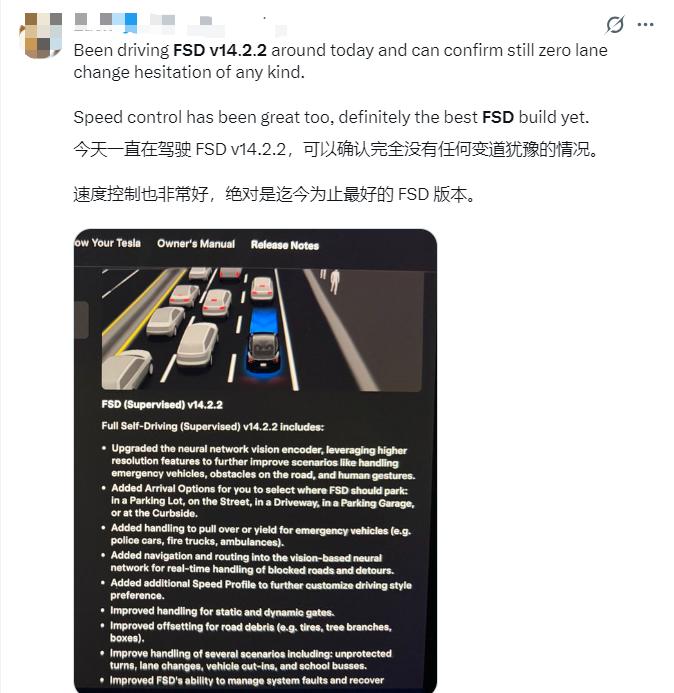
Core Insights - Tesla's FSD v14.2.2 has been recognized as the first AI to pass the "physical Turing test," receiving endorsement from NVIDIA's robotics head, Jim Fan, who expressed amazement at its capabilities [1][3][7] - The update has generated widespread excitement among Tesla owners, with many reporting a significantly improved driving experience, describing it as the best version of FSD to date [2][3][5] Group 1: FSD v14.2.2 Features - The core changes in FSD v14.2.2 focus on upgrades to the neural network visual encoder, enhancing perception and understanding capabilities [8] - The new version improves recognition of emergency vehicles, road obstacles, and complex scenarios, allowing for better decision-making and execution [8][9] - FSD now includes dynamic navigation capabilities that can adapt to real-time traffic conditions, as well as enhanced parking features that allow users to select preferred parking methods [9] Group 2: User Experience and Feedback - Users have reported that the FSD behaves more like an experienced driver, with smoother lane changes and quicker decision-making [6][8] - Feedback from users indicates a significant increase in reliability during long drives, with one user noting they could complete a 90-minute journey without touching the steering wheel [6][8] - The excitement among users is palpable, with many sharing their experiences on social media, highlighting the system's ability to understand and respond to various driving scenarios [5][6] Group 3: Competitive Landscape - Tesla's FSD is in a competitive race with Waymo, which currently leads in the Robotaxi market with a larger fleet and operational scale [10][17] - As of now, Tesla has deployed approximately 30 Robotaxi vehicles in Austin, while Waymo operates nearly 200 in the same area [10] - Despite the current gap, Tesla's FSD advancements are generating increased attention and user engagement, with a notable rise in app downloads compared to Waymo [17][10] Group 4: Future Outlook - Elon Musk has set ambitious goals for Tesla's Robotaxi services, aiming for full autonomy without safety monitors in the near future [7][10] - The ongoing improvements in FSD capabilities and the competitive dynamics with Waymo suggest a rapidly evolving landscape in the autonomous driving sector [10][22] - The debate over the superiority of Tesla's software versus Waymo's hardware-centric approach continues, with both sides having their strengths and weaknesses [22][21]


特斯拉通过「物理图灵测试」!英伟达机器人主管爆吹,圣诞节刷屏了
量子位· 2025-12-26 04:24
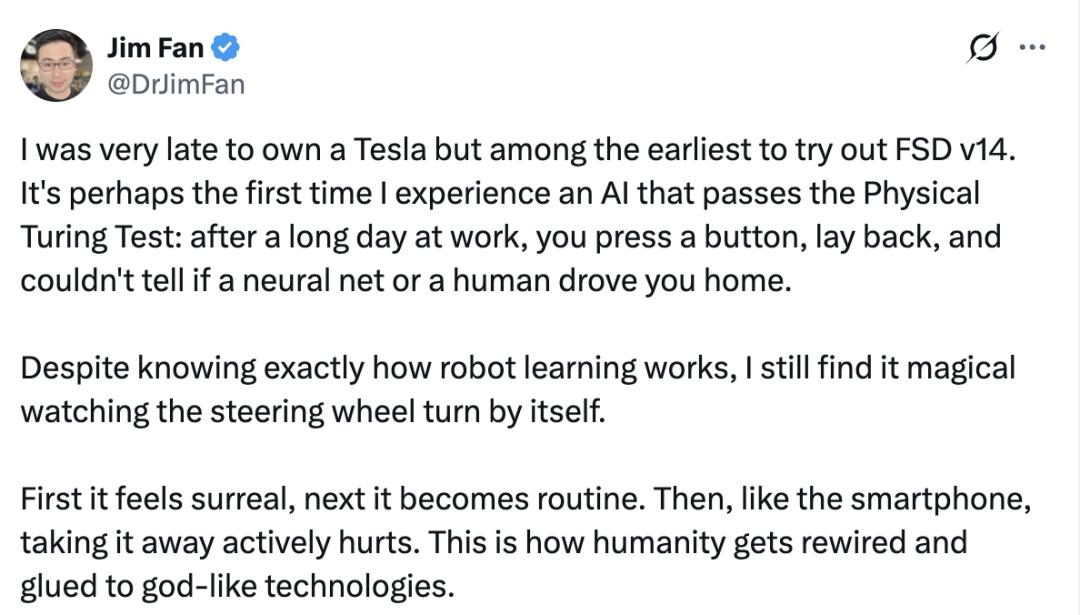
Core Viewpoint - Tesla's FSD v14 has been recognized as the first AI to pass the "physical Turing test," showcasing significant advancements in autonomous driving technology [1][7]. Group 1: User Experience and Feedback - Jim Fan, NVIDIA's robotics head, expressed astonishment at the FSD v14 experience, stating it felt indistinguishable from a human driver [3][4]. - User feedback on FSD v14 has been overwhelmingly positive, with many Tesla owners reporting an addictive quality to the technology [6][10]. - Specific user experiences highlight FSD's improved decision-making, such as effectively reading parking signs and executing lane changes decisively [11][12][26]. Group 2: Technical Enhancements - The FSD v14.2.2 update includes significant upgrades to the neural network's visual encoder, enhancing perception and understanding capabilities [32]. - New features allow for better recognition of emergency vehicles and dynamic navigation adjustments in response to real-time traffic conditions [35][37]. - The update introduces two new driving modes, SLOTH and MADMAX, which cater to different driving styles and preferences [44]. Group 3: Competitive Landscape - Tesla's Robotaxi service is still in its early stages, with approximately 30 vehicles deployed in Austin, compared to Waymo's nearly 200 vehicles in the same area [42]. - Waymo leads in market presence and operational scale, with over 2,500 vehicles across multiple cities and a significant number of weekly paid rides [43][47]. - Despite the current gap, Tesla's FSD improvements and growing user interest indicate a potential for accelerated growth in the Robotaxi market [53][54]. Group 4: Future Outlook - Elon Musk has set ambitious goals for Tesla's Robotaxi service, aiming for full autonomy without safety monitors, which appears to be progressing with the latest FSD updates [29][30]. - The ongoing competition between Tesla and Waymo highlights differing technological approaches, with Tesla focusing on a neural network model while Waymo relies on a modular system [63]. - The future of autonomous driving technology will likely influence consumer purchasing decisions, making it a critical area for both companies [69].

特斯拉最新FSD推送,英伟达机器人主管:分不清人还是AI在开
3 6 Ke· 2025-12-25 01:24
Core Insights - Tesla has officially rolled out the FSD V14.2.2 update to North American owners of Model 3/Y/X/S and Cybertruck, enhancing driving smoothness and parking precision [1][6] - The update has received positive feedback from users and experts, with claims that it has passed a physical Turing test, making it difficult to distinguish between human and AI driving [3][23] Group 1: Update Features - The FSD V14.2.2 update focuses on three main areas: driving smoothness, perception capabilities, and parking abilities [5] - The update includes an upgraded neural network visual encoder, improving recognition of emergency vehicles, road obstacles, and human gestures [12] - New navigation and path planning features allow real-time responses to traffic conditions [12] Group 2: User Experience - Users have reported significant improvements, such as the elimination of lane shaking issues and better handling of complex driving scenarios [8][10] - The system can now recognize and avoid emergency vehicles, and it allows users to set parking preferences, adjusting navigation accordingly [14] - Feedback indicates that the driving process feels more confident, with smoother lane changes and quicker decision-making [9] Group 3: Additional Features - Two new speed modes have been introduced: SLOTH for conservative driving and MAD MAX for more aggressive driving [16] - The update enhances the system's ability to manage faults and recover from degraded operation, improving overall reliability [19] - New alerts for windshield residue and an automatic cleaning feature for the front camera have been added to enhance visibility [20][21] Group 4: Future Prospects - The FSD V14.2.2 version is seen as a step closer to achieving fully autonomous driving, with expectations for a significant model upgrade (FSD V14.3) soon [22][31] - There is anticipation regarding the potential launch of a fully autonomous Robotaxi service by the end of the year, as indicated by Elon Musk [31]
特斯拉FSD通过物理图灵测试
Xin Lang Cai Jing· 2025-12-24 14:07
Core Insights - Jim Fan, Director of Robotics at NVIDIA, stated that Tesla's FSD v14 has successfully passed what he calls the "physical Turing test" for AI [1] - After experiencing FSD v14, Jim Fan noted that the system is initially impressive but quickly becomes integrated into daily life, similar to a smartphone, making its absence feel significantly uncomfortable [1] - Elon Musk expressed agreement on X, stating that FSD v14 allows users to feel the "growing perception capabilities," asserting that Tesla's AI is currently the strongest real-world AI [1]
全球TOP 13战队翻车实录,机器人极限求生,比科幻片还残酷
3 6 Ke· 2025-12-08 10:18
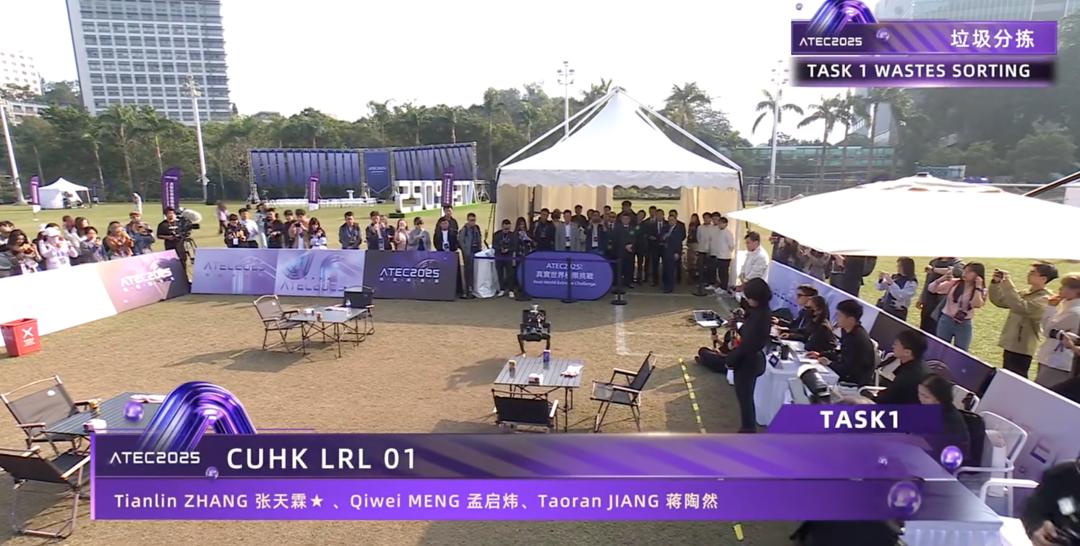
Core Insights - The ATEC 2025 competition showcased the challenges faced by robots in real-world environments, emphasizing the need for advancements in autonomous capabilities [18][20][22] - The event aimed to test robots' abilities to adapt to complex, unpredictable scenarios, moving beyond controlled laboratory settings [21][23][25] - The competition highlighted the importance of developing robots that can operate without human intervention, pushing teams to innovate in AI and robotics [29][61] Group 1: Competition Overview - The ATEC 2025 competition featured 13 elite teams from around the world, with the wongtsai team achieving the highest score of 434 points [48][49] - The competition included four main tasks: garbage sorting, autonomous watering, directional off-road navigation, and bridge crossing, each designed to test various robotic capabilities [30][31] - The event was held in a real outdoor environment, presenting challenges such as varying terrain and environmental conditions, which tested the robots' adaptability [25][22] Group 2: Technical Challenges - Teams faced significant technical hurdles, including environmental perception, intelligent decision-making, and hardware limitations [33][61] - The garbage sorting task illustrated the difficulties robots encounter in recognizing and categorizing objects in real-world conditions [40][34] - The bridge crossing task required robots to make autonomous decisions based on dynamic environmental factors, showcasing the need for advanced planning and execution capabilities [44][46] Group 3: Innovations and Strategies - The competition encouraged the development of "no remote control" technologies, rewarding teams that achieved full autonomy [29][26] - Teams employed diverse technical strategies, with some opting for traditional methods while others explored cutting-edge approaches to enhance robotic performance [58][57] - The event served as a platform for teams to refine their algorithms and hardware, addressing the limitations that hinder the practical application of robotics in everyday scenarios [59][60]
英伟达Jim Fan深度分享:揭秘具身智能路线与障碍
3 6 Ke· 2025-05-14 02:23
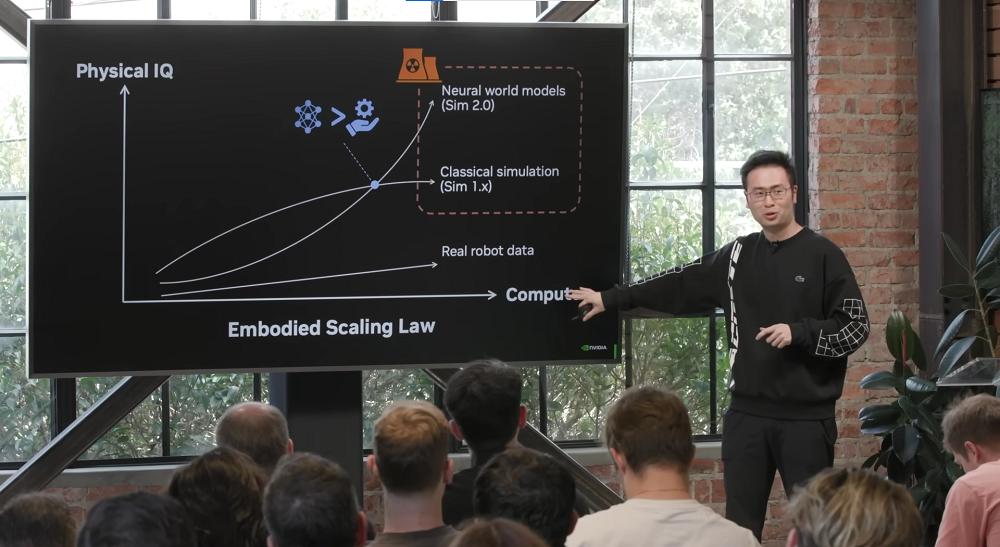
Core Insights - The core challenge in the field of embodied intelligence is the lack of real-world physical interaction data, which is a significant bottleneck for robot development [1][4][10] - The future of robotics lies in the integration of world models and simulation technology, leading to a "Simulation 2.0" era that will provide continuous "nuclear power" for the development of embodied intelligence [2][40] Group 1: Challenges in Robotics - Robots have not yet passed the "physical Turing test," with data scarcity being the primary obstacle [4][6] - Current data collection methods for training robots are inefficient, relying heavily on human input, which limits scalability [16][12] - The performance of robots in physical tasks remains subpar compared to human capabilities, highlighting the need for improved training methods [8][10] Group 2: Simulation as a Solution - Simulation technology allows robots to achieve superhuman performance, completing training in a fraction of the time required in the real world [17][24] - By utilizing high-speed simulations, robots can be trained in environments that mimic real-world conditions, significantly enhancing their learning efficiency [20][22] - The concept of a digital twin enables seamless knowledge transfer from simulated environments to real-world applications [22][24] Group 3: Advancements in Simulation Technology - The introduction of RoboCasa, a large-scale simulation platform, allows for the generation of complex training environments without extensive manual modeling [32][34] - The development of "digital cousins" captures essential features of real-world scenarios, enabling effective training without the need for perfect replication [38][40] - Video diffusion models can create realistic simulations of various scenarios, enhancing the training process for robots [45][49] Group 4: Future Directions - The concept of a "physical API" is proposed as the next frontier, enabling robots to manipulate the physical world similarly to how digital APIs handle information [54][56] - The vision includes a future where robots seamlessly integrate into daily life, performing tasks autonomously and passing the physical Turing test without human awareness [56]
腾讯研究院AI速递 20250512
腾讯研究院· 2025-05-11 14:17
Group 1 - OpenAI has launched the RFT (Reinforcement Fine-Tuning) feature, allowing rapid enhancement of model performance in specific fields with minimal samples [1] - RFT is applied in three main scenarios: instruction-to-code, text summarization, and complex rule application, with companies like ChipStack achieving significant results [1] - An evaluation system must be established before implementing RFT, clearly defining task objectives and reinforcement scoring schemes to avoid ambiguity [1] Group 2 - Gemini 2.5 Pro has achieved a breakthrough in video processing, capable of handling videos up to 6 hours long using low media resolution technology [2] - It seamlessly integrates video content with code, enabling direct conversion of videos into interactive web applications and p5.js animations [2] - The system features precise video segment retrieval and temporal reasoning capabilities for advanced analysis functions like complex scene counting and timestamp localization [2] Group 3 - ChatGPT's deep research feature now connects directly to GitHub, allowing team users to access and analyze code repositories in real-time [3] - The system automatically generates search keywords based on user queries, supporting code repository searches with a 5-minute synchronization time [3] - OpenAI assures that enterprise product user data will not be used for model training, while personal users may have their content used if they opt into the "improve the model for everyone" option [3] Group 4 - Meta has released the next-generation 3D content generation AI system, AssetGen 2.0, which can generate high-precision 3D models and textures directly from text and images [4][5] - The new system shows significant improvements in geometric consistency and texture detail compared to its predecessor and is set to be integrated into the Horizon editor within the year [5] - Meta is developing a "complete 3D scene generation" feature aimed at enabling one-click generation of entire 3D virtual worlds from simple text commands [5] Group 5 - Enigma Labs has developed the world's first AI-generated multiplayer game, Multiverse, achieving real-time multiplayer interaction in a racing game with a development cost of under $1,500 [6] - The innovation lies in a new multiplayer world model architecture that ensures consistent rendering of shared world states by stacking player views along a channel axis [6] - The team has made all code and data publicly available and utilized modifications of the game "GT Racing 4" for data collection, generating training datasets using the B-Spec mode [6] Group 6 - Genspark has launched the "AI Sheets" tool, allowing users to complete data collection, organization, analysis, and visualization through natural language dialogue without needing complex Excel formulas [7] - The tool supports multi-format document imports, automatic data cleaning, and intelligent analysis and visualization, claiming to be several times faster than traditional manual operations [7] - Currently in beta testing, the tool is free to use and applicable across various fields such as sales, marketing, and product management, addressing efficiency and expertise challenges in traditional spreadsheet processing [7] Group 7 - The Sequoia AI Summit highlighted a shift in AI business models from selling tools to selling measurable business outcomes, seen as a "trillion-dollar opportunity" [9] - AI is evolving from application tools to operating system-level entry points, with the potential to control system allocation rights and build new economic collaboration networks [9] - Future AI competition will focus on organizational restructuring, moving from deterministic execution to exploratory goal-setting, necessitating a human-machine collaborative system rather than solely enhancing model performance [9] Group 8 - YC partners criticized the current inadequacies in AI applications, attributing them to outdated product design thinking that fails to leverage AI's full potential [10] - AI-native applications should allow users to customize system prompts, enabling AI to work according to individual styles rather than predefined developer settings [10] - Future AI applications should focus on "Agent builders" rather than just agents, emphasizing tools and interfaces that empower users to train and customize their AI assistants for true automation and personalization [10] Group 9 - NVIDIA's Jim Fan introduced the concept of "physical Turing test," assessing whether robots can complete tasks in the physical world indistinguishably from humans [11] - The key to addressing the lack of training data for robots lies in simulation, utilizing high-speed parallel simulation and domain randomization to generate diverse training environments [11] - Future directions include developing a physical API that allows robots to process the physical world similarly to how LLMs handle digital information, potentially creating new skill economies and service models [11]