白银挤仓

Search documents
遭遇“黑色星期五”之后:白银史上第三轮大牛市结束了吗?
经济观察报· 2026-01-31 14:50
Core Viewpoint - The article discusses the recent volatility in the silver market, particularly the significant price drop following a speculative surge, drawing parallels to historical events like the Hunt brothers' squeeze in 1980 and the quantitative easing speculation in 2011, suggesting that the current market may be facing a similar fate due to regulatory interventions and lack of fundamental support [1][18]. Market Dynamics - The recent surge in silver prices began in November 2025, with the Shanghai silver main contract rising from 11,441 yuan/kg to a peak of 32,382 yuan/kg by January 30, 2026, marking a 183% increase, while the COMEX silver contract saw a 152% rise during the same period [6]. - The speculative frenzy led to significant interest in silver-related stocks, with companies like Hunan Silver and Silver Nonferrous experiencing maximum gains of 273% and 233%, respectively, and the Guotou Silver LOF fund achieving a peak increase of 311.21% [6]. Regulatory Response - In response to the market volatility, the Shanghai Futures Exchange raised the margin requirements for silver futures contracts, which contributed to a sharp decline in prices, with the Shanghai silver main contract dropping 17% to 24,832 yuan/kg shortly after the regulatory changes [2][10]. - The regulatory measures included targeted actions against investors engaging in abnormal trading behaviors, indicating a strong stance to maintain market order and prevent excessive speculation [9]. Investor Behavior - Investors, like Mr. Liu, initially profited from the silver surge but faced significant losses during the subsequent crash, highlighting the risks associated with speculative trading in volatile markets [4][12]. - The article notes that the current market sentiment is characterized by a blind rush into silver investments, with some investors purchasing silver-related assets without a clear understanding of the underlying fundamentals [8]. Historical Context - The article draws comparisons between the current silver market and past speculative bubbles, emphasizing that both the Hunt brothers' event and the 2011 surge ended with regulatory interventions leading to sharp declines in prices [16][18]. - Historical data shows that the current bull market in silver, which began in July 2022, has seen prices rise approximately 600% over three and a half years, echoing patterns seen in previous market cycles [13][17]. Future Outlook - Analysts express cautious optimism about silver's future, noting that while the industrial demand for silver remains strong, the speculative nature of the current market could lead to significant price corrections if macroeconomic conditions shift [19][20]. - The interplay between silver's industrial applications and its financial attributes will be crucial in determining future price movements, with a focus on supply-demand dynamics and regulatory developments [19][20].

遭遇“黑色星期五”之后:白银史上第三轮大牛市结束了吗?
Jing Ji Guan Cha Wang· 2026-01-31 14:41
Core Viewpoint - The silver market has experienced extreme volatility, with significant price fluctuations leading to regulatory interventions and investor panic, culminating in a dramatic drop in silver prices on January 30, 2026 [2][6][12]. Price Movement - The silver price surge began in November 2025, with the Shanghai silver main contract rising from 11,441 yuan/kg to a peak of 32,382 yuan/kg by January 30, 2026, marking a 183% increase; the COMEX silver contract saw a 152% increase during the same period [3]. - On January 30, 2026, the Shanghai silver main contract fell by 6.03% to 27,941 yuan/kg, with a daily volatility of 16%; the following night, it dropped 17% to 24,832 yuan/kg [6][12]. - The COMEX silver contract experienced a nearly 36% drop, closing with a 25.50% decline, marking one of the largest daily declines in history [6][12]. Market Dynamics - The surge in silver prices led to a rush in the stock market, with silver-related stocks like Hunan Silver and Silver Nonferrous experiencing maximum gains of 273% and 233%, respectively; the Guotou Silver LOF fund saw a peak increase of 311.21% [3][5]. - Regulatory bodies, including the Shanghai Futures Exchange and Shenzhen Stock Exchange, have implemented measures to curb excessive speculation and maintain market order, including raising margin requirements and limiting trading activities [5][12]. Investor Behavior - Investors, including those like Mr. Liu, initially profited from the silver surge but faced significant losses during the subsequent market crash, leading to a shift in strategy towards hedging with put options [7][12]. - The market sentiment has been influenced by fears of a potential delivery failure due to low physical silver inventories, raising concerns about the integrity of the pricing mechanism [4][8]. Historical Context - The current silver market dynamics echo past events, notably the Hunt brothers' attempt to corner the silver market in the 1980s, which ended in a crash following regulatory interventions [11][12]. - Analysts suggest that the current market may be experiencing a speculative bubble similar to previous bull markets, with the potential for significant corrections if regulatory measures are intensified [12]. Future Outlook - Analysts express cautious optimism regarding silver's future, emphasizing the importance of industrial demand and macroeconomic factors, while warning of the risks associated with speculative trading [12][13]. - The silver market is expected to enter a phase of high volatility, influenced by both supply-demand dynamics and broader economic conditions, with potential for significant price corrections if market sentiment shifts [13].


COMEX持仓异动!白银“3月交割劫”正提前引爆,挤仓将加速
Jin Shi Shu Ju· 2026-01-13 05:50
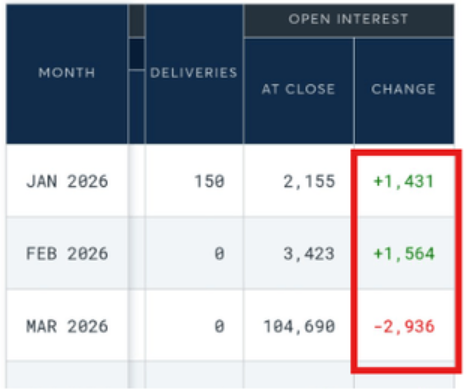
Group 1 - The core issue in the silver market is a significant supply shortage, with demand exceeding supply for four consecutive years, and a projected structural market gap of 148.9 million ounces in 2024, leading to a total shortfall of 678 million ounces over the past four years, equivalent to 10 months of global mine production in 2024 [1] - The recent trend in the COMEX silver market shows investors rolling their contracts back from March to January and February, indicating a desire for immediate physical delivery of silver rather than waiting for the March contract [2][3] - The increase in open interest for January and February contracts, alongside a decrease for March contracts, suggests that traders are seeking to secure physical silver amid a tight supply situation, which could further deplete COMEX registered inventories [4][5] Group 2 - The phenomenon of backwardation in the silver market, where contracts are rolled back to nearer expiration dates, indicates a current spot premium and a shortage of physical silver, as traders prefer immediate delivery [4] - Analysts suggest that the current market dynamics could lead to significant challenges for COMEX if the trend of increasing demand for physical delivery continues, potentially exacerbating the existing supply issues [5]
白银挤仓风暴后,伦敦金库现九年来最大规模流入
美股研究社· 2025-11-11 10:09
Core Viewpoint - The article discusses the significant increase in silver inventory in London, which has alleviated previous supply shortages, driven by a historic arbitrage opportunity that attracted silver to the city [5][10]. Group 1: Silver Inventory Increase - London vaults saw an increase of nearly 54 million ounces of silver in October, the largest rise in at least nine years, which is equivalent to the weight of over 100 iconic double-decker buses in London [5]. - This influx of silver was primarily due to arbitrage opportunities created by tight market conditions, which drew silver away from other regions [5][6]. - Earlier this year, silver inventories in London had dropped to historical lows due to tariff concerns, but the recent demand surge from India and ETF purchases has significantly changed the market dynamics [5][11]. Group 2: Market Dynamics and Price Changes - Approximately 48 million ounces of silver flowed out of the New York Commodity Exchange (Comex) vaults in October, while the Shanghai Futures Exchange saw a reduction of nearly 17 million ounces in its warehouse stocks [10]. - The current spot price of silver in London is slightly lower than that of New York futures, indicating a shift in market conditions [10]. - Despite the increase in inventory, the borrowing cost for silver in London remains high at around 5% annualized, although this is a significant decrease from over 30% during the peak of the squeeze in October [13]. Group 3: Future Outlook - The upcoming wedding season in India is expected to continue driving strong demand for silver, which may keep the market tight in the short term [14]. - There are potential risks related to tariffs, as the U.S. has included silver in a list of critical minerals under the Trump administration's Section 232 investigation, which could lead to tariffs and trade restrictions [14].
贵金属专题20251019
2025-10-19 15:58
Summary of Key Points from the Conference Call Industry Overview - The silver market in 2025 is experiencing a complex squeeze due to multiple factors including increased demand from the photovoltaic (PV) industry, rising domestic PV component production, and a surge in overseas demand for battery cells [2][5][10] - The silver inventory in China has decreased significantly from 6,000-7,000 tons in 2022 to over 2,000 tons, driven by the growing consumption of silver paste in PV components and cells [2][7] - Global silver inventory distribution is uneven, with London stocks dropping to around 25,000 tons due to Indian demand and U.S. tariff policies, while much of the inventory has shifted to New York COMEX, although a significant portion is held as dead inventory by ETFs [2][8][12] Market Dynamics - The current squeeze in the silver market is attributed to a combination of factors, including unexpected growth in PV demand and a shift in inventory from London to New York due to U.S. tariffs [4][6][12] - The U.S. Geological Survey's proposal to list silver as a critical mineral may lead to potential tariffs, which, while unlikely to be implemented, has raised market concerns and could influence trading behavior [14] Company Insights - There are limited publicly listed companies in the silver sector, with Xingyue Silver Stream and Shengda Resources showing significant growth potential in silver production over the next few years [3][22] - Xingyue Silver Stream's silver output is expected to increase from 300 tons in 2025 to over 1,000 tons by 2029, while Shengda Resources is projected to grow from 140 tons in 2024 to 280 tons by 2027 [22] Historical Context - The silver market has experienced notable squeeze events in the past, including those in the 1980s and 2011-2012, with the current squeeze being more complex due to various overlapping factors [4][5] Future Outlook - The future price of silver is likely to be influenced by ongoing demand from the PV industry, uncertainties surrounding U.S. government tariff policies, and technological advancements that may reduce the amount of silver used per unit [10][15] - The overall valuation of the non-ferrous metals sector is at historical lows, with price-to-earnings ratios around 10 to 12 times, indicating strong absorption capacity and potential for upward trends in 2026 [17][18] Additional Considerations - The silver ETF market is dominated by iShares, with total holdings around 15,000 tons, and significant portions of inventory are held in London and New York [11] - The tightening of silver circulation inventory in London is attributed to the concentration of global visible inventory in New York and increased domestic PV demand [12][13]
Why Silver Prices Are Poised to Break Out Again
Investor Place· 2025-10-16 21:00
Core Insights - The article discusses the current surge in silver prices, drawing parallels to the Hunt Brothers' attempt to corner the silver market in 1979, which led to a significant price increase [4][11]. - The ongoing silver squeeze is attributed to rising demand, particularly from India, and a dwindling supply of physical silver, leading to unprecedented market conditions [6][7]. Silver Market Dynamics - By the end of 1979, the Hunt Brothers controlled approximately one-third of all silver not owned by governments, leading to a panic among futures brokers due to insufficient physical silver to meet their contracts [3][4]. - The current silver market is experiencing a similar panic, with prices reaching levels not seen since the 1979 squeeze, driven by a supply-demand imbalance [4][11]. Demand and Supply Factors - Silver mining has been in a deficit for five consecutive years, with demand from various industries, including electronics and solar energy, surpassing traditional uses [11][14]. - The demand for silver is expected to grow significantly, particularly due to its essential role in AI technologies and solar energy, with projections indicating a potential 35% increase in demand over the next five years [14][15]. Investment Opportunities - The silver-to-gold ratio (SGR) has fallen below the historically significant level of 1.27%, indicating a favorable buying opportunity for silver [8][10]. - Silver stocks and ETFs are benefiting from the current market conditions, with notable increases in value, such as a 30% rise in a specific silver ETF recommendation over four months [15][16].