
奥卡姆剃刀原理

Search documents
COMEX持仓异动!白银“3月交割劫”正提前引爆,挤仓将加速
Jin Shi Shu Ju· 2026-01-13 05:50
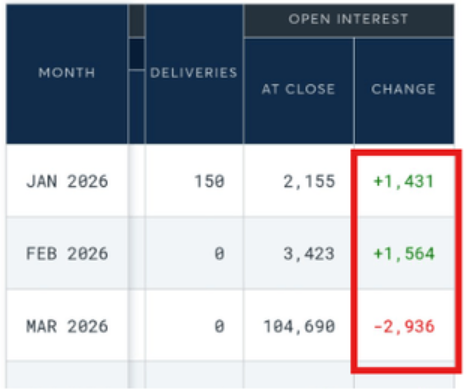
Group 1 - The core issue in the silver market is a significant supply shortage, with demand exceeding supply for four consecutive years, and a projected structural market gap of 148.9 million ounces in 2024, leading to a total shortfall of 678 million ounces over the past four years, equivalent to 10 months of global mine production in 2024 [1] - The recent trend in the COMEX silver market shows investors rolling their contracts back from March to January and February, indicating a desire for immediate physical delivery of silver rather than waiting for the March contract [2][3] - The increase in open interest for January and February contracts, alongside a decrease for March contracts, suggests that traders are seeking to secure physical silver amid a tight supply situation, which could further deplete COMEX registered inventories [4][5] Group 2 - The phenomenon of backwardation in the silver market, where contracts are rolled back to nearer expiration dates, indicates a current spot premium and a shortage of physical silver, as traders prefer immediate delivery [4] - Analysts suggest that the current market dynamics could lead to significant challenges for COMEX if the trend of increasing demand for physical delivery continues, potentially exacerbating the existing supply issues [5]

“埃隆剃刀”颠覆传统汽车制造理念,大摩报告聚焦物理AI驱动变革
Zhi Tong Cai Jing· 2025-12-31 13:39
Core Insights - The automotive manufacturing paradigm is undergoing a significant transformation with Tesla's upcoming Cybercab, which aims to reduce production steps from hundreds to under 20, challenging traditional manufacturing processes established since 1913 [3]. Group 1: Cybercab Production Innovations - Tesla's Cybercab features a minimalist design, eliminating essential components like the steering wheel and pedals, and consists of only two seats and core functional interiors [3]. - The vehicle's structure is formed using a large stamping machine, significantly reducing the number of stamped parts and weld points [3]. - The use of polyurethane body panels allows for direct color injection during the molding process, eliminating the need for traditional painting [3]. - The Cybercab's production efficiency aims for a cycle time of one vehicle every 10 seconds, a substantial improvement over the 60-90 seconds typical for high-volume traditional models [3]. - The production line for the Cybercab is progressing well, with mass production expected to begin in April 2026 [3]. Group 2: AI5 Chip Development - The upcoming AI5 chip is a key component of Tesla's strategy, embodying the "Elon Razor" philosophy by streamlining functionality and removing unnecessary components [4]. - The AI5 chip eliminates traditional GPU and image signal processing units, optimizing design for better performance and efficiency [4]. - Elon Musk emphasizes the chip's significance, indicating substantial personal investment in its development [4]. Group 3: Philosophical Underpinnings of Innovation - The "Elon Razor" concept is rooted in Occam's Razor, advocating for simplicity in manufacturing processes by removing redundant parts and optimizing production workflows [5]. - Tesla's approach is seen as a transformative force in the automotive and robotics industries, leveraging AI to redefine traditional manufacturing paradigms [5]. - The rise of physical AI is expected to propel the global manufacturing sector into a new era driven by these simplified, efficient processes [5].


商超变革:要做减法
3 6 Ke· 2025-12-24 06:49
Core Insights - The retail industry is experiencing a stark contrast, with leading players like Pang Donglai, Aoleqi, and Sam's Club thriving, while traditional giants like Zhongbai Group are facing significant challenges, including the closure of 30 stores and an estimated loss of 180 million yuan due to these closures [1][2] Group 1: Store Management - Retail companies are advised to reduce the number of underperforming stores and focus on high-quality assets, as many stores have become financial burdens in the current market environment [3][4] - A comprehensive evaluation system for stores should be established, assessing profitability and external factors to determine which stores to close or support for improvement [4] - The process of closing stores should involve careful planning and communication with stakeholders to minimize losses and protect brand reputation [5] Group 2: Organizational Efficiency - Traditional retail companies often suffer from excessive organizational complexity, leading to inefficiencies; thus, streamlining departments and clarifying responsibilities is essential [8][9] - Reducing personnel should focus on optimizing the workforce structure, directing resources towards core business areas, and aligning compensation with performance [10] - Decision-making processes should be simplified to enhance responsiveness and efficiency, utilizing digital tools for better communication and data management [11][12] Group 3: Product Management - Retailers need to optimize their SKU structure by eliminating low-performing products and focusing on high-efficiency core items, guided by metrics like the cross-ratio [13][14] - The approach to product selection should avoid the misconception that more products equate to better sales; instead, a focus on familiar brands and essential items is recommended [13] - Regular reviews of product categories should be conducted to adapt to changing market demands and consumer preferences, ensuring a dynamic and relevant product offering [17][18] Conclusion - The principles of efficiency and focused resource allocation are critical for retail companies to navigate the current competitive landscape, emphasizing the need to eliminate redundancies and concentrate on core values [19]

无预训练模型拿下ARC-AGI榜三!Mamba作者用压缩原理挑战Scaling Law
量子位· 2025-12-15 10:33
Core Insights - The article discusses a new research called CompressARC, which introduces a novel approach to artificial intelligence based on the Minimum Description Length (MDL) principle, diverging from traditional large-scale pre-training methods [1][7][48]. Group 1: Research Findings - CompressARC, utilizing only 76K parameters and no pre-training, successfully solved 20% of problems on the ARC-AGI-1 benchmark [3][5][48]. - The model achieved a performance of 34.75% on training puzzles, demonstrating its ability to generalize without relying on extensive datasets [7][48]. - CompressARC was awarded third place in the ARC Prize 2025, highlighting its innovative approach and effectiveness [5]. Group 2: Methodology - The core methodology of CompressARC revolves around minimizing the description length of a specific ARC-AGI puzzle, aiming to express it as the shortest possible computer program [8][10][23]. - The model does not learn a generalized rule but instead seeks to find the most concise representation of the puzzle, which aligns with the MDL theory [8][9][10]. - A fixed "program template" is utilized, which allows the model to generate puzzles by filling in hardcoded values and weights, thus simplifying the search for the shortest program [25][28]. Group 3: Technical Architecture - CompressARC employs an equivariant neural network architecture that incorporates symmetry handling, allowing it to treat equivalent transformations of puzzles uniformly [38][39]. - The model uses a multitensor structure to store high-level relational information, enhancing its inductive biases for abstract reasoning [40][41]. - The architecture is similar to a Transformer, featuring a residual backbone and custom operations tailored to the rules of ARC-AGI puzzles, ensuring efficient program description [42][44]. Group 4: Performance Evaluation - The model was tested with 2000 inference training steps per puzzle, taking approximately 20 minutes for each puzzle, which contributed to its performance metrics [47]. - CompressARC challenges the assumption that intelligence must stem from large-scale pre-training, suggesting that clever application of MDL and compression principles can yield surprising capabilities [48].

如何做出巴菲特式的简单决策?不简单,不最好
Hu Xiu· 2025-09-24 01:57
Group 1 - The essence of value investing, established by Graham and Dodd, focuses on principles such as margin of safety, intrinsic value, and the evolution of investment strategies over time [1][2] - Buffett's approach to value investing incorporates qualitative analysis, emphasizing competitive advantages and intangible assets, which expands beyond Graham's focus on tangible assets [1] - The concept of "economic moat" is introduced, highlighting the importance of brand strength, management integrity, and the ability to generate cash flow for valuation [1] Group 2 - The internet has transformed business paradigms, leading to new characteristics in companies like META, Google, Amazon, Tencent, and Alibaba, which benefit from network effects and reduced marginal costs [3][4] - The rise of AI technology, supported by data, algorithms, and computing power, positions traditional internet giants favorably in the competitive landscape [4] Group 3 - The lifespan of companies has significantly decreased, with many once-prominent firms failing to adapt and ultimately disappearing, indicating that time can be an enemy of value investing [5][6] - The concept of entropy is introduced to explain the natural decline of companies over time, suggesting that maintaining vitality requires creating a dissipative structure [6][7] Group 4 - Companies must focus on reducing entropy to enhance their longevity and vitality, which involves being proactive, open to change, and ready to seize transformative opportunities [7][8] - The ability to maintain a strong "entropy reduction capacity" is crucial for a company's survival and success in the long term [8] Group 5 - Simple decision-making is emphasized as a key aspect of value investing, where identifying a few critical dimensions can lead to high-probability investment opportunities [9][10] - Examples of simple decisions include capitalizing on market downturns or temporary setbacks in companies that have strong fundamentals [11][12][13] Group 6 - The evolution of value investing must return to its foundational principles as outlined in Graham and Dodd's "Security Analysis," which serves as a guiding framework for investors [15]
