
社会和公司治理)

Search documents
CM BANK(03968) - 2025 Q4 - Earnings Call Transcript
2026-03-30 02:30
Financial Data and Key Metrics Changes - Net operating income for 2025 was CNY 337.2 billion, an increase of 0.05% year-on-year [4] - Net profit attributable to shareholders was CNY 150.2 billion, up by 1.21% [4] - Return on Average Assets (ROAA) was 1.19%, and Return on Average Equity (ROAE) was 13.44%, down by 0.09 percentage points and 1.05 percentage points year-on-year respectively [4] - Net interest income reached CNY 215.6 billion, up by 2.04%, while Net Interest Margin (NIM) was 1.87%, down by 11 basis points year-on-year [4] - Non-interest income was CNY 21.7 billion, a decrease of 3.31% year-on-year [4] Business Line Data and Key Metrics Changes - Retail finance contributed significantly, with net operating income and pre-tax profit accounting for 56% and 50% of the total respectively [6] - Total loans and advances were CNY 7.26 trillion, up by 5.37%, with general loans at CNY 6.94 trillion, up by 6.57% [5] - Net fee and commission income increased by 4.39% year-on-year, marking the first positive growth since 2022 [5] - Retail AUM balance was CNY 17 trillion, up by 14.44%, with retail customer deposits totaling CNY 4.5 trillion, up by 11% [16] Market Data and Key Metrics Changes - The bank's total assets exceeded CNY 13 trillion, with total liabilities at CNY 11.79 trillion, up by 7.98% [5] - Demand deposits accounted for 49.4% of total deposits, maintaining a high level [6] - The number of retail customers increased to 224 million, up by 6.67% [13] Company Strategy and Development Direction - The company aims to build a world-class value creation bank and accelerate its transformation towards high-quality development [3] - Focus on digital and intelligent banking, with significant investments in AI and technology [10][11] - Emphasis on ESG principles, with green loans and leasing balances growing by 21% and 23.89% respectively [11] - Plans to enhance international development and support Chinese enterprises going global [21] Management's Comments on Operating Environment and Future Outlook - The management acknowledged challenges such as low interest rates and weak demand but expressed confidence in the resilience of the Chinese economy [30] - The bank will continue to focus on high-quality development and innovation to navigate the competitive landscape [31] - Expectations for stable growth in operating income and profit, with a focus on maintaining a leading NIM [56][67] Other Important Information - The bank's capital adequacy ratios (CAR) showed a decline, with Core Tier 1 CAR at 14.16%, down by 0.7 percentage points [7] - Asset quality remained stable, with a non-performing loan (NPL) balance of CNY 68.2 billion, up by CNY 2.6 billion [8] Q&A Session Questions and Answers Question: What is the strategic vision for China Merchants Bank during the fifteenth Five-Year Plan? - The board emphasizes high-quality development and innovation, focusing on being market-oriented and differentiated from peers [37][39] Question: How does the bank plan to maintain its competitive advantage in a challenging environment? - The bank aims to deepen reforms, accelerate internationalization, and enhance its customer-centric culture to maintain a low funding cost [41] Question: What are the expectations for operating income and profit growth in 2026? - The management anticipates stable growth, with efforts to achieve a 3%-5% growth rate, although challenges remain [56][59] Question: What is the outlook for NIM in 2026? - The bank expects NIM to continue declining but at a smaller magnitude compared to previous years, with ongoing efforts in asset and liability management [67]

战火、石油与底牌
汽车商业评论· 2026-03-04 23:05
Core Viewpoint - The article discusses the recent surge in oil prices and the stock performance of China's "Big Three" oil companies (China National Petroleum Corporation, China Petroleum & Chemical Corporation, and China National Offshore Oil Corporation) due to geopolitical tensions in the Middle East, particularly the conflict involving Iran and the closure of the Strait of Hormuz [5][11][12]. Group 1: Oil Price Surge and Market Impact - The oil price has seen a historic increase, with Brent crude surpassing $85 per barrel, marking a rise of over 20% since the onset of the conflict [6][11]. - The "Big Three" oil companies in China experienced consecutive trading halts, achieving their first collective limit-up in A-share history, with China National Petroleum Corporation reclaiming its position as the top market cap in A-shares [5][12]. - The geopolitical situation has led to a significant disruption in global oil supply, with estimates suggesting that 20%-30% of maritime oil trade could be affected, raising concerns about potential oil prices reaching $150-$200 per barrel if the situation persists [11][12]. Group 2: Investment Logic in Oil Sector - Warren Buffett's Berkshire Hathaway has heavily invested in oil stocks, indicating a long-term strategy based on macroeconomic and industry fundamentals rather than short-term speculation [17][18]. - Major U.S. oil companies have shifted focus from aggressive capacity expansion to capital discipline, leading to increased dividends and stock buybacks, which enhances their attractiveness to investors [18][19]. - The lack of capital expenditure in the fossil fuel sector over the past decade, combined with disciplined production cuts from OPEC+, has created a supportive environment for oil prices and profit margins [19][20]. Group 3: Considerations for Retail Investors - Retail investors are cautioned against entering the market for "Big Three" stocks at this time due to the extreme risk-reward imbalance amid geopolitical tensions and high oil prices [29][30]. - While the "Big Three" companies have shifted towards capital returns and have attractive dividend yields, the potential for a significant price correction exists if geopolitical tensions ease [30][31]. - Historical precedents, such as the Gulf War and the Russia-Ukraine conflict, demonstrate that oil prices can experience rapid increases followed by steep declines, suggesting caution for investors considering entry points during high volatility [31][32]. Group 4: Future Energy Landscape - The article highlights the ongoing transition towards clean energy and the potential for structural demand shifts in oil consumption due to the rise of electric vehicles in China [39][40]. - The need for a diversified energy security strategy is emphasized, with a focus on developing renewable energy sources and hydrogen as part of national security [40]. - The current crisis may serve as a catalyst for accelerating the global energy transition, underscoring the importance of investing in sustainable energy solutions [40].


SHK PPT(00016) - 2026 Q2 - Earnings Call Transcript
2026-02-27 04:32
Financial Data and Key Metrics Changes - The group's underlying profit for the six months ended December 2025 was HKD 12.2 billion, a year-on-year increase of 16.7% driven by higher profits from trading and investment properties and lower finance costs [2][3] - Reported profit increased to HKD 10.2 billion, reflecting a 36.2% year-on-year growth [3] - The underlying earnings per share was HKD 4.21, while reported earnings per share was HKD 3.54 [3] - An interim dividend of HKD 0.98 per share was declared, marking a 3.2% increase from HKD 0.95 last year [3] - Net debt stood at HKD 83.6 billion with an improved gearing ratio of 13.5% compared to 15.1% in June 2025 [4][5] Business Segment Data and Key Metrics Changes - In property development, profit reached approximately HKD 4.9 billion, a substantial increase of 94.9% primarily due to higher profit recognition from Mainland projects [3] - The hotel business recorded an operating profit of HKD 428 million, up from HKD 377 million in the same period last year [4] - Profit from other business segments decreased by 11.7% year-on-year to about HKD 2.3 billion [4] - The group's total operating profit for the first half of fiscal year 2026 was HKD 16.5 billion, representing a 14.3% increase year-on-year [4] Market Data and Key Metrics Changes - The Hong Kong primary residential market saw higher transaction volumes and a modest price recovery, with contracted sales of about HKD 17.4 billion during the period [8][9] - The group's gross rental income in Hong Kong remained stable at around HKD 8.8 billion, with an overall average occupancy of approximately 92% [10] - The Mainland rental portfolio's gross rental income held steady at about RMB 3.1 billion, with a slight decrease of 0.8% in RMB terms [13] Company Strategy and Development Direction - The company aims to maintain a strong financial position to seize land opportunities in Hong Kong while focusing on prudent financial management [5][17] - The strategy includes leveraging a reputable brand to drive premium sales and ongoing portfolio reviews to enhance returns [5][17] - The company plans to continue launching new residential projects and unsold units while enhancing the competitiveness of its property investment portfolio [17][18] Management's Comments on Operating Environment and Future Outlook - The management expressed confidence in the Hong Kong market's recovery, supported by robust IPO activities and favorable mortgage conditions [16][17] - The company anticipates continued strong demand for residential properties, driven by low mortgage rates and improving supply-demand dynamics [35][36] - The management highlighted the importance of adapting to new circumstances and leveraging technology to enhance property quality and services [18] Other Important Information - The group has a total land bank in Hong Kong of about 57.3 million sq ft and in Mainland China of 64.6 million sq ft [6][12] - The International Gateway Centre (IGC) is positioned as a key commercial landmark with high connectivity and sustainability credentials [23][24] - The company is committed to sustainability initiatives and enhancing the quality of living through its developments [16] Q&A Session All Questions and Answers Question: What is your view and outlook for the Hong Kong property home price? - Management noted that the Hong Kong residential market is entering a new phase of recovery, with positive rental carry attracting investors and end users [34] Question: Can we have an update on the leasing progress for the IGC and Artist Square Towers? - Management indicated strong interest in IGC, with leasing progressing well, particularly from the financial services sector [41][42] Question: What is your latest pricing strategy for residential projects in Hong Kong? - The company adheres to current market conditions, with moderate price increases to achieve sales targets while balancing volume and margin [54] Question: Any plans for asset disposal or changes in dividend policy? - Management stated there are no current plans for further asset disposals beyond Dynasty Court, and the dividend policy remains at 40%-50% of profits [57][93]

Telefonica Brasil S.A.(VIV) - 2025 Q4 - Earnings Call Transcript
2026-02-23 15:00
Financial Performance and Key Metrics - Total revenues in Q4 2025 increased by 7.1%, with mobile service revenue growing by 7% and fixed services by 5.4% [6][7] - EBITDA grew by 8.1% year-over-year, with a margin of 42.9%, while excluding concession migration effects, EBITDA advanced by 17.7% [6][20] - Net income for 2025 reached BRL 7.2 billion, reflecting a double-digit growth, and free cash flow increased by 11.4% to BRL 9.2 billion [6][23] - The company paid out BRL 6.4 billion to shareholders in 2025, achieving a payout ratio of 103.4% [7][24] Business Line Performance - The postpaid mobile segment saw a 6.5% year-over-year increase, reaching 70.8 million customers, representing 69% of the mobile base [5][10] - Fiber connections reached 7.8 million, with a footprint extending to 31 million homes, and FTTH accesses grew by 12% year-over-year [11][12] - New businesses generated a 27% revenue increase, now accounting for 12.1% of total revenues, with significant contributions from B2C and B2B solutions [9][14] Market Performance - The mobile customer base reached 103 million, with a 0.7% year-over-year increase, and 5G customers grew to 23.1 million, improving the take-up ratio to 27.8% [10][11] - B2B revenues amounted to BRL 13.5 billion, up 13.7% year-over-year, with digital B2B growing by 29.5% [14][15] - The fiber market share increased from 18.8% to 19.3% year-over-year, with a net addition of 834,000 customers [77] Company Strategy and Industry Competition - The company focuses on convergence, with 62.7% of FTTH customers being convergent, and aims to drive more customers to the Vivo Total offering [86][89] - The competitive environment in the fiber market remains fragmented, with potential for consolidation to improve sustainability [78][79] - The company is committed to maintaining a disciplined capital allocation strategy while exploring opportunities for M&A to strengthen its fiber footprint [93][96] Management Commentary on Operating Environment and Future Outlook - Management expressed optimism about future net income growth, driven by stable EBITDA growth and reduced depreciation starting in mid-2026 [30][31] - The company is leveraging AI to enhance operational efficiency and customer engagement, with expectations for significant cost savings [90][91] - The management remains focused on optimizing CapEx and improving the ratio of CapEx to revenues while continuing to invest in infrastructure [36][37] Other Important Information - The company achieved recognition for its sustainability efforts, ranking among the top companies in various global assessments [16][17] - The board approved a new share buyback program of up to BRL 1 billion, to be executed until February 2027 [25] Q&A Session Summary Question: Distribution strategy for 2026 - Management discussed the mix between buybacks, interest on capital, and capital reduction, emphasizing a commitment to distribute at least 100% of net income [27][28] Question: CapEx outlook for 2026 - Management highlighted ongoing CapEx optimization efforts and the importance of maintaining a balance between infrastructure investment and revenue growth [35][36] Question: Competitive environment in mobile - Management noted a stable mobile market share and emphasized the importance of retaining customers and growing ARPU without engaging in price wars [94][95] Question: Lease expenses reduction - Management explained the reduction in lease expenses due to ongoing renegotiations and expressed optimism about future trends [50][54] Question: Growth in B2B segment - Management confirmed strong growth in B2B revenues and highlighted the importance of digital services in driving future growth [68][69]

“做多能源+做空可选消费” --当下火遍华尔街的“配对交易组合”
Hua Er Jie Jian Wen· 2026-02-17 01:59
Group 1 - A new sector pair trading strategy is emerging on Wall Street, with "long energy + short consumer discretionary" replacing the dominance of tech stocks, becoming one of the most attractive sector trades currently [1] - U.S. energy stocks have risen over 20% this year, outperforming all other sectors, including tech, driven by a rebound in oil prices [1][2] - The consumer discretionary sector, which includes companies like Amazon and Tesla, is facing increased short selling, with a notable rise in short positions compared to tech stocks [1][3] Group 2 - Weak retail sales data in December raised concerns about consumer health, further exacerbated by Mattel's weak earnings forecast, which led to its largest single-day stock drop since 1999 [1][3] - The short interest in consumer discretionary stocks has increased significantly, surpassing that of tech stocks, while short positions in energy stocks have dropped to their lowest levels in nearly a year [1][3] - The shift in investor sentiment reflects a reassessment of sector prospects and a preference for physical asset allocation in an inflationary environment [1][3]
今年,A股首次迎来这项大考→
Jin Rong Shi Bao· 2026-02-03 11:39
Core Viewpoint - The construction of the sustainable development information disclosure system for listed companies in China is advancing steadily along a pragmatic path, focusing on a "main framework first, key issues breakthrough" approach [1] Group 1: Updates on Guidelines - On January 30, under the guidance of the CSRC, the Shanghai, Shenzhen, and Beijing stock exchanges revised and released the "Guidelines for the Preparation of Sustainable Development Reports by Listed Companies," adding three application guidelines related to pollutant emissions, energy utilization, and water resource utilization [1] - The update of the guidelines marks a new stage of refined and standardized implementation of sustainable development information disclosure for listed companies in China [1] - The updated guidelines are expected to provide a more systematic operational framework for sustainable development information disclosure, which is significant for the standardization of sustainable development in China [1] Group 2: Feedback and Optimization - In September 2025, the exchanges publicly solicited opinions on the three application guidelines, with market participants generally recognizing their guiding role and providing optimization suggestions [2] - The exchanges adopted several suggestions, including adding examples of pollutant-related risks and financial impacts, and refining calculation methods for energy and water consumption [2] - The overall framework and core requirements of the officially released guidelines maintained high stability and continuity compared to the draft, with revisions focusing on content refinement [2] Group 3: Implementation Support - The guidelines provide detailed explanations of common risks and opportunities related to environmental issues, helping listed companies identify risks and standardize data accounting methods [4] - Specific disclosure requirements are outlined for pollutant emissions, energy utilization, and water resource utilization, including detailed metrics and calculation methods [5] - The guidelines serve as a practical teaching material, assisting companies in improving their ESG reporting capabilities and report quality [4][5] Group 4: ESG Disclosure Landscape - China is moving towards a new stage of mandatory ESG disclosure, with a rule system forming that combines encouragement and regulation [6] - As of September 2025, over 2,500 A-share listed companies had published sustainable development reports, with a disclosure rate of nearly 35%, reflecting a significant increase [6] - In 2026, A-share listed companies will be required to disclose sustainable development reports for the first time, with specific deadlines for compliance [6] Group 5: Future Directions - The release of the three application guidelines is expected to enhance the depth and breadth of ESG practices among A-share listed companies, transitioning from compliance to proactive engagement [7] - Companies are urged to view sustainable development efforts as tools for enhancing risk resilience and exploring green growth opportunities, rather than merely external compliance requirements [7]
王忠民:AI算力的尽头是电力,电力尽头是绿电
Zhong Guo Xin Wen Wang· 2025-12-16 08:59
Core Insights - The forum emphasized the importance of green electricity as a fundamental requirement for AI capabilities, highlighting that the future of AI is closely tied to environmental sustainability [1][5] - The discussion pointed out that the end goal of AI is aligned with ESG (Environmental, Social, and Governance) principles, indicating a shift towards zero-carbon initiatives in various sectors [3][7] Group 1: AI and Energy - AI's computational power is fundamentally dependent on electricity, which in turn must transition to green energy sources to meet ESG goals [3][7] - The evolution of data centers from water cooling to liquid cooling is a significant advancement in reducing energy consumption and resource use [3][7] Group 2: Open Source and CVC - The concept of CVC (Corporate Venture Capital) is introduced as a means to invest in startups using open-source platforms, allowing for minimal initial costs for entrepreneurs [4][8] - The marginal cost of development approaches zero when utilizing open-source resources, enabling widespread access and innovation [4][8] - The potential for innovation costs to be nearly zero is highlighted, suggesting a transformative impact on the entrepreneurial landscape in the AI era [4][8]
云锋金融战略入股加密货币人寿保险公司Anthea
Mei Ri Jing Ji Xin Wen· 2025-10-15 13:49
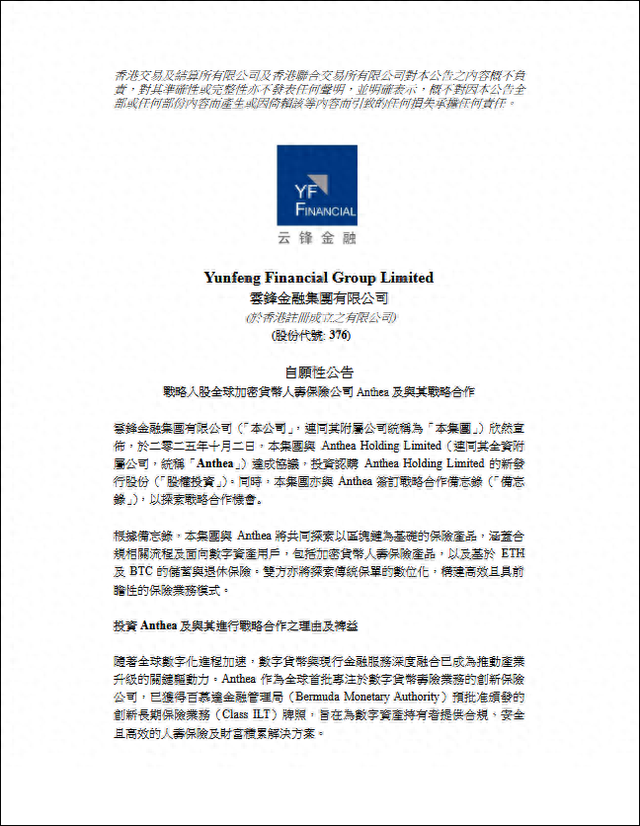
Core Viewpoint - Yunfeng Financial has strategically invested in Anthea, a global cryptocurrency life insurance company, to explore blockchain-based insurance products, including cryptocurrency life insurance and digital asset user-focused solutions [1][6]. Group 1: Strategic Investment and Collaboration - Yunfeng Financial announced a strategic partnership with Anthea to develop blockchain-based insurance products, marking a significant innovation in the financial industry [1][6]. - The collaboration aims to digitize traditional insurance policies and create efficient, forward-looking insurance business models [1][6]. - The investment in Anthea will facilitate the launch of the world's first life insurance product priced in Ether (ETH) [6]. Group 2: Financial Technology and Digital Assets - Yunfeng Financial has made significant moves in the Web 3.0 space, including the purchase of 10,000 ETH for approximately $44 million to enhance its strategic reserve assets [4]. - The company plans to diversify its strategic reserve to include other mainstream digital assets like Bitcoin (BTC) and Solana (SOL) [5]. - The funds raised from a recent share placement will be used to launch comprehensive virtual asset trading services and related investment management services [5]. Group 3: Industry Trends and Future Directions - The partnership between traditional financial institutions and cryptocurrency-native insurance platforms is seen as a step towards addressing compliance and trust issues in the digital asset insurance sector [6][7]. - Experts predict that the development of blockchain insurance products will evolve through three stages, starting with cryptocurrency-related insurance and potentially leading to a comprehensive digital asset lifecycle protection system [7]. - The integration of blockchain technology is expected to enhance data transparency, automate underwriting and claims processes, and facilitate cross-institutional collaboration in the insurance ecosystem [9].

马云持股公司布局加密货币保险赛道,近3个月股价涨超50%
Guan Cha Zhe Wang· 2025-10-15 03:49
Core Viewpoint - Yunfeng Financial has strategically invested in Anthea Holding Limited, a global cryptocurrency life insurance company, and signed a strategic cooperation memorandum to explore blockchain-based insurance products [1][3][4]. Investment Details - The investment aims to develop insurance products priced in cryptocurrencies, including life insurance and savings/retirement insurance based on ETH and BTC [1][3]. - Anthea has received pre-approval for an innovative long-term insurance business license from the Bermuda Monetary Authority, allowing it to offer digital currency-denominated savings life insurance products with fully digital underwriting and claims processes [3][4]. Strategic Collaboration - The partnership will focus on leveraging blockchain technology for insurance innovation, particularly in compliance processes such as KYC (Know Your Customer) and anti-money laundering [4][5]. - This collaboration marks the first institutional-level partnership between a financial institution and a cryptocurrency-native insurance platform, potentially enhancing risk management capabilities and regulatory adaptability [4][5]. Market Context - The investment aligns with Yunfeng Financial's long-term strategy to explore the potential of blockchain technology in the insurance sector, capitalizing on Anthea's innovative business model and market prospects [4][5]. - The company has been actively expanding its presence in the cryptocurrency sector, with recent moves including partnerships and investments in Web 3.0 and digital assets [9][14]. Financial Performance - Yunfeng Financial reported a 11% year-on-year increase in insurance revenue to HKD 1.532 billion and a 142% increase in net profit attributable to equity shareholders to HKD 486 million for the first half of the year [15]. - The annualized premium for new business reached HKD 2.222 billion, a 107% increase year-on-year, indicating strong growth in its insurance segment [15].
摩尔线程科创板上市过会 A股相关概念股ESG报告披露率超50%
Mei Ri Jing Ji Xin Wen· 2025-09-28 13:01
Core Viewpoint - Moole Thread, known as the "Chinese version of Nvidia," has successfully passed the listing review committee of the Sci-Tech Innovation Board, aiming to raise 8 billion yuan for the development of next-generation AI training and inference chips, graphics chips, and AI SoC chips [1] Group 1: Company Overview - Moole Thread was established in 2020 and focuses on GPU-related computing infrastructure and providing one-stop solutions [1] - The company plans to use the funds raised from the IPO primarily for R&D in AI chips and graphics chips [1] Group 2: ESG Disclosure - Among the 17 A-share concept stocks related to Moole Thread, the ESG report disclosure rate is 52.94%, with greenhouse gas emissions disclosure at 35.29%, all of which only cover "Scope 1" (direct emissions) and "Scope 2" (purchased energy emissions) [1][2] - No companies disclosed "Scope 3" (value chain emissions) data, indicating a lack of comprehensive carbon accounting [2] Group 3: Emissions Data - The reported greenhouse gas emissions vary significantly among the concept stocks, with Shengyuan Environmental having the lowest emissions at 25,000 tons and Lianmei Holdings at the highest with 3.05 million tons [3] - Only two companies related to Moole Thread's business, Maijie Technology and Guanghuan New Network, disclosed carbon emissions data, highlighting a significant gap in carbon data disclosure in this sector [3] Group 4: R&D and Talent Management - R&D investment, talent acquisition, and management are core issues for Moole Thread, with only 23.53% of companies disclosing employee turnover rates [4] - Among the companies related to Moole Thread, only two disclosed employee turnover data, while 35.29% disclosed the proportion of R&D personnel, with Donghua Software having the highest at approximately 90% [5] Group 5: Future Recommendations - To align with Nvidia, Moole Thread should build a resilient supply chain and green procurement system, implement comprehensive carbon emission accounting, and disclose "Scope 3" emissions [7] - The company should also develop energy efficiency and green computing strategies, enhance talent strategy disclosure, and provide information on AI application ethics and social responsibility [7]