
第二轮效应

Search documents
英国央行9月会议或“鹰鸽交织”:维持利率不变+放缓QT!
Jin Shi Shu Ju· 2025-09-18 07:51
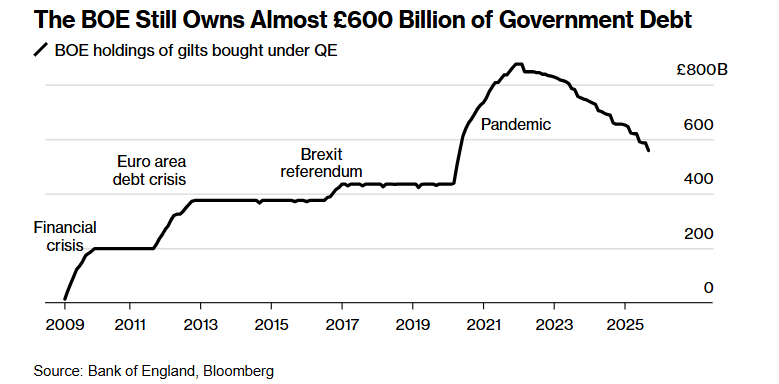
Core Viewpoint - The Bank of England is expected to maintain its benchmark interest rate at 4% during the upcoming monetary policy meeting, while also slowing down its quantitative tightening (QT) plan due to increased volatility in the government bond market [1][4]. Group 1: Interest Rate Decision - Economists anticipate that the Monetary Policy Committee (MPC) will keep the annual reduction of government bond holdings at £700 billion, down from £1 trillion [1]. - The MPC is expected to vote 7 to 2 in favor of maintaining the interest rate, as decision-makers await clearer signals regarding potential inflationary pressures from the labor market [5][7]. - The market currently sees only a one-third probability of further rate cuts by the end of the year, breaking the trend of quarterly cuts since August 2024 [7][10]. Group 2: Economic Performance - The UK economy showed better-than-expected performance, with a 0.3% growth in Q2, surpassing the previous forecast of 0.1%, making it the leader in growth among G7 countries [11]. - Despite positive economic indicators, the Bank of England remains cautious, predicting a 0.3% growth for Q3 and expressing concerns over persistent inflationary pressures [11]. Group 3: Inflation Concerns - The Bank of England expects inflation to peak at 4%, driven by temporary factors, but officials are wary of a potential "second-round effect" where rising wages could further elevate prices [11]. - The current inflation level remains significantly higher than that of the US and Eurozone, indicating ongoing challenges for the UK economy [11].

日本央行的“观望期”结束了?分析师警告:后市每次会议都可能加息!
Jin Shi Shu Ju· 2025-08-01 08:57
Core Viewpoint - The Bank of Japan (BOJ) is laying the groundwork for a potential interest rate hike, acknowledging the risk of broad-based inflation due to persistent food price increases [2][5] Group 1: BOJ's Policy Direction - The BOJ's recent comments indicate a shift towards a more hawkish stance, suggesting that the central bank is preparing to act on interest rates after a period of inaction [2][3] - BOJ Governor Kazuo Ueda emphasized that the decision to raise rates will depend on the likelihood of core inflation reaching the 2% target, rather than waiting for it to be firmly established [2][3] - Analysts predict that the BOJ may raise rates in upcoming meetings, with a 54% chance of a hike to 0.75% in October and a 71% chance by December [3] Group 2: Economic Indicators and Inflation Risks - The BOJ has revised its inflation outlook, indicating that the risks to price stability are now balanced, contrasting with previous assessments that highlighted downside risks [4] - The central bank is particularly focused on the second-round effects of rising food prices, which could lead to broader inflationary pressures [5][6] - Recent data shows a significant increase in food prices, with 1,010 food and beverage items rising in August and over 3,000 expected to increase in October [5]
茶叶、肉类等价格上涨推动下 英国7月食品通胀升至17个月来新高
智通财经网· 2025-07-29 02:01
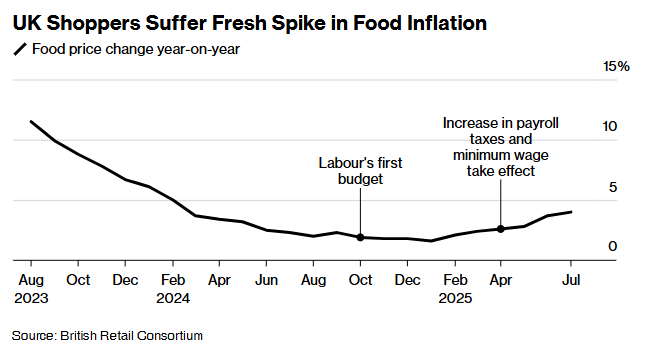
Group 1 - The continuous rise in prices of products such as tea and meat has pushed UK food inflation to its highest level in 17 months [1] - The British Retail Consortium reported a 4% year-on-year increase in food bills for July, marking the highest increase since February 2024 [1] - Overall commodity prices have risen for the second consecutive month, with a year-on-year increase of 0.7%, the highest level in over a year [1] Group 2 - Retailers are transferring costs to consumers in response to policy changes effective from April, despite a weak economic backdrop [3] - The CEO of the British Retail Consortium, Helen Dickinson, stated that the retail sector faced £7 billion (approximately $9.4 billion) in costs due to last year's budget, forcing most retailers to raise prices [3] - There are increasing speculations about further tax hikes in the autumn as the Chancellor of the Exchequer, Rachel Reeves, seeks to stabilize the UK's fragile public finances, with economists estimating a potential funding gap of up to £30 billion [3] Group 3 - Rising food costs are particularly sensitive to household inflation expectations, increasing the risk of a "second-round effect" where workers demand higher wages to offset rising living costs [3] - According to Rightmove, the pressure from rapidly rising rents on tenants has slightly eased, with the average monthly rent outside London rising by 3.9% to £1,365, the smallest annual increase since 2020 [3] - In London, the average monthly rent increased by 1.9%, reaching a historic high of £2,712 [3]
英国央行按兵不动,市场押注八月降息
Di Yi Cai Jing· 2025-06-19 12:54
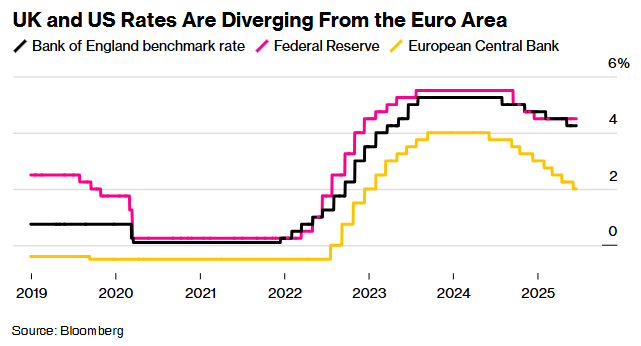
Core Viewpoint - The Bank of England decided to maintain the benchmark interest rate at 4.25%, reflecting a careful balance of economic data and risk factors, with market expectations aligning with this decision [1][2]. Economic Data - The UK inflation rate remains high, with the Consumer Price Index (CPI) showing a year-on-year increase of 3.4% in May, which is above the Bank's target of 2% [3]. - Despite a previous drop in inflation to 2.6% in March, the rate rebounded to 3.5% in April due to rising energy prices, indicating persistent inflationary pressures [3]. Monetary Policy Outlook - Market analysts expect the Bank of England to lower the benchmark interest rate by 25 basis points in the upcoming August meeting and again in the fourth quarter [4]. - The decision to hold rates steady was anticipated, but comments from the Bank's officials suggest a potential for further rate cuts within the year [4]. Geopolitical and Economic Risks - The ongoing geopolitical tensions in the Middle East are complicating the economic landscape, potentially affecting oil prices and thereby inflation [5]. - External risks such as global trade tensions and geopolitical shocks may limit the Bank's policy flexibility, necessitating a more aggressive response if economic conditions worsen [4][5].
高通胀与经济放缓夹击下 英国央行今夜料按兵不动
智通财经网· 2025-06-19 01:37
Core Viewpoint - The Bank of England is expected to maintain the benchmark interest rate at 4.25% amid high inflation, rising oil prices, and economic slowdown, with a consensus among economists indicating no rate cut in the immediate future [1][4]. Monetary Policy - The Monetary Policy Committee (MPC) had a divided vote last month, with some members advocating for a 50 basis point cut while others supported maintaining the current rate [4]. - The MPC has lowered rates four times since August of the previous year, but the current economic data does not warrant drastic policy changes [5][12]. Economic Performance - Recent data shows the UK economy experienced its largest contraction in 18 months in April, with significant declines in exports to the US and record layoffs in May [10]. - Despite a strong growth of 0.7% in Q1, the MPC may revise its outlook on economic growth and inflation based on the latest data [12]. Geopolitical Risks - The escalation of tensions in the Middle East has replaced trade war concerns, with oil prices rising approximately 9% following recent conflicts, which could further impact UK inflation [13][16]. - Estimates suggest that a rise in Brent crude oil prices could increase UK inflation by 0.1 to 0.2 percentage points, potentially pushing inflation peaks higher [13].
英国通胀飙升至15个月高点 “糟糕四月”价格冲击下居民“压力山大”
Zhi Tong Cai Jing· 2025-05-21 07:03
Core Points - The UK inflation rate has surged to its highest level in over a year, reaching 3.5%, driven by multiple price increases, exceeding market expectations [1] - The rise in inflation is attributed to a 6.4% increase in the energy price cap, along with rising costs for water, train fares, and local government taxes, leading to a comprehensive increase in living costs [1] - The service inflation rate accelerated from 4.7% to 5.4%, surpassing the Bank of England's previous forecast of 5% [1] Group 1 - The inflation rate has risen from 2.6% to 3.5%, higher than the Bank of England's prediction of 3.4% and economists' expectation of 3.3% [1] - The increase in living costs coincides with two significant policy changes: a £26 billion increase in employer payroll taxes and a nearly 7% rise in the minimum wage [1] - A significant proportion of businesses are planning to raise product prices to maintain profit margins amid rising costs [1] Group 2 - The Bank of England anticipates that inflation will further accelerate to a peak of 3.7% in September, which poses challenges for Prime Minister Keir Starmer as households face a new wave of cost pressures [1] - Despite market expectations that the inflation rebound is temporary, the Bank of England remains cautious due to high wage growth, favoring a gradual path for interest rate cuts [2]