
美债波动率

Search documents
美股前瞻|三大股指期货齐跌 美联储会议纪要公布在即 高盛力挺美国经济“软着陆”叙事
智通财经网· 2025-12-30 13:29
Market Movements - US stock index futures are all down, with Dow futures down 0.06%, S&P 500 futures down 0.07%, and Nasdaq futures down 0.10% [1] - European indices show positive movement, with Germany's DAX up 0.25%, UK's FTSE 100 up 0.35%, France's CAC 40 up 0.29%, and the Euro Stoxx 50 up 0.46% [1] - WTI crude oil is up 0.34% at $58.28 per barrel, and Brent crude oil is also up 0.34% at $61.70 per barrel [1] Economic Outlook - Goldman Sachs supports the narrative of a "soft landing" for the US economy, driven by the easing of tariff headwinds, tax cuts, and interest rate reductions [2] - The firm predicts strong economic growth resilience in 2025, with growth expected to accelerate in 2026 due to favorable financial conditions and reduced inflationary pressures [2] - Despite recent stagnation in the non-farm employment market, factors such as AI data center construction and significant tax refunds are expected to boost economic momentum [2] Corporate Developments - Bank of America CEO Brian Moynihan warns against excessive focus on the Federal Reserve, stating that the US economy is much larger than the Fed's influence [3] - Moynihan emphasizes the need for an independent Federal Reserve, cautioning that political interference could lead to market repercussions [3] - Former President Trump hints at potentially dismissing current Fed Chair Jerome Powell, indicating he has a preferred successor but is not in a rush to announce [3] Bond Market Insights - The ICE BofA MOVE index, a key measure of bond market volatility, has dropped significantly to around 59, the lowest since October 2021 [4] - This decline is expected to result in one of the steepest annual drops since 2009, following the financial crisis [4] - A reduction in long-term debt supply by the US Treasury could enhance the price performance of long-term bonds in a low-volatility environment [4] Oil Market Dynamics - OPEC+ is expected to reaffirm its decision to pause production increases in the first quarter of next year due to signs of oversupply in the global oil market [5] - The group, led by Saudi Arabia and Russia, will hold a meeting on January 4 to review this decision [5] - Oil prices have fallen by 17% this year, marking the largest annual decline since 2020, amid increasing supply and slowing demand [5] Company-Specific News - Meta has agreed to acquire AI startup Manus, which could enhance its AI-driven commercial initiatives [7] - CEO Mark Zuckerberg has committed to investing $600 billion in US infrastructure projects over the next three years, primarily focused on AI [7] - Lululemon's founder Chip Wilson is initiating a proxy battle to nominate independent directors to the board amid dissatisfaction with the company's strategy [8] - Strategy has purchased $108.8 million worth of Bitcoin, increasing its total holdings to 672,497 Bitcoins valued at $50.4 billion [9] - Tesla has publicly disclosed a more pessimistic forecast for Q4 vehicle deliveries, estimating 422,850 units, a 15% decline year-over-year [10]


股市早观点,哪些热点?哪些消息?12月30日
Sou Hu Cai Jing· 2025-12-30 12:46
Group 1 - U.S. President Trump stated that his preferred candidate for the Federal Reserve Chairman position "has not changed," and he plans to announce the new nominee in January while considering legal action against current Chairman Powell [1] - International precious metals experienced significant declines, with COMEX gold futures dropping 4.45% to $4,350.2 per ounce, and COMEX silver futures falling 7.2% to $71.64 per ounce. Spot silver plummeted nearly 9%, while spot palladium and platinum fell over 15% and 14%, respectively [1] - U.S. stock indices saw slight declines, with the Dow Jones down 0.51%, Nasdaq down 0.5%, and S&P 500 down 0.35%. The Nasdaq Golden Dragon China Index decreased by 0.67% [1] Group 2 - International crude oil futures settled with gains exceeding 2%, with WTI crude oil futures up 2.36% to $58.08 per barrel, and Brent crude oil futures rising 2.14% to $61.94 per barrel [1] - The volatility index for U.S. Treasuries has dropped to approximately 59, influenced by the Federal Reserve's interest rate cuts effectively reducing recession risks [1]
美债波动率即将创2009年来最大年降幅 “全球资产定价之锚”踏向下行轨迹?
智通财经网· 2025-12-30 00:06
Core Viewpoint - The U.S. Treasury market is experiencing a significant decline in volatility, potentially leading to a favorable environment for long-term Treasury bonds in 2026, especially if the government shifts towards issuing more short-term debt [1][4][5]. Group 1: Market Volatility and Economic Indicators - A key indicator of U.S. Treasury market volatility, the ICE BofA MOVE index, has dropped to approximately 59, the lowest level since October 2021, indicating a substantial decline from a high of about 99 at the end of 2024 [1][4]. - The decline in volatility is attributed to a combination of reduced global tariffs, a shift in the Trump administration's stance, and the Federal Reserve's interest rate cuts, which have contributed to a more stable economic outlook [4][5]. - Economic data suggests that the U.S. is moving closer to a "soft landing," with cooling inflation and a resilient labor market, further reducing uncertainty in financial markets [4][5]. Group 2: Federal Reserve and Interest Rate Expectations - The Federal Reserve has lowered interest rates three times since September to prevent a downturn in the labor market, with expectations of two more 25 basis point cuts in 2026 [5][6]. - Market consensus is focused on lower policy rates and a slightly steeper yield curve in 2026, reflecting ongoing discussions about inflation persistence and economic growth resilience [5][6]. Group 3: Long-term Treasury Bonds Outlook - If the U.S. Treasury reduces the net supply of 10-year and longer bonds while increasing short-term debt issuance, it could enhance the attractiveness of long-term bonds, potentially marking 2026 as a "reversal year" for these assets [6][7]. - The expectation of lower interest rates and rising global economic uncertainty may drive risk-averse investors towards U.S. Treasury bonds, particularly long-term ones, which are seen as more appealing compared to short-term bonds [7][9]. - Predictions indicate that the yield on 10-year Treasuries could fall below 3.5% by the end of 2026, driven by strong demand and a favorable pricing environment [9][10]. Group 4: Impact on Broader Financial Markets - A sustained decline in the 10-year Treasury yield could positively influence the valuations of risk assets such as stocks, cryptocurrencies, and high-yield corporate bonds, as these assets are sensitive to changes in the risk-free rate [9][10]. - The potential for a new bull market in equities is supported by strong narratives surrounding major tech companies and the AI sector, which could thrive in a low-interest-rate environment [10].

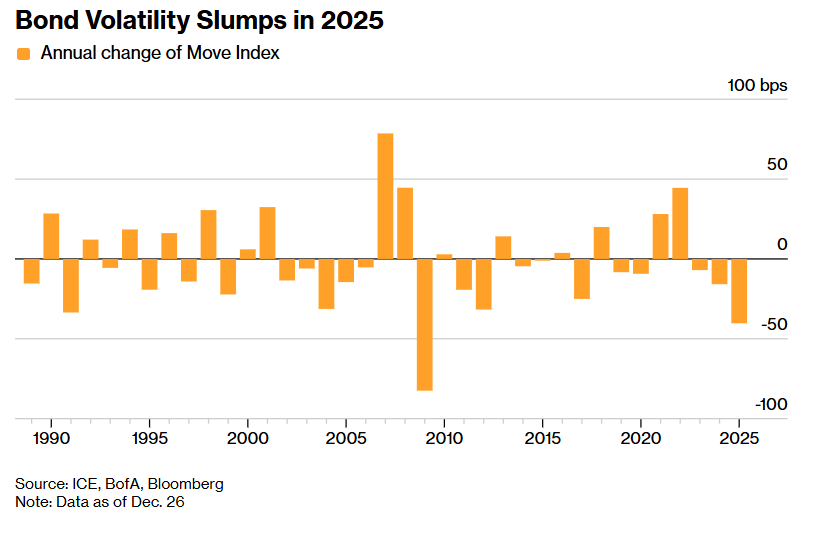
【美债波动率或创2009年以来最大年度降幅】受美联储降息有效降低经济衰退风险的影响,衡量美国债券市场波动率的一项指标正趋向于金融危机以来最大的年度跌幅。ICE BofA MOVE指数(衡量债市预期波动率的指标)上周五已跌至约59,创2024年10月以来的最低水平。该指数从2024年底的99...
Sou Hu Cai Jing· 2025-12-29 18:26
Core Insights - The volatility of U.S. Treasury bonds is expected to experience its largest annual decline since 2009, influenced by the Federal Reserve's interest rate cuts that have effectively reduced the risk of economic recession [1] Group 1: Market Indicators - The ICE BofA MOVE Index, which measures expected volatility in the bond market, has fallen to approximately 59, marking the lowest level since October 2024 [1] - The index has decreased significantly from around 99 at the end of 2024, indicating a potential record annual decline since data collection began in 1988, second only to the sharp drop in 2009 [1]
美债波动率或创2009年以来最大年度降幅
Sou Hu Cai Jing· 2025-12-29 18:20
Core Insights - The Federal Reserve's interest rate cuts have effectively reduced the risk of economic recession, leading to a significant decline in bond market volatility [1] - The ICE BofA MOVE Index, which measures expected volatility in the bond market, has dropped to approximately 59, marking the lowest level since October 2024 [1] - The index has decreased from around 99 at the end of 2024, potentially recording one of the largest annual declines since data began in 1988, second only to the crash in 2009 [1]
美债波动率创“解放日”以来最大,市场忧心美国财政且对非农感到不安
Sou Hu Cai Jing· 2025-09-04 09:46
Group 1 - The core viewpoint of the article highlights increased volatility in the U.S. Treasury market due to uncertainties in the government's fiscal situation and concerns over upcoming non-farm payroll data impacting Federal Reserve rate cut bets [1] Group 2 - The implied volatility of U.S. government bonds surged by 12.12 points over the past three days, marking the largest consecutive increase since April 2, when Trump announced reciprocal tariffs [1]
美债波动率创“解放日”以来最大 市场忧心美国财政且对非农感到不安
Sou Hu Cai Jing· 2025-09-04 09:40
Group 1 - The U.S. government faces uncertainty regarding its fiscal situation, leading to increased volatility in the U.S. Treasury market [1] - The implied volatility of U.S. Treasury bonds surged by 12.12 points over the past three days, marking the largest consecutive increase since April 2 [1] - Concerns about the non-farm payroll data on Friday may impact the Federal Reserve's interest rate cut expectations, with market participants closely monitoring the report [1] Group 2 - The Trump administration's spending and tax cut plans are expected to worsen the U.S. fiscal situation unless tariff revenues are sustained [1] - There is growing market anxiety due to Trump's attempts to exert greater control over the Federal Reserve, including efforts to dismiss board member Lisa Cook [1] - These concerns are reflected more in interest rates, gold futures, and stocks than in currency markets, according to JPMorgan strategists [1]
交投平稳 中美国债利差小幅走阔
Jin Rong Shi Bao· 2025-06-26 01:41
Group 1: Currency Exchange Trends - In May, the RMB exchange rate showed a general strengthening trend due to multiple factors, including a temporary easing of the US-China trade situation [1][2] - The RMB/USD exchange rate fluctuated and rose, breaking the 7.20 mark on May 12, despite a rebound in the dollar index [2] - By the end of May, the RMB exchange rate was recorded at 7.1953, reflecting an overall appreciation of 0.94% for the month [3] Group 2: Market Activity - The interbank foreign exchange market remained stable in May, with an average daily trading volume of $207.29 billion, a year-on-year increase of 12.59% [4] - The average daily trading volume in the RMB foreign exchange market was $158.10 billion, also showing a year-on-year increase of 8.43% [4] - The trading direction in the spot market showed variability, with institutions alternating between net selling and buying, resulting in an average daily net selling of $2.67 million [4] Group 3: Interest Rate Differentials - The interest rate differential between China and the US widened slightly in May, influenced by factors such as US government policies and inflation risks [5] - The 10-year US Treasury yield reached a three-month high of 4.58% before slightly retreating to 4.41% by the end of May [5] - The 10-year China-US bond yield spread ended the month at -274 basis points, widening by 20 basis points compared to the previous month [5] Group 4: Swap Points and Liquidity - The one-year swap points ended May at -2060 basis points, down 107 basis points from the previous month, primarily driven by interest rate factors [6] - The offshore swap points moved in sync with onshore points, with the one-year swap point spread narrowing to -97 basis points, the tightest since March 2023 [7] - Overall, dollar liquidity in the domestic market was relatively loose, with the domestic-offshore dollar overnight interest rate spread turning negative by the end of May [7]