
美联储利率走向

Search documents
日韩半导体股大涨,三星电子涨超4%,黄金白银由涨转跌
2 1 Shi Ji Jing Ji Bao Dao· 2026-02-19 01:41
Group 1 - Japanese and South Korean stock markets opened higher, with the Nikkei 225 index rising by 0.64% to 57,507 points and the KOSPI index increasing by 2.92% to 5,667.82 points, reaching a historical high [1] - The semiconductor sector led the gains, with Samsung Electronics rising over 4% amid negotiations for HBM4 pricing at $700 per unit, while SK Hynix increased nearly 3% [1] - Tokyo Electron and Advantest also saw gains of nearly 3% and over 2% respectively, following a positive trend in US tech stocks [1] Group 2 - The Japanese yen depreciated slightly, trading at 154.8 against the US dollar [2] - Gold and silver prices experienced volatility, with spot gold dropping below $4,970 after briefly surpassing $5,000, while spot silver fell to $76.734 per ounce after a significant rise [2] - Investors are assessing geopolitical risks related to the US-Iran and Russia-Ukraine situations, while the Federal Reserve's January meeting minutes revealed differing opinions on future interest rate directions [3]


美元兑瑞郎10月8日上涨0.47% 收于0.8016
Jin Tou Wang· 2025-10-09 07:24
Core Viewpoint - The USD/CHF exchange rate increased by 0.47% on October 8, closing at 0.8016, but is expected to face short-term pressure due to Fed rate cut expectations [1] Group 1: Exchange Rate Movements - The USD/CHF rate has retreated to around 0.8000, with support levels identified at 0.7970–0.7965 and the monthly low of 0.7920 [1] - Resistance levels are noted at 0.8030 (monthly high) and the range of 0.8050–0.8060, with a potential rebound if these levels are breached [1] Group 2: Federal Reserve Insights - The Fed's dot plot indicates a potential reduction of the federal funds rate to 3.6% by year-end, suggesting two more rate cuts this year [1] - Market expectations for rate cuts in October and December remain strong, with nearly certain probability for this month's meeting and approximately 78.6% for December [1] Group 3: Market Sentiment and Future Outlook - Investors are focused on Jerome Powell's speech at the Washington Community Banking Conference for signals regarding future Fed rate direction, which will directly impact the USD and USD/CHF trends [1] - Overall, while the dollar is under pressure affecting the USD/CHF pullback, attention is needed on Fed communications and key technical level breakthroughs to assess future movements [1]
美元走软助推国际金价沪金拉锯
Jin Tou Wang· 2025-09-12 02:35
Core Viewpoint - The recent fluctuations in the US dollar have negatively impacted gold prices, with a notable correlation observed between the two, as the dollar's decline has provided external support for gold prices [3]. Group 1: Market Overview - As of September 12, gold futures are trading around 833.24 yuan per gram, with a slight decline of 0.02%, having reached a high of 833.60 yuan and a low of 826.64 yuan [1]. - The short-term outlook for gold futures appears to be oscillating [1]. Group 2: Economic Indicators - The US dollar index fell by 0.3% to 97.52, reversing all gains from the Asian and European trading sessions, primarily due to mixed US inflation data and a significant increase in initial jobless claims, which contributed to a dovish sentiment [3]. - The Consumer Price Index (CPI) data did not significantly alter the Federal Reserve's interest rate trajectory, with the market focusing more on employment weakness, which has put pressure on the dollar [3]. Group 3: Gold Price Dynamics - The weakening dollar has made gold, priced in dollars, more attractive to investors holding other currencies, which explains the rapid narrowing of gold's decline following the inflation data release [3]. - Key resistance levels for gold futures are identified between 840 yuan and 860 yuan per gram, while important support levels are between 799 yuan and 850 yuan per gram [4].
这个数据让股市爆发让美元跳水,生产流程却有了重要变化,被质疑偏差明显,还能信吗?
Mei Ri Jing Ji Xin Wen· 2025-08-13 00:48
Group 1 - The core CPI data for July showed a year-on-year increase of 2.7%, which is lower than the expected 2.8%, while the core CPI rose by 3.1%, exceeding the forecast of 3% [1] - The release of this CPI data has led traders to increase bets on a potential interest rate cut by the Federal Reserve in September, resulting in a sharp decline in the dollar and a rise of over 1% in major U.S. stock indices, with the S&P 500 and Nasdaq reaching historical highs [1][2] Group 2 - The importance of the CPI data is heightened due to its role as a "key gauge" of the impact of new tariff policies on consumer spending, which may directly influence the Federal Reserve's interest rate decisions [2] - The data collection process has faced significant challenges, including a reduction in sampling scope and reliance on estimation methods due to budget cuts and personnel shortages at the Bureau of Labor Statistics (BLS) [5][7] - The BLS has reduced its sampling range, halting price collection in certain cities and temporarily suspending data collection in about 15% of surveyed areas, raising concerns about the accuracy and reliability of the CPI data [5][8] Group 3 - The BLS is experiencing internal challenges, including staff shortages and budget cuts, which have led to a significant reduction in the number of data collection points and increased reliance on estimation methods for CPI calculations [7][8] - The BLS's ability to provide reliable economic data is being questioned, as the agency has lost about 15% of its workforce since the beginning of the year, and budget proposals suggest further cuts [8][20] - The credibility of the CPI data is under scrutiny, with experts warning that the reduction in sampling and increased reliance on estimation could lead to greater volatility and inaccuracies in the reported inflation figures [15][21] Group 4 - The current CPI data's reliability is debated, with historical simulations suggesting minimal impact on national inflation rates, but concerns remain about the accuracy of localized data due to reduced sampling [15][16] - Experts express caution regarding the future quality of CPI data, indicating that ongoing budget and personnel cuts will likely lead to a decline in data accuracy and reliability [17][21] - The implications of compromised CPI data quality extend to monetary policy and social welfare programs, as many federal benefits are tied to inflation metrics, potentially affecting economic decision-making and public trust [20][21]
美罢免劳工统计局长后 首个重要数据再遭质疑:样本缺失、数据缩水、人员短缺 7月CPI还能信吗?
Mei Ri Jing Ji Xin Wen· 2025-08-12 16:14
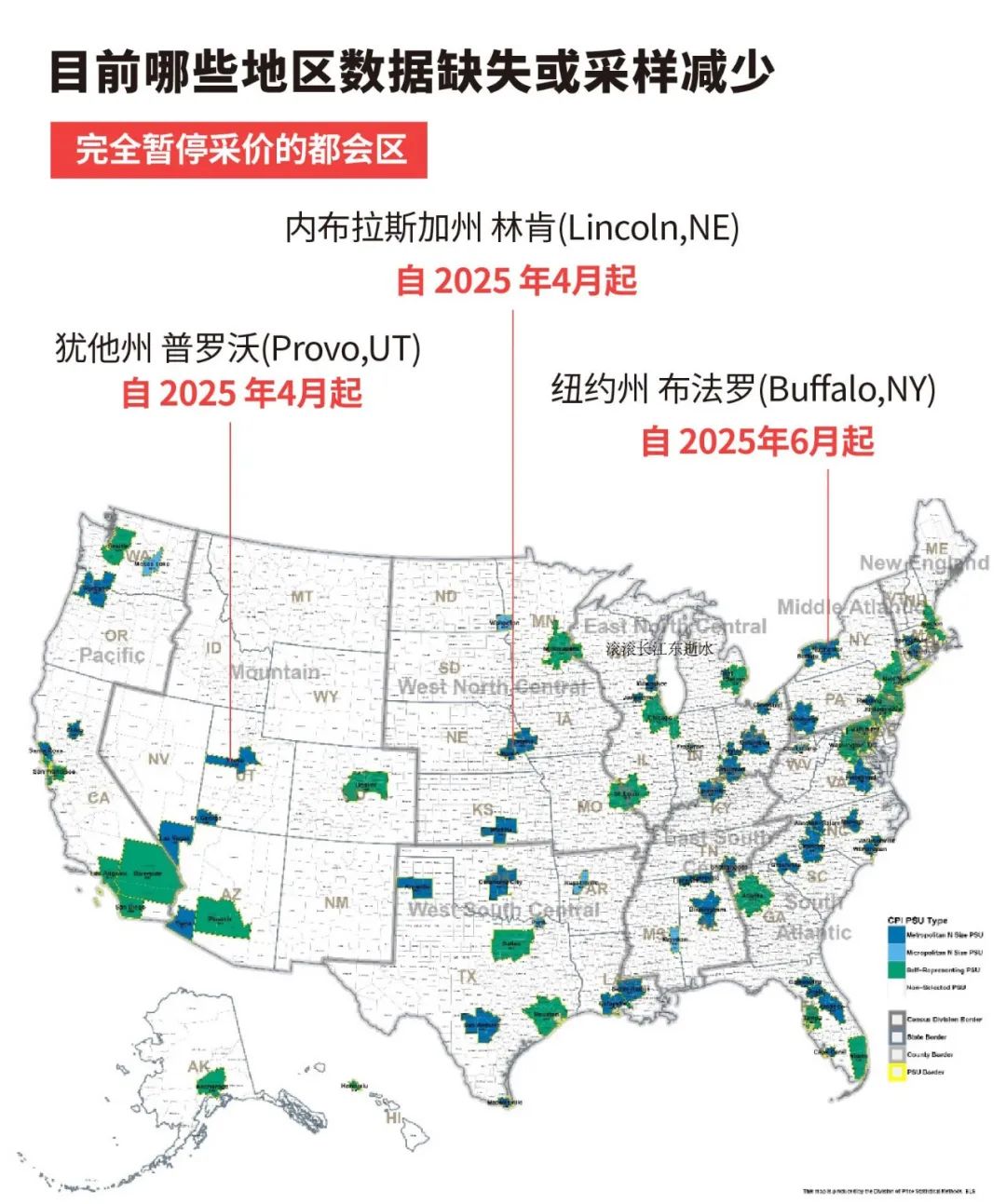
Core Viewpoint - The U.S. July CPI data revealed a year-on-year increase of 2.7%, lower than the expected 2.8%, while the core CPI rose by 3.1%, exceeding the forecast of 3%. This data is crucial as it may influence the Federal Reserve's interest rate decisions and has led to increased bets on a rate cut in September, causing a drop in the dollar and a rise in U.S. stocks [1] Data Collection Challenges - The Bureau of Labor Statistics (BLS) has reduced its sampling range for CPI data collection, halting price collection in cities like Lincoln, Nebraska, and Provo, Utah, and pausing collection in Buffalo, New York. Approximately 15% of price samples in other areas have also been temporarily suspended [2][5] - These adjustments have impacted the survey of goods and services prices, as well as housing rent surveys, leading to a decrease in the number of items used to calculate CPI. BLS claims that the overall inflation rate should remain stable, but volatility in the price index may increase in the affected areas [5] Internal Issues at BLS - BLS faces dual pressures from personnel shortages and budget cuts, with a significant hiring freeze and a proposed 8% budget reduction for the 2026 fiscal year. This has resulted in a 15% staff loss since the beginning of the year, limiting data collection capabilities [7][8] - The disbandment of advisory committees has further complicated BLS operations, leading to concerns about the reliability of government economic data due to reduced staffing and resources [8] Data Reliability Concerns - The reliance on imputation methods to fill data gaps has increased, with a notable rise in the use of "different unit" imputation, which is less accurate. This indicates a decline in the coverage and quality of CPI data, raising questions about its reliability [10][12] - Historical simulations by BLS suggest that the impact of reduced sampling on national inflation rates may be minimal, but localized data reliability could be compromised, leading to increased volatility in specific indices [12][13] Implications of Data Credibility - The credibility of CPI data is critical for monetary policy, as the Federal Reserve relies on it to assess inflation and make interest rate decisions. Inaccurate CPI data could mislead the Fed regarding inflation pressures [17] - The implications extend to various federal welfare programs and financial instruments, indicating that compromised data quality could affect economic decision-making at multiple levels [17][18]
美联储今年“必降息” 只是鲍威尔没反应过来?
Jin Shi Shu Ju· 2025-06-02 14:02
Group 1 - The market anticipates that the Federal Reserve will lower interest rates this year, although the Fed itself may not yet be aware of this direction [1] - Derivatives market traders predict that the Fed will remain inactive until September, followed by a "rapid and significant" rate cut, with expectations of a 100 basis point drop to a range of 3.25%-3.5% by June next year [1] - Top economists warn that the market may be misjudging the Fed's stance, emphasizing that the Fed has prioritized its 2% inflation target and has implemented the most aggressive tightening cycle in history [1][2] Group 2 - The optimism regarding rate cuts stems from the Fed's previous slow response to inflation, but this has led to an underestimation of its subsequent hawkish resolve [2] - Former Fed officials indicate that Chairman Powell is under pressure to avoid being labeled as a failure in the fight against inflation, with recent statements reflecting a commitment to controlling inflation [2] - There is a possibility of continued rate hikes if inflation spirals out of control, highlighting the complexity of the current economic situation [3]