金融数智化

Search documents
刘晓春:金融数智化的本质与误区
3 6 Ke· 2026-01-12 11:37
Core Insights - The narrative around financial digital innovation has shifted towards "smart digitalization" replacing "digitalization" due to breakthroughs in AI models and the introduction of stablecoin regulations in regions like the US and Hong Kong since 2025 [1] - The excitement surrounding AI and tokenization mirrors the early days of internet finance, emphasizing the need to eliminate intermediaries and enhance customer targeting and risk control [1] - AI and blockchain are tools in financial innovation, and understanding the essence of financial innovation is crucial for effective application [1] Group 1: Financial Innovation Technologies - Financial innovation requires three key technologies: financial technology, institutional technology, and scientific technology [2][3] - Financial technology encompasses broad economic and financial knowledge, emphasizing that financial innovation is fundamentally about finance, not just technology [3] - Institutional technology involves legal and regulatory frameworks that ensure stakeholder rights and risk prevention during financial transactions [4] - Scientific technology plays a supportive role in financial innovation, facilitating breakthroughs and improvements through the application of new and existing technologies [4][5] Group 2: Role of AI and Human Intervention - AI should not be viewed as a complete replacement for human roles; rather, it should enhance human capabilities in financial processes [6][7] - Relying solely on AI for risk control in lending has shown that human intervention can significantly improve loan quality [7] - The pursuit of reducing human labor through AI must be balanced with the need for human oversight to avoid misdirection in innovation [7] Group 3: Technology and Business Compatibility - No single technology can address all aspects of financial business; a combination of technologies is often necessary to meet specific business needs [8][9] - Financial transactions are based on trust and relationships, which cannot be solely managed by technology [9][10] - The complexity of financial services requires a nuanced approach to technology application, ensuring that it aligns with the unique characteristics of financial transactions [10][11] Group 4: Cost-Effectiveness in Financial Innovation - The primary goal of financial innovation is to achieve reasonable returns that cover costs and risks while serving the real economy [14] - Smaller financial institutions face challenges in competing with larger ones regarding technology investment and returns, necessitating strategic resource allocation [14][15] - The application of new technologies should be evaluated based on their cost-effectiveness and overall impact on business operations, rather than simply replacing old technologies [16][17]
西部陆海新通道建设不断提速
Jin Rong Shi Bao· 2026-01-06 01:25
Core Viewpoint - The construction of the Western Land-Sea New Corridor is a clear requirement outlined in the "14th Five-Year Plan," with the People's Bank of China and other departments issuing guidelines to enhance financial support for this initiative [1] Group 1: Financial Support Measures - The guidelines propose 21 key measures across six areas to improve financial services for the corridor, including enhancing organizational collaboration, strengthening financial support, optimizing cross-border settlement, and improving financial risk prevention [1] - The banking sector is identified as a primary financial force in supporting the corridor's development, with experts indicating that the guidelines clarify the direction and focus for banks in this initiative [1][2] Group 2: Cross-Regional Collaboration - The guidelines emphasize the establishment of cross-regional financial collaboration mechanisms to address existing coordination issues among banks, governments, and logistics entities [2] - The People's Bank of China aims to promote coordinated financial development across provinces and with countries along the corridor, facilitating a dual circulation economic model [2] Group 3: Digital Financial Services - The guidelines encourage the banking sector to innovate in digital financial services, with a focus on integrating blockchain technology and enhancing logistics financing services [4] - Digital financial services are highlighted for their advantages in risk identification, service efficiency, cost control, and product innovation, which are crucial for supporting the corridor's development [4] Group 4: Innovative Financing Models - The National Development Bank's Guangxi branch has adopted innovative financing models, providing significant funding for infrastructure projects to enhance the region's connectivity and trade with ASEAN countries [6] - The corridor serves as a key node in the Belt and Road Initiative, necessitating expanded financial cooperation and a clear financial collaboration network with relevant countries [6] Group 5: Responsibilities of the Banking Sector - The guidelines call for the banking sector to take on greater responsibilities in establishing financial cooperation mechanisms and exploring international financial collaboration [7] - Banks are encouraged to work with regulatory bodies and international organizations to develop financial solutions tailored to regional trade characteristics [7]
CIFS 2026第八届中国金融数智峰会重磅启航,开始报名!
Sou Hu Wang· 2025-12-29 03:47
Group 1 - The CIFS 2026, the 8th China Financial Intelligence Summit, will be held on March 25, 2026, in Shanghai, focusing on the theme "Data-Driven New Finance, Intelligent New Ecosystem" [2][3] - The summit aims to explore new paths for financial digital transformation and build an open and collaborative industrial ecosystem, gathering over 220 leaders from domestic and international financial institutions [1][3] - Key topics include the impact of AIGC and large model technologies on financial product design, risk control logic, and customer service systems [1][3] Group 2 - The summit will feature authoritative insights on the "14th Five-Year Plan" for financial digitalization policies, sharing over 20 cutting-edge reports and innovative case studies [1] - A series of forums will address pain points and solutions in digital transformation across banking, securities, insurance, funds, and asset management sectors [1][5] - The event will facilitate effective collaboration between digital solution providers and financial institutions through closed-door discussions and technology exhibitions [1][5] Group 3 - The agenda includes discussions on the application of generative AI in fraud detection, personalized wealth management solutions, and the cloud-native transformation of core banking systems [5][6] - The summit will also explore the integration of green finance with digital technologies and the collaborative innovation models between technology companies and financial institutions [5][6] - The "Golden Intelligence Cup" awards will recognize exemplary enterprises, products, and individuals in the financial and digital sectors, providing a platform for showcasing best practices [6][8]


“十五五”规划建议的“必答题”,银行业何解?
Jin Rong Shi Bao· 2025-12-26 11:47
Core Viewpoint - The construction of the Western Land-Sea New Corridor is a clear requirement outlined in the "14th Five-Year Plan," with the People's Bank of China and other departments issuing guidelines to enhance financial services for this initiative [1] Group 1: Financial Support Measures - The guidelines propose 21 key measures across six areas to improve financial services for the Western Land-Sea New Corridor, focusing on logistics, trade, and industry integration [1] - The measures include enhancing organizational collaboration, strengthening financial connectivity, optimizing cross-border payment processes, and supporting the digital transformation of financial services [1] Group 2: Cross-Regional Collaboration - The issuance of the guidelines is significant for establishing cross-regional financial collaboration mechanisms among banking institutions [2] - Current challenges include a lack of regular coordination platforms between banks and other entities, slow response times for cross-province services, and inefficient cross-border settlement processes [2] Group 3: Digital Financial Services - The guidelines encourage the adoption of digital financial services, highlighting the advantages of risk identification, service efficiency, and cost control through digitalization [4] - Financial institutions are urged to innovate product offerings and optimize their overseas presence to better support the digital transformation of financial services [5] Group 4: Innovative Financing Models - The National Development Bank's Guangxi branch has adopted an innovative financing model, providing 7.373 billion yuan for the Pinglu Canal project, demonstrating the financial sector's role in enhancing logistics and infrastructure [6] - Strengthening trade relations with ASEAN countries is a key focus of the Western Land-Sea New Corridor, emphasizing the need for expanded financial cooperation [6] Group 5: Responsibilities of the Banking Sector - The guidelines call for the banking sector to take on greater responsibilities in establishing financial cooperation mechanisms and exploring international financial collaboration [7] - Banks are encouraged to work with domestic and international financial institutions to develop tailored financial solutions that meet regional trade characteristics [7]
“AI+金融”系列专题研究(二):应用场景打开,AI助推金融机构内部效率与外部价值双升
Haitong Securities International· 2025-11-25 14:02
Investment Rating - The report suggests a positive investment outlook for the AI and financial services sector, highlighting the potential for significant advancements and cost reductions due to the release of DeepSeek R1 in 2025, which is expected to be a turning point for localized AI deployment in financial institutions [7]. Core Insights - AI applications are rapidly penetrating core business areas and back-office functions of various financial institutions, enhancing both internal efficiency and external value [1][7]. - The report identifies that most financial institutions are currently in the exploration and accumulation phase of AI application, with deep application being an inevitable trend [14]. - AI is expected to transform financial business processes and organizational structures, ushering in a new era of digital intelligence in finance [7]. Summary by Sections Investment Recommendations - The report recommends focusing on several sectors within the financial industry, including: 1. Financial information services with key stocks like Tonghuashun, Jiufang Zhitu Holdings, and Guiding Compass [8]. 2. Third-party payment services, recommending stocks such as Newland and Newguodu, with related stocks like Lakala [9]. 3. Banking IT, with recommended stocks including Yuxin Technology, Jingbeifang, and Guodian Yuntong [9]. 4. Securities IT, recommending stocks like Hengsheng Electronics and Jinzhen Shares [10]. 5. Insurance IT, with recommended stocks including Xinzhi Software and Zhongke Software [11]. Application Stages - Financial institutions' AI applications are categorized into three stages: 1. Initial exploration of large model applications. 2. Development of certain model application capabilities with data accumulation. 3. Achieving deep application of large models [14]. Application Value - AI applications provide value through: 1. Internal cost reduction and efficiency improvement, optimizing operational management and core business processes [21]. 2. External value extraction, enhancing marketing and customer service to improve sales conversion and customer value [21]. Application Pathways - Different types of financial institutions exhibit varied pathways for AI application deployment: 1. Large institutions leverage strong self-research capabilities for deep AI application penetration. 2. Smaller institutions focus on cost-effective solutions, utilizing lightweight models and integrated systems for agile development [26]. AI Empowerment in Banking - AI is enhancing front-office quality and efficiency, optimizing back-office processes across various banking functions [43]. - In credit risk management, AI models can analyze financial data to identify potential risks and improve decision-making processes [47]. AI Empowerment in Securities - The number of securities firms exploring large models is rapidly increasing, with applications extending across various business functions, including investment advisory and research [58][59].
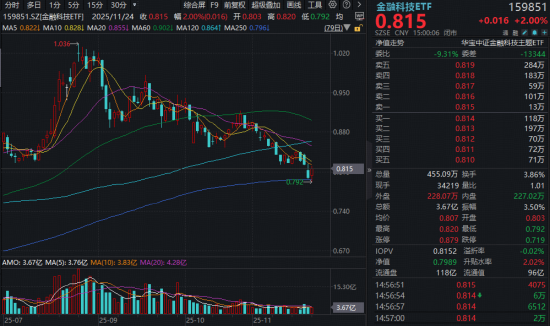
AI应用点火!恒银科技涨停,金融科技ETF(159851)反弹2%年线失而复得!机构:AI+金融拐点已至
Xin Lang Ji Jin· 2025-11-24 11:57
Group 1 - The core viewpoint of the articles highlights the resurgence of the fintech sector driven by AI applications, with the China Securities Financial Technology Theme Index rebounding and constituent stocks generally closing in the green, with 51 stocks rising over 1% [1][3] - The AI assistant Qianwen App from Alibaba has surpassed 10 million downloads within a week of its public testing, making it the fastest-growing AI application, outpacing competitors like ChatGPT and Sora [3] - Financial institutions are increasingly adopting AI technologies in core business areas and back-office scenarios, indicating a significant shift towards digital transformation in the financial sector [3] Group 2 - The largest fintech ETF (159851) experienced a price increase of 2% after a period of adjustment, with a trading volume of 367 million yuan on the day [1][4] - The financial technology ETF has a current scale exceeding 9 billion yuan, with an average daily trading volume of 800 million yuan over the past six months, indicating strong liquidity and market interest [4] - East Wu Securities suggests focusing on fintech opportunities through the fintech ETF and its associated funds, emphasizing coverage of internet brokerages, financial IT, cross-border payments, and AI applications [3][4]



“AI+金融”系列专题研究(一):行业拐点已至,金融是AI应用落地的绝佳“试验田”
Haitong Securities International· 2025-11-18 07:25
Investment Rating - The report suggests a positive investment outlook for the financial industry, highlighting its strong alignment with AI application and digital transformation needs [3][7]. Core Insights - The financial industry is identified as an ideal "testing ground" for AI applications due to its data-intensive nature and the increasing demand for digital transformation [1][7]. - The release of DeepSeek R1 in 2025 is anticipated to be a pivotal moment for local AI deployment in financial institutions, enhancing model reasoning capabilities and reducing costs [3][7]. - AI applications are rapidly penetrating core business areas and back-office functions within various financial institutions, with the potential to reshape business processes and organizational structures [3][7]. Summary by Sections Investment Recommendations - The report emphasizes the financial sector's need for digital transformation, which aligns well with the characteristics of large models in AI. It predicts a shift from "digital intelligence" to "artificial intelligence" in financial institutions [7]. - Key areas to focus on include: 1. Financial information services with relevant companies like Tonghuashun, Jiufang Zhitu Holdings, and Guiding Compass [8]. 2. Third-party payment services, particularly New大陆 and New国都, with related companies like Lakala [9]. 3. Bank IT, focusing on companies such as Yuxin Technology, Jingbeifang, and Guodian Yuntong [9]. 4. Securities IT, with a focus on companies like Hengsheng Electronics and Jinzhen Shares [10]. 5. Insurance IT, highlighting companies like Newzhisoft and Zhongke Soft [11]. Industry Drivers and Policy Support - The report discusses the strong internal and external drivers for AI application in finance, including the continuous expansion of IT spending by financial institutions and supportive government policies [14][25]. - The maturity of large model technology and its alignment with the financial industry's needs are emphasized, indicating a shift towards industry adaptation [14][18]. Technical Aspects - The report outlines two main technical paths for AI integration in finance: general models trained with financial data and specialized financial models [36]. - DeepSeek R1 is highlighted as a significant advancement in AI deployment for financial institutions, offering enhanced reasoning capabilities and cost efficiency [45][52]. - The report notes that the performance of DeepSeek R1 has improved significantly, with accuracy rates in complex reasoning tasks rising from 70% to 87.5% after updates [48]. Market Trends - The financial sector's technology investment is projected to grow significantly, with a total expected investment of 650 billion yuan by 2028, reflecting a compound annual growth rate of approximately 13.3% [25][31]. - The report indicates a notable increase in AI-related procurement projects within the financial sector, with 133 large model projects initiated in 2024 alone [27][35].




国泰海通:AI+金融行业拐点已至 在核心业务及中后台场景加速渗透
Zhi Tong Cai Jing· 2025-11-17 09:01
Core Insights - The financial industry is experiencing a significant shift towards AI applications, driven by both internal and external factors, marking a pivotal moment for AI implementation in finance [2] - The release of DeepSeek R1 in 2025 is expected to enhance general model reasoning capabilities and reduce costs, facilitating localized AI deployment in financial institutions [1][3] - AI is anticipated to transform financial business processes and organizational structures, ushering in a new era of digital intelligence in finance [1] Industry Drivers - The financial sector is characterized as data, information, and decision-intensive, making it an ideal testing ground for AI applications [2] - Since the introduction of GPT-1 by OpenAI in 2018, general model technology has progressed from "technology validation" to "industry adaptation," indicating readiness for large-scale application in vertical sectors [2] - Recent policies and top-level designs have provided external impetus for financial institutions to transition from "digital intelligence" to "artificial intelligence" [2] Technological Pathways - There are two main technological approaches for integrating AI in finance: 1. Training general models with financial data, enhancing the ability to solve complex financial problems, with DeepSeek R1 marking a key industry milestone for localized AI deployment [3] 2. Developing financial-specific models that better address industry-specific challenges and compliance requirements [3] - AI agents, particularly multi-agent collaboration, are identified as a future focus area, with current applications primarily in short-thinking financial scenarios like understanding and information extraction [3] Investment Opportunities - Suggested sectors for investment include: 1. Financial information services with recommended stocks like Tonghuashun and JiuFang Zhitou Holdings [4] 2. Third-party payment services with recommended stocks like Newland and New Guodu [4] 3. Banking IT with recommended stocks including Yuxin Technology and Jingbeifang [4] 4. Securities IT with recommended stocks such as Hengsheng Electronics and Jinzhen Shares [4] 5. Insurance IT with recommended stocks like New Wisdom Software and Zhongke Software [4]

(经济观察)AI时代,金融数智化生态怎么建设?
Zhong Guo Xin Wen Wang· 2025-10-30 10:38
Group 1 - The conference on "Building a Financial Intelligent Ecosystem under Artificial Intelligence" emphasizes the integration of AI in the financial sector as a core engine for transformation and high-quality economic development [1][2] - Beijing is positioning itself as a global financial technology innovation hub, leveraging its resources and talent to enhance international competitiveness [1] - The report on "2025 Global Financial Technology Center Cities" identifies the top ten cities, with Beijing, San Francisco, and New York leading the list, and highlights the rise of Paris as a key player in Europe [2] Group 2 - The digital transformation strategy of Industrial Bank focuses on moving from traditional branch operations to a digital-centric model, aiming for 10% coverage of key business processes with AI by 2026 [3] - Discussions at the conference highlighted the need to address regional disparities in financial technology development across China, particularly in coastal areas and cities like Chengdu and Chongqing [3]
当 AI 从试点进入规模化,华为数字金融的长期选择
晚点LatePost· 2025-09-23 13:58
Core Insights - The article discusses the rapid adoption of AI technologies in the financial sector, highlighting a significant increase in the application of large models and intelligent agents within industrial enterprises, projected to rise from 9.6% in 2024 to 47.5% by 2025 [3] - Companies are shifting their focus from technology validation to measuring the return on investment (ROI) from AI implementations, with over 70% of surveyed executives reporting returns within the first year of deployment [3][4] - Huawei's FinAgent Booster (FAB) is introduced as a solution to help financial institutions accelerate their AI integration, emphasizing the need for a systematic approach to meet evolving client demands [4][6] Industry Transformation - The financial industry is transitioning from manual processes to digitalization, with significant milestones marked by the introduction of automated systems in the late 20th century [7][8] - The current phase is characterized by the integration of AI technologies, with banks embedding AI in over 100 business processes, leading to improved operational efficiency and financial returns [8][9] - The average annual growth rate of shareholder returns for digitally advanced banks is 8.2%, compared to 4.9% for less advanced institutions, indicating the financial benefits of AI adoption [8] Huawei's Role - Huawei has evolved from providing basic IT infrastructure to offering comprehensive solutions that include hardware, software, cloud services, and AI capabilities, establishing a strong market position [10][11] - The company has built a robust ecosystem with over 150 financial solution partners and serves more than 5,600 financial clients globally [10] - Huawei's strategy focuses on enhancing infrastructure resilience, modernizing applications, and fostering innovation in business scenarios to support AI transformation [11][19] FAB Features and Benefits - The FAB platform is designed to lower the barriers for clients to develop their AI capabilities, enabling faster deployment of intelligent agents [12][14] - Key features of FAB include pre-built workflows for over 50 specific scenarios, a knowledge base for easy customization, and optimization tools to enhance model accuracy [13][15] - Huawei emphasizes the importance of data management and knowledge integration to improve AI decision-making processes [15] Ecosystem Collaboration - The financial sector's reliance on collaboration necessitates a multi-faceted approach to meet diverse regulatory and operational needs [16] - Huawei's "融海计划" (Ronghai Plan) aims to strengthen partnerships between Chinese financial institutions and global software developers, enhancing the ecosystem's capabilities [17] - The plan includes initiatives for market expansion, system integration, and innovation in AI applications, demonstrating Huawei's commitment to fostering a collaborative environment [17][18] Talent Development - Huawei has initiated training programs for over 2,000 AI professionals across more than 30 financial institutions, with plans to expand this to 5,000 domestically and internationally [18][19] - The company recognizes the importance of building a skilled workforce to support the ongoing digital transformation in the financial sector [19]