银油比

Search documents
白银的历史大顶,从来不是“贵出来”的
Hua Er Jie Jian Wen· 2026-02-05 08:42
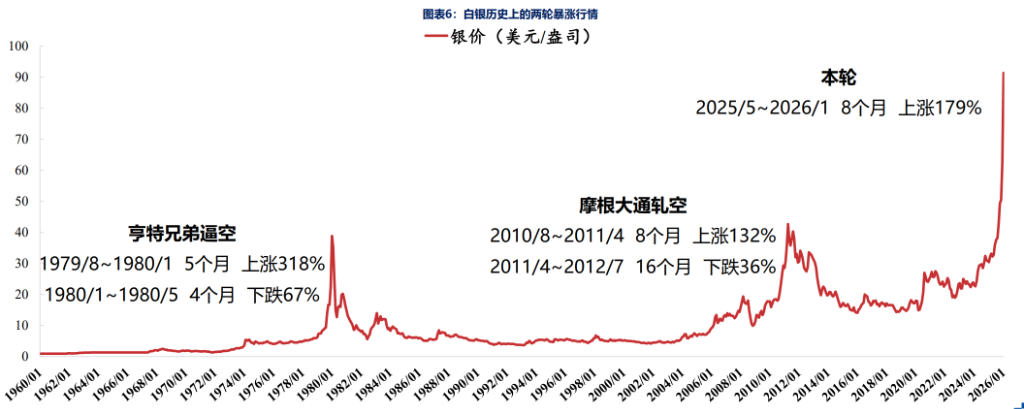
Core Viewpoint - The silver market has experienced extreme volatility, with prices soaring by 179% and reaching over $100 per ounce, followed by a dramatic decline of over 35% in just a few days, indicating a highly unstable trading environment [1][3]. Market Dynamics - Silver's price reached a historical high of approximately $121.8 per ounce on January 29, followed by a sharp drop to around $73 on January 31, marking the largest single-day decline on record [3]. - The volatility in the silver market has reached unprecedented levels, with a 60-day standard deviation exceeding 1800%, a stark contrast to the historical norm of remaining below 200% for 93% of the time since 1978 [6]. Leverage and Market Structure - The current market conditions are characterized by a forced deleveraging process, with trading volumes and volatility indicating a fragile market structure [5]. - The extreme volatility is often unsustainable, and historical patterns suggest that a return to lower volatility typically accompanies significant price corrections [8]. Exchange Intervention - Historical instances of silver market bubbles, such as the 1980 Hunt brothers incident and the 2011 JPMorgan case, were ended by exchange interventions that restricted trading and increased margin requirements [9][11]. - The CME has raised margin requirements five times in a month, reflecting a clear intent to cool down the silver market and enforce deleveraging [14][16]. Price Dislocation - The current gold-silver ratio has dropped to around 42, nearing historical lows, indicating a high premium for silver relative to gold [17]. - The silver-oil ratio has dramatically diverged from historical norms, currently exceeding 1.8, which suggests that silver prices have detached from their industrial value and are now driven by speculative trading [20][22]. Macro Environment - The macroeconomic backdrop is shifting, with potential implications from the nomination of Kevin Warsh to the Federal Reserve, which may lead to tighter liquidity and a stronger dollar, negatively impacting precious metals [23]. - While geopolitical tensions may provide short-term support for silver, anticipated improvements in U.S.-China relations could further diminish the safe-haven premium for precious metals [23].

大宗商品迎来“银强油弱”时代
Bei Jing Shang Bao· 2026-01-07 15:26
Group 1 - The recent surge in silver prices, surpassing oil prices, indicates a significant shift in market dynamics, with the silver-to-oil ratio fluctuating between 1.2 and 1.3 [3][4] - Historical context shows that the last time silver was more expensive than oil was approximately 45 years ago, during the Hunt brothers' manipulation of the silver market [2] - The current geopolitical situation in Venezuela has not significantly impacted oil prices, which have been on a downward trend, reflecting a broader supply surplus in the global market [3][4] Group 2 - Silver's demand is closely tied to industrial applications, particularly in sectors like electronics and photovoltaics, which are expected to drive its price, despite a projected slowdown in photovoltaic installation growth [4][5] - Oil prices are expected to remain under pressure due to anticipated increases in U.S. oil production and ongoing global supply surplus, with Goldman Sachs predicting an average WTI oil price of $52 per barrel in 2026 [5][6] - The silver-to-oil ratio is expected to remain above 1, but significant increases are unlikely, with key factors including OPEC+ production cuts and global energy policy changes influencing this dynamic [6]
一盎司银贵过一桶油,大宗商品迎来“银强油弱”新时代
第一财经· 2026-01-06 13:25
Core Viewpoint - The article discusses the contrasting trends in silver and oil markets, highlighting the recent surge in silver prices while oil prices remain subdued, indicating a potential shift in supply-demand dynamics and market perceptions of value in the context of energy transition [2][8]. Group 1: Market Trends - As of January 6, 2026, silver futures prices are around $77 per ounce, while WTI crude oil futures are at $58 per barrel, resulting in a silver-to-oil ratio of approximately 1.3, meaning one ounce of silver can purchase 1.3 barrels of oil [2]. - Over the past six months, oil prices have dropped over 32% from a high of $74 per barrel to a low of $50, while silver prices have doubled from around $40 per ounce to a peak of $80 [3]. - The last time silver was more expensive than oil was approximately 45 years ago, excluding extreme market conditions [4]. Group 2: Historical Context - In extreme market conditions, the silver-to-oil ratio reached 0.8 in 2020 during negative oil price events, while during the Hunt brothers' manipulation of the silver market from 1979 to 1980, silver prices surged from $6 to nearly $50, with oil prices ranging from $30 to $40 per barrel, resulting in a silver-to-oil ratio of about 1.25 to 1.67 [5]. Group 3: Current Market Dynamics - The current silver-to-oil ratio fluctuates between 1.2 and 1.3, with silver showing strong rebound momentum after a drop from its historical high, supported by increasing net long positions in COMEX silver futures [6]. - In contrast, oil prices have shown resilience against geopolitical events, with a significant decline of over 18% in 2025, marking the largest annual drop since 2020, as the market adjusts to a supply surplus [6][9]. - Venezuela's oil production, despite its vast reserves of 303 billion barrels, is currently limited to about 1 million barrels per day, contributing to the perception of a stable oil price environment [6]. Group 4: Supply-Demand Reassessment - The contrasting performance of silver and oil reflects a re-evaluation of the value of different commodities amid the accelerating energy transition, with silver being increasingly recognized for its financial attributes and industrial applications [8]. - Silver's demand is closely tied to global economic conditions, particularly in sectors like electronics and photovoltaics, while oil's demand remains weak due to ongoing inventory builds and increased production forecasts [9]. - Despite the anticipated energy transition, uncertainties such as insufficient clean energy infrastructure investment and traditional energy subsidies may slow the transition process, impacting future silver and oil price dynamics [9].
一盎司银贵过一桶油,大宗商品迎来“银强油弱”新时代
Di Yi Cai Jing· 2026-01-06 12:00
Core Viewpoint - The price dynamics of silver and oil have diverged significantly, with silver prices surging while oil prices remain subdued, indicating a potential shift in market sentiment and supply-demand dynamics in 2026 [1][4]. Group 1: Price Movements - As of January 6, 2026, COMEX silver futures are trading around $77 per ounce, while WTI crude oil futures are at $58 per barrel, resulting in a silver-to-oil ratio of approximately 1.3 [1]. - Over the past six months, oil prices have dropped over 32% from a high of $74 per barrel to a low of $50, while silver prices have doubled from around $40 per ounce to a peak of $80 [2]. - The last time silver was more expensive than oil was about 45 years ago, with historical instances showing significant fluctuations in the silver-to-oil ratio [2]. Group 2: Market Dynamics - The current silver-to-oil ratio fluctuates between 1.2 and 1.3, with silver showing strong rebound momentum despite a recent drop from its historical high [3]. - Financial institutions are increasing their net long positions in COMEX silver futures, indicating strong bullish sentiment, while oil prices are experiencing a decline due to oversupply concerns [3][5]. - The geopolitical situation in Venezuela has limited impact on oil prices, as the country’s production capacity is currently low, and global supply remains excessive [3][5]. Group 3: Supply and Demand Factors - The contrasting performance of silver and oil reflects a re-evaluation of their values amid changing supply-demand dynamics and macroeconomic conditions [4]. - Silver is increasingly recognized for its industrial applications, particularly in electronics and solar energy, which are expected to drive demand, although growth in solar installations is projected to slow down [4][5]. - Oil supply remains weak globally, with the U.S. Energy Information Administration projecting record-high oil production, reinforcing expectations of oversupply in the market [5]. Group 4: Future Outlook - Analysts suggest that while the silver-to-oil ratio may remain above 1.0, significant further increases are unlikely, with key factors such as OPEC+ production cuts and global energy policies influencing future price relationships [5].

关于白银的一些思考
雪球· 2025-12-27 06:55
Core Viewpoint - The article discusses the recent surge in silver prices, which have reached $71 per ounce, marking a 44% increase from the previous historical high of $49.82 in 2011 and a 294% increase from the low of $18 in 2020. The author draws parallels between the current market conditions and previous silver crashes in 1980 and 2011, questioning whether the current situation will lead to a similar outcome [2][5][46]. Historical Context - In 1980, silver prices collapsed from $50 to $10 within three months due to market manipulation and sudden changes in margin requirements by COMEX, which destroyed liquidity [11]. - In 2011, silver prices fell from $49.82 to $26 in eight weeks, driven by increased margin requirements and the end of quantitative easing, leading to a significant drop in prices [12]. - The current price increase of 294% from the 2020 low is compared to the 486% increase seen in 2011, suggesting that there may still be room for further price growth [13]. Reasons for Holding Silver Mining Stocks - **Monetary Policy Comparison**: The current monetary policy environment is likened to that of the post-2008 financial crisis, where excessive monetary easing led to a significant rise in silver prices. The ongoing geopolitical tensions and economic conditions are seen as supportive of silver price increases [16]. - **Supply Shortage**: Silver has been in a state of supply shortage, with demand consistently outpacing new mining and recycling supplies. However, the author questions whether the current price increase will lead to panic buying among industrial users [17][19]. - **Industrial Demand Growth**: Silver is essential for various industries, including solar energy and electric vehicles, which are expected to drive demand. However, the author notes that the cost of silver in these applications may lead to manufacturers seeking alternatives [21][24]. - **Supply Rigidity**: Approximately 70% of silver production comes as a byproduct of mining other metals, which limits the ability to increase supply in response to price increases. While supply rigidity may support prices in the long term, it may not prevent short-term price corrections [26]. Valuation Assessment - **Gold-Silver Ratio**: The current gold-silver ratio is at 62.5, which is considered low historically. If it returns to an average of 80, silver prices would need to adjust to around $56 [30]. - **Silver-Oil Ratio**: The silver-oil ratio has reached a 40-year high of 1.24, indicating that either oil prices must rise significantly or silver prices must correct downward [32]. Margin Requirements and Market Dynamics - The CME has recently increased silver futures margin requirements by 10%, which is seen as a potential precursor to further tightening. Historical precedents show that rapid increases in margin requirements can lead to significant market corrections [33][35]. - The article outlines a feedback loop where rising prices lead to increased margin requirements, forcing leveraged positions to liquidate, which in turn drives prices down further [36]. Future Scenarios - **Bullish Scenarios**: Potential for new rounds of monetary easing or continued geopolitical tensions could drive silver prices to $100-150 per ounce. Industrial demand could also exceed expectations, pushing prices higher [40][42]. - **Bearish Scenarios**: A moderate correction could stabilize prices between $55-65 per ounce, while a systemic collapse could see prices fall to $35-45 per ounce if margin requirements increase significantly and geopolitical tensions ease [44].