
长护险制度

Search documents
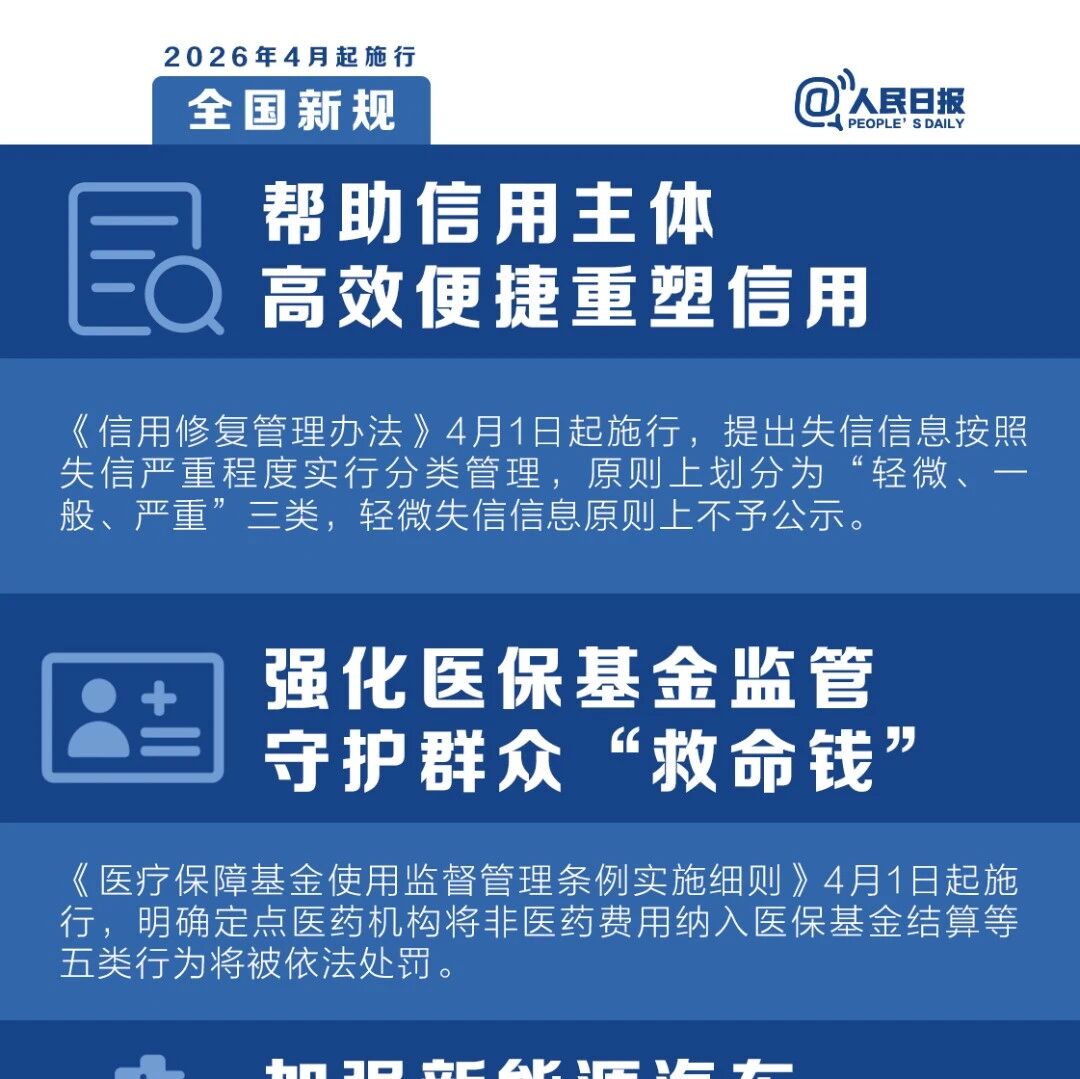
明天起,这些新规将影响你的生活
证券时报· 2026-03-31 02:10
Core Points - The article discusses various new regulations and standards that will take effect on April 1, 2026, aimed at improving different sectors including credit management, healthcare, and environmental sustainability. Group 1: Credit Management - The "Credit Repair Management Measures" will categorize dishonest information based on severity, with minor infractions generally not being publicly disclosed [1]. Group 2: Healthcare - The "Implementation Rules for the Supervision and Management of Medical Security Fund Usage" will impose penalties on designated medical institutions for including non-medical expenses in medical fund settlements [2]. Group 3: Environmental Management - The "Interim Measures for the Recycling and Comprehensive Utilization of Waste Power Batteries from New Energy Vehicles" mandates that battery manufacturers are responsible for the recycling of batteries sold and used within the country [3]. Group 4: E-commerce - A new customs announcement allows cross-border e-commerce companies to handle returns flexibly, without the requirement to return goods to the original export customs [4]. Group 5: Traditional Medicine - The "National Standard for the Classification and Determination of Traditional Chinese Medicine Constitution" will be implemented, providing a basis for various health-related sectors [5]. Group 6: Elderly Care - The "Basic Standards for Life Care Services in Elderly Care Institutions" will enhance the safety and comfort of elderly residents by outlining service requirements and processes [6]. Group 7: Child Welfare - The revised "Management Measures for Child Welfare Institutions" allows qualified institutions to provide services for children with rehabilitation needs [7]. Group 8: Tax Policy - The Ministry of Finance and the State Administration of Taxation announced the cancellation of VAT export rebates for photovoltaic products and a reduction in the rebate rate for battery products from 9% to 6% [8]. Group 9: Infectious Disease Management - The National Health Commission will classify Chikungunya fever and fever with thrombocytopenia syndrome as Category B infectious diseases, implementing corresponding prevention and control measures [9]. Group 10: Local Regulations - Various local regulations will also take effect, including the "Beijing Housing Safety Regulations" which hold property owners responsible for safety [12], and the "Tianjin Electronic Administrative Law Enforcement Certificate" for enhancing transparency in inspections [14].

专家带你读政策-两会医药政策及长护险制度解读
2026-03-30 05:15
Summary of Conference Call Notes Industry Overview - The conference call discusses the **biomedical industry** and the **long-term care insurance (LTCI)** system in China, highlighting its significance as a pillar of the national economy and its evolution into a new phase of development [2][4]. Key Points and Arguments Biomedical Industry - The **2026 Two Sessions Report** elevates the biomedical industry to a new status, categorizing it alongside integrated circuits, aerospace, and low-altitude economy as a **national emerging pillar industry** [2][3]. - The report emphasizes **full-chain support for innovative drugs**, addressing the challenges of hospital access for new medications, with over **700 new drugs** added to the medical insurance directory in the past five years [2][3]. - The **"Three Medical Coordination"** mechanism is adjusted to prioritize healthcare, indicating a shift towards meeting public medical needs as the core directive of healthcare reform [3]. Long-Term Care Insurance (LTCI) - LTCI is established as the **sixth independent insurance type** in the social security system, aimed at addressing the aging population and promoting the **"silver economy"** [4][5]. - The **funding rate** for LTCI is set at **0.3%**, with reimbursement ratios of **70% for employees** and **50% for residents**, reflecting a **"pay more, get more"** principle [6][9]. - The **implementation timeline** for LTCI spans three years, focusing on establishing a nationwide system and framework, although not all citizens will be covered immediately [5][6]. Funding and Sustainability - LTCI will operate as an **independent insurance** with separate accounts, avoiding confusion with basic medical insurance funds [7][8]. - The funding mechanism will involve contributions from employers, individuals, and government support, with a potential for **differentiated financial sharing** based on regional fiscal capacities [10][11]. - The **dynamic adjustment of the funding rate** is not explicitly outlined but may be considered after the three-year observation period based on actual data [9][10]. Impact on Related Industries - The rollout of LTCI is expected to significantly benefit the **elderly care market**, with a surge in demand for nursing services and community care [13]. - There will be a notable increase in the need for **supportive assistive devices** and **smart technology** in elderly care, as policies may include these in the payment scope [12][13]. - The development of **training programs** for caregivers and the establishment of **LTCI industry parks** are anticipated, indicating a trend towards industry cluster development [13]. Additional Considerations - The **dynamic adjustment mechanism** for the service directory of LTCI will be established, allowing for periodic updates based on economic conditions and public needs, although specific timelines are not yet defined [12][13]. - The integration of **commercial long-term care insurance** is expected to follow the establishment of the LTCI system, with potential policy support to encourage product development [11]. This summary encapsulates the critical insights from the conference call, focusing on the biomedical industry and the long-term care insurance system, their implications, and the anticipated developments in related sectors.
国内“词元”激活数字经济新动能,美伊谈判或一波三折
Southwest Securities· 2026-03-27 08:03
Domestic Developments - The long-term care insurance system is accelerating its implementation, aiming for nationwide coverage by the end of 2028, benefiting approximately 35 million disabled elderly individuals[15] - The "Token" has been officially named "词元," marking a significant step in the digital economy, with daily usage surpassing 140 trillion, a growth of over 1000 times since early 2024[11] - The 2026 Boao Forum predicts Asia's economic growth rate at 4.5%, slightly lower than 2025's 4.7%, but still leading globally amid uncertainties[13] International Developments - Trump announced negotiations with Iran, but significant differences in conditions may lead to a complicated negotiation process, with Brent crude oil prices dropping by 10.9% to $99.94 per barrel following his statements[17] - Japan's February CPI growth slowed to 1.3%, the lowest since March 2022, while the manufacturing PMI for March fell to 51.4, indicating a cooling economic sentiment[18] - The Eurozone's March composite PMI dropped to 50.5, the lowest since May 2022, with the European Central Bank signaling a strong likelihood of interest rate hikes due to rising energy prices[22] High-Frequency Data - Brent crude oil and iron ore prices increased by 1.19% and 1.14% week-on-week, while copper prices fell by 3.28%[24] - Real estate sales rose by 16.37% week-on-week, indicating a rebound in the housing market[24] - The price of domestic polysilicon dropped by 8.49% week-on-week, reflecting volatility in emerging industries[24]
【新春走基层】春节坚守的“居家护理员”
Xin Lang Cai Jing· 2026-02-13 20:37
Core Insights - The long-term care insurance (LTCI) system in Shanghai plays a crucial role in ensuring the well-being of disabled elderly individuals during the Chinese New Year, a period marked by increased demand for care services due to family reunions and health risks associated with winter [2] Group 1: Long-term Care Insurance System - The LTCI system in Shanghai has evolved significantly over the past decade, with the city being one of the first to pilot the program in 2016, leading to expanded coverage and improved assessment standards [2] - By 2025, the home care service volume in Baoshan District is projected to reach 4.34 million visits, with 2,072 registered home care providers like Zhao Tingting actively participating in the system [2] Group 2: Caregiver Challenges and Strategies - Caregivers face significant challenges during the Chinese New Year, including staffing shortages and the need to provide care for a growing number of severely disabled elderly individuals [1] - Caregivers, such as Zhao Tingting, proactively plan for the holiday season by organizing care schedules and addressing the specific needs of high-need patients to ensure quality care during this critical time [1]
程智涛:参保人数再创新高,基金累计结余近67亿元
Nan Fang Du Shi Bao· 2026-02-11 06:31
Core Viewpoint - The Zhuhai government is focusing on the development goals for the "15th Five-Year Plan" period, building on the achievements of the "14th Five-Year Plan" and emphasizing key areas such as the Guangdong-Hong Kong-Macao Greater Bay Area construction, new productivity development, and integrated education and technology talent development [1] Group 1: Healthcare Insurance Achievements - The number of basic medical insurance participants in Zhuhai has exceeded 2.6 million, surpassing the provincial target of 2.52 million, marking a historical high [2] - The medical insurance fund's income reached 8.6 billion yuan, with expenditures of 7.5 billion yuan, resulting in a cumulative surplus of 6.688 billion yuan, indicating stable operations [2] - The annual reimbursement for hospitalization reached 299,000 cases, and outpatient reimbursements totaled 12.13 million cases, with 1.23 million cases of direct settlement for cross-regional medical treatment [2] Group 2: Enhanced Medical Benefits - The annual maximum payment limit for medical insurance has been raised to 1.5 million yuan for employees and 800,000 yuan for residents, with significant improvements in maternity support, including full reimbursement for prenatal and delivery costs [3] - Over 190,000 flexible employment individuals have joined the medical insurance scheme, ensuring coverage for gig economy workers such as delivery personnel [3] - Medical assistance has been provided to 6,365 individuals, with instant settlement for 66,000 cases, amounting to 8.153 million yuan in aid [3] Group 3: Cost Reduction in Medical Services - The average hospitalization cost has decreased from 12,900 yuan to 11,100 yuan, reflecting efficient fund utilization and reduced expenses for patients [4] - A total of 3.706 billion yuan was saved through centralized procurement of drugs and medical supplies, benefiting the public with lower prices [4] - 30 enterprises in Zhuhai have had 86 types of drugs and medical supplies included in national procurement lists, promoting high-quality development for local businesses [4] Group 4: Improved Healthcare Accessibility - The establishment of 757 service points across towns, streets, and banks facilitates easier access for residents to handle medical insurance matters [4] - The introduction of intelligent customer service for medical insurance allows for one-stop processing of insurance issues [4] - The goal is to enhance the medical security level for all insured individuals through various initiatives [6]
从养老服务到灾后重建 北京政协委员建言加大民生保障
Xin Lang Cai Jing· 2026-01-23 13:44
Group 1 - The Beijing Municipal Committee's 14th session will open on January 24, with members sharing experiences related to enhancing public welfare, particularly in elderly care and disaster recovery [1][3][5] - Long-term care insurance (LTCI) is introduced as the "sixth insurance" in social security to address aging population challenges and the issue of "one person losing ability, the whole family being unbalanced" [1] - The Shijingshan District has been a pilot area for LTCI since September 2020, with approximately 420,000 insured individuals annually, leading to improved service frameworks for severely disabled elderly individuals and their families [1] Group 2 - The Beijing Boai Social Work Service Center has highlighted challenges in rural elderly care services, advocating for improved infrastructure and home-based care systems to ensure rural elderly receive adequate support [3] - The "Jinghua Consultation Hall" initiative by the Beijing Municipal Committee has facilitated 230 consultation activities across 16 districts, engaging over 10,000 participants on various topics including elderly care and economic development [3] - Following extreme rainfall in July 2025, the Huairou District utilized the "Jinghua Consultation Hall" to quickly address disaster recovery needs, establishing key topics for discussion and immediate action within two days [5]
长护险托底,让生活更有尊严
Xin Lang Cai Jing· 2026-01-18 21:30
Core Insights - Jiangsu province is leading in long-term care insurance (LTCI) with over 66 million participants, addressing the needs of an aging population and providing financial relief to families [1] - By 2025, 374,000 individuals in Jiangsu are expected to be covered, with cumulative fund payments exceeding 14.8 billion yuan [1] Group 1: Long-Term Care Insurance Impact - The LTCI program has significantly reduced the financial burden on families, with an average annual reduction of over 10,000 yuan for insured disabled individuals [3] - The program offers a range of services including assistance with eating, bathing, and toileting, which are covered by the LTCI fund, enhancing the quality of life for disabled individuals [3] - Jiangsu's LTCI has achieved a satisfaction rate of over 97% among beneficiaries, indicating effective service delivery and management [3][7] Group 2: Community and Institutional Support - The LTCI program has activated local healthcare resources, with many rural health facilities now offering LTCI services, thus addressing the dual challenges of patient outflow and care for disabled elderly [4] - In Xuzhou, the introduction of LTCI service areas in local health institutions has led to increased occupancy and revenue, benefiting both families and healthcare providers [4][5] - The program has spurred the development of the elderly care market, with nearly 2,800 designated LTCI care institutions and a workforce of 79,000 caregivers across the province [5] Group 3: Systematic Approach and Future Goals - Jiangsu's LTCI operates as an independent insurance type with distinct funding and regulatory frameworks, ensuring clarity and efficiency in service delivery [7] - The government aims to expand coverage to all urban and rural residents, enhancing the quality of the LTCI system [7][8] - Professionalization of caregivers is crucial for the sustainability of the LTCI program, with over 3,200 certified long-term care professionals currently in the province [7][8]
2026:26个关键词里的未来(三)
Di Yi Cai Jing· 2025-12-30 13:14
Group 1: State-Owned Enterprise Reform - The central economic work conference emphasized the need to deepen state-owned enterprise (SOE) reform, focusing on optimizing the layout of state-owned economy, improving modern enterprise systems, and enhancing state asset supervision efficiency [1][2] - Key areas of reform include functional, structural, and institutional reforms, with a focus on better utilizing market forces to fulfill national strategic missions and improving the evaluation system for SOEs [2][3] Group 2: Urban and Rural Resident Income Increase Plan - The central economic work conference proposed a new income increase plan for urban and rural residents, transitioning from a focus on low-income groups to a broader approach covering all residents [3][4] - The plan aims to enhance consumer spending and stabilize the middle-income group while addressing income disparities and illegal income [3][4] Group 3: Investment Stabilization - The conference highlighted the need to stabilize investment, suggesting an increase in central budget investment and optimizing the use of local government special bonds [6][7] - Investment growth has been declining due to various factors, including real estate market adjustments and competition, with fixed asset investment down by 2.6% year-on-year [6][7] Group 4: Education Resource Allocation - The "14th Five-Year Plan" suggests improving education resource allocation in response to demographic changes, particularly by expanding ordinary high school enrollment to address the shortage of high school places [8][9] - The number of ordinary high school enrollments is set to exceed 10 million in 2024, with a recorded admission rate of over 60% [8][9] Group 5: Long-Term Care Insurance Implementation - Long-term care insurance (LTCI) is set to be implemented nationwide in 2026 after a decade of trials, aiming to cover nearly 3 billion people and provide equal protection for all disabled individuals [16][17] - The LTCI is expected to inject significant funds into the market, potentially exceeding 100 billion annually, thus stimulating the long-term care service industry [17] Group 6: Birth Policy Optimization - The central economic work conference stressed the need for a comprehensive optimization of birth policies to stabilize the declining birth rate, with a focus on financial support and service system improvements [18][19] - New measures include expanding maternity insurance coverage to flexible workers and enhancing public services for early childhood care [19][20]
阳光人寿重庆分公司:长护服务温暖山城,让“民有所护”照进现实
Qi Lu Wan Bao· 2025-08-14 23:27
Core Viewpoint - The article highlights the proactive efforts of Sunshine Life Insurance's Chongqing branch in implementing long-term care insurance (LTCI) services, emphasizing the positive impact on families in need and the accessibility of care for the elderly [1][2][3][4][5][6] Group 1: Implementation of Long-Term Care Insurance - Since 2022, Sunshine Life Insurance has been actively providing LTCI services in four districts of Chongqing, transforming national policies into tangible support for families [1] - The LTCI service team has been described as "sowers" and "guardians" of policy, ensuring that the benefits reach those in need [1][6] - The team engages in community outreach, identifying families in distress and offering assistance through home visits and support [2][3] Group 2: Case Studies of Impact - A case study of an elderly teacher, Mr. Zhu, illustrates how proactive outreach led to timely assistance, alleviating his family's burdens through LTCI support [2] - Another example features Mr. Qin, who receives regular home care services, showcasing the program's commitment to reaching remote areas and providing necessary care [3] - The article also highlights the case of Mr. Fu, who benefited from cross-city evaluation processes, allowing him to receive care funds without the need for travel [4] Group 3: Expansion of Coverage - In 2023, the LTCI program expanded its coverage to include individuals with moderate disabilities, reflecting a broader commitment to support more families [5] - The case of Mr. Xia demonstrates the positive effects of this policy change, as his family received professional care services that significantly improved their quality of life [5] Group 4: Overall Impact and Future Commitment - Over the past three years, Sunshine Life Insurance has effectively implemented LTCI services across various regions, ensuring that support reaches the most vulnerable families [6] - The company aims to continue enhancing its services, reinforcing the social safety net and ensuring that the warmth of policy benefits reaches every corner in need [6]