
风险因子调整

Search documents
千亿级A股增量资金来了
和讯· 2026-01-05 10:01
Core Viewpoint - The insurance industry is entering a new phase of stricter capital and risk management standards with the full implementation of the "Second Generation Solvency" Phase II regulations in 2026, marking a shift towards high-quality development focused on risk and capital management [3][4][5]. Group 1: Regulatory Changes - The "Second Generation Solvency" Phase II regulations were officially released by the China Banking and Insurance Regulatory Commission on December 30, 2021, requiring insurance companies to fully implement new solvency capability reporting standards starting from the first quarter of 2022 [4]. - The new regulations aim to enhance the precision of risk measurement for non-standard assets and impose stricter standards on financial reinsurance, thereby tightening capital management and increasing the minimum capital requirements [4][5]. - A transitional period has been established, extending until the end of 2025, to allow non-listed insurance companies to adapt to these regulatory changes [5]. Group 2: Capital Management and Adjustments - Insurance companies are actively adjusting their asset structures to reduce the proportion of high-risk assets and increase allocations to lower-risk, more liquid assets such as government bonds and high-grade credit bonds [6][7]. - Many insurance companies have resorted to issuing bonds and increasing capital to meet the new regulatory requirements, with a total proposed capital increase exceeding 20 billion yuan in 2025 and bond issuance reaching 151.77 billion yuan [8]. - The urgency for capital replenishment reflects the industry's need to comply with new regulations and optimize capital structures amid a challenging economic environment [8]. Group 3: Impact of Risk Factor Adjustments - Recent regulatory measures have included lowering risk factors for certain equity assets, which is expected to release additional capital and slightly improve solvency ratios for insurance companies [9][10]. - The adjustment in risk factors allows for a reduction in the minimum capital required for holding certain assets, thereby freeing up capital for new business initiatives or enhancing solvency ratios [10][11]. - Analysts estimate that the adjustments could lead to a static release of at least 32.6 billion yuan in minimum capital, potentially translating to an additional 108.6 billion yuan in market funds if fully allocated to the CSI 300 index [13]. Group 4: Long-term Strategic Implications - The comprehensive implementation of the "Second Generation Solvency" Phase II regulations and timely adjustments in risk factors are designed to guide the insurance industry towards a more refined and value-driven development model [13]. - This shift is expected to provide a more stable and long-term capital supply focused on high-quality assets, encouraging insurance funds to act as stabilizing forces in the capital market [13]. - The overall impact of these policies is anticipated to enhance the insurance sector's ability to support national strategies through investments in green bonds and export credit insurance [13].


险资入市再松绑
Jing Ji Ri Bao· 2025-12-16 23:21
Core Viewpoint - The National Financial Supervision Administration has issued a notice to adjust risk factors related to insurance companies' business, aiming to cultivate patient capital and support technological innovation while enhancing the support for foreign trade enterprises [1][3]. Group 1: Adjustments to Risk Factors - The risk factor for stocks in the CSI 300 index and the CSI Low Volatility 100 index held for over 3 years has been reduced from 0.3 to 0.27 [1]. - The risk factor for ordinary shares listed on the Sci-Tech Innovation Board held for over 2 years has been decreased from 0.4 to 0.36 [1]. - The premium risk factor for export credit insurance and overseas investment insurance has been lowered from 0.467 to 0.42, while the reserve risk factor has been adjusted from 0.605 to 0.545 [1]. Group 2: Impact on Insurance Companies - Higher risk factors are closely related to capital occupation in insurance companies, with higher risk factors leading to increased capital consumption and potentially lowering solvency adequacy ratios [2]. - In 2023, the Financial Supervision Administration previously adjusted risk factors for investments in the CSI 300 index from 0.35 to 0.3 and for Sci-Tech Innovation Board stocks from 0.45 to 0.4 [2]. - Insurance companies have been actively increasing their equity asset holdings, with nearly 40 instances of shareholding in listed companies this year, marking a 10-year high [2]. Group 3: Long-term Investment Management - The notice aims to effectively prevent risks, guide insurance companies to enhance long-term investment management capabilities, and better match assets and liabilities [3]. - The adjustments are intended to leverage insurance funds as patient capital to effectively serve the real economy and promote the sustainable and stable operation of insurance companies [3].
A股新变量“涌现”
Xin Lang Cai Jing· 2025-12-09 12:29
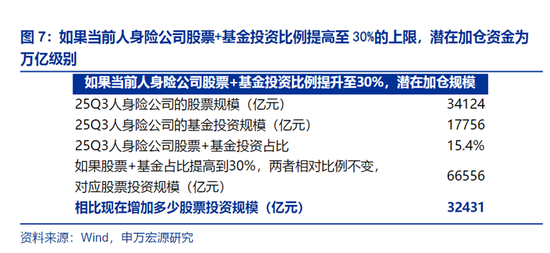
Core Viewpoint - The article emphasizes a significant shift in the investment behavior of insurance funds, which are becoming a new source of long-term capital for the A-share market, driven by regulatory changes and a declining interest rate environment [2][24]. Group 1: Changes in Insurance Fund Investment - Insurance funds are experiencing a directional adjustment, with over 1 trillion yuan added to stock investments this year [2][12]. - Recent regulatory adjustments have lowered the "invisible costs" associated with insurance funds entering the stock market, making it more attractive for them to invest [2][10]. - The adjustment in risk factors for long-term holdings in major indices indicates a clearer path for insurance funds to allocate capital [4][5]. Group 2: Impact of Regulatory Changes - The risk factor for stocks held over three years in the CSI 300 index has been reduced from 0.3 to 0.27, and for stocks in the Sci-Tech Innovation Board from 0.4 to 0.36 [4][5]. - Lower risk factors mean that insurance companies need to set aside less capital for potential losses, effectively reducing their internal cost of investment [10][11]. - This reduction in "invisible burden" is expected to increase the potential investment space for insurance funds [11][32]. Group 3: Future Investment Potential - By the end of Q3 2025, the direct stock holdings of insurance funds are projected to increase from 2.43 trillion yuan to 3.62 trillion yuan, reflecting a significant increase in investment activity [12][33]. - If the investment ratio of stocks and funds by life insurance companies increases from 15% to 30%, the potential additional investment could reach approximately 3.2 trillion yuan [39]. - Regulatory proposals suggest that from 2025, large state-owned insurance companies will allocate 30% of new premiums to A-share investments, potentially adding around 2 trillion yuan to the market by 2026 [40].
引导“长钱长投” 险企多项业务风险因子下调
Zheng Quan Shi Bao· 2025-12-05 17:26
Core Viewpoint - The Financial Regulatory Bureau has issued a notification adjusting risk factors for insurance companies' investments, aiming to encourage long-term capital and support technological innovation [1][2]. Group 1: Risk Factor Adjustments - Insurance companies holding stocks from the CSI 300 Index and the CSI Low Volatility 100 Index for over three years will see their risk factor reduced from 0.3 to 0.27 [1]. - For stocks listed on the Sci-Tech Innovation Board held for over two years, the risk factor will decrease from 0.4 to 0.36 [1]. - The notification also lowers the premium risk factor for export credit insurance and overseas investment insurance from 0.467 to 0.42, and the reserve risk factor from 0.605 to 0.545 [3]. Group 2: Impact on Insurance Industry - The adjustments are expected to alleviate capital occupation for insurance companies, enhancing solvency ratios and encouraging long-term investments in the stock market [2]. - The industry is likely to shift towards a "long-term holding" strategy, focusing on high-dividend blue-chip stocks and stocks supported by national strategies [2]. - There will be a greater emphasis on "long-term capability" in internal assessments and investment research systems, aligning with long-term performance [2]. Group 3: Industry Demand and Suggestions - In a low-interest-rate environment, there is a growing demand for equity asset allocation among insurance companies, with calls for optimized solvency policies [3]. - Suggestions include further refining risk factor classifications based on investment fields and holding periods, providing capital advantages for long-term strategic stocks [3].
险资入市再松绑 增量长期资金有望“跑步入场”
Xin Jing Bao· 2025-12-05 12:44
Core Viewpoint - The recent adjustment by the National Financial Regulatory Administration to lower risk factors for certain insurance company investments is aimed at encouraging insurance capital to enter the stock market and support strategic industries in China [1][4]. Group 1: Risk Factor Adjustments - The risk factor for insurance companies holding stocks in the CSI 300 Index and the China Securities Low Volatility 100 Index for over three years has been reduced from 0.3 to 0.27 [2][4]. - For stocks listed on the Sci-Tech Innovation Board held for over two years, the risk factor has been lowered from 0.4 to 0.36 [2][4]. - Lowering the risk factor allows insurance companies to free up capital, enhancing their investment capacity in the stock market [2][3]. Group 2: Encouragement of Long-term Investment - The adjustments encourage insurance companies to hold stocks for longer periods, which supports corporate development and aligns with national strategies [3][4]. - The focus on specific indices and stocks, such as blue-chip and technology stocks, indicates a strategic direction to bolster investments in key economic sectors [4][5]. Group 3: Increased Market Participation - As of the end of Q3 this year, insurance companies have accelerated their stock market participation, with investments in stocks and securities reaching 5.59 trillion yuan, accounting for 14.92% of their total investment [5]. - Insurance capital has been increasing its holdings in major stocks, with significant acquisitions noted in several banks and companies [5]. - The ongoing reduction in risk factors is expected to further enhance insurance capital's engagement in the stock market, driving improvements in investment efficiency and market stability [5].
金融监管总局:险企持仓超过两年的科创板普通股的风险因子下调至0.36
Bei Jing Shang Bao· 2025-12-05 12:16
Group 1 - The core point of the article is the adjustment of risk factors for insurance companies regarding their holdings of ordinary shares listed on the Sci-Tech Innovation Board, specifically a reduction from 0.4 to 0.36 for positions held over two years [1]. Group 2 - The adjustment in risk factors is based on the weighted average holding period over the past four years [1].
金融监管总局:险企持仓超三年的沪深300指数成分股的风险因子下调至0.27
Bei Jing Shang Bao· 2025-12-05 12:16
Core Viewpoint - The Financial Regulatory Administration has announced adjustments to the risk factors for insurance companies related to certain stock indices, indicating a regulatory shift aimed at managing investment risks more effectively [1] Group 1: Regulatory Changes - The risk factor for stocks held by insurance companies for more than three years in the CSI 300 Index and the CSI Dividend Low Volatility 100 Index has been reduced from 0.3 to 0.27 [1] - This adjustment is based on the weighted average holding period over the past six years [1]
监管下调险企股票投资风险因子,保险股集体“狂欢”
Huan Qiu Lao Hu Cai Jing· 2025-12-05 09:38
Group 1 - The core viewpoint of the news is that the financial sector, particularly insurance stocks, experienced a significant rally due to favorable regulatory changes [1][2] - Major insurance companies such as China Pacific Insurance and China Life Insurance saw stock increases of over 4%, with China Pacific Insurance rising nearly 7% [1] - The National Financial Regulatory Administration announced a reduction in risk factors for certain insurance company business operations, which is expected to enhance capital efficiency for these companies [2] Group 2 - The adjustments to risk factors include a decrease from 0.3 to 0.27 for stocks held over three years and from 0.4 to 0.36 for stocks held over two years on the STAR Market [2] - The risk factor for export credit insurance and overseas investment insurance was also lowered, with the premium risk factor decreasing from 0.467 to 0.42 and the reserve risk factor from 0.605 to 0.545 [2] - Analysts believe that these regulatory changes will encourage insurance funds to increase market participation and improve long-term investment management capabilities [3] Group 3 - The insurance industry is transitioning from a narrative of balance sheet recession to healthy expansion, with net assets growing from 2.7 trillion yuan at the beginning of 2024 to 3.7 trillion yuan by the end of Q3 2025 [3] - This positive trend in the insurance sector is expected to strengthen further by 2026, indicating a robust outlook for the industry [3]
A股“吹哨人”突放大利好!非银金融集体狂飙,中银证券涨停
2 1 Shi Ji Jing Ji Bao Dao· 2025-12-05 09:12
Core Viewpoint - The A-share market showed signs of recovery on December 5, with the ChiNext index rising over 1% after an initial drop of more than 0.5%. The non-bank financial sector experienced significant gains, driven by positive news regarding China Ping An and regulatory adjustments in the insurance sector [2]. Group 1: Market Performance - The A-share market rebounded, with the ChiNext index increasing by over 1% after a morning decline [2]. - The non-bank financial sector saw a collective surge in the afternoon, with notable stocks like China Ping An and China Pacific Insurance rising over 5% [2]. Group 2: Company-Specific Developments - Morgan Stanley, referred to as the "whistleblower" of the A-share market, added China Ping An to its focus list and maintained it as a top pick [2]. - Morgan Stanley raised the target price for China Ping An's A-shares from 70 yuan to 85 yuan and for its H-shares from 70 HKD to 89 HKD [2]. Group 3: Regulatory Changes - The Financial Regulatory Bureau released a notice adjusting risk factors related to insurance companies' business operations, aiming to promote high-quality development while maintaining risk control [2]. - The adjustments include changes to the risk factors for insurance companies investing in stocks and for export credit insurance, encouraging greater support for foreign trade enterprises [2].



