
AI互联网

Search documents
新一代互联网的终局:零电力成本的“能源霸权”
美股研究社· 2026-03-29 11:42
Core Insights - The article discusses the significant shift in the internet paradigm from a focus on user scale to the cost of energy and computational power, highlighting the implications for AI companies and their business models [1][2][3][4]. Group 1: Transition from Scale to Energy - OpenAI's indefinite suspension of Sora's free testing service signals a critical change in the industry, emphasizing that the cost of computation and energy consumption is now a primary concern [1]. - The traditional internet model, which relied on fixed costs and low marginal costs, is being challenged by AI products like Sora, where each user interaction incurs substantial computational costs [2][3]. - The growth in user base is no longer a profit lever but a cost amplifier, leading to increased losses for AI applications despite high revenue growth [3][4]. Group 2: Cost Structure Reconfiguration - The cost structure for AI companies has shifted from one-time capital expenditures to ongoing operational costs, similar to energy companies, which pressures profit margins [5][6]. - The phenomenon of "negative scale effects" emerges, where increased user engagement leads to higher operational costs, complicating the path to profitability for AI firms [6]. - Competitive advantages are transitioning from algorithmic capabilities to energy and infrastructure efficiency, with companies focusing on reducing the cost per token generated [6][7]. Group 3: Future of Internet Competition - The future of the internet may revolve around energy monopolies rather than user traffic, with companies that can access low-cost energy gaining a competitive edge [7][8]. - Investment trends are shifting towards energy assets and data center infrastructure, with companies like Amazon and Google securing long-term power purchase agreements to ensure energy supply [8][9]. - The geographical landscape of internet infrastructure is changing, with energy-rich regions becoming new hubs for computational power, potentially leading to a decentralization of internet architecture [9][10]. Group 4: Philosophical Implications - The article posits that the evolution of productivity is tied to energy efficiency, suggesting that the future of AI will require a balance between intelligence generation and energy consumption [10][11]. - The concept of "smart restraint" emerges, indicating that the pursuit of unlimited generation may be unrealistic, and a more calculated approach to energy use will be necessary [11].


OpenClaw 生态正在疯长,我们拆解了 PH 上 40 多款相关产品
Founder Park· 2026-03-08 06:16
Core Insights - OpenClaw has surpassed 250K stars on GitHub, becoming the most starred software project, exceeding React's 243K stars [2] - The ecosystem around OpenClaw is rapidly expanding, with over 500 products launched on Product Hunt in February alone, covering various domains such as cloud hosting, skill development, and agent social networking [3][4] - The AI internet is transitioning from being designed for humans to being designed for agents [5] Ecosystem Overview - OpenClaw's ecosystem has developed a complete industrial chain from foundational capabilities to application layers without any official planning, indicating a robust commercial ecosystem [4] - The ecosystem includes various categories, with notable products emerging in each category [6] Agent Social Ecosystem - A new layer of A2A social ecosystems is emerging, providing a social infrastructure for OpenClaw agents [7] - On February 2, three agent social products were launched, creating a strong community consensus around agent social spaces [8] - Products like moltbook, Molthunt, and Moltweet are designed for agent-exclusive interactions, allowing agents to post, vote, and engage without human intervention [9][10] Memory and Skill Packages - OpenClaw's skill plugin design allows for easy creation and distribution of skills, significantly lowering the barrier for agent capabilities [16][17] - Products like MemoryPlugin and Claw Cognition provide memory management solutions for agents, enhancing their cognitive capabilities [19][22] Communication and Collaboration - Communication tools for agents, such as ClawdTalk and MailMolt, enable agents to interact with humans and other agents effectively [25][26] - RentAHuman.ai offers a unique solution where agents can hire humans for physical tasks, reversing the typical human-to-AI command structure [30][31] Cloud Hosting and Deployment - The cloud hosting and deployment sector is experiencing the highest demand, with numerous products available for easy installation and management of OpenClaw [32][33] - KiloClaw and Clawi.ai are notable products that simplify deployment and management for users, catering to both technical and non-technical audiences [35][40] Security and Operations - The security and operations sector is currently underdeveloped, despite the increasing need for secure agent operations [46][47] - Products like IronClaw and ClawMetry are emerging to address security concerns and provide monitoring capabilities for agent activities [49][51] Hardware Integration - The popularity of OpenClaw has led to increased sales of Mac Mini devices, indicating a trend towards hardware integration with software capabilities [52] - Products like Umbrel Pro are designed to run OpenClaw in home environments, showcasing the potential for hardware-software synergy [54][57] Competitive Landscape - New competitors are emerging in the market, such as Tidy and happycapy, which offer alternative solutions to OpenClaw with varying features and deployment methods [58][60][63]

2026年春节“AI红包”派发超45亿元 “脉冲式流量”后用户黏性成关键
Xin Hua Cai Jing· 2026-02-25 03:27
Core Insights - The 2026 Spring Festival AI "ecological battle" marked a significant shift in the domestic AI industry from technical competition to a focus on consumer scenarios, with major players investing over 4.5 billion yuan during the holiday [1] - Different strategies were employed by major companies: Doubao leveraged exclusive AI collaboration with the Spring Festival Gala, Alibaba's Qianwen combined "free orders + consumption" to drive real transactions, while Tencent's Yuanbao utilized social interactions within the WeChat ecosystem to maintain user engagement [1][2] Investment and Market Dynamics - The competition is increasingly concentrated among leading platforms, creating significant barriers for smaller players, as the focus shifts from model parameters to integrating AI into daily consumption, social, and entertainment scenarios [2] - The ability to convert short-term user engagement into long-term value will be crucial for success in the AI market, with key factors including addressing real user pain points, continuous model iteration based on user data, and seamless integration into existing ecosystems [2][3] User Retention and Experience - Retaining users post-campaign will depend more on the core value and experience of AI products rather than the size of the red envelopes offered, emphasizing the importance of integrating AI assistants into real-life scenarios [3] - Historical context suggests that successful integration of payment behaviors into social interactions, as seen with WeChat red envelopes, is essential for transforming short-term traffic into lasting user engagement [3]



“烧钱”80亿发红包,四款AI轮流登顶榜首,背后公司股价却集体走低,靠“撒钱”能留住用户吗?
Xin Lang Cai Jing· 2026-02-24 12:30
Core Insights - The "AI Red Packet War" among internet companies has concluded following the Spring Festival holiday, with significant financial investments made in AI tools and related apps [1][11] - A total of over 8 billion yuan was reportedly spent by multiple internet companies during this period, raising questions about user retention beyond the monetary incentives [3][13] Investment and User Engagement - Alibaba's Qianwen invested 3 billion yuan, Tencent's Yuanbao distributed 1 billion yuan, and ByteDance's Doubao offered tech gifts during the campaign [3][13] - Yuanbao reported over 50 million daily active users (DAU) and 114 million monthly active users (MAU) during the event, with users participating in over 36 billion lottery draws and completing over 1 billion AI creations [14] - Qianwen facilitated nearly 200 million orders during the Spring Festival, with significant sales in beverage categories [14] App Performance - Four apps, Yuanbao, Qianwen, Antifortune, and Doubao, dominated the iOS free app rankings, with varying durations at the top [4][14] - Post-campaign, Yuanbao's ranking dropped significantly, indicating potential challenges in maintaining user engagement [18] Market Reaction - The capital market showed skepticism towards the "AI Red Packet War," with the Hang Seng Technology Index experiencing declines, and major companies like Alibaba and Tencent seeing their stock prices fall [6][16] User Retention Challenges - Experts suggest that user retention will depend more on the core value and experience of the products rather than the size of the red packets [8][19] - Successful AI tools must integrate into real-life scenarios and provide personalized services to maintain user interest [19][20] Future Outlook - The "AI Red Packet War" may signify a pivotal shift from mobile internet to AI internet in China, similar to how WeChat red packets transformed payment landscapes [19] - The AI assistant market is expected to evolve into a competitive landscape with differentiated offerings, where leading players leverage ecosystems and scale [20]


2026春节档:80亿AI红包大战落幕,狂欢过后何去何从?
2 1 Shi Ji Jing Ji Bao Dao· 2026-02-24 09:52
Core Insights - The AI "red envelope war" during the Spring Festival resulted in over 8 billion yuan in spending, marking a significant shift in the competition landscape of the AI industry, with major platforms leveraging their resources to dominate the market [1][3][10] - This event is seen as a pivotal moment for the transition of China's internet towards an AI-driven ecosystem, with the competition determining future business strategies and investment landscapes [3][10] Industry Dynamics - The Spring Festival has traditionally been a prime time for user acquisition, but in 2026, it transformed into a major test for AI technology, directly engaging a nationwide audience [3][4] - Major players like Tencent, Alibaba, and ByteDance invested heavily, with Tencent's "Yuanbao" achieving over 36 billion lottery draws and 11 million "lucky money" red envelopes distributed, while Alibaba's "Qianwen" facilitated 1.3 billion AI shopping experiences [4][5] - The competition highlighted a trend towards market consolidation, where larger companies with resources and technology are increasingly dominating the AI landscape, making it difficult for smaller players to compete [4][6] Competitive Strategies - ByteDance's strategy involved exclusive collaboration with the CCTV Spring Festival Gala, significantly increasing user engagement and interaction, with 1.9 billion AI interactions on New Year's Eve [5][6] - Alibaba's approach focused on integrating AI into consumer transactions, resulting in a 372-fold increase in AI ticket orders, demonstrating the potential for AI to drive real transactions [6][7] - Tencent utilized its social media ecosystem to embed AI interactions within social contexts, achieving user penetration with minimal marketing costs, reminiscent of its earlier success with mobile payments [7][8] Future Challenges - Post-festival, the real challenge lies in retaining users, as the initial surge in interactions may not translate into long-term engagement without addressing genuine user needs [8][9] - The ability to integrate AI into everyday life and solve real problems will be crucial for maintaining user interest and loyalty, as highlighted by industry experts [9][10] - The long-term success of AI platforms will depend on their capacity to create seamless user experiences and establish a strong presence in daily activities, moving beyond short-term engagement strategies [10]
焦点|狂撒红包 大厂血拼全民AI入口
Guang Zhou Ri Bao· 2026-02-13 03:18
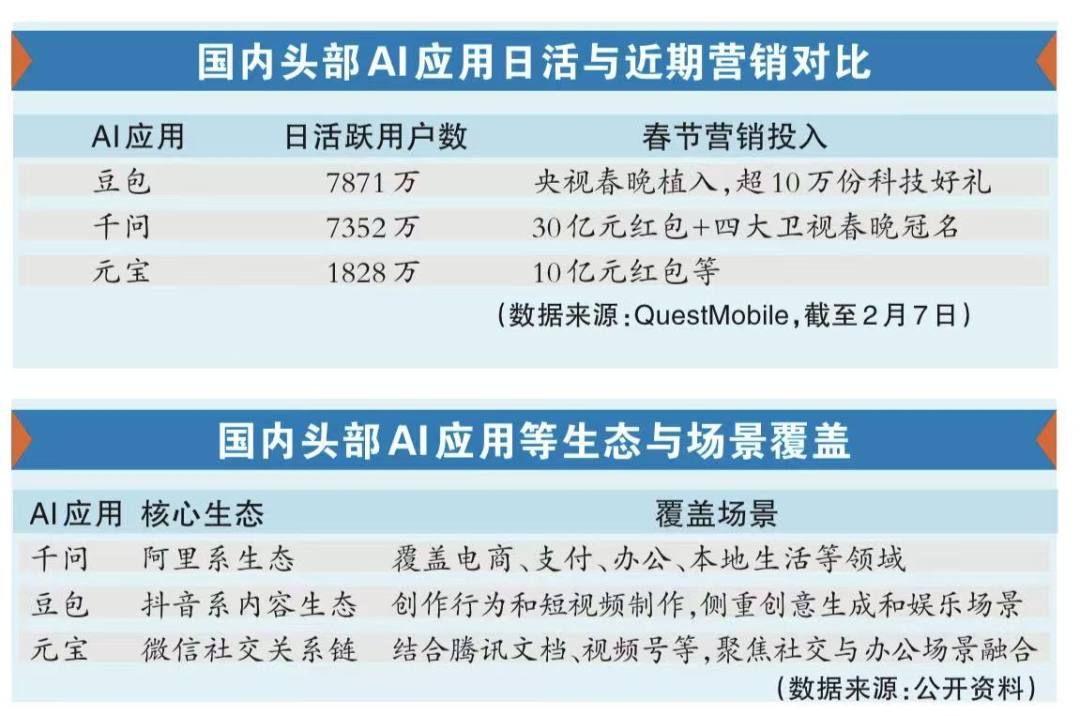
Core Insights - The Chinese internet landscape is witnessing a significant transformation as major companies like Tencent, Alibaba, and Baidu engage in an AI-driven competition for user engagement during the Spring Festival, with a total investment exceeding 45 billion yuan in AI red envelopes [1][4][15] - This competition is not merely about cash giveaways but represents a strategic positioning for the next generation of traffic super entry points, focusing on integrating AI into various consumer scenarios [1][10][15] Group 1: Company Strategies - Tencent launched a 10 billion yuan cash red envelope initiative and introduced a new AI social feature called "Yuanbao Pai," aiming to create a collaborative social space [2][3] - Alibaba's Qianwen app initiated a 30 billion yuan "treat" campaign, integrating AI into its ecosystem across multiple platforms like Taobao and Alipay, and secured naming rights for four local TV stations' Spring Festival galas [2][3] - ByteDance's Doubao maintained a low-profile strategy, focusing on its existing user base while investing in AI interactions during the CCTV Spring Festival gala [3][4] Group 2: User Engagement and Growth - The competition has led to significant increases in daily active users (DAU) for these AI applications, with Qianwen's DAU surging by 727.7% to 58.48 million on the first day of its campaign, while Yuanbao's DAU increased by 2.1 times to 23.99 million [5][7] - The overall user engagement reflects a shift from traditional promotional methods to AI-driven interactions, with companies aiming to embed AI into everyday consumer activities [9][10] Group 3: Market Trends and Future Implications - The Spring Festival serves as a critical period for AI products to penetrate the market, particularly among underrepresented demographics such as older users and those in lower-tier cities [4][15] - The competition is seen as a pivotal moment in the transition from mobile internet to AI internet, with companies vying for long-term user loyalty and establishing AI as an integral part of daily life [15][18] - The effectiveness of these AI applications will ultimately depend on their ability to provide practical solutions and integrate seamlessly into existing user ecosystems [9][15][18]
海南自贸港封关,资本的新机遇在哪?
母基金研究中心· 2026-01-03 08:45
Core Viewpoint - The second Hainan Free Trade Port Innovation Investment Development Forum emphasizes the theme "Capital to the South" and aims to explore how capital can support Hainan's high-quality development through policy and industry collaboration [1][2]. Group 1: Conditions for Attracting Long-term Capital and Key Industry Layout - Hainan is rapidly becoming a hotspot for domestic and foreign capital due to multiple advantages, including national strategic support, continuous policy benefits, and unique geographical positioning [5]. - The core conditions for attracting long-term capital include comprehensive policy support, such as zero tariffs and low tax rates, and a clear industrial strategy focused on upgrading traditional industries and developing strategic emerging industries [5][6]. - Three recommended investment areas are: 1. Upgrading traditional industries like modern agriculture and high-end tourism 2. Breakthroughs in strategic emerging industries such as marine economy and renewable energy 3. Development of green energy industries, particularly offshore wind power [6][7]. Group 2: Capital Role and Policy Interaction Pathways - The interaction between capital and policy is crucial for the successful implementation of Hainan's industrial strategies, requiring a conducive investment environment and effective policy execution [9]. - The government should focus on long-term capital investment, moving beyond short-term project thinking to establish market-oriented cooperation with capital [9][10]. - Hainan's unique policies in the biopharmaceutical sector provide a competitive edge, making it an ideal location for biopharmaceutical companies to reduce costs and accelerate product launch cycles [10]. Group 3: International Cooperation and Strategic Development - Capital should act as a bridge for international cooperation, leveraging Hainan's strategic position to connect with global resources and enhance economic and cultural exchanges [11][12]. - The establishment of specialized industrial parks within Hainan's free trade zone can facilitate resource sharing and policy alignment with international free trade zones, promoting a collaborative development model [12]. - The forum highlights the importance of high-level openness, not just in trade and finance, but also in personnel, technology, and industry, to foster a virtuous cycle of high-quality development [12].

“创智古美・侨启未来”2025 青年国际大学生创新创业大赛宣讲会顺利举办
Sou Hu Wang· 2025-10-22 02:49
Core Insights - The "Chuangzhi Gumei: Qiaoqi Future" 2025 Youth International College Student Innovation and Entrepreneurship Competition has officially entered the preparation stage, aiming to assist young entrepreneurs from Hong Kong, Macau, Taiwan, and overseas returnees in transforming their entrepreneurial ideas into actual projects [1][15]. Group 1: Event Overview - The competition is initiated by the Gumei Road Subdistrict of Minhang District in collaboration with the OCEA HUB, focusing on creating an international and professional platform for innovation and entrepreneurship [1][2]. - A successful promotional meeting was held on October 15, providing a comprehensive interpretation of the event's highlights, resource support, and participation pathways [1][15]. Group 2: Objectives and Support - The core goal of the competition is to promote deep integration of domestic and overseas youth in terms of projects, capital, technology, and talent, facilitating entrepreneurial exchanges and cultural mutual learning across regions [2][4]. - The Gumei Road Subdistrict will provide systematic training, expert guidance, and resource connections to help young students overcome challenges in resource acquisition [4]. Group 3: Insights from OCEA HUB - Dr. Chen Jidong, President of OCEA HUB, shared insights on global entrepreneurial trends and core competency requirements, emphasizing the significant changes in the global entrepreneurial ecosystem post-pandemic [5][7]. - He highlighted that projects focusing on cross-border resource integration, cultural fusion, and addressing specific community needs are emerging as new hotspots in the innovation and entrepreneurship field [7]. Group 4: Targeted Advice for Youth - Dr. Chen provided tailored advice for youth from different academic backgrounds, suggesting that STEM students focus on technology-driven projects like AI and smart hardware, while liberal arts students should explore cross-cultural creative industries and international education consulting [9][10]. - He encouraged breaking down "professional barriers" to form diverse teams, as successful entrepreneurial teams require both technical and cultural communication skills [10]. Group 5: International Resource Support - OCEA HUB will open an "international resource connection channel" for participating teams, providing essential support such as overseas market research data, cross-border supply chain resources, and collaboration channels with overseas Chinese communities [12]. Group 6: Competition Details - The competition is open to current students and recent graduates (within two years) from domestic and international universities, with a focus on supporting youth from Hong Kong, Macau, Taiwan, and overseas [16]. - It covers six potential fields: fashion industry, AI internet, modern services, social public welfare education, cultural and creative industries, and retail catering [17]. - The competition consists of four key phases, with a clear timeline for submission and evaluation [18][19]. Group 7: Awards and Support - Monetary awards include 5,000 yuan for the gold award, 3,000 yuan for the silver award, and 2,000 yuan for the bronze award, along with additional support through an entrepreneurial training camp [18]. - Winning teams will receive an exclusive entrepreneurial resource package from OCEA HUB, including free office space trials, industry resource connections, and introductions to investors [18].

港股科技反攻!港股科技ETF(513020)开盘领涨超1.5%,近10日净流入超2亿元,机构:港股具备走强预期
Mei Ri Jing Ji Xin Wen· 2025-09-12 02:02
Group 1 - The expectation of interest rate cuts by the Federal Reserve is increasing, leading to a more accommodative external environment, which supports the outlook for the Hong Kong stock market to strengthen [1] - The solid fundamentals of the constituent stocks in the Hong Kong market also support the potential for further upward movement [1] - The Hong Kong stock market has a higher proportion of growth stocks, particularly in technology and pharmaceuticals, compared to the A-share market, providing a structural advantage [1] Group 2 - The Hong Kong Technology ETF (513020) tracks the Hong Kong Stock Connect Technology Index (931573), which is compiled by China Securities Index Co., Ltd., selecting no more than 50 quality companies from the technology sector listed within the Stock Connect [1] - The index covers multiple sub-sectors including Internet, biomedicine, and new energy vehicles, aiming to reflect the overall performance of core technology enterprises in the Hong Kong market [1] - Companies in this index not only hold advantages in the domestic market but also possess strong expansion capabilities in overseas markets [1] Group 3 - Investors without stock accounts can consider the Cathay China Securities Hong Kong Stock Connect Technology ETF Initiated Link A (015739) and Link C (015740) [1]
港股科技ETF(513020)盘中上涨2%,连续5日净流入超1.4亿元,流动性改善与行业景气支撑行情
Mei Ri Jing Ji Xin Wen· 2025-09-10 06:29
Group 1 - The expectation of interest rate cuts by the Federal Reserve is increasing, leading to a more accommodative external environment, which supports the bullish outlook for the Hong Kong stock market [1] - The strong fundamentals of the constituent stocks in the Hong Kong market further bolster the potential for upward movement [1] - The Hong Kong stock market has a higher proportion of growth stocks, particularly in technology and pharmaceuticals, compared to the A-share market, providing a structural advantage [1] Group 2 - The Hong Kong Technology ETF (513020) tracks the Hong Kong Stock Connect Technology Index (931573), which is compiled by China Securities Index Co., Ltd., selecting up to 50 quality companies from the technology sector listed under the Stock Connect [1] - The index covers multiple sub-sectors including Internet, biomedicine, and new energy vehicles, aiming to reflect the overall performance of core technology enterprises in the Hong Kong market [1] - Companies in this index not only hold advantages in the domestic market but also possess strong expansion capabilities in overseas markets [1]