AI科技股

Search documents
韩国散户近月大举买入中国电力机械等HALO资产
Mei Ri Jing Ji Xin Wen· 2026-03-13 08:21
Group 1 - South Korean retail investors have significantly increased their net purchases of Chinese assets, particularly in sectors such as power equipment, engineering machinery, and chemicals, which are classified as HALO assets by Goldman Sachs [1] - The top net bought A-shares by South Korean investors include companies like SANY Heavy Industry, China Power Construction, and Guangxun Technology, while the leading Hong Kong stocks include China Energy Construction and Baidu [1] - The current trend indicates that as risk appetite rises among investors, there is a shift towards HALO assets, suggesting that AI technology stocks are perceived to be overvalued [1] Group 2 - The performance of US tech stocks has been mediocre this year, while the South Korean stock market has shown strong growth but recently experienced volatility [1] - Global capital is increasingly seeking certainty in investments, especially following geopolitical events in the Middle East, indicating that HALO assets are unlikely to be replaced by AI and some sectors are entering a price increase cycle [1]





A股剧烈分化!贵金属板块大跌超10%,电网设备板块逆势涨停潮,白酒股再度拉升
Jin Rong Jie· 2026-02-02 03:06
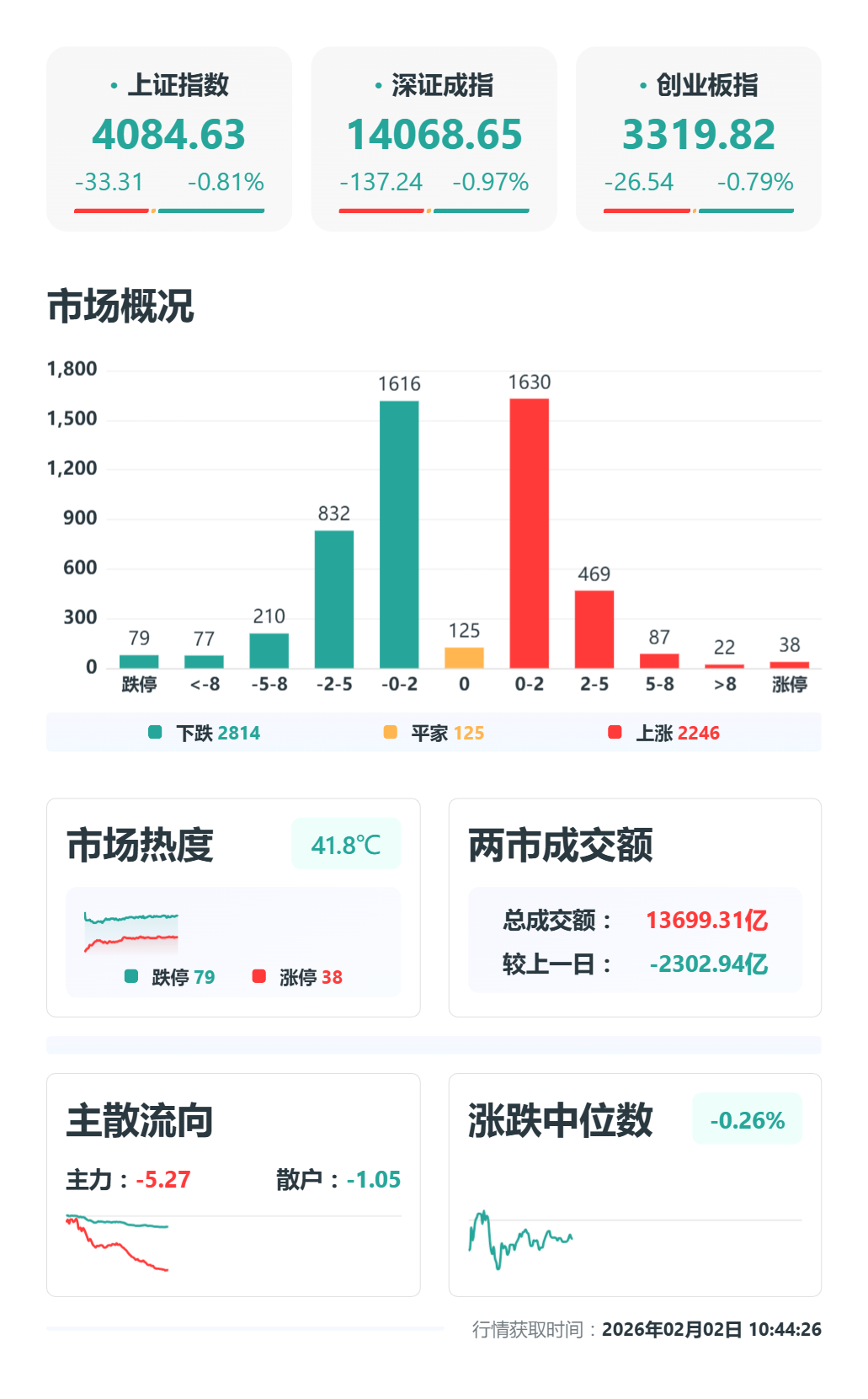
Market Overview - The market is experiencing a narrow fluctuation, with the Shanghai Composite Index down 0.81% at 4084.63 points, the Shenzhen Component Index down 0.97% at 14068.65 points, and the ChiNext Index down 0.79% at 3319.82 points. The total trading volume in both markets is 13699.31 billion yuan, a decrease of over 230 billion yuan compared to the same time the previous trading day, with more than 2800 stocks declining across the market [1]. Sector Performance - The performance of sectors shows a clear divergence, with the non-ferrous metals and oil & petrochemical sectors continuing to decline. In contrast, sectors such as high-voltage power transmission, liquor, beverages, and smart grids are performing actively. The non-ferrous metals sector has the most significant decline, with over 30 stocks hitting the daily limit down, and precious metals dropping over 10% [6][9]. - Specific stocks like Xiaocheng Technology hit the daily limit down at 15.08%, while major stocks like Shandong Gold and Jiangxi Copper also faced significant declines [6][7]. Precious Metals and Non-Ferrous Metals - The capital market is showing a linkage effect, with futures for precious and non-ferrous metals experiencing sharp declines. Silver futures dropped by 17%, gold by over 14%, and tin futures also hit the limit down. In the spot market, gold and silver initially rebounded but then fell again, with gold down over 6% and silver nearly 8% [7][8]. - Analysts from Huatai Securities suggest that the recent downturn may be triggered by the confirmation of a new Federal Reserve chairman, increased margin requirements by domestic and international futures exchanges, and concerns over the sustainability of AI tech stock revenues. They note that the crowded positions in the non-ferrous metals sector, particularly silver, have reached extreme historical levels [8]. Oil & Petrochemical Sector - The oil and petrochemical sector also saw declines, with companies like Zhongman Petroleum and Zhun Oil hitting the daily limit down. This is closely related to the significant drop in international crude oil prices due to geopolitical tensions involving Iran [9]. Telecommunications Sector - The three major telecommunications operators collectively declined over 4% in early trading. This follows an announcement from the Ministry of Finance and the State Taxation Administration regarding an increase in the VAT rate for certain telecommunications services from 6% to 9%, which will impact company revenues and profits [10]. Liquor Sector - In contrast to the declining cyclical stocks, the liquor sector saw a resurgence, with stocks like Shui Jing Fang and Huangtai Liquor hitting the daily limit up. Kweichow Moutai rose over 4%, reaching a peak of 1458.58 yuan per share. Analysts indicate that the liquor sector has adjusted for about five years and is currently at a historical low in terms of valuation and institutional positions [11][12]. Electric Power Equipment Sector - The electric power equipment sector is experiencing a surge, with stocks like Yinen Electric and Shuangjie Electric hitting the daily limit up. This is attributed to the global explosion in AI computing power infrastructure, with many transformer factories operating at full capacity [13][14].
崩了!有色金属大面积跌停,这一板块却猛涨
Zhong Guo Ji Jin Bao· 2026-02-02 02:56
Market Overview - On February 2, A-shares opened mixed with the Shanghai Composite Index down 0.93%, Shenzhen Component Index down 0.54%, and ChiNext Index up 0.65% [1] - By mid-morning, the declines in the Shanghai and Shenzhen indices narrowed while the ChiNext Index remained positive [1] Sector Performance - The non-ferrous metals and oil & petrochemical sectors continued to decline, with significant drops in gold jewelry, industrial metals, copper industry, advanced packaging, memory chips, and oil and gas extraction [3] - The non-ferrous metals sector experienced a sharp decline, with the index dropping nearly 7% and over 30 stocks hitting the daily limit down [3] - Notable stocks such as Xiaocheng Technology and Jiangxi Copper faced limit down situations [3] Specific Stock Movements - Xiaocheng Technology opened at 54.00 CNY, down 20.00% [4] - Other significant declines included Tongling Nonferrous Metals down 10.04%, Zinc Industry down 10.03%, and Hengbang Shares down 10.02% [4] - The silver sector also saw a drastic drop, with silver futures down 17% and gold futures down over 14% [7][8] Oil & Petrochemical Sector - The oil and petrochemical sector saw a collective decline, with major companies like Zhongman Petroleum and Zhun Oil Shares hitting limit down [12] - The decline was influenced by international oil prices dropping significantly due to geopolitical tensions [12] Telecommunications Sector - The three major telecom operators, China Mobile, China Telecom, and China Unicom, all fell over 4% following a tax adjustment announcement that will affect their revenue and profits starting January 1, 2026 [14][15] Alcohol Sector - The liquor sector saw a surge, with stocks like Shui Jing Fang hitting the daily limit up, and other brands like Huangtai Liquor and Jinwei Liquor also experiencing significant gains [16] - The overall sentiment in the liquor sector is improving after a prolonged adjustment period of about five years, with expectations for a recovery in the industry [21]

刚刚,崩了!大面积跌停!这一板块却猛涨
Zhong Guo Ji Jin Bao· 2026-02-02 02:44
Market Overview - The A-share market opened with mixed results on February 2, with the Shanghai Composite Index down 0.93%, Shenzhen Component Index down 0.54%, and the ChiNext Index up 0.65 [1] - The market showed slight fluctuations in the morning, with the declines in the Shanghai and Shenzhen indices narrowing while the ChiNext Index continued to rise [1] Nonferrous Metals Sector - The nonferrous metals sector experienced a significant drop, with the index falling nearly 7% and over 30 stocks hitting the daily limit down during the opening [2][3] - Major stocks such as Xiaocheng Technology (300139) and Jiangxi Copper (600362) also faced limit down situations [3] Precious Metals Futures - Domestic precious metals and nonferrous metal futures saw a sharp decline, with silver futures down 17% and gold futures down over 14% [5][6] - Spot gold and silver initially rebounded but then continued to decline, with gold dropping over 6% and silver nearly 8% [7] Oil and Petrochemical Sector - The oil and petrochemical sector also faced declines, with major stocks like Zhongman Petroleum (603619) and PetroChina (600759) hitting limit down [8][9] - The drop in international oil prices was influenced by geopolitical tensions in Iran, with recent statements from U.S. President Trump indicating a desire for negotiations [8] Telecommunications Sector - The three major telecom operators, China Mobile (600941), China Telecom (601728), and China Unicom, all saw declines of over 4% [10] - A recent announcement from the Ministry of Finance and the State Taxation Administration indicated an increase in VAT rates for telecom services starting January 1, 2026, which may impact revenue and profits [11] Liquor Sector - The liquor sector saw a rebound, with stocks like Shui Jing Fang (600779) and Huangtai Liquor (000995) hitting the daily limit up [12][13] - The liquor industry has been in a correction phase for about five years, with current valuations and institutional positions at historical lows, suggesting potential for recovery [14]







权益理财近一年平均涨22%,A股“开门红”后怎么走
2 1 Shi Ji Jing Ji Bao Dao· 2026-01-07 15:02
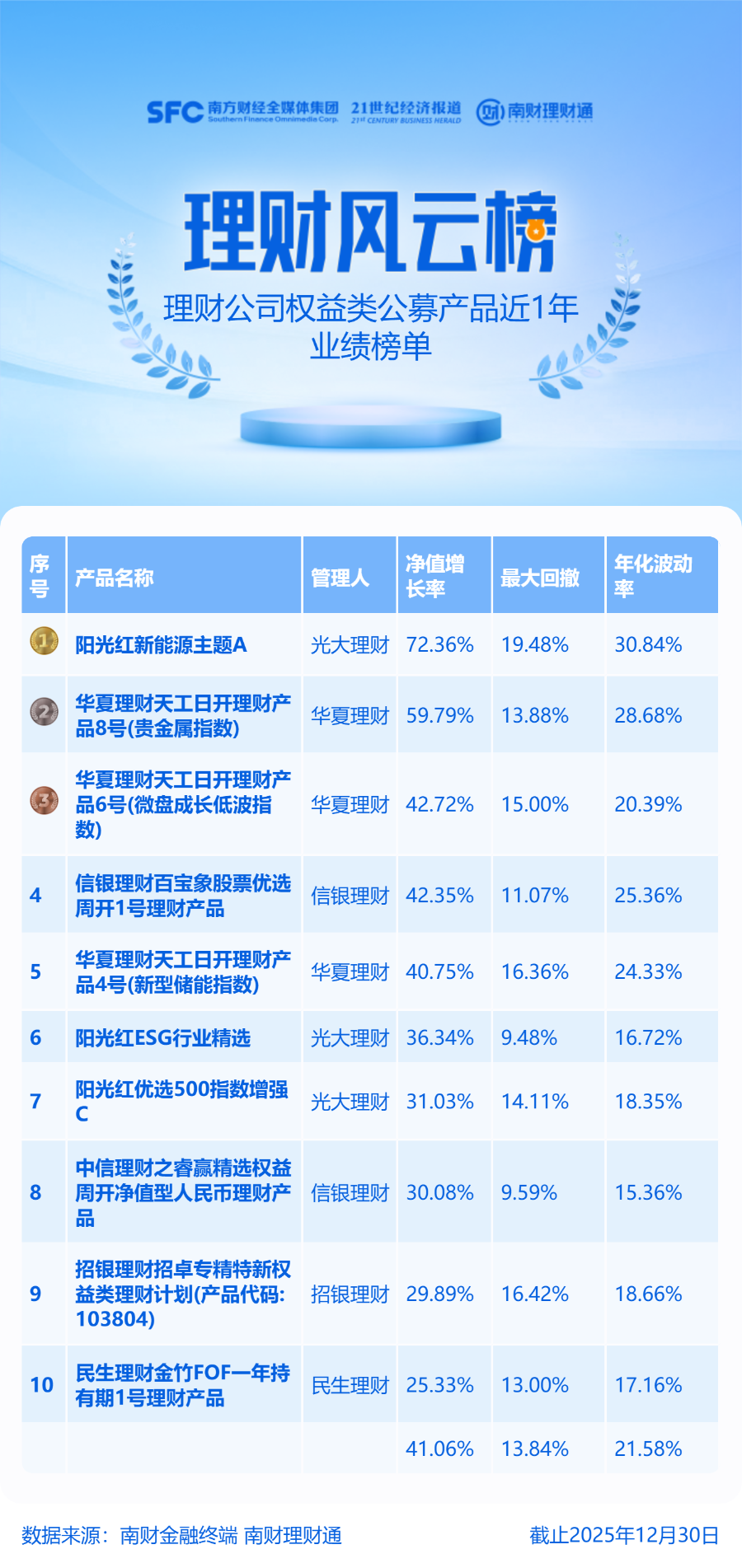
Core Viewpoint - The A-share market experienced a strong start in 2026, with the Shanghai Composite Index nearing 4100 points, marking a 10-year high. The overall market performance in 2025 showed significant growth, with the Shanghai Composite Index rising by 18.41%, the Shenzhen Component Index by 29.87%, and the ChiNext Index by nearly 50% [5]. Group 1: A-Share Market Performance - In 2025, the total market capitalization of A-shares surpassed 100 trillion yuan, with notable sector performances: non-ferrous metals, communications, and electronics saw increases of 94.7%, 84.8%, and 47.9% respectively, while food and beverage and coal sectors faced declines [5]. - The average net value growth rate of equity public wealth management products was 22.45%, with 20 out of 36 sample products exceeding a 20% growth rate [5][6]. Group 2: Top Performing Wealth Management Products - The top 10 wealth management products had an average net value growth rate of 41.06%, with industry/theme products leading the way. Notably, the "Sunshine Red New Energy Theme A" from Everbright Wealth and "Hua Xia Wealth Management Product 8" achieved growth rates of 72.36% and 59.79% respectively [6]. - Both top products exhibited high annualized volatility exceeding 28%, indicating a characteristic of high returns coupled with high risk [6]. Group 3: Future Market Outlook - Following the "opening red," the A-share market is expected to maintain an optimistic trend, with a focus on technology growth and resource cycles. Key sectors to watch include commercial aerospace, artificial intelligence, and robotics, as well as oil, petrochemicals, and non-ferrous metals [7]. - Analysts suggest that the market is poised for a spring rally, with structural opportunities in AI technology stocks and defensive allocations to benefit from the anticipated upward movement [7].
美股三大指数齐跌 多只科技股下挫
Sou Hu Cai Jing· 2025-11-19 07:51
Market Performance - The major U.S. stock indices collectively declined, with the Dow Jones down 1.07%, S&P 500 down 0.83%, and Nasdaq down 1.21% on November 18 [1] - The Dow Jones has fallen 4.48% over four consecutive trading days since reaching a new high, while the Nasdaq and S&P 500 have dropped 4.16% and 3.41% respectively during the same period [1] Technology Sector Concerns - There are growing concerns regarding AI technology stocks, despite leading companies maintaining profit growth; investors are questioning the sustainability of large capital expenditures and their future profit growth potential [1] - Major tech stocks such as Amazon and AMD fell over 4%, while Microsoft and Nvidia dropped over 2%, indicating a broader market retreat in the tech sector [1] Economic Data and Federal Reserve Outlook - The absence of key economic data has made it difficult for the Federal Reserve and the market to accurately assess economic conditions and inflation trends, leading to a significant increase in hawkish sentiments within the Fed [2] - The probability of a 25 basis point rate cut by the Federal Reserve in December has dropped from approximately 66% to below 50% [2] Gold Price Support Factors - Multiple factors, including potential Fed rate cuts, a weaker dollar, central bank demand, and risk aversion, are expected to continue supporting gold prices [2]





巨鲸抛售加剧,连续被血洗,今年前十个月的涨幅,币圈一个月跌完
Sou Hu Cai Jing· 2025-11-09 10:23
Core Viewpoint - The cryptocurrency market has experienced significant volatility, with Bitcoin's price dropping from a peak of $120,000 to around $99,000 in just over a month, leading to a substantial decrease in overall market capitalization [1][3][17] Market Performance - On October 6, Bitcoin reached a high of $120,000, contributing to a total cryptocurrency market capitalization of approximately $4.4 trillion [1] - By early November, Bitcoin fell below $100,000, with a low around $99,000, marking a decline of nearly 20% in total market capitalization over the month [3][17] - The overall gains from the beginning of the year have diminished significantly, leaving only a fraction of the initial increase [3] Investor Behavior - There has been a notable shift in investor sentiment; previously, dips in cryptocurrency prices prompted buying, but this behavior has ceased [10] - In the past week, over $700 million was withdrawn from digital asset ETFs, with nearly $600 million flowing out of BlackRock's Bitcoin fund alone [10] - The number of long-term Bitcoin holders, referred to as "whales," has decreased, raising concerns about market liquidity [15] Market Dynamics - The cryptocurrency downturn coincided with a broader sell-off in AI technology stocks, indicating a correlation between high-risk assets [6][17] - A significant number of investors faced liquidation, with over 400,000 being liquidated globally, resulting in losses exceeding $2 billion, predominantly from long positions [3][12] - Analysts suggest that the lack of new capital entering the market is exacerbating the situation, as existing investors exit without sufficient new investment to stabilize prices [12] Future Outlook - Analysts warn that if Bitcoin falls below the $100,000 mark, further declines could occur, potentially dropping to $70,000 [15] - The recent market turbulence serves as a reminder of the inherent risks associated with high-risk assets, emphasizing the importance of careful investment strategy [17][18]

今天!A股,奇迹日!
中国基金报· 2025-11-05 08:01
Core Viewpoint - The A-share market showed resilience and performed well despite a global downturn, with major indices recovering from initial losses and closing in positive territory [1][4]. Market Performance - On November 5, A-shares opened lower but rebounded, with the Shanghai Composite Index rising by 0.23%, the Shenzhen Component by 0.37%, and the ChiNext Index by 1.03% [4]. - A total of 3,380 stocks rose, with 83 hitting the daily limit up, while 1,905 stocks declined [4]. - The total trading volume reached 18,943.40 billion, with 132,682.2 million shares traded [5]. Sector Highlights - The electric power equipment sector saw a collective surge, with nearly 20 stocks, including Shuangjie Electric and Jinguang Electric, hitting the daily limit up [5]. - The Hainan sector continued to strengthen, with stocks like Haima Automobile and Haixia Shares reaching the daily limit up [6]. - The photovoltaic and energy storage sectors also experienced gains, with stocks such as Aters and Dongfang Risheng showing significant increases [8]. Declines and Risks - Quantum technology stocks faced declines, with Keda Guochuang dropping over 7% [9]. - Analysts noted that after a strong rally in tech stocks, a correction was expected, driven by concerns over valuations and market sentiment shifting from euphoria to a focus on profitability [9][11]. International Context - The Singapore Monetary Authority issued warnings about high valuations in the tech sector, particularly in AI, indicating potential for significant market corrections if optimism wanes [11]. - A recent announcement from the Chinese government regarding the suspension of additional tariffs on U.S. imports may have positively influenced market sentiment [10].



“论道·创蓝筹” 华安基金资产配置策略高端峰会解码投资新机遇
Quan Jing Wang· 2025-07-30 03:10
Core Insights - 2025 is expected to be a year of deepening high-quality economic development in China, with accelerated cultivation of new productive forces and ongoing reforms in the capital market [1] - The "Chuang Blue Chip" growth dividend and asset allocation optimization are key focuses for investors in the current market environment [1] Group 1: Capital Market and Industry Trends - The establishment of a multi-tiered capital market system in China provides a financing platform for growth-oriented innovative enterprises, particularly in five key industries: new generation information technology, high-end equipment manufacturing, new energy, new materials, and biopharmaceuticals [1][2] - The ChiNext board has seen a cumulative total of 1,366 listed companies, with a clustering effect in advantageous industries [1] - The ChiNext 50 Index has experienced a rebound, with the latest PE-TTM valuation at 32 times, which is still relatively low compared to the past decade [1][2] Group 2: Investment Strategies and Market Outlook - The narrative around the ChiNext board is shifting, with increasing weight on AI technology stocks and a balanced representation of new energy stocks [2] - Investors are expected to focus on sectors with strong trends in AI, particularly in TMT hardware, communications, electronics, and military industries due to geopolitical tensions [2] - The Chinese stock market is anticipated to experience a steady upward trend, supported by macro policy optimization and capital market reforms [2][3] Group 3: Asset Allocation and Risk Management - With a moderately loose monetary policy, institutional funds are likely to continue increasing their positions in dividend stocks, particularly in the context of declining risk-free rates [4] - Gold is highlighted as an important asset allocation tool due to its strong monetary attributes and weak industrial attributes, providing effective risk diversification [4]
申万宏源ETF实盘大赛双周达人奖榜单(2025.7.2-7.15)
申万宏源证券上海北京西路营业部· 2025-07-22 02:05
Market Review - In the first half of July, the market continued its strong momentum, with major indices breaking previous highs and expanding upward space [3] - A-share trading volume increased, indicating active market participation and improving investor sentiment [3] - The indices attempted to break through the 3150-3500 range, which is characterized by concentrated positions, leading to significant selling pressure during the breakout [3] - Despite recent volatility, moving averages remain in a bullish divergence, suggesting an ongoing upward trend [3] - Investors are advised to adapt their portfolio structure to navigate high-level fluctuations, employing a "barbell" strategy that includes high-dividend sectors and AI technology stocks benefiting from industry growth and policy support [3]