
OCR技术

Search documents
DeepSeek概念股短线拉升,OCR 2重磅发布,让AI学会“人类视觉逻辑”
Jin Rong Jie· 2026-01-27 06:18
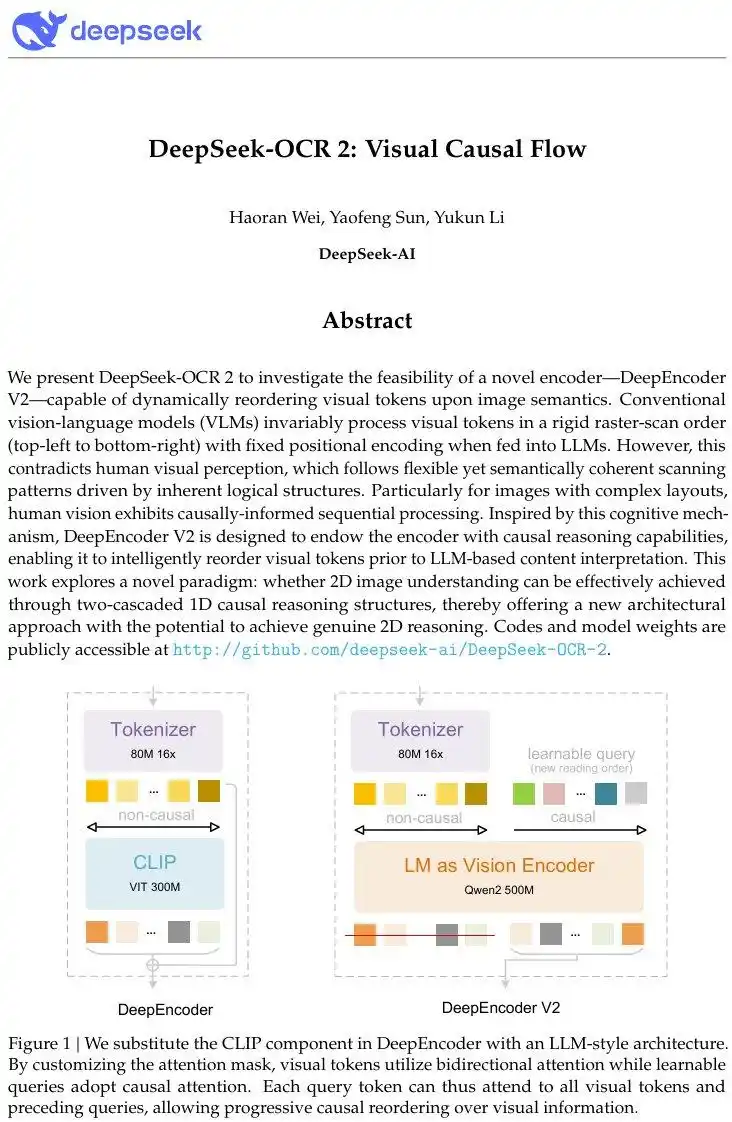
Core Insights - DeepSeek's release of the DeepSeek-OCR2 model has led to a short-term surge in related stocks, with companies like YunSai ZhiLian and Hongjing Technology hitting their upper trading limits [1] - The DeepSeek-OCR2 model utilizes the innovative DeepEncoder V2 method, allowing AI to dynamically rearrange image components based on their meanings, closely mimicking human visual encoding logic [1][6] Technology Advancements - The DeepSeek-OCR2 model breaks the limitations of traditional OCR by improving semantic understanding of images, significantly enhancing recognition accuracy in complex layouts, distortions, and occlusions [6] - In the OmniDocBench v1.5 benchmark test, the model achieved a score of 91.09%, a 3.73% improvement over its predecessor [6] - The model maintains high precision while controlling computational costs, with visual token counts limited to between 256 and 1120, aligning with Google's Gemini-3 Pro [6][7] Architectural Significance - The release of DeepSeek-OCR2 represents not just an upgrade in OCR performance but also a significant exploration of architecture, validating the potential of using language model architectures as visual encoders [7] - The model's "two cascaded 1D causal reasoning" approach may signify a breakthrough in achieving true 2D reasoning by decomposing 2D understanding into complementary sub-tasks [7] Industry Implications - The launch of the DeepSeek-OCR2 model provides a technological upgrade direction for the OCR industry, enabling companies involved in graphic information processing and digital transformation services to optimize their products and expand business opportunities in finance, healthcare, and government sectors [8] - DeepSeek's commitment to an open-source technology route and the continuous release of high-performance model products will benefit developers and enterprises focusing on secondary development and deployment services [8] - The adaptation of DeepSeek's model on edge devices is pushing AI capabilities towards the edge, creating growth opportunities for companies involved in edge hardware development and edge computing solutions [8]


三友化工:公司成立了财务共享中心
Zheng Quan Ri Bao Wang· 2026-01-26 14:13
Group 1 - The company has established a financial shared service center to enhance operational efficiency [1] - The technology utilized includes RPA (Robotic Process Automation) and OCR (Optical Character Recognition) [1] - The financial shared service center is organized by business sectors to streamline processes [1]

合合信息20260115
2026-01-16 02:53
Summary of the Conference Call for 合合信息 Company Overview - 合合信息 is a native AI application company with a clear global vision, balancing both C-end and B-end business development [doc id='5'][doc id='23'] - The company was established in 2006 and went public in Q3 2024 [doc id='3'] Industry and Market Position - The company operates in the AI and OCR (Optical Character Recognition) technology sector, with a strong focus on deep learning algorithms and natural language processing [doc id='3'] - The OCR technology of 合合信息 is significantly ahead of competitors, achieving a multilingual recognition rate of 99%, compared to competitors' 91%-95% [doc id='6'] Financial Projections - Revenue is expected to reach 22.4 billion yuan by 2026, with C-end business being the main driver, particularly through the product "扫描全能王" [doc id='2'][doc id='4] - The gross margin is projected to remain above 80%, with a profit margin around 20% [doc id='2'][doc id='4'] - The overseas revenue share is gradually increasing to about 30% [doc id='2'][doc id='4'] Product Highlights - "扫描全能王" has the highest monthly active users (MAU) globally, nearing 200 million, with a diverse user base including students, researchers, lawyers, and business professionals [doc id='8] - The product's paid user rate is expected to increase from 4% in 2023 to 5% by 2025 [doc id='8] - "启信慧眼" combines commercial data with AI technology, offering features like intelligent customer search and risk control for B-end clients [doc id='5'][doc id='21'] Growth Opportunities - Future growth is anticipated from domestic paid conversion and overseas market expansion, particularly in increasing overseas payment rates [doc id='9][doc id='10] - If overseas payment rates reach domestic levels, overall revenue could potentially increase by 3 to 4 times due to the larger overseas user base [doc id='10] Competitive Landscape - Despite the rapid development of large models, 合合信息's high-precision OCR technology remains essential for specific applications, with many large model companies using it as an API [doc id='7'] - The company has a symbiotic relationship with large model firms, indicating its strong market position [doc id='19] Strategic Insights - The company plans to enhance its overseas market penetration through a Hong Kong stock listing, which will support its strategic implementation and revenue growth [doc id='10] - The focus on improving overseas market payment conversion is a key strategic priority [doc id='9] Conclusion - 合合信息 is positioned as a noteworthy investment opportunity in the AI sector, with a balanced approach to C-end and B-end markets and significant growth potential in both domestic and international arenas [doc id='23]
合合信息(688615):智能文字识别领军,AI爆发核心受益者
Shenwan Hongyuan Securities· 2025-12-05 06:03
Investment Rating - The report initiates coverage with a "Buy" rating for the company [3][6]. Core Insights - The company is a leader in intelligent text recognition and commercial big data, benefiting from the AI boom. It has a dual-driven product strategy targeting both B2C and B2B markets, leveraging proprietary OCR and data mining technologies [5][18]. - The company has demonstrated steady revenue and profit growth, with its core business in intelligent text recognition. For 2024, the expected revenue from intelligent text recognition is 1.09 billion yuan, with a year-on-year growth of 20.5% [5][24]. - The company plans to issue H shares to enhance its global strategy, with a target market capitalization of 43.4 billion yuan based on a 69x PE ratio for 2026 [5][6]. Financial Data and Profit Forecast - The company forecasts total revenue of 1.8 billion yuan for 2025, with a year-on-year growth rate of 25.1%. The expected net profit attributable to the parent company is 495 million yuan, reflecting a growth rate of 23.7% [4][6]. - Revenue and profit projections for 2026 and 2027 are 2.25 billion yuan and 2.83 billion yuan, with corresponding net profits of 627 million yuan and 783 million yuan, maintaining growth rates of 26.5% and 25.0% respectively [4][6]. Business Model and Product Strategy - The company has established a robust product matrix, including key consumer applications like "Scan All-in-One" and "Business Card All-in-One," which have shown significant user engagement and revenue contributions [5][18]. - The B2B segment is transitioning from project-based services to standardized solutions, capitalizing on the demand for AI-driven applications [5][6]. Market Position and Competitive Advantage - The company's OCR technology is a significant barrier to entry, with 18 years of R&D experience leading to industry-leading recognition rates. The integration of AI capabilities enhances its competitive edge [5][40]. - The report argues that the emergence of large models in AI does not threaten the company's OCR technology but rather complements it, allowing for broader application scenarios [5][64]. User Engagement and Growth Potential - The "Scan All-in-One" app has reached 1.3 billion monthly active users, with a paid penetration rate of 5.28% and a VIP renewal rate of 51.62%, indicating strong user retention and growth potential [5][33]. - The company is expanding its overseas market presence, with significant opportunities for user acquisition and revenue growth in international markets [5][6].
【兴证计算机】合合信息(深度):OCR领军,恰沐AI应用春风
兴业计算机团队· 2025-12-01 12:11
Core Viewpoint - The company, Hehe Information, is a leading enterprise in text recognition, leveraging its core OCR technology to achieve stable and sustainable growth in the AI and big data industry [1][2]. Group 1: Company Overview - Hehe Information has developed into an industry leader in AI and big data, primarily driven by its intelligent text recognition technology [1]. - The company’s revenue is projected to grow from 988 million yuan in 2022 to 1.438 billion yuan in 2024, with year-on-year growth rates of 22.67%, 20.04%, and 21.21% respectively [1]. - The net profit attributable to shareholders is expected to increase from 284 million yuan in 2022 to 401 million yuan in 2024, with growth rates of 96.37%, 13.91%, and 23.93% respectively [1]. Group 2: C-end Business - The C-end business boasts a large user base with strong engagement and significant growth potential, having 181 million monthly active users and 8.5255 million paying users as of the first half of 2025 [1]. - The main revenue source from C-end products is the "Scan All-in-One" app, which holds a leading global market share, while "Business Card All-in-One" and "Qixinbao" also contribute to brand recognition and commercial big data efforts [1][2]. - The C-end segment benefits from continuous technological leadership and strategic positioning in various application scenarios, with substantial growth opportunities in overseas markets where current revenue contribution is relatively low [1]. Group 3: B-end Business - The B-end business focuses on intelligent text recognition and commercial big data, with a dual approach to drive growth [2]. - The company has developed the TextIn platform, which offers a comprehensive suite of intelligent document solutions, including general text recognition and specialized identification services [2]. - The commercial big data segment provides enterprise data APIs and databases, with a key product, Qixin Huayan, aimed at facilitating data-driven decision-making for businesses [2].

混元OCR模型核心技术揭秘:统一框架、真端到端
量子位· 2025-11-29 04:02
Core Insights - Tencent's HunyuanOCR model is a commercial-grade, open-source, lightweight OCR-specific visual language model with 1 billion parameters, combining native ViT and lightweight LLM architectures [1] - The model excels in perception capabilities (text detection and recognition, complex document parsing) and semantic abilities (information extraction, text-image translation), winning the ICDAR 2025 DIMT challenge and achieving SOTA results on OCRBench for models under 3 billion parameters [2] Model Performance and Popularity - HunyuanOCR ranks in the top four on Hugging Face's trending list, has over 700 stars on GitHub, and was integrated by the vllm official team on Day 0 [3] Team Achievements - The HunyuanOCR team has achieved three major breakthroughs: 1. Unified efficiency, supporting various tasks like text detection, complex document parsing, and visual question answering within a lightweight framework [5] 2. Simplified end-to-end architecture, eliminating dependencies on pre-processing and reducing deployment complexity [6] 3. Data-driven innovations using high-quality data and reinforcement learning to enhance OCR task performance [8] Core Technology - HunyuanOCR focuses on lightweight model structure design, high-quality pre-training data production, application-oriented pre-training strategies, and task-specific reinforcement learning [11] Lightweight Model Structure - The model employs an end-to-end training and inference paradigm, requiring only a single inference to achieve complete results, avoiding common issues of error accumulation in traditional architectures [14][19] High-Quality Data Production - The team built a large-scale multimodal training corpus with over 200 million "image-text pairs," covering nine core real-world scenarios and over 130 languages [21] Pre-Training Strategy - HunyuanOCR uses a four-stage pre-training strategy focusing on visual-language alignment and understanding, with specific stages dedicated to long document processing and application-oriented training [29][32] Reinforcement Learning Approach - The model innovatively applies reinforcement learning to enhance performance, using a hybrid strategy for structured tasks and LLM-based rewards for open-ended tasks [36] Data Quality and Reward Design - The data construction process emphasizes quality, diversity, and difficulty balance, utilizing LLM to filter low-quality data and ensuring effective training [39] - Adaptive reward designs are implemented for various tasks, ensuring precise and verifiable outputs [40][42]


只有0.9B的PaddleOCR-VL,却是现在最强的OCR模型。
数字生命卡兹克· 2025-10-23 01:33
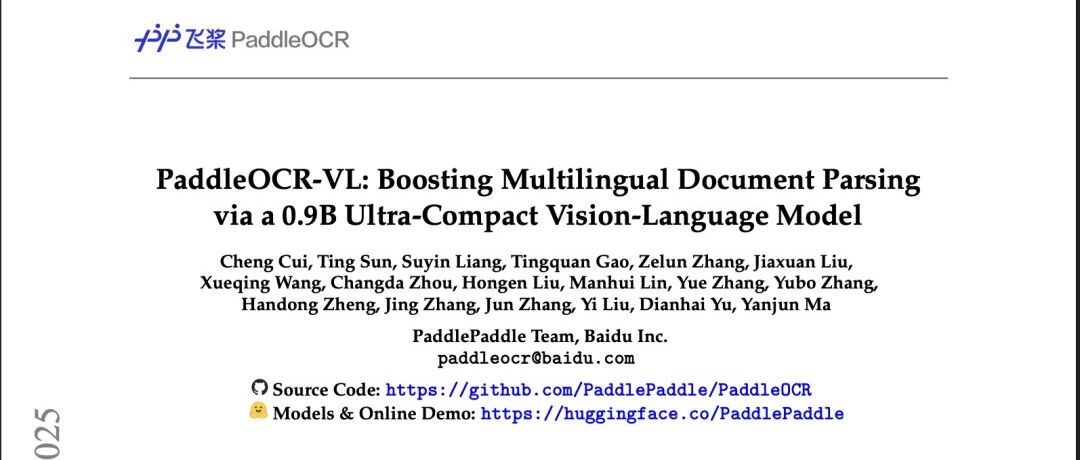
Core Viewpoint - The article highlights the significant advancements in the OCR (Optical Character Recognition) field, particularly focusing on the PaddleOCR-VL model developed by Baidu, which has achieved state-of-the-art (SOTA) performance in document parsing tasks [2][9][45]. Summary by Sections Introduction to OCR Trends - The term OCR has gained immense popularity in the AI community, especially with the emergence of DeepSeek-OCR, which has revitalized interest in the OCR sector [1][2]. Overview of PaddleOCR-VL - PaddleOCR is not a new project; it has been developed by Baidu over several years, with its origins dating back to 2020. It has evolved into the most popular open-source OCR project, currently leading in GitHub stars with 60K [6][7]. - The PaddleOCR-VL model is the latest addition to this series, marking the first time a large model has been applied to the core of OCR document parsing [9][11]. Performance Metrics - PaddleOCR-VL, with only 0.9 billion parameters, has achieved SOTA across all categories in the OmniDocBench v1.5 evaluation set, scoring 92.56 overall [11][12]. - In comparison, DeepSeek-OCR scored 86.46, indicating that PaddleOCR-VL outperforms it by approximately 6 points [14][15]. Model Architecture and Efficiency - PaddleOCR-VL employs a two-step architecture for efficiency: first, a traditional visual model (PP-DocLayoutV2) performs layout analysis, and then the PaddleOCR-VL model processes smaller, framed images for text recognition [18][20]. - This approach allows PaddleOCR-VL to achieve high accuracy without the need for a larger model, demonstrating that effective solutions can often be more about problem-solving than sheer size [16][20]. Practical Applications and Testing - PaddleOCR-VL has shown impressive results in various challenging scenarios, including processing scanned PDFs, handwritten notes, and complex layouts like academic papers and invoices [22][28][34]. - The model's ability to accurately recognize and extract information from structured documents, such as tables, has been particularly noted as a significant advantage for automating data extraction processes [39][41]. Conclusion and Future Prospects - PaddleOCR-VL is now open-source, allowing users to deploy it locally or use it through various demo platforms [44][45]. - The advancements made by both PaddleOCR-VL and DeepSeek-OCR are recognized as significant contributions to the OCR field, each excelling in their respective areas [45][46].
智谱运气是差一点点,视觉Token研究又和DeepSeek撞车了
量子位· 2025-10-22 15:27
Core Viewpoint - The article discusses the competition between Zhipu and DeepSeek in the AI field, particularly focusing on the release of Zhipu's visual token solution, Glyph, which aims to address the challenges of long context in large language models (LLMs) [1][2][6]. Group 1: Context Expansion Challenges - The demand for long context in LLMs is increasing due to various applications such as document analysis and multi-turn dialogues [8]. - Expanding context length significantly increases computational costs; for instance, increasing context from 50K to 100K tokens can quadruple the computational consumption [9][10]. - Merely adding more tokens does not guarantee improved model performance, as excessive input can lead to noise interference and information overload [12][14]. Group 2: Existing Solutions - Three mainstream solutions to the long context problem are identified: 1. **Extended Position Encoding**: This method extends the existing position encoding range to accommodate longer inputs without retraining the model [15][16]. 2. **Attention Mechanism Modification**: Techniques like sparse and linear attention aim to improve token processing efficiency, but do not reduce the total token count [20][21]. 3. **Retrieval-Augmented Generation (RAG)**: This approach uses external retrieval to shorten inputs, but may slow down overall response time [22][23]. Group 3: Glyph Framework - Glyph proposes a new paradigm by converting long texts into images, allowing for higher information density and efficient processing by visual language models (VLMs) [25][26]. - By using visual tokens, Glyph can significantly reduce the number of tokens needed; for example, it can represent the entire text of "Jane Eyre" using only 80K visual tokens compared to 240K text tokens [32][36]. - The training process for Glyph involves three stages: continual pre-training, LLM-driven rendering search, and post-training, which collectively enhance the model's ability to interpret visual information [37][44]. Group 4: Performance and Results - Glyph achieves a token compression rate of 3-4 times while maintaining accuracy comparable to mainstream models [49]. - The implementation of Glyph results in approximately four times faster prefill and decoding speeds, as well as two times faster supervised fine-tuning (SFT) training [51]. - Glyph demonstrates strong performance in multimodal tasks, indicating its robust generalization capabilities [53]. Group 5: Contributors and Future Implications - The primary author of the paper is Jiale Cheng, a PhD student at Tsinghua University, with contributions from Yusen Liu, Xinyu Zhang, and Yulin Fei [57][62]. - The article suggests that visual tokens may redefine the information processing methods of LLMs, potentially leading to pixels replacing text as the fundamental unit of AI input [76][78].

泰对外贸易厅支持企业使用 DFT SMART C/O 系统推动泰国出口
Shang Wu Bu Wang Zhan· 2025-09-18 07:49
Core Insights - The Thai Ministry of Commerce is enhancing the DFT SMART-I system by integrating artificial intelligence and OCR technology to fully digitize export and import licensing and certification services, aiming to facilitate businesses, reduce costs, and improve the competitiveness of Thai products in international markets [1] Group 1: System Features - The DFT SMART C/O system allows businesses to apply and track progress online using only their ID cards [1] - Approved documents can be self-printed, and electronic payment options are available, eliminating the need for in-person collection, which significantly saves time and costs [1] Group 2: Implementation Timeline and Scope - From December 15, 2023, to August 2025, the system has issued 12 types of certificates of origin, covering specific goods under RCEP, ASEAN agreements, and trade with Japan, Australia, Peru, and the European Union [1]