
国际金融组织

Search documents
摩尔多瓦共和国:推进审计改革的技术援助报告(英)
IMF· 2026-03-02 08:40
Investment Rating - The report indicates a positive outlook on the audit reform agenda in Moldova, suggesting a favorable investment environment due to the implementation of international best practices in auditing [12][18]. Core Insights - The audit reform agenda is progressing well, with 23 initiatives outlined in the action plan, and a color-coded system is used for quarterly monitoring of implementation status [12][22]. - Positive outcomes have been identified, including improvements in VAT refund management, lifting of hiring bans, and successful collaboration with educational institutions to attract skilled auditors [13][21]. - The report emphasizes the importance of taxpayer segmentation for effective compliance management, which impacts risk assessment, workflow, resource allocation, and performance monitoring [15][46]. Summary by Sections I. Introduction - The State Tax Service (STS) is reforming its audit program to align with international best practices, with a comprehensive action plan developed for the period from 2025 to 2029 [18]. II. Reform Progress - The action plan consists of 23 initiatives across six themes, including compliance and audit roles, legislative framework, organization and human resources, processes and procedures, performance evaluation, and reform management [20]. - As of now, 29 implementation steps have been completed, and 16 are in progress, indicating that the overall progress aligns with the deadlines set in the action plan [22]. III. Taxpayer Segmentation - Detailed discussions on taxpayer segmentation have been conducted to ensure STS has appropriate groups for effective compliance management, which is crucial for risk assessment and resource allocation [15][45]. - The report highlights the benefits of taxpayer segmentation, such as improved compliance, targeted services, and enhanced resource efficiency [46]. IV. Donor Coordination and Next Steps - Coordination with development partners is ongoing to ensure that capacity development activities are aligned and avoid duplication of efforts [59]. - The report recommends continuing the implementation of the audit plan and completing data analyses to inform decisions regarding taxpayer segmentation [60].
经济韧性超预期!世界银行上调全球增长预期至2.6%,美国经济表现强劲
Zhi Tong Cai Jing· 2026-01-14 00:19
Group 1 - The World Bank has raised its global growth forecast for 2026 to 2.6%, up from the previous estimate of 2.4% made in June [1] - The U.S. economic growth forecast for this year has been significantly increased from 1.6% to 2.2% [1] - The global growth forecast for 2025 is estimated at 2.7%, driven by three main factors: preemptive stockpiling by businesses and households before the implementation of tariffs, the actual economic suppression effect of high tariffs being weaker than expected, and sustained spending in the information and technology sectors providing structural support for growth [1] Group 2 - The World Bank's Deputy Chief Economist, Ayhan Kose, noted that global growth is trapped within a specific range, showing resilience but failing to accelerate [2] - Since 2023, actual GDP growth has fluctuated between 2.6% and 2.8%, contrasting sharply with the average growth rate of 3.2% during the decade before the pandemic (2010-2019) [2] - The World Bank's report indicates that global inflation is expected to slightly decrease to 2.6% in 2026, which is 0.3 percentage points lower than previous expectations [2] Group 3 - Brent crude oil prices are projected to decline from an average of $69 per barrel in 2025 to $60 per barrel in 2026 [3] Group 4 - In the next decade, 1.2 billion young people in emerging markets will reach working age, making job creation a pressing priority [4]
国际货币基金组织通过对加第5次审查
Shang Wu Bu Wang Zhan· 2025-12-19 15:49
Core Insights - The International Monetary Fund (IMF) Executive Board approved the fifth review of Ghana's IMF-supported program, reflecting the country's good performance under the Extended Credit Facility (ECF) [1] - The approval acknowledges the Ghanaian government's ongoing efforts to restore macroeconomic stability, strengthen public finances, and support economic recovery [1] - Completion of the fifth review paves the way for the disbursement of the sixth tranche of $380 million in assistance from the IMF [1]
全球目光再度转向中国:多家机构同步上调增速预测
Sou Hu Cai Jing· 2025-12-12 11:21
Group 1 - International institutions such as the World Bank, IMF, and ADB have raised their growth forecasts for China's economy for next year, with the World Bank increasing by 0.4 percentage points, IMF by 0.2 percentage points, and ADB by 0.1 percentage points, indicating a consensus in their updated judgment logic [1][3] - China's economic resilience has proven stronger than many anticipated at the beginning of the year, supported by sustained fiscal efforts and loose monetary policy, which have kept consumption and investment active under pressure [3] - The diversification of export markets has provided more stable support for external demand, prompting international institutions to reassess their growth expectations for the coming year [3] Group 2 - The World Bank's chief economist for China, Melissa, believes that China's long-term growth potential remains considerable, with key factors being technological innovation and productivity improvement, suggesting that the potential growth rate is not declining as rapidly as feared [3] - IMF President Georgieva emphasized the importance of domestic demand, noting that China is enhancing consumption stability through targeted policy measures such as improving the social security system and providing childcare subsidies, which will positively impact mid-term growth quality [3] - The expectation of improved certainty in the operating environment is seen as beneficial for both consumer spending and corporate investment, which will support the financial sector, small and medium enterprises, and asset allocation needs [3][4]


国际货币基金组织上海中心开业 潘功胜龚正格奥尔基耶娃致辞并揭牌
Jie Fang Ri Bao· 2025-12-09 01:41
Core Viewpoint - The opening of the International Monetary Fund (IMF) Shanghai Center signifies China's commitment to multilateralism and global governance, enhancing cooperation with the IMF and promoting macroeconomic policy exchange in the Asia-Pacific region [1][2][3] Group 1: IMF Shanghai Center Significance - The IMF Shanghai Center's operation reflects China's firm stance on cooperative win-win partnerships with the IMF, aiming to deepen collaboration and maintain global and regional financial stability [1] - The center is expected to serve as a hub for research and policy reference for emerging markets and middle-income countries, facilitating dialogue among regional members and various stakeholders [3] Group 2: Support from Chinese Authorities - The People's Bank of China (PBOC) will continue to support the development of the Shanghai Center in collaboration with the Shanghai municipal government and the IMF [1] - The Shanghai municipal government aims to enhance the competitiveness and influence of Shanghai as an international financial center, leveraging the IMF Shanghai Center to expand high-level financial openness [2]
IMF上海中心开启运营 国际经济合作“发新芽”
Shang Hai Zheng Quan Bao· 2025-12-08 18:18
Core Viewpoint - The establishment and operational launch of the IMF Shanghai Center marks a significant milestone in Shanghai's development as an international financial center, enhancing China's role in global financial governance and promoting a more inclusive and pragmatic international economic order [1][2][6]. Group 1: IMF Shanghai Center's Objectives and Significance - The IMF Shanghai Center aims to strengthen communication and cooperation between the IMF and Asia-Pacific economies, focusing on research in areas of interest to emerging markets and middle-income countries, and providing targeted capacity-building support [1][5]. - The center's operation is seen as a catalyst for elevating Shanghai's status as a key hub in the international financial network, reflecting China's increasing influence in global financial governance [2][3]. Group 2: Strategic Implications for Shanghai - The establishment of the IMF Shanghai Center is part of a broader trend of international economic organizations setting up in Shanghai, which is becoming a critical node in the global financial landscape [2][3]. - Shanghai's local government is committed to creating favorable conditions for the center's efficient operation, which is expected to enhance the city's attractiveness to international financial institutions and facilitate the gathering of global financial resources [2][4]. Group 3: Enhancing Global Financial Governance - The IMF Shanghai Center is positioned to facilitate the introduction of international regulatory standards and serve as a platform for sharing China's experiences and solutions with the global community [4][6]. - The center's establishment reflects China's determination to deepen its participation in global financial governance, transitioning from a rule-taker to a rule-maker in the international economic system [6][7].
潘功胜出席国际货币基金组织上海中心开业仪式
证券时报· 2025-12-08 12:18
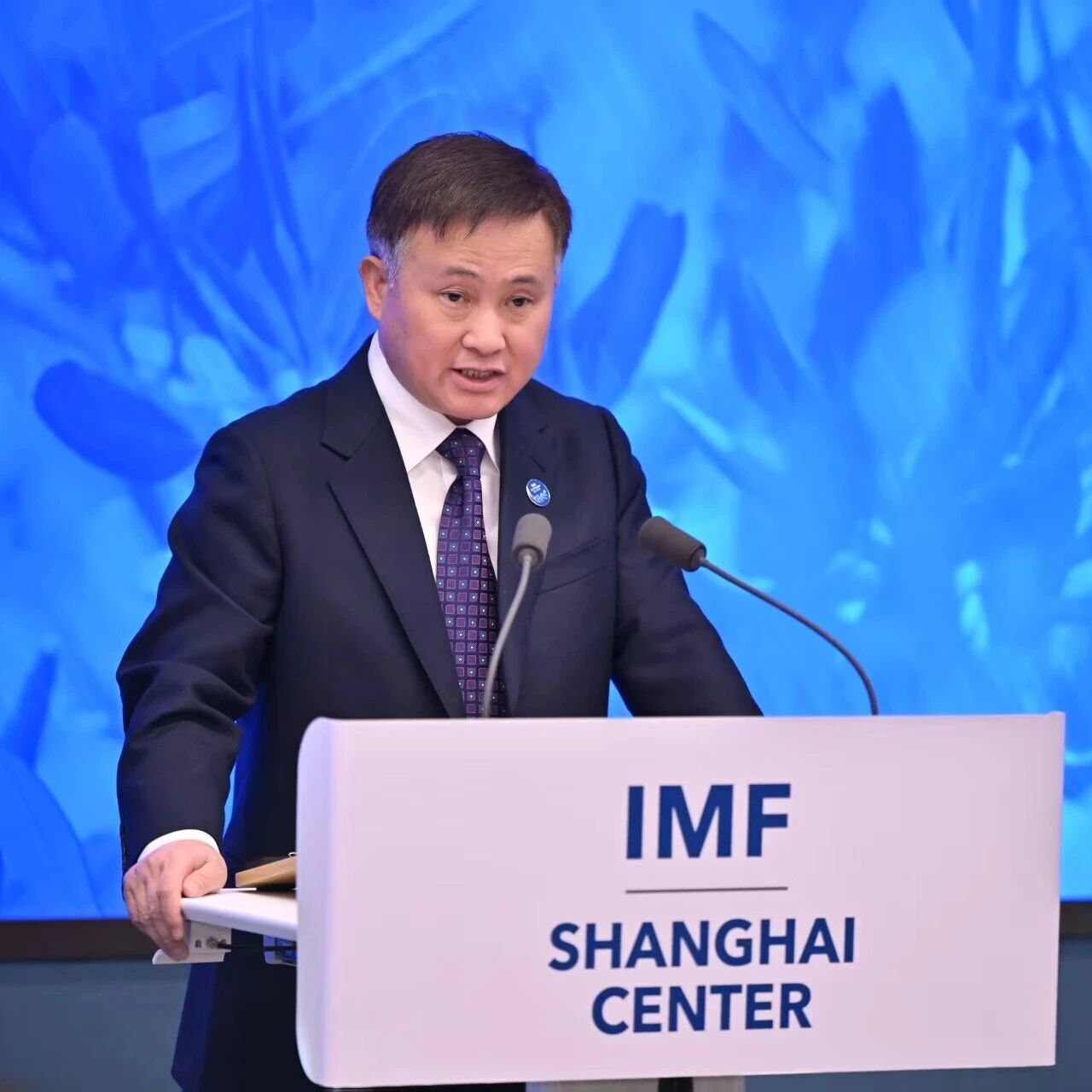
Core Viewpoint - The opening of the IMF Shanghai Center signifies a commitment to enhancing cooperation and dialogue between the IMF and Asia-Pacific economies, focusing on macroeconomic policy exchange and financial stability [1][2]. Group 1: Opening Ceremony - The IMF Shanghai Center officially opened on December 8, with key figures including IMF President Kristalina Georgieva, PBOC Governor Pan Gongsheng, and Shanghai Mayor Gong Zheng in attendance [1]. - The center aims to strengthen the IMF's engagement with emerging markets and middle-income countries, providing targeted capacity-building support [1]. Group 2: Statements from Officials - Pan Gongsheng emphasized the importance of the center in promoting a fair global governance system and enhancing cooperation between the IMF and China, as well as facilitating macroeconomic policy coordination among Asia-Pacific countries [1]. - Kristalina Georgieva congratulated the Shanghai Center, highlighting its role as a hub for policy research and dialogue among regional stakeholders [2]. - Mayor Gong Zheng expressed hopes that the center would support Shanghai's development as an international financial center through policy research and cooperation [2].
IMF上海中心正式运营
Guo Ji Jin Rong Bao· 2025-12-08 10:45
Core Viewpoint - The International Monetary Fund (IMF) officially launched its Shanghai Regional Center on December 8, marking the beginning of its operational phase, which aims to enhance cooperation with the dynamic Asia-Pacific region [1][2]. Group 1: Purpose and Functionality - The IMF Shanghai Center, located at 777 Zhongshan South Road, Huangpu District, will serve as a hub for research and knowledge sharing, providing information for policy-making in emerging markets and middle-income countries [2]. - The center aims to deepen dialogue and exchange with members, regional institutions, and other stakeholders in the region, collaborating with the China International Monetary Fund Capacity Development Center (CICDC) to maximize synergies [2]. Group 2: Leadership and Expertise - Johannes Wiegand has been appointed as the first director of the IMF Shanghai Center, bringing over 25 years of experience as an economist at the IMF, with expertise in various fields including structural transformation and growth in the Asia-Pacific region [3]. - Deputy Director Cao Li has held senior positions in the People's Bank of China and has extensive experience in policy research and practice across multiple domains, including global financial crisis response and sustainable development [3]. Group 3: Research Focus - The Shanghai Center will focus on three main areas: improving the business environment to unleash private sector potential, leveraging new technologies in the financial sector while maintaining stability, and adapting to changing global trade dynamics to ensure trade remains a growth engine [5][6]. - The center aims to identify regulatory reforms needed to enhance the business environment, emphasizing the removal of outdated regulations to facilitate the flexible movement of production factors [5]. - It will also explore how to balance innovation and financial stability in the context of new technologies, particularly artificial intelligence, which has the potential to increase economic growth by 0.8 to 1 percentage point annually [6]. - Lastly, the center will investigate necessary reforms to maintain trade as a growth driver amidst evolving global trade patterns, including regional integration efforts that could potentially increase GDP by 8% in the long term [6].
国际货币基金组织(IMF)上海中心启动运营
Zhong Guo Jing Ying Bao· 2025-12-08 10:41
Core Viewpoint - The International Monetary Fund (IMF) has officially launched the Shanghai Center, which will enhance cooperation with the dynamic Asia-Pacific region and serve as a hub for research and knowledge sharing [1] Group 1 - The Shanghai Center aims to provide policy-making references for emerging markets and middle-income countries [1] - The center is designed to deepen dialogue and outreach between the IMF and member countries, regional institutions, and other stakeholders in the region [1]
IMF上海中心正式启动运营
Zheng Quan Shi Bao Wang· 2025-12-08 02:44
Core Viewpoint - The International Monetary Fund (IMF) has officially launched its regional center in Shanghai, with Johannes Wiegand appointed as the director, aiming to enhance cooperation and communication between the IMF and the Asia-Pacific region [1] Group 1: Establishment of the Shanghai Center - The Shanghai center is one of the regional centers established by the IMF globally, announced during the Lujiazui Forum in June last year [1] - The center aims to strengthen communication and collaboration between the IMF and economies in the Asia-Pacific region, focusing on emerging markets and middle-income countries [1] Group 2: Objectives and Functions - The Shanghai center will conduct research on areas of interest for emerging markets and middle-income countries, providing targeted capacity-building support [1] - It is expected to enhance macroeconomic policy communication and coordination among countries in the Asia-Pacific region, contributing to global and regional financial stability [1] Group 3: Leadership and Expertise - Johannes Wiegand, the newly appointed director, is recognized for his extensive knowledge of IMF-related matters and his broad network in global policy research and academia [1] - The center is anticipated to play a significant role in fostering dialogue and outreach with member countries, regional institutions, and other stakeholders in the region [1]