
不动产投资信托

Search documents
2000亿元!这一品种成为机构重要配置方向
Sou Hu Cai Jing· 2025-06-05 16:11
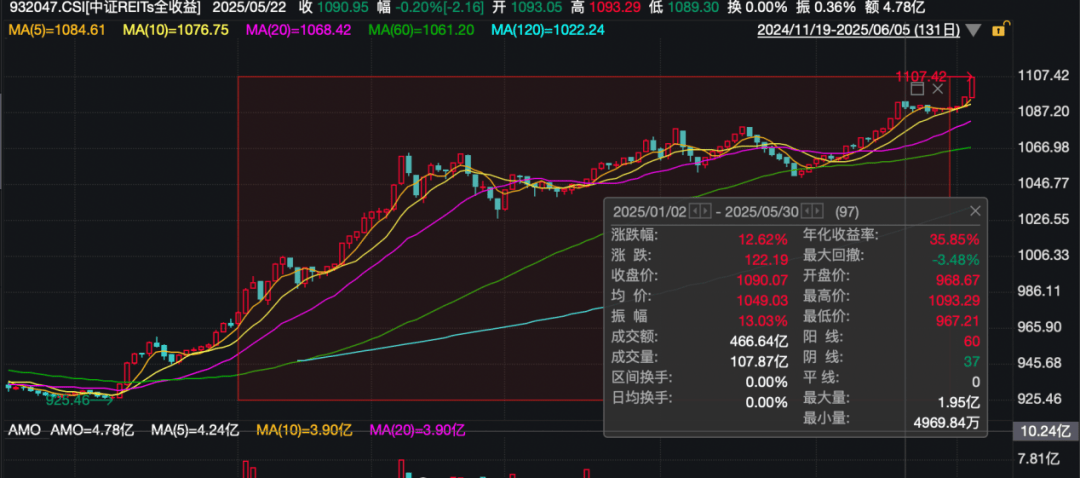
Core Insights - REITs are rapidly becoming an important asset allocation tool in the "fixed income +" era, with the total market capitalization surpassing 200 billion yuan as of June 5, 2023 [1] - The market has seen a significant increase in the number of REITs, with 66 products launched and a total fundraising amount of approximately 179.46 billion yuan [3] - The market is transitioning from a policy-driven phase to a market-driven phase, with strong demand for stable cash flow assets like consumer and affordable housing REITs [7] Market Performance - As of June 5, the CSI REITs Total Return Index has increased by 12.62% year-to-date, indicating a strong upward trend [5] - 29 REIT products have recorded a year-to-date increase of over 20%, with several products exceeding 40% [2][6] Fundraising and Growth - The REITs market has completed 66 initial public offerings, raising a total of 174.39 billion yuan, with an additional 4 products raising 5.06 billion yuan through expansions [3] - The REITs market is experiencing a continuous expansion trend, supported by various policies promoting regular issuance and expansion [12] Institutional Investment - Institutional investors hold over 60% of public REITs, indicating a strong interest in the dual characteristics of REITs as both equity and fixed income investments [11][12] - The stable cash flow and mandatory dividend mechanisms of public REITs are expected to attract more risk-averse capital [13] Performance of Individual REITs - 39 out of 51 REITs reported growth in both revenue and net profit for the 2024 fiscal year, with total dividends amounting to 8.39 billion yuan [9] - New asset types such as consumer and water conservancy projects have shown robust performance, while rental housing and logistics projects maintain high occupancy rates [10]

REITs行业周报:试点持有型不动产ABS扩募,消费REITs表现持续优异
KAIYUAN SECURITIES· 2025-05-25 10:23
REITs 业 研 试点持有型不动产 ABS 扩募,消费 REITs 表现持续 优异 2025 年 05 月 25 日 投资评级:看好(维持) 行业走势图 数据来源:聚源 -19% -10% 0% 10% 19% 2024-05 2024-09 2025-01 沪深300 中证REITs全收益 相关研究报告 《地方政策积极支持公募 REITs 产 品发行,消费 REITs 表现持续优异 —行业周报》-2025.5.18 duzhiyuan@kysec.cn 证书编号:S0790124070064 试点持有型不动产 ABS 扩募,消费 REITs 表现持续优异 2025 年第 21 周,中证 REITs(收盘)指数为 869.19,同比上涨 9.27%,环比上 涨 1.19%;中证 REITs 全收益指数 1089.72,同比上涨 16.22%,环比上涨 1.2%。 本周 REITs 市场交易规模成交量达 6.87 亿份,同比增长 44.33%;成交额达 31.21 亿元,同比增长 57.95%;区间换手率 3.58%,同比下降 6.77%。本周保障房、环 保、高速公路、产业园区、仓储物流、能源、消费类 REI ...
行业周报:试点持有型不动产ABS扩募,消费REITs表现持续优异-20250525
KAIYUAN SECURITIES· 2025-05-25 10:06
Investment Rating - The industry investment rating is "Positive" (maintained) [2][5] Core Viewpoints - The market for REITs is expected to continue to perform well due to supportive policies and the anticipated entry of social security and pension funds, enhancing the cost-effectiveness of allocations in this sector [5][6] - The market trading volume for REITs reached 687 million shares, a year-on-year increase of 44.33%, with a transaction value of 3.121 billion yuan, up 57.95% year-on-year [5][28] - The China Securities REITs (closing) index rose to 869.19, a year-on-year increase of 9.27% and a quarter-on-quarter increase of 1.19% [5][16] Summary by Sections 1. REITs Role and Expansion - The National Development and Reform Commission emphasizes the need for a diversified funding mechanism for urban renewal projects, highlighting the role of REITs in infrastructure investment [6][14] 2. Market Review - The China Securities REITs (closing) index increased by 1.19% quarter-on-quarter, with a cumulative increase of 14.91% since the beginning of 2024, outperforming the CSI 300 index by 1.76% [16][21] - The China Securities REITs total return index rose by 1.2% quarter-on-quarter, with a cumulative increase of 26.45% since the beginning of 2024, significantly outperforming the CSI 300 index by 13.3% [21][26] 3. Weekly Performance - Weekly performance for various REIT sectors showed mixed results, with consumer REITs increasing by 1.04% and a monthly increase of 7.58% [39][56] - The weekly and monthly performance for other sectors included: affordable housing (+0.83% weekly, +6.32% monthly), environmental (-0.05% weekly, -0.03% monthly), and logistics (+1.58% weekly, +5.81% monthly) [39][56] 4. Active Market for New REITs - There are currently 14 REIT funds awaiting listing, indicating a vibrant issuance market [8][39] 5. Investment Recommendations - The report maintains a "Positive" rating for the industry, suggesting favorable conditions for investment in REITs [5][39]
亚洲不动产投资信托基金(REITs)研究报告2025
Cushman & Wakefield· 2025-05-19 10:35
Investment Rating - The report does not explicitly state an investment rating for the Asian REITs market in 2024 Core Insights - The 2024 Asian REITs market has seen significant developments, particularly in the mainland China infrastructure public REITs sector, which has entered a phase of normalized issuance, surpassing Hong Kong in market capitalization for the first time [3][5] - The total market capitalization of active REITs in Asia is $235.8 billion, reflecting a year-on-year decline of 6.5% as of December 31, 2024 [4][12] - Emerging markets such as mainland China, Thailand, and India are showing robust growth, while traditional markets like Japan, Singapore, and Hong Kong are experiencing a contraction in market value [12][22] Summary by Sections Overview of the Asian REITs Market - As of December 31, 2024, there are 263 active REITs in Asia, with a total market capitalization of $235.8 billion, down 6.5% from the previous year [4][8] - The mainland China REITs market has grown significantly, now ranking among the top three markets in Asia, alongside Japan and Singapore [8][22] Mainland China Infrastructure Public REITs Market - The mainland China infrastructure public REITs market has achieved historic highs in issuance speed and scale, with 64 products listed and a total market capitalization of 186 billion yuan [5] - The report emphasizes the diversification of underlying assets, including consumer infrastructure and logistics, as a key trend in the market [5] Overseas Hotel REITs Case Analysis - The report highlights successful cases from mature markets, particularly in hotel REITs, and discusses their relevance to the development of China's public REITs market [3] ESG Practices in the REITs Market - ESG considerations are identified as crucial for the long-term health of the REITs market, with a need for further development in ESG certification and rating practices in China [5]
亚洲不动产投资信托基金(REITs)研究报告-戴德梁行
Sou Hu Cai Jing· 2025-05-17 01:17
一、亚洲REITs市场整体概况 截至2024年12月31日,亚洲活跃REITs产品达263支,总市值2358亿美元,同比下降6.5%,市场呈现结构性分化。日本、新加坡、中国内地及中国香港市值 合计占比超80%,其中中国内地市值214.4亿美元,首次超越中国香港,成为亚洲第三大市场。新兴市场如泰国、印度等因经济基本面良好,市值分别增长 41%和13%,为市场注入活力。 从物业类型看,综合型REITs数量最多(90支),工业/物流、办公、零售类紧随其后。数据中心和酒店类REITs表现亮眼,前者受益于人工智能发展,后者 因旅游业复苏估值提升。 市场规模:市值673.8亿美元,占比28.6%,活跃REITs 39支,市值下降11%。 (一)日本 市场规模:市值908.4亿美元,占比38.5%,活跃REITs 57支,受汇率和股价影响市值下降17%。 财务指标:平均杠杆率45.2%,分派收益率5.4%(亚洲主要市场中涨幅最大),市净率0.81。酒店REITs表现突出,如Japan Hotel REIT入住率和收入双增 长,分派收益率超5%。 (二)新加坡 财务指标:平均杠杆率39.3%,分派收益率6.9%,市净率0.7 ...

REITs行业周报:将REITs纳入沪深港通标的,保障房REITs表现持续优异
KAIYUAN SECURITIES· 2025-05-11 14:23
Investment Rating - The industry investment rating is "Positive" (maintained) [1] Core Viewpoints - The REITs market is expected to continue to provide good investment opportunities due to the downward pressure on bond market interest rates and the expectation of increased allocations from social security and pension funds [3][5] - The market performance of various REITs sectors shows a mixed trend, with housing REITs performing particularly well [5][37] Market Overview - As of the 19th week of 2025, the CSI REITs closing index was 848.41, up 5.59% year-on-year and up 0.28% month-on-month; the CSI REITs total return index was 1062.05, up 11.94% year-on-year and up 0.39% month-on-month [3][19] - Year-to-date, the CSI REITs closing index has increased by 12.16%, slightly outperforming the CSI 300 index, which has increased by 12.1% [14] - The trading volume in the REITs market reached 418 million shares, a year-on-year decrease of 12.37%, with a total transaction value of 1.773 billion yuan, down 8.56% year-on-year [26][29] Sector Performance - Weekly and monthly performance of various REITs sectors includes: - Housing REITs: +2.35% weekly, +2.68% monthly - Environmental REITs: -0.11% weekly, -2.76% monthly - Highway REITs: -0.39% weekly, -4.44% monthly - Industrial park REITs: +0.46% weekly, +4.28% monthly - Warehousing and logistics REITs: +1.57% weekly, -1.34% monthly - Energy REITs: +0.23% weekly, +3.96% monthly - Consumer REITs: +0.84% weekly [5][37] Upcoming Developments - There are currently 14 REITs funds awaiting listing, indicating a sustained active issuance market [6][12]
公募REITs扩容进行时,民企如何跨过收益门槛
2 1 Shi Ji Jing Ji Bao Dao· 2025-04-29 12:34
Core Viewpoint - The performance of public REITs in the first quarter remains robust despite a volatile market environment, with significant support from policies and increasing interest from private capital [1][4][5]. Group 1: Performance Overview - A total of 62 public REITs have disclosed their operating data, achieving a combined revenue of 4.779 billion yuan and a net profit of 840 million yuan in the first quarter [1]. - 15 products reported revenues exceeding 100 million yuan, and 29 products had net profits over 10 million yuan, indicating a stable income for investors [1]. - Consumer REITs showed impressive growth, with revenues for specific products like Huaxia Huayun Commercial REIT increasing by 82.28% year-on-year [2]. Group 2: Market Expansion and Support - The number of public REITs is expected to continue expanding, with 7 new REITs listed this year, bringing the total to 65 [4]. - Local governments, such as Guangdong, are actively promoting the cultivation and application of infrastructure REITs, supporting more private capital projects [1][5]. - Non-state-owned enterprises are also showing interest in public REITs, with companies like CapitaLand submitting applications for consumer infrastructure REITs [5]. Group 3: Challenges for Private Enterprises - Private enterprises face challenges in participating in the REITs market, including the need for higher yield rates and market acceptance [6]. - The requirements for asset clarity and stable cash flow are high, with a need for a compound annual growth rate of net operating income (NOI) of at least 5% over three years [6][7]. - To successfully issue REITs, private enterprises must improve asset compliance, operational quality, and governance structures [7].
广东REITs为民间资本搭建新赛道!未来扩募“关卡”引关注
Mei Ri Jing Ji Xin Wen· 2025-04-25 11:12
Core Viewpoint - The Guangdong Provincial Government has released a notification aimed at deepening the reform of the investment and financing system, focusing on clarifying government investment responsibilities, stimulating social capital investment, and expanding diversified financing channels for projects [1][2]. Group 1: Support for Private Capital in Major Projects - The notification emphasizes the need to enhance the cultivation and application of infrastructure Real Estate Investment Trusts (REITs), supporting more eligible private capital projects to issue infrastructure REITs [2][4]. - Currently, there are 66 publicly listed REITs on the Shanghai and Shenzhen stock exchanges, primarily focused on infrastructure projects such as parks, transportation, and affordable rental housing, with many assets located in cities like Guangzhou and Shenzhen [2][3]. Group 2: Future Focus Areas - Future efforts will concentrate on sectors such as railways, highways, ports, airports, water conservancy, nuclear power, thermal power, charging stations, energy storage, advanced manufacturing, and modern facility agriculture, aiming to attract private capital for project construction [3]. Group 3: REITs Expansion and Financing - REITs are recognized as innovative financing tools, with the potential for future expansion to serve as a refinancing channel for invested assets. Some public REITs have already completed expansions, indicating a growing interest in this area [4]. - From the initial public offering of REITs to the present, four public REITs have undergone expansion, including CICC ProLogis REIT and Bosera Shekou Industrial Park REIT [4]. Group 4: Challenges and Considerations - The issuance of REITs requires credit ratings, and attracting institutional investors necessitates high credit and returns, making it challenging for private capital projects to meet these criteria [5]. - The unique expansion mechanism of REITs may impact the equity structure of original rights holders, raising questions about whether private capital can accept such changes [5].
REITs研究笔记系列:C-REITs发行说明书
Tianfeng Securities· 2025-04-22 10:14
Group 1 - The development of C-REITs has progressed through three phases: exploration and cultivation (2004-2019), pilot phase (2020-2024 H1), and normalization phase (2024 H2 onwards) [1][9] - The C-REITs market has seen a total of 65 listed REITs with a total market value of 190.9 billion as of April 21, 2025, with the top three asset types being transportation infrastructure (32%), park infrastructure (16%), and consumer infrastructure (16%) [9][14] - The regulatory framework for C-REITs has evolved to include a multi-department collaboration model, with the National Development and Reform Commission (NDRC) overseeing project compliance, the China Securities Regulatory Commission (CSRC) managing product registration, and exchanges ensuring listing and information disclosure [2][20] Group 2 - The issuance process for C-REITs consists of four main stages: preparation, application and review, registration and issuance, and listing management, with a focus on improving efficiency and ensuring investor protection [3][19] - The normalization phase aims to shift from "scale expansion" to "quality improvement," optimizing the market ecosystem and promoting a multi-tiered REITs market system [4][22] - The NDRC has expanded the asset scope for C-REITs to include 12 categories, enhancing the flexibility of fund usage while prohibiting the use of recovered funds for residential development projects [4][24]