
乘用车

Search documents
智能驾驶元年或开启!Robotaxi商业化进程加速,智能驾驶ETF(516520)开年首周强势吸金3.75亿元
Xin Lang Cai Jing· 2026-01-12 06:01
Group 1 - The year 2026 is widely regarded as the "year of commercialization for autonomous driving," driven by the implementation of L3-level autonomous driving regulations, a significant drop in hardware costs, and the empowerment of AI large models [1][5] - The smart driving ETF (516520) has attracted 375 million yuan in the first week of 2026, reaching a new high in fund size and shares at 1.067 billion yuan and 778 million shares, respectively [1][5] - Tesla's Robotaxi has recently launched operations without safety drivers, representing a significant advancement in L4/L5 level autonomous driving technology for shared mobility services [5][6] Group 2 - The smart driving ETF (516520) closely tracks the CSI Smart Car Theme Index, which includes companies providing terminal perception and platform applications for smart vehicles, reflecting the overall performance of the smart automotive industry [2][6] - The top five secondary industries represented in the index are automotive parts (24.0%), semiconductors (19.6%), passenger vehicles (14.4%), software development (11.3%), and communication equipment (7.1%), covering multiple segments of the smart automotive supply chain [2][6] - Huatai-PB Fund, the manager of the smart driving ETF, is one of the first ETF managers in China and has launched the Huatai-PB CSI 300 ETF (510300), which has a market size of 437.4 billion yuan and is highly active in the market [2][6] Group 3 - On January 11, Huatai-PB Fund announced a cash dividend for the Huatai-PB CSI 300 ETF (510300), distributing 1.23 yuan per 10 fund shares, with a total dividend amount close to 11 billion yuan, potentially setting a new record for single cash dividends in domestic ETFs [3][7]
海马汽车涨2.10%,成交额6.87亿元,主力资金净流出887.59万元
Xin Lang Cai Jing· 2026-01-12 05:25
Core Viewpoint - Haima Automobile's stock has shown fluctuations with a recent increase of 2.10%, but the overall performance this year reflects a decline of 4.66% [1] Group 1: Stock Performance - As of January 12, Haima Automobile's stock price reached 7.78 CNY per share, with a trading volume of 6.87 billion CNY and a turnover rate of 5.49%, resulting in a total market capitalization of 12.795 billion CNY [1] - Year-to-date, the stock has decreased by 4.66%, with a slight increase of 0.65% over the last five trading days, a decline of 18.36% over the last 20 days, and an increase of 8.96% over the last 60 days [1] Group 2: Financial Performance - For the period ending September 30, 2025, Haima Automobile reported a revenue of 1.254 billion CNY, reflecting a year-on-year growth of 19.84%, while the net profit attributable to shareholders was -74.4371 million CNY, a decrease of 232.68% compared to the previous period [2] - The company has distributed a total of 153 million CNY in dividends since its A-share listing, with no dividends paid in the last three years [3] Group 3: Shareholder Information - As of December 31, the number of shareholders for Haima Automobile was 237,900, a decrease of 3.18% from the previous period, with an average of 6,903 circulating shares per person, which is an increase of 3.29% [2] - The third-largest circulating shareholder is Hong Kong Central Clearing Limited, holding 25.3185 million shares, an increase of 9.4238 million shares from the previous period [3]

2026年第5期:晨会纪要-20260112
Guohai Securities· 2026-01-12 02:23
Group 1: Geely Automobile - Geely Automobile achieved a total sales volume of 3.025 million vehicles in 2025, a year-on-year increase of 39%, exceeding its annual target [3] - The sales target for 2026 is set at 3.45 million vehicles, with brand-specific targets of 2.75 million for Geely (including Galaxy), 300,000 for Zeekr, and 400,000 for Lynk & Co [3] - The Galaxy brand significantly contributed to growth, with December 2025 sales exceeding 100,000 units, a 45% year-on-year increase, and total annual wholesale of 1.236 million units, up 149.9% [3][4] - Geely's export volume remained stable at 420,000 vehicles in 2025, with entry into 13 new markets and local production advancements in Egypt and Indonesia [5] Group 2: OSL Group - OSL Group completed the strategic acquisition of Banxa Holdings, enhancing its compliance and global payment capabilities [7] - Banxa serves as a bridge between traditional finance and digital assets, focusing on B2B payment solutions and compliance systems [8] - The acquisition is expected to significantly increase OSL's payment business revenue, with Banxa's revenue for the first half of 2025 projected at 53.93 million HKD [9] Group 3: Royal Technology - Royal Technology announced an employee stock ownership plan (ESOP) involving 48 core employees, representing 6.41% of the workforce, aimed at enhancing employee engagement and retention [13][15] - The ESOP includes performance targets for 2026, requiring a minimum of 12% growth in sales or net profit compared to 2025 [14][16] - The company is a leading producer of specialty surfactants, with a focus on customized products to meet diverse customer needs [17][18] Group 4: Huijia Times - Huijia Times reported a revenue of 1.868 billion CNY in the first three quarters of 2025, a 1.2% year-on-year increase, with a net profit of 80 million CNY, up 60.1% [20] - The company is implementing a self-reform strategy inspired by the "Pang Donglai" model, which has significantly boosted sales [21] - The company is also exploring low-altitude economy opportunities, integrating technology, logistics, and tourism for long-term growth [21] Group 5: Industry Trends - The photovoltaic industry is experiencing price increases, with polysilicon prices rising by approximately 10% week-on-week [33] - The wind power sector is seeing a surge in project approvals, with significant increases in both offshore and onshore wind projects expected in 2026 [34][35] - The energy storage market is expanding, with nearly 60 GWh of storage systems and equipment contracts awarded in December 2025 [36]




汽车行业周报:吉利集团2025年总销量首次突破400万辆,智元机器人登顶全球人形机器人出货量榜首-20260111
KAIYUAN SECURITIES· 2026-01-11 13:47
Investment Rating - The investment rating for the automotive industry is "Positive" (maintained) [1] Core Insights - The automotive sector is experiencing significant growth, with notable performances from companies like Xpeng and Geely, which have reported substantial year-on-year increases in deliveries and sales [5][14] - The market is witnessing a shift towards electric vehicles (EVs), with a strong emphasis on autonomous driving technology and AI integration [13][14] - The overall automotive market in China is projected to continue its upward trajectory, with increasing penetration of new energy vehicles [19] Industry News - Xpeng delivered over 420,000 vehicles in 2025, marking a 126% year-on-year increase, and is focusing on full autonomous driving and physical AI production in 2026 [5][13] - Geely's total sales surpassed 4 million vehicles for the first time in 2025, achieving a 26% increase, with a 56% penetration rate for new energy vehicles [5][14] - GAC Group's sales fell by 14.06% in 2025, with GAC Toyota being the only brand to show growth [5][15] - Xiaomi's SU7 model became a bestseller in the 200,000+ yuan category, with over 360,000 units delivered [5][16] - Tesla's Shanghai Gigafactory produced its 5 millionth electric drive system, highlighting its significant role in global EV production [5][18] Market Performance - The automotive sector's performance in the A-share market showed a 2.73% increase, ranking 20th among primary industries [6][28] - The passenger vehicle index rose by 0.71%, while the commercial vehicle index increased by 3.14% [6] - The automotive parts index saw a 3.87% rise, with specific segments like electric control systems and bearings showing notable gains [6][38] Investment Recommendations - For passenger vehicles, there is a strong demand for high-end domestic luxury cars, with recommendations for companies like JAC Motors and Seres, while Geely is identified as a beneficiary [7] - In the automotive parts sector, profitability is expected to improve, with recommendations for companies such as Desay SV and Zhejiang Xiantong, and beneficiaries including Weichai Power and Fuyao Glass [7]

崔东树:2025年全国乘用车累计零售2378万辆 同比增长4%
智通财经网· 2026-01-10 23:21
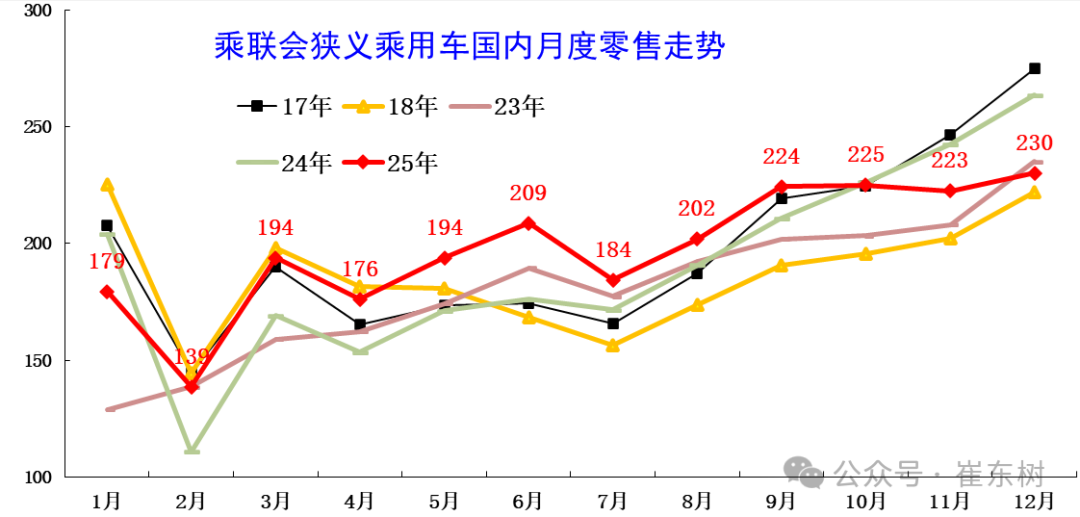
Core Insights - The retail sales of passenger cars in December 2025 reached 2.3 million units, representing a year-on-year decline of 13% but a month-on-month increase of 3% [1][7] - Cumulative retail sales for the year 2025 amounted to 23.78 million units, showing a year-on-year growth of 4% [1][7] - The wholesale growth rate for passenger cars in 2025 is projected at 9%, with a 25% growth rate for new energy vehicles, aligning with the growth expectations set for the "14th Five-Year Plan" [1] Retail Market Analysis - In December, the retail sales of fuel vehicles decreased by 30% year-on-year, while pure electric vehicle sales grew by 3% and range-extended vehicles increased by 19% [2] - The penetration rate of new energy vehicles in December reached 59%, indicating a significant shift towards a "new energy-dominated" market phase [2] - The cumulative export of self-owned fuel passenger vehicles in 2025 was 2.87 million units, down 7%, while self-owned new energy vehicle exports surged by 139% to 2.04 million units [2] Wholesale Market Trends - In December, the wholesale volume of passenger cars was 2.79 million units, down 9% year-on-year and 7% month-on-month, marking a rare decline for December [10][12] - The cumulative wholesale volume for the year reached 29.55 million units, reflecting a 9% year-on-year increase [12] - The production of passenger cars in December was 2.79 million units, a decrease of 5% year-on-year and 10% month-on-month [14] Production Insights - The production of passenger cars in December was 2.79 million units, which is 140,000 units lower than the historical peak of 2.93 million units in December 2024 [13][14] - The overall production for the year 2025 reached 29.61 million units, with a cumulative year-on-year growth of 10% [14] Export Performance - In December, the export of passenger cars (including complete vehicles and CKD) was 590,000 units, representing a year-on-year increase of 46% but a month-on-month decline of 2% [16] - The cumulative export for the year reached 5.74 million units, showing a 20% year-on-year growth [16] Inventory Dynamics - In December, the overall inventory of passenger cars decreased by 60,000 units, with a total inventory growth of 150,000 units for the year [19] - The inventory reduction in December was a result of proactive measures by manufacturers, contrasting with the previous year's inventory decline driven by retail demand [19] Promotional Strategies - The promotional intensity for new energy vehicles in December reached 10.1%, reflecting a stable promotional environment [22] - Traditional fuel vehicles maintained a promotional level of 24.3%, while luxury vehicles saw promotions rise to 29.1% [26][30] - The promotional pressure for conventional fuel and hybrid vehicles remained low, while new energy vehicle promotions were more aggressive [32]

周观点 | 商业航天开启万亿蓝海市场 关注汽车相关标的【国联民生汽车 崔琰团队】
汽车琰究· 2026-01-10 14:42
Market Performance - The automotive sector in A-shares rose by 2.7% from January 5 to January 11, outperforming the Shanghai and Shenzhen 300 index, which increased by 0.2% [3] - Sub-sectors such as automotive services, auto parts, motorcycles and others, commercial vehicles, and passenger cars saw increases of 5.3%, 3.8%, 2.4%, 1.4%, and 0.6% respectively, while commercial passenger vehicles decreased by 0.3% [3] Investment Recommendations - Recommended core stocks include Geely Automobile, Xpeng Motors, BYD, Berteli, Top Group, New Spring Co., Hu Guang Co., and Chunfeng Power [4] - For passenger vehicles, Geely, Xpeng, and BYD are recommended, with Jianghuai Automobile suggested for attention [7] - In the auto parts sector, recommendations include Berteli and Horizon Robotics for intelligent driving, and Jifeng Co. for intelligent cockpits [7] - For the motorcycle segment, Chunfeng Power and Longxin General are recommended as leading companies in the large-displacement motorcycle market [8] - In the tire industry, Sailer Tire and Senqilin are recommended [9] - For commercial vehicles, Weichai Power and China National Heavy Duty Truck are recommended for heavy trucks, while Yutong Bus is suggested for passenger vehicles [10] Robotics Sector - The Chinese robotics exhibition at CES 2026 showcased over 30 companies, indicating a strong presence in the humanoid robotics sector [5] - The focus is on Tesla's production progress and technological iterations, with domestic robot manufacturers like Yushu Technology expected to enter the IPO phase soon, serving as catalysts for the sector [5] - Recommended stocks in the robotics sector include Top Group, Berteli, Yinlun Co., and Junsheng Electronics, among others [7][35] Commercial Aerospace - The commercial aerospace sector is viewed as a core strategic area with significant long-term growth potential, currently transitioning from technology validation to large-scale commercial application [6] - The industry is supported by strong policy backing and increasing demand from national satellite internet projects, which may drive private rocket launch frequency and success rates [6] - Companies like Haoneng Co., Longsheng Technology, and Xusheng Group are highlighted as key players in this sector [6][12] Policy Impact on Automotive Sector - The new national subsidy policy for 2026 aims to stimulate demand by providing vehicle replacement subsidies based on vehicle price, with electric vehicles receiving 12% of the price (up to 20,000 yuan) and fuel vehicles 10% (up to 15,000 yuan) [22][23] - The transition from fixed subsidies to percentage-based subsidies is expected to improve the structure of subsidized vehicles and activate demand for mid-to-high-end models [28][29] - The overall automotive market is anticipated to benefit from these policies, with a focus on intelligent and globalized growth among quality domestic brands [30][31]

2025年乘用车零售2374.4万辆,新能源占比约54%
Bei Ke Cai Jing· 2026-01-09 15:05
Group 1 - The core viewpoint of the article indicates that the retail sales of passenger vehicles in China are projected to reach 23.744 million units in 2025, representing a year-on-year growth of 3.8% [1] - Among these, the retail sales of new energy passenger vehicles are expected to total 12.809 million units in 2025, showing a year-on-year increase of 17.6%, which accounts for 53.9% of the total passenger vehicle retail sales [1] - The market trend for passenger vehicles in 2025 is described as a "U-shaped" pattern, with a low start, a high middle, and a low end, driven by sufficient demand for vehicle replacement from 2024 to 2025 [1] Group 2 - In 2026, the policy encouraging subsidies for commercial vehicle updates will remain unchanged, while the scrapping and updating of passenger vehicles is expected to decrease by 20% based on the 2025 structure, with the maximum decrease for trade-ins estimated at 30% [1] - The growth effect for commercial vehicles in 2026 is anticipated to be better than that for passenger vehicles, with the overall vehicle market sales in 2026 expected to remain flat compared to the domestic retail volume in 2025 [1]
每日投行/机构观点梳理(2026-01-09)
Jin Shi Shu Ju· 2026-01-09 09:05
Group 1 - Fitch expects the Federal Reserve to cut interest rates twice in the first half of 2026, with the unemployment rate stabilizing at 4.6% [1] - Goldman Sachs reports that investor sentiment towards oil is at its most pessimistic level in nearly a decade, with over 59% of surveyed institutional investors bearish on the oil market [2] - Goldman Sachs forecasts a robust global economic growth of 2.8% in 2026, surpassing the market expectation of 2.6%, driven by a strong performance in the US and China [3] Group 2 - Guggenheim indicates that the market has largely absorbed geopolitical risks but remains cautious about headline risks that could impact stock market resilience [4] - UOB raises its gold price forecast due to increased demand for safe-haven assets amid rising geopolitical risks, projecting gold prices to reach $5,000 per ounce by Q4 2026 [5] - CICC anticipates a short-term supply gap in the wood chip market in 2026, leading to a potential increase in pulp prices as demand improves [6] Group 3 - Tianfeng Securities is optimistic about A-share gaming companies entering a strong product cycle in 2026, driven by improved competition and stable regulatory environments [7] - CITIC Securities expects an expansion in the issuance of local government bonds in 2026, with a focus on matching issuance pace with market conditions [8] - CITIC Securities predicts that the Hang Seng Index will undergo adjustments, with 38 stocks expected to enter the Hong Kong Stock Connect [9] Group 4 - CITIC Securities highlights the potential for increased domestic tourism revenue in 2026, estimating an annual increment of 500 to 1,650 billion yuan due to new policies promoting worker consumption [10] - CITIC Jian Investment identifies a bottoming opportunity in the liquor sector, suggesting that the current adjustment phase may soon reverse as market expectations improve [11] - Huatai Securities sees a recovery in the innovative drug sector in Hong Kong, driven by liquidity restoration and multiple catalysts expected in the upcoming year [12]
乘用车板块1月9日涨0.09%,北汽蓝谷领涨,主力资金净流出1.95亿元
Zheng Xing Xing Ye Ri Bao· 2026-01-09 08:54
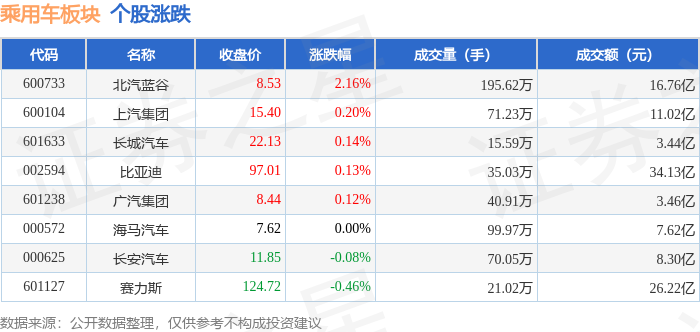
Group 1 - The passenger car sector increased by 0.09% on January 9, with Beiqi Blue Valley leading the gains [1] - The Shanghai Composite Index closed at 4120.43, up 0.92%, while the Shenzhen Component Index closed at 14120.15, up 1.15% [1] - Beiqi Blue Valley's stock price rose by 2.16% to 8.53, with a trading volume of 1.9562 million shares and a transaction value of 1.676 billion yuan [1] Group 2 - The net outflow of main funds in the passenger car sector was 195 million yuan, while retail investors saw a net inflow of 341 million yuan [1] - Beiqi Blue Valley had a net inflow of 26 million yuan from main funds, while retail investors contributed 14.16 million yuan [2] - BYD experienced a net outflow of 21.18 million yuan from retail investors, despite a net inflow of 96.28 million yuan from main funds [2]





2025年乘用车零售量为2374.4万辆
Bei Jing Shang Bao· 2026-01-09 08:37
北京商报讯(记者 刘晓梦)1月9日,中国汽车流通协会乘用车市场信息联席分会发布的数据显示, 2025年累计零售2374.4万辆,同比增长3.8%。其中,12月全国乘用车市场零售226.1万辆,同比下降 14%,环比增长1.6%。 ...