工业机器人

Search documents
以错位竞争谋协同共赢
Zhong Guo Jing Ying Bao· 2026-01-30 18:35
Core Viewpoint - China's industrial development is characterized by "innovation, elevation, and greening," focusing on differentiated development to overcome homogenization challenges and achieve high-quality growth through collaborative efforts [1][2][4]. Group 1: Innovation-Driven Development - The emphasis on differentiated industrial development is guided by local resource endowments and industrial foundations, leading to a focus on cutting-edge sectors such as artificial intelligence and quantum technology in eastern regions [1][2]. - New industries and products are rapidly emerging, with companies like Chengdu Kanopu advancing in industrial robotics, and the new energy vehicle sector maintaining its position as the world's largest for 11 consecutive years [2][3]. - The integration of innovation chains, industrial chains, and talent chains is crucial for industrial upgrades, with R&D investment intensity surpassing the OECD average for the first time [2][3]. Group 2: Collaborative Efforts in Industrial Upgrades - Regional collaboration enhances industrial development, with the Beijing-Tianjin-Hebei area and the Yangtze River Delta effectively linking industrial chains, fostering a collaborative ecosystem [3][4]. - Digital technologies, such as 5G and industrial internet platforms, facilitate rapid transformation and application of innovative results across regions, contributing to overall industrial advancement [3][4]. Group 3: Sustainable Development and Green Transformation - The "dual carbon" goals position green initiatives as a core component of industrial competitiveness, integrating ecological considerations into industrial strategies [3][4]. - Collaborative efforts in green transformation are evident, with advancements in flexible hydrogen production and digitalized microgrid operations, promoting large-scale adoption of energy-efficient technologies [4]. - The focus on green energy resources from western regions supports high-end manufacturing in the east, establishing green as a prominent identifier of China's industrial development [4].
首超20万亿美元!我国去年GDP超140万亿人民币,增长率5%利好多多
Sou Hu Cai Jing· 2026-01-30 08:08
Economic Overview - In 2025, China's economy demonstrated resilience and growth amidst global economic challenges, achieving a GDP of 140 trillion RMB (over 20 trillion USD) [3][11] - The economic growth rate of 5% is significant given the complex international environment, showcasing China's strong resilience and potential [5][10] Structural Changes - A notable shift in the economic drivers is observed, moving away from real estate and infrastructure towards high-tech manufacturing [7][8] - High-tech manufacturing saw a value-added growth of 9.4%, outpacing overall industrial growth by 3.5 percentage points, indicating a transition to technology-driven and smart manufacturing [8] Digital Economy - The information transmission, software services, and leasing business services sectors are thriving, contributing to economic vitality and changing the economic structure [10] - The digital economy, including short videos, food delivery apps, and mobile games, is becoming a new engine for growth, reflecting China's adaptation to modern economic trends [10] Income and Employment - In 2025, the per capita disposable income reached 43,377 RMB, with a real growth of 5.0%, indicating equitable distribution of economic gains [10] - The urban unemployment rate averaged 5.2%, with new job creation comparable to the labor force of a medium-sized city, highlighting employment stability [10] Trade and Global Positioning - China's total import and export volume reached 45.4687 trillion RMB, growing by 3.8%, solidifying its role as a key hub in global trade [11] - The share of private enterprises in imports and exports increased to 57.3%, showcasing the vibrancy and resilience of the Chinese economy [12] Future Outlook - The achievement of 140 trillion RMB is seen as a new starting point, indicating China's ability to withstand external risks and pursue transformation [12] - The future economic growth is expected to be driven by new energy, artificial intelligence, a unified national market, and the evolving consumption demands of 1.4 billion people [12]


经济“成绩单”出齐,这个东北大省跑慢了
Mei Ri Jing Ji Xin Wen· 2026-01-29 23:52
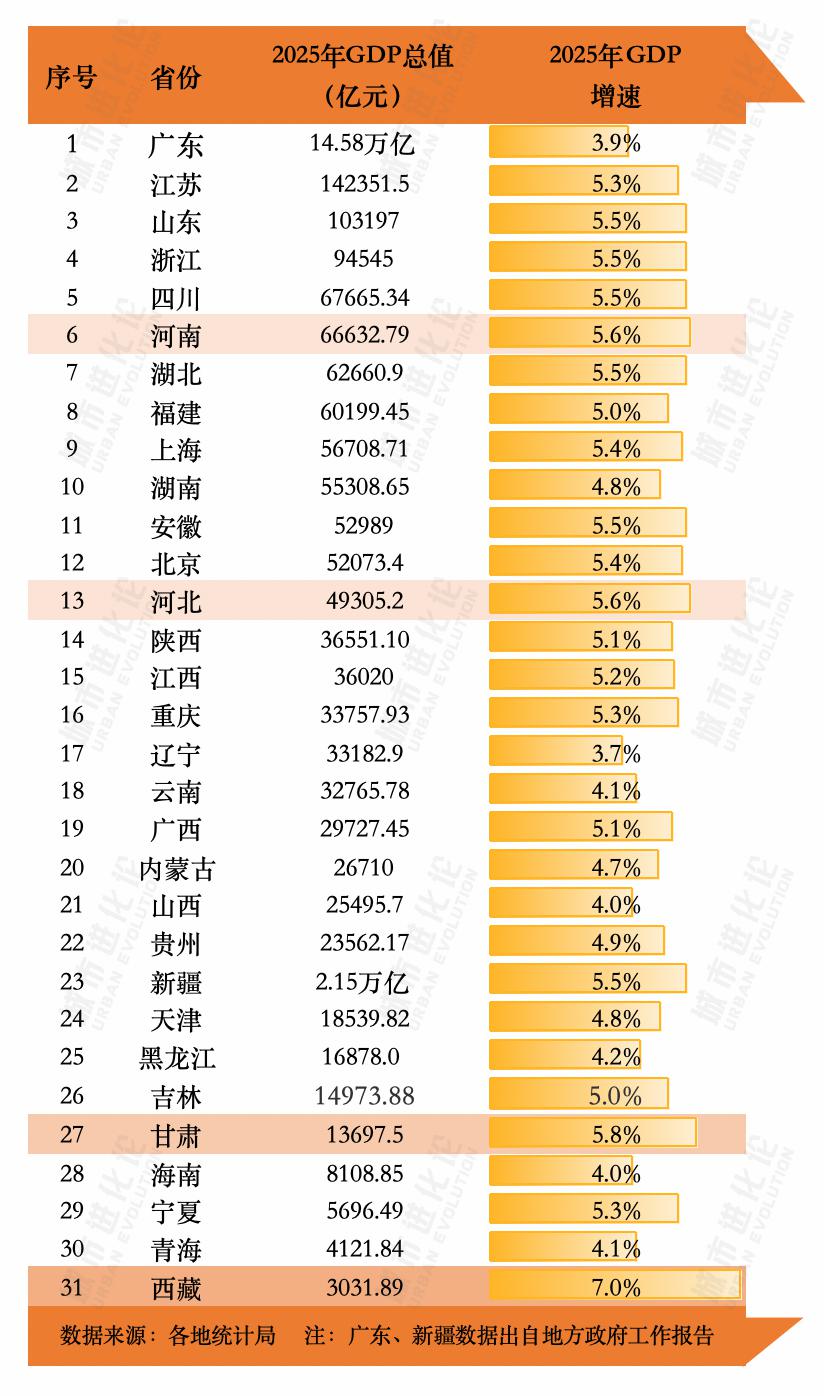
随着江苏公布2025年经济数据,全国31个省份2025年经济"成绩单"全部出炉。在GDP总量方面,广东、江苏、山东跻 身"10万亿俱乐部",浙江、四川、河南、湖北、福建、上海、湖南紧随其后,排在全国第四名至第十名,生产总值均 超5万亿元。 | | 省份 | 2025年GDP总值 | 2025年GDP | | --- | --- | --- | --- | | | | (亿元) | 増速 | | 16 | 广东 | 14.58万亿 | 3.9% | | 2 5 | 江苏 | 142351.5 | 5.3% | | 3 | 山东 | 103197 | 5.5% | | 4 | 浙江 | 94545 | 5.5% | | 5 | 四川 | 67665.34 | 5.5% | | 6 | 河南 | 66632.79 | 5.6% | | 7 | 湖北 | 62660.9 | 5.5% | | 8 | 福建 | 60199.45 | 5.0% | | 9 | 上海 | 56708.71 | 5.4% | | 10 | 湖南 | 55308.65 | 4.8% | | 11 | 安徽 | 52989 | 5.5% | | ...
一揽子政策加码支持民间投资和居民消费 财政金融协同促内需
Jing Ji Ri Bao· 2026-01-29 23:22
Core Viewpoint - The recent series of policies issued by the Ministry of Finance and other departments aims to promote domestic demand through financial and fiscal collaboration, focusing on stimulating private investment and enhancing consumer spending, which will provide tangible benefits to businesses and individuals [1][2]. Group 1: Stimulating Private Investment - The new policies significantly enhance support for private investment, utilizing tools such as loan interest subsidies and guarantee compensation to lower financing costs and barriers for private enterprises [2]. - A new loan interest subsidy for small and micro enterprises will provide a 1.5% annual subsidy on the principal for up to two years, with a maximum loan amount of 50 million yuan per entity, covering 14 key industries including new energy vehicles and medical equipment [2]. - The newly established special guarantee plan for private investment aims to provide guarantees for loans to small and micro private enterprises, with a total planned amount of 500 billion yuan over two years, supporting various production and operational activities [2][3]. Group 2: Enhancing Consumer Spending - The policies also focus on boosting consumer spending, which is crucial for improving livelihoods and sustaining economic growth, with updates to personal consumption loan interest subsidies and service industry loan interest subsidies [4]. - The updated personal consumption loan interest subsidy allows for a maximum subsidy of 3,000 yuan per transaction, significantly increasing the potential support for large purchases and enhancing consumer purchasing power [5]. - The service industry loan interest subsidy has been optimized, increasing the maximum loan amount from 1 million yuan to 10 million yuan, with a 1% interest subsidy for one year, benefiting a wider range of consumption sectors [5]. Group 3: Implementation and Effectiveness - The comprehensive policies aim to enhance support for private investment and consumer spending, aligning fiscal policy with bank credit activities to release policy dividends more effectively [6]. - The Ministry of Finance emphasizes the need for efficient implementation, simplifying processes to ensure that benefits are accessible without cumbersome applications, and ensuring that fiscal expenditures are adequately budgeted for 2026 [6].
财政金融协同促内需
Sou Hu Cai Jing· 2026-01-29 23:16
Core Viewpoint - The recent series of policies issued by the Ministry of Finance and other departments aims to promote domestic demand through financial and fiscal collaboration, focusing on stimulating private investment and enhancing consumer spending [1] Group 1: Stimulating Private Investment - The new policies significantly enhance support for private investment, utilizing tools like loan interest subsidies and guarantee compensation to lower financing costs and barriers for private enterprises [2] - A new loan interest subsidy for small and micro enterprises will provide a 1.5% annual subsidy on loan principal for up to two years, with a maximum loan amount of 50 million yuan per entity [2] - The newly established special guarantee plan for private investment aims to provide guarantees for loans to small and micro private enterprises, with a total planned amount of 500 billion yuan over two years [2][3] - The policies also expand the scope of support to include medium-sized enterprises, increasing the single credit limit to 20 million yuan [2] Group 2: Enhancing Consumer Spending - The updated personal consumption loan interest subsidy policy significantly broadens its beneficiary scope, allowing for a maximum subsidy of 3,000 yuan per transaction, thus encouraging large-scale consumer spending [4][5] - The service industry loan interest subsidy policy has been optimized, increasing the single loan limit from 1 million yuan to 10 million yuan, with a subsidy of 1% for one year [5] - The implementation period for both personal consumption and service industry loan interest subsidies has been extended to the end of 2026, aiming to create a favorable environment for consumption [5] Group 3: Policy Implementation and Effectiveness - The coordinated fiscal and financial policies are designed to release policy dividends more effectively, aligning with the increased credit issuance in the first quarter [6] - The policies emphasize convenience and efficiency, aiming for direct benefits without complex application processes, thus ensuring that financial support is readily accessible [6] - Sufficient budgetary arrangements have been made for the necessary fiscal expenditures in 2026, encouraging local and managing institutions to actively engage in business [6]
一揽子政策加码支持民间投资和居民消费——财政金融协同促内需
Jing Ji Ri Bao· 2026-01-29 22:12
Core Insights - The recent series of policies from the Ministry of Finance aims to promote domestic demand through financial collaboration, focusing on stimulating private investment and enhancing consumer spending [1][2] Group 1: Stimulating Private Investment - The new policies significantly enhance support for private investment, utilizing tools like loan interest subsidies and guarantee compensation to lower financing costs and barriers for private enterprises [2] - A new loan interest subsidy for small and micro enterprises will provide a 1.5% annual subsidy on loan principal for up to two years, with a maximum loan amount of 50 million yuan [2] - The newly established special guarantee plan for private investment aims to support loans for small and micro private enterprises with a total plan amount of 500 billion yuan over two years, covering various production and operational activities [2][3] Group 2: Enhancing Consumer Spending - The updated personal consumption loan interest subsidy policy significantly broadens its scope, allowing for a maximum subsidy of 3,000 yuan per transaction, thus encouraging larger consumer purchases [4][5] - The service industry loan interest subsidy policy has been optimized, increasing the maximum loan amount from 1 million yuan to 10 million yuan, with a 1% subsidy for one year [5] - The implementation period for both personal consumption and service industry loan interest subsidies has been extended to the end of 2026, aiming to create a favorable environment for consumption [5][6] Group 3: Policy Implementation and Effectiveness - The coordinated approach between fiscal and financial policies aims to release policy dividends more effectively, with a focus on simplifying processes and ensuring direct benefits to enterprises and consumers [6] - The government has made sufficient budget arrangements for the necessary fiscal expenditures related to these policies, encouraging local institutions to actively engage in business [6]
苏州绿的谐波传动科技股份有限公司2025年年度业绩预告
Shang Hai Zheng Quan Bao· 2026-01-29 20:33
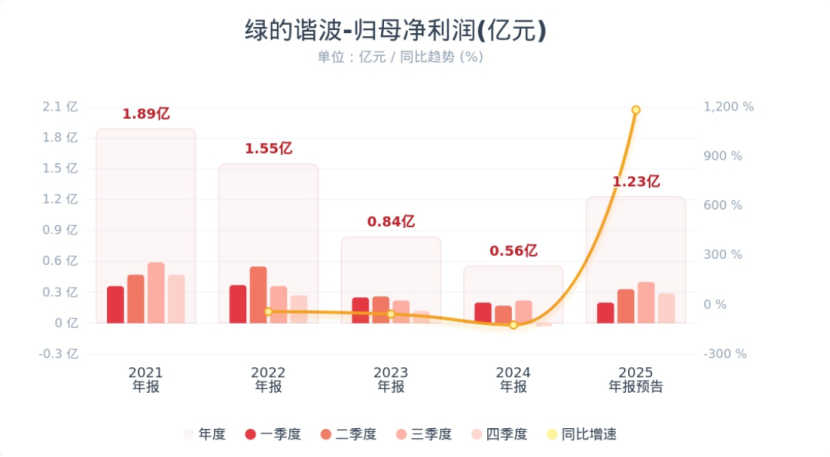
Group 1 - The company expects a net profit attributable to shareholders of the parent company for 2025 to be between 115 million to 130 million yuan, representing an increase of 58.83 million to 73.83 million yuan compared to the previous year, with a year-on-year growth of 104.74% to 131.45% [1] - The net profit attributable to shareholders of the parent company after deducting non-recurring gains and losses is projected to be between 90 million to 105 million yuan, an increase of 43.79 million to 58.79 million yuan compared to the previous year, with a year-on-year growth of 94.78% to 127.25% [1] - The previous year's net profit attributable to shareholders of the parent company was 56.17 million yuan, with a basic earnings per share of 0.33 yuan [2] Group 2 - The significant growth in the company's performance for 2025 is attributed to multiple favorable factors, including a recovery in the industrial robotics industry, sustained market demand, and the company's strong industry accumulation and product competitiveness [3] - The company has seen substantial growth in business scale due to the transition of key clients from the research phase to small-scale production, with its products gaining high recognition for quality and adaptability [3] - The company is actively pursuing overseas market expansion, which has begun to yield results, contributing new momentum to overall growth [3] - The company has improved production efficiency and resource utilization through continuous optimization of production processes, enhancing its profit conversion capability [3]

埃夫特上调部分工业机器人整机产品售价
Zheng Quan Ri Bao Zhi Sheng· 2026-01-29 17:16
在此背景下,埃夫特此次调价或是实现盈利修复的重要选择之一。2025年上半年,埃夫特工业机器人销 量同比增长近20%,市场占有率从5.4%提升至5.5%;报告期内,因行业价格竞争加剧,叠加公司针对战 略客户的定价策略,公司机器人业务收入同比下降7.44%,归属于母公司所有者的净利润为-1.52亿元。 1月29日,埃夫特智能机器人股份有限公司(以下简称"埃夫特")通过官方微信公众号发布消息称,经 公司董事会与管理层多轮审慎评估、综合研判,决定对公司部分工业机器人整机产品售价进行优化调 整,调价幅度区间为5%至12%。本次价格调整的正式生效时间为2026年2月1日。 此次调价是受上游原材料与核心元器件价格上涨影响。埃夫特表示,近期,全球制造业供应链压力持续 攀升,以铜、铝等有色金属为代表的大宗原材料及存储类芯片价格大幅震荡上行,从去年年初至今,铜 价格上涨38%以上、铝价格上涨25%以上、存储类芯片价格上涨300%左右且还在持续上涨。 上海大学悉尼工商学院讲师王雨婷对《证券日报》记者表示,作为工业机器人企业,埃夫特产品的生产 制造对铜、铝等金属材料的用量大且依存度高,而存储类芯片价格上涨将直接推高其生产成本。 工业 ...

城市24小时 | 经济“成绩单”出齐,这个东北大省跑慢了
Mei Ri Jing Ji Xin Wen· 2026-01-29 16:01
Economic Overview - In 2025, Guangdong, Jiangsu, and Shandong joined the "10 trillion club" in GDP, while Zhejiang, Sichuan, Henan, Hubei, Fujian, Shanghai, and Hunan followed, all exceeding 5 trillion yuan in GDP [2][3] GDP Data - Guangdong's GDP reached 14.58 trillion yuan with a growth rate of 3.9% - Jiangsu's GDP was 14.24 trillion yuan, growing at 5.3% - Shandong's GDP stood at 10.32 trillion yuan, with a growth rate of 5.5% - Other provinces like Zhejiang, Sichuan, and Henan also reported GDPs above 6.66 trillion yuan, with growth rates ranging from 5.0% to 5.6% [3] Economic Growth Rates - 18 provinces outperformed the national growth rate of 5%, with Tibet achieving the highest growth rate of 7% - Gansu followed with a growth rate of 5.8%, while Henan and Hebei both recorded 5.6% [3] Investment Trends in Liaoning - Liaoning's fixed asset investment decreased by 19% in 2025, with construction project investments down by 16.2% - Notably, high-tech manufacturing investments increased by 1.6%, with aerospace and computer equipment sectors seeing significant growth [5][6] Government Initiatives - Liaoning's government aims for a GDP growth of around 4.5% in 2026, focusing on consumption and investment expansion, new industrialization, and enhancing technological innovation [5][6] Consumption and Retail - Liaoning's retail sales reached 1.037 trillion yuan, growing by 1.4%, with a target of 4% growth for 2026 [5] Service Consumption Growth - The State Council issued a plan to enhance service consumption, focusing on sectors like transportation, home services, and tourism to support high-quality economic development [7] Youth Development in Shanghai - Shanghai is implementing a three-year action plan to create a youth-friendly city, aiming to attract and retain young talent [8] Shenzhen's Consumption Action Plan - Shenzhen's three-year action plan aims to optimize the consumption environment and boost spending, leveraging the APEC meeting to enhance its status as a global consumption center [9] Zhejiang's Market Development - Zhejiang plans to increase its professional market transaction volume to over 2.5 trillion yuan by 2030, introducing an exit mechanism for underperforming markets [10] Competitiveness in New Energy Equipment Manufacturing - Suzhou topped the list of cities in the new energy equipment manufacturing industry with a score of 87.71, followed closely by Shenzhen and Changzhou [14][21]
具身智能机器人业务增长明显 绿的谐波2025年净利同比预增至高131.45%
Xin Lang Cai Jing· 2026-01-29 10:56
《科创板日报》1月29日讯(记者 吴旭光) 1月29日盘后,绿的谐波发布公告称,公司预计2025年归属于上市公司股 东的净利润为1.15亿元-1.30亿元,同比增长104.74%-131.45%。 据此计算,该公司2025年Q4净利预计0.21亿元-0.36亿元,同比增长900.55%至1463.45%,环比下降9%至47%。** "要推动具身智能真正落地应用,行业还需共同突破当下普遍存在的技术难题。"今日(1月29日),中国城市发展研 究院投资部副主任袁帅在接受《科创板日报》记者采访时表示,后续的核心发力点,在于提升机器人的"大脑"运算能 力与实际操作水平。其认为,若机器人无法具备接近人类的操作效率,那么其最终只会沦为观赏性的"花瓶",难以发 挥实际价值。 与此同时,在袁帅看来,在工业领域,机器人的效率高低与柔性表现,会直接决定用户是否愿意采纳,那些可即插即 用、高效便捷的机器人,未来将在生产线中占据重要地位、发挥关键作用。 二级市场表现方面,截至1月29日收盘,绿的谐波股价报212.46元/股,公司总市值为389.50亿元。 对于业绩变化,绿的谐波表示,2025年公司业绩实现显著增长,核心得益于多方面有利 ...