
石油加工

Search documents
燃料油、低硫燃料油周度报告:国泰君安期货·能源化工-20260201
Guo Tai Jun An Qi Huo· 2026-02-01 08:52
Report Information - Report Title: Fuel Oil and Low-Sulfur Fuel Oil Weekly Report [1] - Report Date: February 1, 2026 [1] - Analyst: Liang Kefang [1] Investment Rating - No investment rating information is provided in the report. Core Views - The prices of domestic and international fuel oils have continued to fluctuate widely recently, and the short-term market has entered a situation where it is easy to rise and difficult to fall. High-sulfur fuel oil prices are expected to remain high, while low-sulfur fuel oil prices have support at the bottom and are unlikely to weaken significantly in the short term. [4] - The recommended trading strategies are: 1) Unilateral trading: Fuel oil prices are in a high-volatility environment in the short term, and there may be further upside potential. 2) Inter-period trading: The inter-period spreads of FU and LU have returned to backwardation and may return to contango after the geopolitical issues cool down. 3) Inter-variety trading: The crack spreads of FU and LU have rebounded slightly in the short term, and the LU-FU spread will continue to shrink in the short term. [4] - The estimated price ranges for FU and LU are 2850 - 2950 and 3200 - 3400, respectively. [4] Summary by Directory Supply - The number of global CDU maintenance units has increased slightly. Although the exports from the Middle East have continued to rise, they have not flowed into Singapore and Malaysia in the short term, and the imports in the Singapore market have not increased significantly for the time being. [4] - Data on the capacity utilization rates of Chinese refineries, global refinery maintenance, and domestic refinery fuel oil production and commercial volumes are presented in the form of charts. [6][13][15] Demand - Data on domestic and international fuel oil demand, including the actual consumption of marine fuel oil in China, the sales volume of fuel oil bunkering in Singapore, and the apparent consumption of fuel oil in China, are presented in the form of charts. [17][18] Inventory - Data on global fuel oil spot inventories, including the heavy oil inventories in Singapore, the fuel oil inventories in the European ARA region, the heavy distillate inventories in Fujairah, and the residual fuel oil inventories in the United States, are presented in the form of charts. [20][21][22] Price and Spread - Data on the FOB prices of fuel oil in the Asia-Pacific region, Europe, and the United States, as well as the prices of paper and derivatives, are presented in the form of charts. [26][31][32] - Data on fuel oil spot spreads, global fuel oil crack spreads, and global fuel oil paper monthly spreads are presented in the form of charts. [41][42][47] Import and Export - Data on domestic fuel oil import and export, as well as global high-sulfur and low-sulfur fuel oil import and export, are presented in the form of charts. [50][54][57] Futures Market Indicators and Inter-Region Spreads - The prices of Asia-Pacific fuel oil in the week increased significantly, and the trend in the Zhoushan market was in sync. The inter-region spreads of high-sulfur fuel oil narrowed, while those of LU widened. [63] - Data on the inter-region spreads in the spot market, as well as the changes in the trading volume, open interest, and warehouse receipts of FU and LU, are presented in the form of charts. [66][73][83]
大炼化周报:成本端支撑强劲,化工品及涤纶产业链价格拉涨-20260201
Xinda Securities· 2026-02-01 05:05
Investment Rating - The report does not explicitly state an investment rating for the oil refining industry Core Insights - The cost support for the chemical products and polyester industry chain is strong, leading to price increases [2] - Domestic key refining project price difference is 2537.18 CNY/ton, with a week-on-week increase of 18.62 CNY/ton (+0.74%) as of January 30, 2026 [3] - International oil prices have shown a significant increase, with Brent and WTI prices at 70.69 and 65.21 USD/barrel respectively, reflecting increases of 4.81 and 4.14 USD/barrel [2] Summary by Sections Refining Sector - The geopolitical situation involving the US, Russia, and Ukraine has influenced oil prices, with a notable increase in geopolitical risk premiums due to US military actions in the Middle East [2] - Domestic refined oil prices have shown slight fluctuations, with diesel, gasoline, and aviation kerosene averaging 6265.14, 7535.14, and 5183.14 CNY/ton respectively [2] - The price difference between domestic refined oil and crude oil has decreased, indicating a potential impact on profitability [2] Chemical Sector - The chemical products sector is experiencing strong cost support, with price differences for pure benzene and styrene continuing to rise due to robust cost support and expected maintenance in overseas markets [2] - The polyester industry chain has seen comprehensive price increases, driven by enhanced cost support and market sentiment [2] - The market for nylon has seen price adjustments, although the price difference has slightly narrowed [2] Market Performance of Major Refining Companies - The stock price performance of six major private refining companies shows varied results, with Rongsheng Petrochemical increasing by 7.51% and Dongfang Shenghong by 16.48% over the past week [2] - Over the past month, Rongsheng Petrochemical has increased by 31.81%, indicating strong market performance [2]


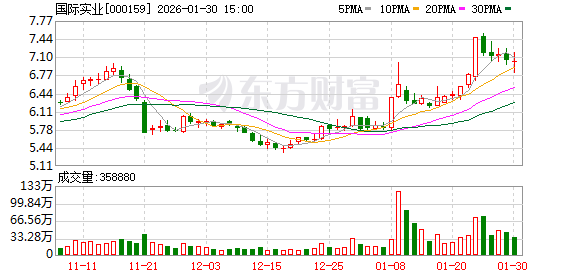
每周股票复盘:国际实业(000159)预计2025年净利3600万元
Sou Hu Cai Jing· 2026-01-31 19:38
Core Viewpoint - International Industry (000159) is expected to achieve a net profit of approximately 36 million yuan for the year 2025, marking a turnaround from a previous loss [1][3] Performance Disclosure Highlights - The company forecasts an earnings per share of approximately 0.0749 yuan for 2025, compared to a loss of 0.9128 yuan per share in the same period last year [1] - The expected net profit after deducting non-recurring gains and losses is approximately 36.7 million yuan, which represents a decline of about 31.90% compared to the previous year's figure of 53.89 million yuan [1][3] Company Announcement Summary - The anticipated net profit for 2025 is a significant improvement from a loss of 43.88 million yuan in the same period last year, indicating a successful turnaround [1] - The performance change is primarily attributed to a substantial loss incurred in the previous year due to the sale of a real estate subsidiary's equity [1]

东方盛虹:原油是公司最主要的原料
Zheng Quan Ri Bao Wang· 2026-01-30 15:10
证券日报网1月30日讯,东方盛虹(000301)在接受调研者提问时表示,原油是公司最主要的原料,每 年原油加工能力达到1600万吨。目前公司原油采购从海外进口,以美元结算。人民币升值有利于降低公 司原油采购成本。 ...
国际实业:预计2025年净利润同比增加约108.20%
Zheng Quan Ri Bao· 2026-01-30 12:28
(文章来源:证券日报) 证券日报网讯 1月30日,国际实业发布公告称,公司预计2025年度归属于上市公司股东的净利润约为 3600万元,上年同期亏损43878.20万元,比上年同期增长约108.20%。 ...

宝利国际:预计2025年全年扣非后净利润亏损1.05亿元至1.3亿元
Sou Hu Cai Jing· 2026-01-30 10:45
Core Viewpoint - Baoli International expects a net profit loss of 105 million to 130 million yuan for the full year of 2025 after deducting non-recurring items [1] Group 1: Reasons for Performance Changes - The company experienced a delay in the construction projects of some clients, leading to postponed asphalt demand and a decline in gross margin due to fluctuations in raw material costs influenced by international oil prices [2] - The industry recovery faces significant challenges, with weak demand for asphalt products and delayed payment progress from downstream clients, resulting in an expected increase in credit impairment losses and asset impairment losses [2] - Non-recurring gains are estimated to impact net profit by approximately 40 million yuan, primarily from the disposal of non-current assets [2] Group 2: Financial Performance - For the first three quarters of 2025, the company's main revenue was 1.067 billion yuan, a year-on-year decrease of 36.42% [2] - The net profit attributable to the parent company was -10.1287 million yuan, a year-on-year decline of 245.22%, while the net profit after deducting non-recurring items was -50.4023 million yuan, down 92.83% [2] - In the third quarter of 2025, the company's single-quarter main revenue was 547 million yuan, a year-on-year increase of 2.61%, with a net profit attributable to the parent company of -3.2463 million yuan, a year-on-year decline of 15.17% [2] - The company's debt ratio was 42.79%, with investment income of 4.4048 million yuan and financial expenses of 5.1313 million yuan, resulting in a gross margin of 1.75% [2]

宝利国际:预计2025年全年归属净利润亏损6000万元至8400万元
Sou Hu Cai Jing· 2026-01-30 10:45
Core Viewpoint - Baoli International expects a net profit loss of 60 million to 84 million yuan for the full year of 2025, indicating significant financial challenges ahead [1]. Group 1: Reasons for Performance Change - The company experienced delays in project commencement from some clients, leading to postponed asphalt demand and a decline in gross margin due to fluctuations in raw material costs influenced by international oil prices [2]. - The industry recovery faces numerous challenges, with weak demand for asphalt products and delayed payment progress from downstream clients, resulting in anticipated increases in credit impairment losses and asset impairment losses [2]. - Non-recurring gains are expected to impact net profit by approximately 40 million yuan, primarily from the disposal of non-current assets [2]. Group 2: Financial Performance Overview - For the first three quarters of 2025, the company's main revenue was 1.067 billion yuan, a year-on-year decrease of 36.42% [2]. - The net profit attributable to shareholders was -10.1287 million yuan, a year-on-year decline of 245.22%, while the net profit excluding non-recurring items was -50.4023 million yuan, down 92.83% [2]. - In Q3 2025, the company's single-quarter main revenue was 547 million yuan, a year-on-year increase of 2.61%, but the single-quarter net profit attributable to shareholders was -3.2463 million yuan, a decline of 15.17% [2].
国际实业:预计2025年归属于上市公司股东的净利润3600万元
Mei Ri Jing Ji Xin Wen· 2026-01-30 09:17
每经头条(nbdtoutiao)——核电建设热潮下,设备厂忙到"飞起"!订单已排至2028年,员工三班倒, 产线24小时不停 (记者 曾健辉) 每经AI快讯,国际实业1月30日晚间发布业绩预告,预计2025年归属于上市公司股东的净利润3600万 元,同比扭亏为盈。基本每股收益约0.0749元。上年同期基本每股收益亏损0.9128元。报告期内归属于 上市公司股东的净利润变动较大的主要原因系上年同期出售房地产子公司股权导致上年同期净利润出现 较大亏损所致。 ...
燃料油1月报-20260130
Yin He Qi Huo· 2026-01-30 07:08
1. Report Industry Investment Rating No relevant information provided. 2. Core Viewpoints of the Report - The fundamental weakness of fuel oil persists, with geopolitical factors remaining the main bullish drivers [4]. - High - sulfur fuel oil cracking has risen to a high level for the same period, but the fundamental situation of high inventory and weak demand in the first quarter still exists. Attention should be paid to the near - term logistics changes in major supply regions such as Iran and Russia. Low - sulfur fuel oil supply remains abundant, and there is no strong support for its economy compared to natural gas under the background of cold snaps. Geopolitical factors are still the most important bullish drivers, and cost - side risks should be monitored [6]. 3. Summary According to Relevant Catalogs 3.1 Introduction and Overview 3.1.1 Market Review - High - sulfur fuel oil prices followed the increase in crude oil costs in early January. The high - sulfur cracking remained at a low level of - 10 to - 7 US dollars per barrel on a month - on - month basis and a medium level on a year - on - year basis, reflecting the weak seasonal fundamentals of high inventory and weak demand in the first quarter. In late January, due to the intensification of the Iranian geopolitical situation and Russian sanctions, the bullish sentiment in the market increased. - Low - sulfur fuel oil fluctuated with crude oil costs in January. Its supply increased while demand had no drivers. After the return of Al - Zour's production capacity, low - sulfur production and exports reached a historical high. The low - sulfur exports of the Dangote refinery also increased, and the low - sulfur inventory in Singapore accumulated. The cracking remained at 3 to 5 US dollars per barrel, oscillating at an extremely low level year - on - year; the premium increased by about 2 US dollars per ton month - on - month but was still at the lowest level for the same period [5][11]. 3.1.2 Market Outlook - High - sulfur fuel oil cracking is supported by the increase in market demand and geopolitical supply concerns and has risen to a high level for the same period. However, the fundamental situation of high inventory and weak demand in the first quarter still exists. Attention should be paid to the near - term logistics changes in major supply regions such as Iran and Russia. Low - sulfur fuel oil supply remains abundant. There is no strong support for its economy compared to natural gas under the background of cold snaps. Geopolitical factors are still the most important bullish drivers, and cost - side risks should be monitored [6]. 3.1.3 Strategy Recommendations - Unilateral: Strong oscillation, pay attention to geopolitical risks. - Arbitrage: Enter the FU59 positive spread at low prices. Narrow the BU - FU spread at high prices. Narrow the BU - LU spread at high prices. High - sulfur cracking oscillates at a high level, and low - sulfur cracking oscillates at a relatively low level. - Options: None [7][57]. 3.2 Fundamental Situation 3.2.1 High - Sulfur Supply - Due to the continuous Russia - Ukraine conflict and tariff expectations, there is still bullish sentiment in the short - term supply. In the first two weeks of January, the crude oil processing volume decreased month - on - month and was at a medium level year - on - year. - Some refineries were shut down due to attacks, and some refineries resumed operations. The sanctions from Europe and the United States continued, and concerns about fuel oil retention in the market persisted. - In terms of logistics monitoring, the high - sulfur fuel oil exports in the week of January 22 increased by 110,000 tons month - on - month. The expected inflow of fuel oil in Singapore in January remained at a high level. - Mexico's near - term high - sulfur exports decreased and are expected to remain at a low level in February. - The Iranian situation is turbulent, and concerns about high - sulfur fuel oil supply have increased. The exports of high - sulfur fuel oil in Iran rebounded in the week of January 22 [16][17][21][26]. 3.2.2 High - Sulfur Demand - The demand for high - sulfur marine fuel is stably supported, and the marginal increase comes from the stable growth in the number of ships with desulfurization towers. - After the restriction of Venezuelan oil, the market expects that Chinese local refineries may import Iranian and Russian crude oil and fuel oil as substitutes, but the support from feedstock is not strong due to the abundant crude oil quotas at the beginning of the year and the general economic efficiency of high - sulfur fuel oil feedstock [31][36]. 3.2.3 Low - Sulfur Fuel Oil - The return of the RFCC unit of the Nigerian Dangote refinery was postponed, and the low - sulfur supply remained at a high level. - The low - sulfur supply and exports of the Middle East Al - Zour refinery returned to a high level. - The energy supply in South Sudan is gradually recovering. - In the Pan - Singapore region, the new and restarted production capacities of refineries have been implemented and returned. - The low - sulfur demand has no specific drivers, the marine fuel demand is stable, and the power - generation economy of low - sulfur fuel oil is still inferior to that of natural gas under the background of cold snaps in Europe and the United States, with no strong substitution demand [41][42][43][46][47]. 3.3 Future Outlook and Strategy Recommendations - High - sulfur spot premiums continue to rise, and the on - land inventory in Singapore decreased significantly on a week - on - week basis. Short - term fuel oil exports and production are expected to be continuously disturbed by geopolitical and macro - strategic factors, and the unilateral fluctuations of fuel oil will intensify. Geopolitical factors are still the most important bullish drivers. - The near - term low - sulfur supply and exports have increased significantly. - Strategy recommendations: Unilateral: Strong oscillation, pay attention to geopolitical risks. Arbitrage: Enter the FU59 positive spread at low prices. Narrow the BU - FU spread at high prices. Narrow the BU - LU spread at high prices. High - sulfur cracking oscillates at a high level, and low - sulfur cracking oscillates at a relatively low level. Options: None [56][57].
宝利国际:目前公司生产经营管理有序推进
Zheng Quan Ri Bao Zhi Sheng· 2026-01-29 12:44
Core Viewpoint - Baoli International's stock price is influenced by multiple factors including macroeconomic conditions, industry cycles, and the company's operational development [1] Group 1: Company Operations - The company is currently managing its production and operations in an orderly manner [1] - Existing business operations are being deepened and refined [1] Group 2: Strategic Initiatives - The company plans to actively leverage its status as a listed entity and the advantages of state-owned enterprises to promote transformation and upgrading [1] - There is a focus on continuously enhancing core competitiveness and sustainable profitability [1] - The company aims to improve its overall value [1]