
银行理财

Search documents
罕现“双零费率”,银行理财需高质量揽客
Zhong Guo Ji Jin Bao· 2026-01-18 12:35
Core Viewpoint - The banking wealth management market is experiencing a "fee reduction wave" with the rare occurrence of "double zero rates" for investment management and sales service fees, driven by factors such as "deposit migration" and the "New Year marketing push" [1][2]. Group 1: Fee Reduction Trends - The banking wealth management market has seen significant fee reductions, with examples including Ningyin Wealth Management offering zero sales service fees and eight products with zero floating management fees [2]. - Some products from China Zhongyuan Bank have also adjusted both investment management and sales service fees to 0.00% per year, sparking discussions in the industry despite the products being terminated shortly after [2]. - The fee reduction trend is attributed to the continuous decline in deposit rates, prompting banks to attract funds through more appealing wealth management products [2][3]. Group 2: Implications of Fee Reductions - Fee reductions can rapidly increase scale and market share for wealth management companies, but over-reliance on price competition may erode overall industry profits and weaken long-term research and innovation capabilities [3]. - The challenge lies in balancing customer satisfaction with the sustainable development of the company, as excessive focus on low fees could lead to "low fee, low efficiency" scenarios that harm brand reputation [3]. Group 3: Future Strategies for Wealth Management Companies - With limited further fee reduction space, wealth management companies are encouraged to optimize product structures and diversify fee mechanisms to enhance competitiveness [4]. - Companies should explore various types of wealth management products, such as "low volatility + stable return" themes and "fixed income +" enhanced products, while also considering flexible management fees based on holding periods [4]. - Leading wealth management firms are increasingly collaborating with local commercial banks to penetrate county and lower-tier markets, expanding customer reach and reducing acquisition costs [4]. Group 4: Importance of Research and Reputation - Continuous improvement in research capabilities is essential for wealth management companies to build a positive reputation and maintain scale in a competitive environment [5].
罕现“双零费率”,银行理财需高质量揽客
中国基金报· 2026-01-18 12:33
Core Viewpoint - The banking wealth management market is experiencing a "fee reduction wave" due to factors such as "deposit migration" and the "New Year marketing push," leading to a rare occurrence of "double zero rates" for investment management and sales service fees [1][3]. Group 1: Fee Reduction Trends - Since the beginning of the year, banks have been reducing fees to attract customers, with examples including Ningyin Wealth Management offering zero sales service fees and management fees for several products [3]. - Some banks, like Zhongyuan Bank, have adjusted fees for certain products to 0.00% per year, which has sparked significant discussion in the industry despite these products being terminated shortly after [3]. - The fee reduction trend is primarily driven by the need to attract funds flowing out of deposits due to declining deposit rates and the urgency of the "New Year" marketing period [3][4]. Group 2: Implications of Fee Reduction - Experts suggest that while fee reductions can quickly increase scale and market share, they may also erode overall industry profits and weaken long-term research and innovation capabilities [4]. - The challenge lies in balancing customer satisfaction with the sustainable development of wealth management companies, as excessive reliance on price competition could harm brand reputation if investment performance does not keep pace [4][6]. Group 3: Future Strategies for Wealth Management Companies - Moving forward, the space for further fee reductions is limited, and companies are encouraged to optimize product structures and diversify fee mechanisms to enhance competitiveness [6][9]. - Wealth management firms should focus on improving research capabilities and building brand trust, rather than relying solely on low fees to attract customers [9]. - Strategies such as developing low-volatility and stable-return products, as well as exploring flexible fee structures based on holding periods, are recommended to adapt to the competitive landscape [9].


运河财富|0费率理财产品涌现 机构盯上万亿存款搬家蛋糕
Sou Hu Cai Jing· 2026-01-17 02:12
Core Viewpoint - The banking wealth management sector is experiencing a significant wave of fee reductions, with 0-fee and ultra-low fee products emerging as key market trends aimed at capturing the influx of deposit migration funds [1][5]. Group 1: Fee Reduction Trends - In early 2026, multiple banking wealth management companies announced fee adjustments, with 0-fee products becoming a focal point in the market [3]. - For instance, China Merchants Bank's wealth management division reduced the fixed investment management fee for certain products from 0.15% to 0.01%, and several products were offered at a 0% management fee [3]. - Ningyin Wealth Management also initiated a large-scale fee reduction, with over 40 products having their sales service fees adjusted to 0, and more than 40 products eliminating floating management fees starting January 1, 2026 [3]. Group 2: Driving Factors Behind Fee Reductions - The current wave of fee reductions is driven by multiple factors, including the need to attract deposit migration funds and expand management scale [5]. - Estimates suggest that the average scale of time deposits maturing in 2026 is around 50 trillion yuan, with the total long-term fixed deposit scale expected to be between 59 trillion and 71 trillion yuan [5]. Group 3: Implications of Fee Reductions - While fee reductions can enhance perceived investor returns, they may also compress profit margins for wealth management companies, making it challenging to cover operational costs [6]. - The price war could lead to increased industry competition, which may not be sustainable in the long term [6]. Group 4: Building Core Competitiveness - Industry experts emphasize that while price competition can provide short-term relief, long-term success will depend on developing core competencies [7]. - Key capabilities identified for wealth management firms include strong research and asset allocation abilities, product innovation, efficient operations, and professional customer service [8].

备战巨量到期资金,“固收+”策略成新宠
中国基金报· 2026-01-16 12:44
Core Viewpoint - A significant competition for over 30 trillion yuan in maturing deposits has begun, with "fixed income +" becoming a favored choice for bank wealth management products as investors seek low-volatility and stable returns [2][3]. Group 1: Market Dynamics - Since the end of September 2024, despite a temporary recovery in equity markets and strong performance in assets like gold, investors continue to prefer low-volatility wealth management products [2]. - The estimated maturing deposits in 2026 include approximately 20.7 trillion yuan from two-year deposits, 9.6 trillion yuan from three-year deposits, and 2.0 trillion yuan from five-year deposits, totaling around 32 trillion yuan [4]. - Major financial institutions are eager to capture this wealth, with bank wealth management and insurance products being key contenders [5]. Group 2: Product Trends - In 2024, the top 14 wealth management companies saw nearly 4 trillion yuan growth in low-volatility, shorter-duration open-ended products, with a further increase of over 3 trillion yuan in the first 11 months of 2025, accounting for nearly 90% of the overall growth in wealth management scale [5]. - The "fixed income +" strategy has emerged as a crucial choice for investors aiming for stable growth in a low-interest-rate environment [8]. - As of September 30, 2025, the growth rate of "fixed income +" funds (including first and second-tier bond funds and bond-mixed funds) reached 39.5%, while pure bond funds experienced a decline of 10% [8]. Group 3: Asset Allocation - With the stock market showing steady growth in 2025, the risk-return profile of equity assets has significantly improved, with the Sharpe ratio rising from 0.21 in 2024 to nearly 1 [6]. - The demand for 10-year government bonds has shifted from trading desks to banks, which are now the primary players in pricing, contributing to a stabilization effect in the market [8]. - Analysts predict that wealth management companies will further expand their offerings of products with equity components, while maintaining a solid base of low-volatility products [9].

2025年12月银行理财市场月报:银行理财大事记:2025指数型理财崛起,理财公司加码A股与港股IPO-20260116
HWABAO SECURITIES· 2026-01-16 11:41
Investment Rating - The report indicates a positive outlook for the banking wealth management industry, highlighting the explosive growth of index-based wealth management products in 2025 [4]. Core Insights - The banking wealth management market is experiencing a significant transformation, with a focus on index-based products and enhanced risk management capabilities through independent participation in interest rate derivatives [4][15]. - The report emphasizes the importance of diversified asset allocation and multi-strategy approaches as mainstream directions for the industry [4][15]. - Regulatory developments, such as the implementation of the Asset Management Product Information Disclosure Management Measures, are establishing a unified regulatory framework for information disclosure [15][19]. Summary by Sections Market Overview - As of December, the total market size of wealth management products was 31.66 trillion yuan, showing a slight decrease of 0.16% month-on-month but an increase of 6.69% year-on-year [6][11]. - The annualized yield for cash management products increased to 1.34%, up 5.57 basis points from the previous month [6][11]. New Product Launches - The issuance of new wealth management products increased in December, with a focus on fixed income plus products, closed-end products, and 1-3 year term products dominating the market [7][9]. - The performance benchmarks for newly issued fixed income plus wealth management products mostly continued to decline, reflecting a consensus on long-term low interest rates [7][9]. Regulatory Developments - The banking wealth management industry is moving towards a "net value 3.0" era, emphasizing the need for a comprehensive management system that integrates investment decision-making and risk management [15][19]. - The new disclosure regulations aim to standardize the information disclosure process across different asset management products, enhancing transparency and accountability [19]. Industry Innovations - Wealth management companies are actively participating in IPOs in both A-shares and Hong Kong markets, with notable investments in companies focused on green transformation and technology [5][20]. - The report highlights the trend of wealth management firms developing their own indices to enhance competitive differentiation and meet client demands for customized investment strategies [4][13].
【银行理财】银行理财大事记:2025指数型理财崛起,理财公司加码A股与港股IPO——2025年12月银行理财市场月报
华宝财富魔方· 2026-01-16 09:39
Key Points - The core viewpoint of the article emphasizes the significant growth expected in index-based wealth management products by 2025, driven by regulatory changes and market dynamics [3][4][21] - The article discusses the transition of wealth management companies towards net value transformation and the introduction of independent qualifications for interest rate derivatives, enhancing risk management capabilities [3][4][10] - It highlights the active participation of wealth management companies in IPOs of both A-shares and Hong Kong stocks, supporting green transformation and technology enterprises [3][10] Regulatory and Industry Dynamics - In December, the wealth management industry saw a slight decrease in the total scale of products to 31.66 trillion yuan, a 0.16% decrease month-on-month but a 6.69% increase year-on-year [4][12] - The annualized yield for cash management products rose to 1.34%, an increase of 5.57 basis points, while pure fixed-income products saw a yield of 2.06% [4][12] - The introduction of the "Management Measures for Information Disclosure of Asset Management Products by Banking and Insurance Institutions" marks a new phase in the regulatory framework, focusing on standardized disclosure practices [3][10][21] New Product Launches - In December, the scale of newly issued wealth management products increased, maintaining a focus on fixed income and cash management products, with a notable trend towards lower performance benchmarks for new fixed income + products [4][12] - Wealth management companies are increasingly adopting index-based products, with a focus on transparency and risk distribution, as they seek to differentiate themselves in a competitive market [3][4][10] - The launch of innovative products, such as the "Star Whale Global+" product by Su Yin Wealth Management, reflects a trend towards diversified asset allocation strategies [10][12] Performance Metrics - The closed-end product compliance rate was 82.91%, while the open-end product compliance rate was 58.61%, indicating a slight decline in performance metrics compared to the previous month [5][12] - The overall market for wealth management products experienced a net value decline rate of 4.13%, which is an increase of 1.3 percentage points month-on-month [4][5] Industry Innovation - Wealth management companies are actively engaging in innovative strategies, such as the introduction of ETF covered call strategy indices to provide transparent yield benchmarks in volatile markets [3][10] - The first-ever pledge-style repurchase transaction of a science and technology bond ETF by Su Yin Wealth Management signifies a shift towards proactive asset management and liquidity optimization [3][10] - The article notes the importance of enhancing research capabilities and risk management strategies as wealth management firms navigate a changing regulatory landscape and market conditions [3][10][21]

14家银行理财,规模增约3万亿元!
Zheng Quan Shi Bao· 2026-01-15 07:32
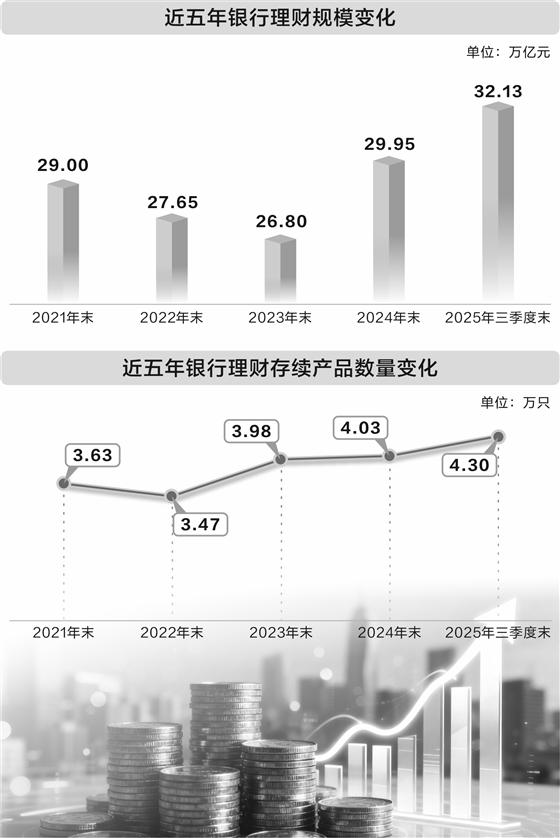
Core Insights - The banking wealth management industry experienced significant growth in 2025, with 14 major wealth management companies increasing their total assets under management by nearly 3 trillion yuan, reaching a record high by year-end [1][2] Group 1: Industry Growth - By the end of December 2025, the total scale of the 14 major wealth management companies was 25.41 trillion yuan, reflecting a year-on-year growth of approximately 13.3% and an annual increase of 2.98 trillion yuan [2] - The peak industry scale reached nearly 34 trillion yuan in November 2025, marking a historical high with an increase of over 4 trillion yuan since the beginning of the year [2] - The growth in the industry was primarily driven by fixed pure bond products and enhanced fixed-income equity products, which added 1.64 trillion yuan and 1.27 trillion yuan, respectively [3] Group 2: Market Dynamics - The bond market has been volatile, with the yield on 10-year government bonds fluctuating around 1.60% to 1.80% throughout 2025, impacting the yields of wealth management products [4] - The average annualized yield for open-ended fixed-income products dropped to 2.32% and 2.25% for six months and one year, respectively, indicating a downward trend [4] - As deposit rates hit historical lows, many customers are shifting their maturing fixed deposits into wealth management products, reflecting a change in risk appetite [4] Group 3: Future Opportunities - In 2026, wealth management institutions are expected to benefit from multi-asset layouts and a further decline in household savings rates, potentially attracting 2 trillion to 4 trillion yuan of "activated funds" into non-deposit investments [5] - The industry is moving towards a multi-asset and multi-strategy approach to enhance returns, with a focus on diversifying asset allocation beyond traditional equity [6] - Collaboration with public funds is emphasized as a strategy for wealth management companies to enhance their product offerings and risk management capabilities [7]
14家银行理财,规模增约3万亿!
券商中国· 2026-01-15 00:55
Core Viewpoint - The banking wealth management industry experienced significant growth in 2025, reaching a record high in total assets under management despite a slight monthly contraction due to seasonal factors at the end of the year [1][2]. Group 1: Industry Growth and Performance - In 2025, 14 major wealth management companies, including 6 state-owned and 8 joint-stock banks, saw their total assets grow by nearly 3 trillion yuan, reaching a peak of 34 trillion yuan in November [2][3]. - By the end of December 2025, the total assets of these companies amounted to 25.41 trillion yuan, reflecting a year-on-year increase of approximately 13.3% and an annual growth of 2.98 trillion yuan [3]. - The growth was primarily driven by fixed pure bond products and enhanced fixed-income equity products, which added 1.64 trillion yuan and 1.27 trillion yuan, respectively [4]. Group 2: Market Trends and Client Behavior - As fixed deposit rates declined and matured deposits were reinvested, there was a noticeable shift in client risk preferences, with many opting for wealth management products as a conservative investment choice [5][6]. - The average annualized yield for open-ended fixed-income products dropped to 2.32% and 2.25% for the past six months and one year, respectively, indicating a challenging environment for fixed-income investments [5]. Group 3: Future Outlook and Strategies - The wealth management industry is expected to embrace a multi-asset and multi-strategy approach to enhance returns, moving away from traditional asset management models [7][8]. - Collaboration with public funds is emphasized as a key strategy, allowing wealth management companies to focus on asset allocation and risk management while leveraging external expertise for specific investment strategies [8]. - Predictions suggest that the wealth management sector could attract an additional 1.5 trillion to 3 trillion yuan in equity asset allocation funds in 2026 [7].

银行理财规模创历史新高 净值震荡难挡增量资金涌入
Zheng Quan Shi Bao· 2026-01-14 17:36
Core Viewpoint - The banking wealth management industry has experienced significant growth in 2025, with the total scale reaching a record high, despite a slight monthly contraction at the end of the year due to seasonal factors [2][3]. Group 1: Industry Growth - By the end of December 2025, the top 14 wealth management companies had a combined management scale of 25.41 trillion yuan, reflecting a year-on-year growth of approximately 13.3% and an annual increase of 2.98 trillion yuan [3]. - The overall industry scale peaked at nearly 34 trillion yuan in November 2025, marking an increase of over 4 trillion yuan since the beginning of the year [3]. - The growth in wealth management products was primarily driven by fixed pure debt products and enhanced fixed-income equity products, which added 1.64 trillion yuan and 1.27 trillion yuan, respectively, since the beginning of 2025 [4]. Group 2: Market Dynamics - The decline in fixed deposit rates and the maturity of these deposits have led to a migration of low-risk preference funds towards bank wealth management products [3][5]. - As of the end of 2025, mixed wealth management products saw a significant increase of over 300 billion yuan, reversing a previous trend of decline [4]. - Analysts expect the bond market to remain volatile in 2026, which may impact the yields of fixed-income products offered by wealth management companies [5]. Group 3: Future Opportunities - The wealth management sector is anticipated to benefit from a further decline in household savings rates and an increase in risk appetite among residents, potentially leading to an influx of 2 trillion to 4 trillion yuan into non-deposit investment areas [6]. - Companies are expected to adopt multi-asset and multi-strategy approaches to enhance returns, moving beyond traditional asset management models [7]. - There is a growing emphasis on expanding the range of products to include equity assets and index funds, while also maintaining a solid base of low-risk, fixed-income products [8].
2026年投资展望系列之十三:2026信用债机构行为新动向
HUAXI Securities· 2026-01-14 13:24
1. Report Industry Investment Rating - Not mentioned in the provided content 2. Core Viewpoints of the Report - In 2026, the scale of wealth management may grow steadily, but the proportion of credit bond allocation is likely to decline. The behavior of funds will be the core indicator of the credit bond market, and the concentrated opening of amortized bond funds may boost the demand for credit bonds with specific maturities. The growth rate of credit bond ETFs may slow down [1][2][4][5][6] 3. Summary by Relevant Catalogs 3.1 2026 Wealth Management Scale May Grow Steadily, Credit Bond Allocation Proportion Is Hard to Rise - **2026 wealth management scale growth may be in the range of 2.7 - 3.4 trillion yuan**: From 2024 - 2025, the scale of bank wealth management grew steadily, with annual increments exceeding 3 trillion yuan. The core driver was asset re - allocation during the downward cycle of deposit rates. It is estimated that the growth of wealth management scale in 2026 may be in the range of 2.7 - 3.4 trillion yuan [2][13][24] - **The proportion of credit bond allocation in wealth management shows a downward trend**: In 2025, due to the rectification of net - value smoothing methods, the proportion of bond allocation and credit bond allocation in wealth management decreased. In 2026, in the context of full net - value management and a low - spread environment, the proportion of credit bond allocation may be difficult to increase [26] - **Wealth management bond allocation shows seasonal characteristics and focuses on coupon cost - effectiveness**: In 2025, the willingness of wealth management to increase credit bond allocation decreased, mainly concentrating on bonds within 3 years. The bond allocation rhythm of wealth management is affected by scale changes and shows seasonal characteristics [30] - **The net purchase of inter - bank certificates of deposit by other asset management products exceeded that of credit bonds**: In 2025, the proportion of net purchases of credit bonds by other asset management products decreased significantly, while they increased the allocation of inter - bank certificates of deposit, which reflects the wealth management's large - scale increase in inter - bank certificates of deposit through entrusted asset management products for liquidity management [35][36] 3.2 In 2026, Fund Behavior Is the Core Indicator of the Credit Bond Market - **In 2026, the growth rate of bond fund scale may be under pressure**: The new regulations on fund sales fees in December 2025 may weaken the attractiveness of short - term bond funds, and if the pattern of a strong stock market and a weak bond market continues in 2026, it may suppress the growth of bond fund scale [4][43] - **The proportion of funds allocating credit bonds increased, and the duration operation is flexible**: In 2025, the willingness of funds to increase credit bond allocation increased, mainly due to the large expansion of credit bond ETFs and the relative advantage of credit bond coupon strategies in a volatile market. Funds mainly net - bought credit bonds within 5 years in 2025, with flexible duration operations [50][53] - **The concentrated opening of amortized bond funds may drive the demand for credit bond allocation with specific maturities**: In 2026, the concentrated opening of amortized bond funds is expected to exceed 60 billion yuan. If some products turn to a credit - style, it may boost the demand for credit bonds with corresponding maturities, especially medium - to high - grade 5 - year and 3 - year varieties [6][63] - **The growth rate of credit bond ETF scale may slow down**: In 2025, credit bond ETFs achieved leap - forward development, but in 2026, it may be difficult to reproduce the large - scale new issuance, and the scale growth may mainly rely on existing products to attract incremental funds. The scale change of credit bond ETFs is also greatly affected by interest rate trends [6][67][68]