加密货币

Search documents
origin起源奥拉丁经济飞轮的秘密:债券购买如何玩转代币生态?
Sou Hu Cai Jing· 2025-11-08 17:05
Core Insights - The origin Oladin ecosystem has introduced an economic flywheel model that operates on a tightly interconnected value cycle, with bond purchases serving as the initial key to activate this system [1] Group 1: Dual-Track Entry - Investors in the Oladin ecosystem can enter through two complementary methods: purchasing LGNS tokens directly via the SWAP exchange or strategically buying liquidity or reserve bonds [3] - Bond purchases act as a regulatory mechanism for the economic system, where increased funds through bonds reduce the circulating supply of LGNS tokens, impacting token prices [3] Group 2: Intelligent Regulation - The risk-adjusted value (RFV) mechanism is a notable feature of the origin Oladin system, where each bond sale injects precisely calculated value reserves into the treasury, forming the basis for new token issuance [5] - The release of new tokens is controlled by smart contracts, ensuring that supply aligns with developmental demand, thus preventing liquidity crises and price shocks [5] Group 3: Value Loop - The chain reaction initiated by bond purchases extends beyond token price fluctuations, with newly generated LGNS tokens allocated to staking pools, development funds, and liquidity pools in a designed value transmission mechanism [7] - This allocation enhances network security, ensures protocol upgrades, and improves market trading depth, ultimately supporting bond value and stabilizing token prices [7] - The economic flywheel model exemplifies a sustainable blockchain economic design, demonstrating that clever mechanism design can maintain market vitality while achieving long-term system stability [7]


币圈血流成河之际 又一个稳定币“脱锚”
智通财经网· 2025-11-08 13:54
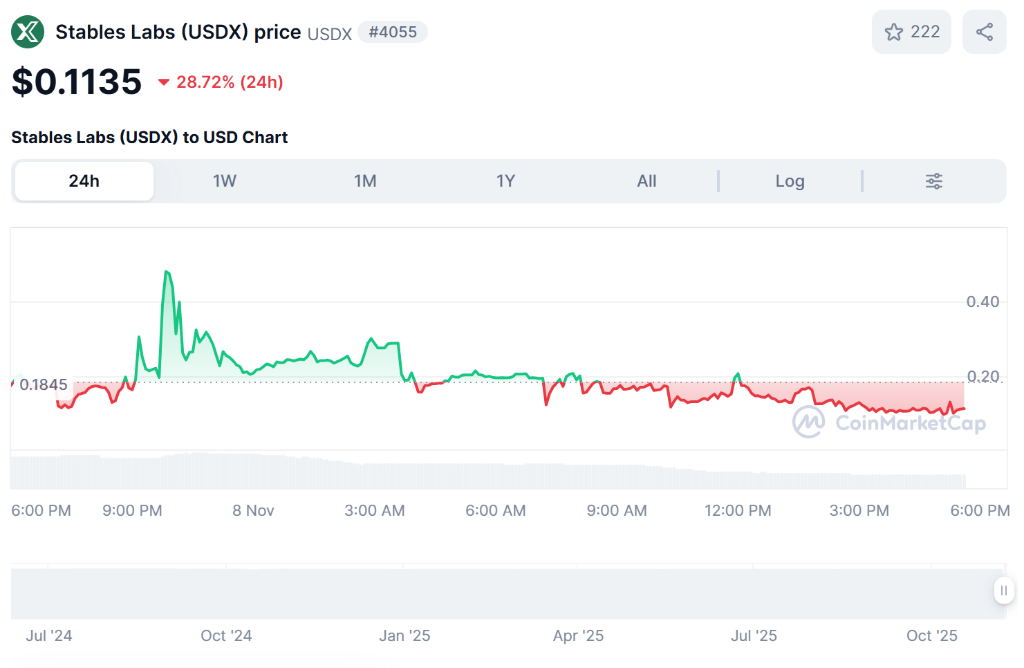
Core Viewpoint - The USDX stablecoin, issued by Stable Labs, has experienced a significant de-pegging from its $1 value, raising concerns about potential cascading effects on decentralized finance (DeFi) protocols [1][3] Group 1: Market Reaction - Following the de-pegging of USDX, major DeFi protocols like Lista DAO and PancakeSwap have taken immediate action to monitor the situation and mitigate risks [1][3] - Lista DAO initiated an emergency governance vote to authorize forced liquidation of related assets, citing a spike in borrowing rates and lack of repayment activity from major borrowers associated with Stable Labs [1][3] - The emergency vote (LIP 022) aims to minimize potential losses and maintain a healthy market environment within the ecosystem [3][5] Group 2: Liquidation Actions - Lista DAO executed a flash loan to recover over 2.9 million USD1 tokens before the governance vote [3][1] - The governance vote is set to conclude on November 9, with all participating veLISTA token holders expressing support for the proposal [3][7] - PancakeSwap has alerted users to monitor their positions related to the affected vaults [3][1] Group 3: Underlying Issues - Speculation surrounds the cause of USDX's de-pegging, with theories linking it to a recent $128 million theft from Balancer, which may have forced Stable Labs to liquidate its hedging positions [8][9] - Concerns have been raised about the management of USDX, with questions regarding the lack of active portfolio management and the apparent failure of borrowers to repay loans [8][9] - The silence from Stable Labs amidst the crisis has heightened market uncertainty, despite the company's notable investment background [9]
贸易战6天狂赚百亿,亚洲行收割了近万亿,川普如此捞钱还能走多远
Sou Hu Cai Jing· 2025-11-08 12:41
Core Insights - The article discusses the intertwining of power and money in American politics, particularly through the actions of Trump, highlighting significant financial maneuvers and investments during his presidency [1][12]. Group 1: Tariff Policies and Financial Gains - In early 2025, Trump announced a new round of tariffs on Chinese goods, which led to market volatility and significant financial gains for his inner circle, including a reported $5.7 billion profit for his son-in-law Kushner [3][5]. - The tariff policies are described as a mechanism for wealth transfer, benefiting Trump's family and allies while negatively impacting ordinary American consumers [5][12]. Group 2: International Investments and Economic Impact - During his 2025 Asia trip, Trump secured investment commitments of $550 billion from Japan and $350 billion from South Korea, framing the trip as a "super investment conference" [5][7]. - Trump's overseas ventures, particularly in the Middle East, resulted in a 650% increase in income from international licensing and partnerships, indicating a strong link between political actions and business opportunities [7][9]. Group 3: Cryptocurrency and New Economic Ventures - The article notes Trump's shift towards promoting cryptocurrency and NFTs, which have become significant sources of income for his family, with plans for a Bitcoin company to go public [9][12]. - The intertwining of political actions with emerging economic sectors like digital assets reflects a broader trend of capitalizing on new financial opportunities [9][12]. Group 4: Systemic Issues and Long-term Implications - The article suggests that the current system allows for the monetization of political power, leading to a deepening divide between the wealthy and the general populace, with potential long-term risks for American democracy [12][16]. - The transformation of political finance into a more overt system of wealth accumulation raises concerns about the erosion of trust in institutions and the implications for global governance [12][16].
连续被血洗!今年前十个月的涨幅,币圈一个月跌完了
华尔街见闻· 2025-11-08 12:01
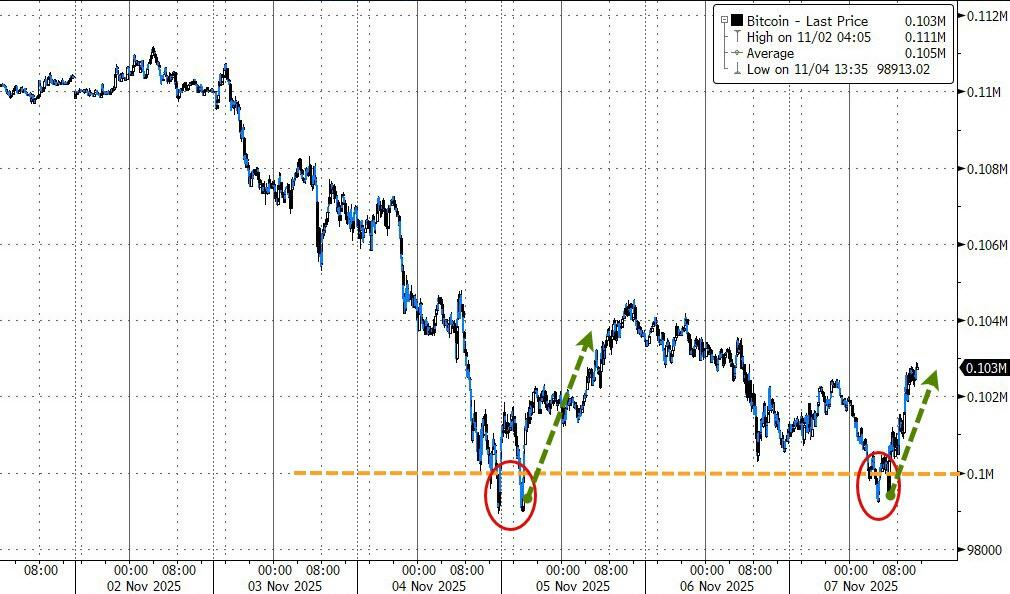
Core Insights - Bitcoin price stabilized above $103,000 after a week of sharp declines, but remains approximately 18% lower than the record high of $120,000 set on October 6 [1][2] - The total market capitalization of cryptocurrencies reached nearly $4.4 trillion on October 6 but has since dropped about 20%, leaving a year-to-date gain of only 2.5% [3] - The decline in cryptocurrency values is causing concern on Wall Street, as Bitcoin is viewed as a leading indicator for high-volatility sectors in the stock market [3][16] Market Trends - The recent downturn in cryptocurrencies coincides with a cooling off in AI tech stocks, indicating a decrease in risk appetite across high-risk asset classes [4] - U.S. tech stocks experienced their worst week since April, driven by concerns over AI valuations and actual returns [5] - Meme stocks, recent IPOs, and unprofitable tech stocks have all seen declines of over 10% from recent highs [6][7] Investor Sentiment - The "buy the dip" strategy, which had been effective previously, is now failing, leading to a significant shift in investor confidence [9][10] - Data shows that investors withdrew over $700 million from digital asset ETFs in the past week, with nearly $600 million coming from BlackRock's Bitcoin fund [12] - The performance of alternative coins has been notably worse, with little new capital flowing into these assets [13] Market Dynamics - Concerns over high valuations in AI stocks are contributing to the decline in digital assets, with warnings that Bitcoin could fall below $100,000 if tech stocks are sold off [8][20] - The number of "whale" investors holding large positions is decreasing, raising fears of tightening liquidity in the market [18][19] - A significant liquidation of approximately $19 billion in leveraged positions occurred weeks ago, and the market has yet to recover from this shock [15]
币圈血流成河之际,又一个稳定币“脱锚”
Hua Er Jie Jian Wen· 2025-11-08 10:59
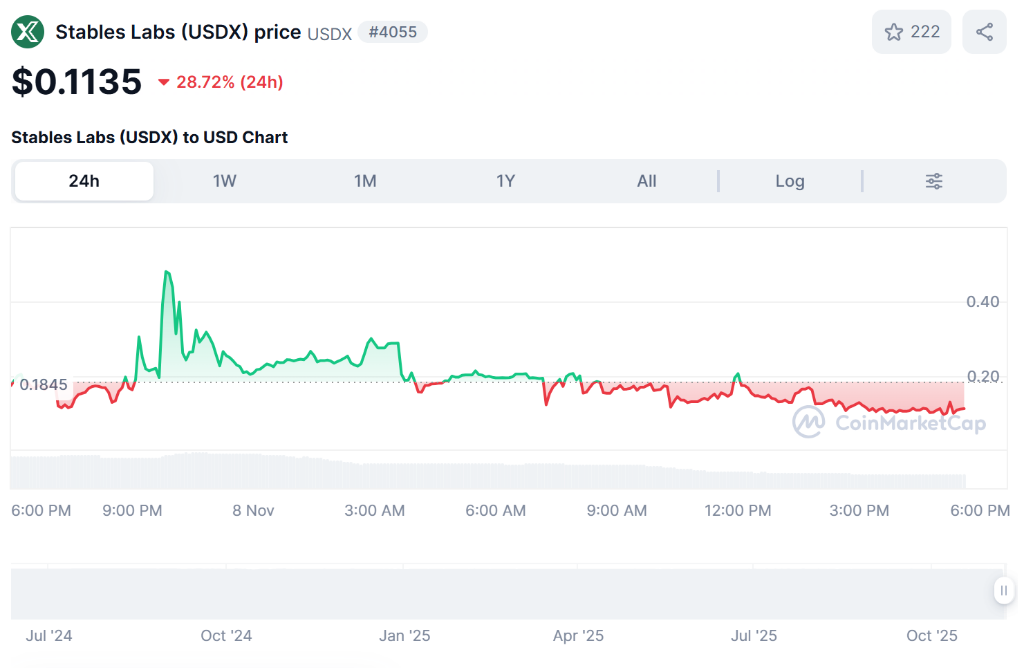
Core Insights - The synthetic stablecoin USDX issued by Stable Labs has experienced a significant de-pegging from its $1 value, raising concerns about potential cascading effects on decentralized finance (DeFi) protocols [1][3] - Major DeFi protocols, including Lista DAO and PancakeSwap, have initiated emergency measures to monitor the situation and mitigate risks associated with the USDX crisis [1][3] Group 1: Market Reaction - Following the de-pegging of USDX, Lista DAO launched an emergency governance vote (LIP 022) to authorize forced liquidation of assets linked to MEV Capital and Re7 Labs [3][4] - Lista DAO executed a flash loan to recover over 2.9 million USD1 tokens, aiming to contain the crisis before it escalated further [1][3] - PancakeSwap has alerted users to monitor their positions in affected liquidity pools, indicating the widespread impact of the USDX situation [5][6] Group 2: Underlying Issues - Speculation regarding the cause of USDX's de-pegging includes a potential link to a $128 million theft from Balancer, which may have forced Stable Labs to liquidate its Bitcoin and Ethereum short positions [7][8] - Concerns have been raised about the management of USDX, with questions about the lack of active portfolio management and the apparent failure of major borrowers to repay loans [7][8] Group 3: Company Background - Stable Labs, the issuer of USDX, claims to comply with EU MiCA regulations and has a notable investment background, having raised $45 million at a $275 million valuation [8] - Despite its significant backing from well-known investors, Stable Labs has remained silent regarding the USDX crisis, contributing to market uncertainty [8]
连续被血洗!今年前十个月的涨幅,币圈一个月跌完了
美股IPO· 2025-11-08 08:19
Core Insights - The cryptocurrency market experienced a significant decline, erasing nearly all gains accumulated in the first ten months of the year, with a total market cap drop of about 20% from a peak of nearly $4.4 trillion on October 6, leaving only a 2.5% year-to-date increase [1][5][6] Market Performance - Bitcoin's price stabilized above $103,000 after a week of sharp declines, but it remains approximately 18% lower than its record high of $120,000 set on October 6 [3][4] - The overall cryptocurrency market has shown weakness, causing concern among Wall Street analysts, as Bitcoin is viewed as a leading indicator for high-volatility stocks in the U.S. [5][14] Investor Sentiment - The traditional "buy the dip" strategy appears to be failing, leading to increased market caution and a significant shift in investor behavior [10][11] - Recent data indicates that investors withdrew over $700 million from digital asset ETFs in just one week, with nearly $600 million flowing out of BlackRock's Bitcoin fund [11] Altcoin Performance - Alternative coins have performed even worse than Bitcoin, with a lack of new capital inflow into the market for altcoins or DeFi projects [12] - A significant liquidation of a $19 billion leveraged position weeks ago has left the market struggling to recover [13] Market Indicators - Bitcoin is increasingly seen as a "canary in the coal mine," with its price fluctuations serving as a leading indicator for high-volatility tech stocks and retail liquidity [14][15] - The number of "whale" investors holding large positions has decreased, raising concerns about tightening liquidity in the market [16] Future Outlook - Analysts warn that if Bitcoin falls below the critical support level of $100,000, further sell-offs may occur, potentially driving the price down to $70,000 in the near future [17]

Bitcoin Survives the $100,000 Crash Test — What’s Next for the Market?
Yahoo Finance· 2025-11-08 07:17
Core Insights - Bitcoin's recent dip below $100,000 tested investor confidence, but it quickly rebounded, establishing a new psychological support level [1] - Analysts generally maintain a bullish outlook for Bitcoin despite short-term volatility, with the US government shutdown seen as a significant price constraint [1] Group 1: Market Analysis - PlanB views the recent correction as a mid-cycle pause, noting that Bitcoin has remained above $100,000 for six consecutive months, indicating a shift from resistance to support [2] - PlanB anticipates that the next major price movement could target the range of $250,000 to $500,000, contingent on Bitcoin's divergence from its realized price [4] Group 2: Liquidity Dynamics - Arthur Hayes links Bitcoin's short-term weakness to tightening US dollar liquidity, attributing this to the increase in the Treasury General Account (TGA) since the US debt ceiling was raised [5] - Hayes predicts that once the US government reopens and reduces its TGA balance, it will initiate a "stealth QE," indirectly injecting liquidity into the market [5] - Raoul Pal's liquidity model supports this view, indicating that the current phase is a "Window of Pain," but he expects a sharp reversal in liquidity conditions soon [6]
连续被血洗!今年前十个月的涨幅,币圈一个月跌完了
Hua Er Jie Jian Wen· 2025-11-08 01:53
Core Insights - Bitcoin experienced a significant drop, falling below $100,000 twice this week before rebounding to above $103,000, but it remains approximately 18% lower than its record high of $120,000 set on October 6 [2][3] - The total market capitalization of cryptocurrencies reached nearly $4.4 trillion on October 6 but has since fallen about 20%, leaving a year-to-date increase of only 2.5% for the entire asset class [3] - The decline in cryptocurrency prices is causing concern on Wall Street, as Bitcoin is viewed as a leading indicator for high-volatility stocks in the U.S. market [3][12] Market Trends - The recent cryptocurrency downturn coincides with a decline in AI tech stocks, indicating a cooling of risk appetite in high-risk asset classes [4] - Meme stocks and recently IPO'd companies, which have been popular among retail investors, have also seen declines of over 10% from recent highs [4][5] - Concerns over the high valuations of AI stocks are partially attributed to the drop in digital assets, with warnings that if tech stocks continue to sell off, Bitcoin could fall below the $100,000 mark [6][12] Investor Behavior - The previously strong "buy the dip" mentality among investors is being tested, with a noticeable shift in market sentiment [7][8] - Data indicates a cautious sentiment among investors, with over $700 million withdrawn from digital asset ETFs in the past week, including nearly $600 million from BlackRock's Bitcoin fund [9] - The lack of new capital inflow into alternative tokens and DeFi projects suggests a stagnant market, with many areas of the crypto market remaining defensive [9][10] Market Dynamics - Analysts note that there is insufficient new capital to offset the exits of local investors, and a recovery in upward trends may require "whales" to stop selling [10] - A significant liquidation of approximately $19 billion in leveraged positions occurred weeks ago, and the market has yet to recover from that shock [11] - Bitcoin is increasingly seen as a "canary in the coal mine," with its price fluctuations serving as an early warning signal for high-volatility tech stocks and retail liquidity [12][13] Whale Activity - The number of "whale" investors holding large positions has been declining, which raises concerns about tightening liquidity in the market [13][14] - The potential for Bitcoin to fall below the critical support level of $100,000 could indicate that further sell-offs are imminent, with predictions of a possible drop to $70,000 in the near future [14]
Crypto markets rebound after volatile week that saw bitcoin drop below $100,000
Youtube· 2025-11-07 21:34
Group 1: Crypto Market Overview - The crypto markets are experiencing a rebound after a volatile week, with Bitcoin briefly falling below the $100,000 mark due to macroeconomic uncertainties affecting risk assets [2] - Despite the overall negative sentiment, some investors are taking the opportunity to buy the dip, leading to a rise in corporate treasury stocks [3] - Institutional ETF trading volume remains low, with net inflows into spot Bitcoin funds being negative for the week [2] Group 2: Corporate Involvement and Trends - Companies such as ETHZilla, backed by notable figures like Peter Thiel, and others like Tom Lee's Bit Mine and Immersion, are seeing their Ether proxy trades increase after a down week [3] - Strategy remains the largest corporate holder of Bitcoin, indicating ongoing corporate interest in the cryptocurrency [3] - Kathy Wood from ARK Invest suggests that stablecoins are beginning to encroach on Bitcoin's expected dominance, particularly in emerging markets [4]
赵长鹏透露他为至少12个国家提供加密货币方面的建议
Sou Hu Cai Jing· 2025-11-07 17:13
Core Insights - Changpeng Zhao (CZ) has transitioned from CEO of Binance to a global policy advisor, providing insights on cryptocurrency regulation and adoption strategies to at least 12 countries [1][10] - His involvement in Kyrgyzstan's national cryptocurrency strategy highlights significant advancements, including the launch of a national stablecoin and the legal recognition of a central bank digital currency (CBDC) [4][10] Group 1: National-Level Advisory Role - CZ is assisting Kyrgyzstan in developing its national cryptocurrency strategy, which includes the introduction of the KGST stablecoin, pegged 1:1 to the national currency, Som [4] - The Digital Som, Kyrgyzstan's CBDC, has received legal recognition, with plans for its use in government payments, marking a significant shift in the country's financial infrastructure [4][6] - CZ clarified misconceptions regarding his role, stating he has no interest in operating a bank, emphasizing his position as an advisor rather than an operator [4] Group 2: Educational and Technological Initiatives - CZ's initiatives include establishing a national cryptocurrency reserve containing various digital assets to enhance financial resilience [6] - Binance Academy has partnered with 10 universities in Kyrgyzstan to develop courses aimed at cultivating blockchain talent [6] - Binance is providing training to local law enforcement, and CZ's family fund is collaborating with the Kyrgyz government to develop smart contract infrastructure [6] Group 3: Philanthropic and Future-Oriented Vision - Despite a peak net worth of $87.3 billion, CZ emphasizes the importance of helping others and improving the world, leading to the creation of Giggle Academy, a nonprofit providing free online education [5][10] - He envisions a future where cryptocurrency serves as the primary medium for AI economic activities, predicting a significant increase in microtransactions facilitated by blockchain technology [8][10]