基金管理

Search documents
易方达创业板50交易型开放式指数证券投资基金联接基金基金份额发售公告
Zhong Guo Zheng Quan Bao - Zhong Zheng Wang· 2025-11-26 04:22
Group 1 - The fund is named E Fund ChiNext 50 Exchange-Traded Open-Ended Index Fund Linked Fund, with A class code 026095 and C class code 026096 [20] - The fund is a contractual open-ended index fund and linked fund, with an indefinite duration [20] - The fund aims to closely track the performance benchmark, minimizing tracking deviation and tracking error [21] Group 2 - The initial fundraising cap for the fund is set at 8 billion RMB, excluding interest accrued during the fundraising period [2] - If the total valid subscription amount exceeds 8 billion RMB, the fund manager will implement a proportionate confirmation method to control the scale [2][3] - The calculation method for the proportionate confirmation on the last day is provided, ensuring that the total valid subscription amount is managed effectively [3] Group 3 - The fund will be publicly offered from December 1, 2025, to December 26, 2025, with the possibility of adjusting the fundraising period based on subscription conditions [4][23] - The minimum subscription amount for individual investors through non-direct sales institutions is set at 1 RMB, while the minimum for direct subscriptions is 50,000 RMB [5][6] Group 4 - The fund's investment target is to invest at least 90% of its net asset value in the target ETF [15] - The fund will not open conversion services between different share classes initially, but may do so in the future [2] Group 5 - The fund's underlying index is the ChiNext 50 Index, which consists of the top 50 stocks based on average daily trading volume over the last six months [9][10] - The index is calculated using a weighted method, ensuring real-time updates based on stock prices and weights [12]


华桥汇利中国投资基金管理有限公司:经济学家预测美国明年经济小幅加速 就业市场仍显疲软
Sou Hu Cai Jing· 2025-11-26 02:48
Economic Outlook - Economists have raised their median forecast for U.S. economic growth next year to 2%, an increase of 0.2 percentage points from the previous month and a significant rise from 1.3% six months ago [4] - The main drivers of economic growth are expected to be personal consumption and business investment, although nearly all economists anticipate that current tariff policies will drag down economic growth by at least 0.25 percentage points [4] Employment Market - The U.S. job market is projected to add approximately 64,000 jobs per month, which is slightly above the current year's end level but still far below recent norms [7] - The unemployment rate is expected to rise to 4.5% at the beginning of next year and remain within this range throughout the year [7] Inflation and Monetary Policy - Inflation is expected to decline to 2.9% by the end of this year and only slightly decrease to 2.6% next year, with new import tariffs contributing an estimated 0.25 to 0.7 percentage points to inflation [7] - Economists predict that the Federal Reserve will cut interest rates by 25 basis points in December and an additional 50 basis points throughout next year, gradually moving towards a neutral rate [7] Trade Policy Impact - Trade policies are seen as a key variable that could disrupt growth prospects, potentially increasing costs and compressing corporate profit margins while also limiting consumer spending [10] - Market participants are advised to closely monitor upcoming data releases to verify whether these economic forecasts align with actual economic performance [10]


这些基金可以抄底了吗?
Sou Hu Cai Jing· 2025-11-25 22:51
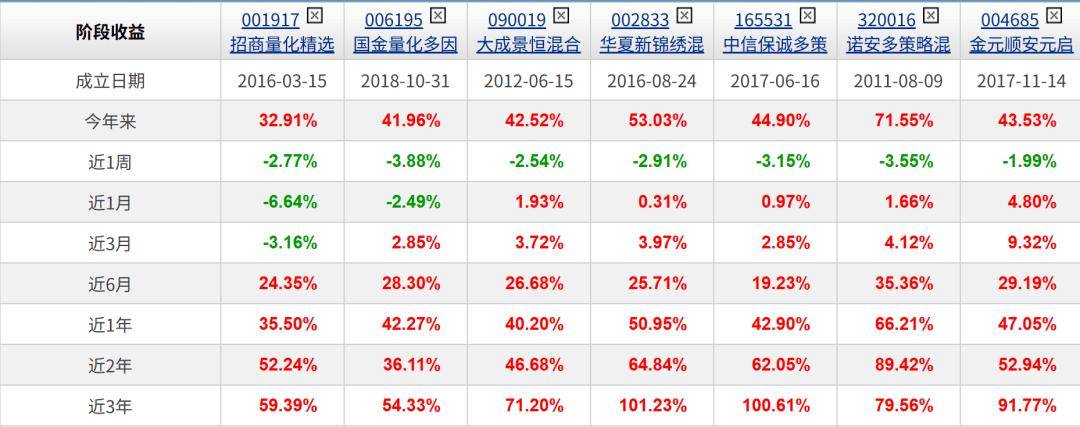
Core Insights - The recent market sentiment has improved, particularly in the artificial intelligence and new energy sectors, which have shown significant gains after previous adjustments [1] - Active quantitative funds have provided opportunities for entry due to recent adjustments, with some funds showing returns exceeding 40% this year [1] - The performance of various active quantitative funds varies, with some experiencing significant drawdowns while others remain relatively stable [1][4][6][8] Fund Performance Summary - **招商量化精选股票A**: Experienced a drawdown of -3.46% on November 21, followed by gains of 1.26% and 1.31% on subsequent days [11] - **国金量化多因子股票A**: Noted a significant drawdown of -4.85% on November 21, with minor recoveries of 0.31% and 2.14% [11] - **大成景恒混合A**: Showed a drawdown of -2.71% on November 21, with recoveries of 0.80% and 0.84% [11] - **华夏新锦绣混合A**: Experienced a drawdown of -3.23% on November 21, followed by recoveries of 0.94% and 1.11% [11] Fund Characteristics - Active quantitative funds typically have diversified holdings across many stocks, with individual stock allocations not exceeding 2% [1] - These funds utilize quantitative models combined with subjective strategies for stock selection, aiming for high returns with low volatility [1] - Some funds, like 神基, have not opened for new purchases despite high returns, indicating limited capacity [1]
人保上证科创板综合指数增强型证券投资基金基金合同、招募说明书及基金产品资料概要提示性公告
Shang Hai Zheng Quan Bao· 2025-11-25 17:58
Group 1 - The announcement includes the full text of the fund contract, prospectus, and product summary for the PICC Shanghai Stock Exchange Sci-Tech Innovation Board Enhanced Index Securities Investment Fund, which will be disclosed on November 26, 2025 [1] - The fund manager commits to managing and utilizing fund assets with honesty, diligence, and responsibility, but does not guarantee profits or minimum returns [1] - Investors are advised to fully understand the risk-return characteristics of the fund and make prudent investment decisions [1]
人保上证科创板综合指数增强型证券投资基金基金份额发售公告
Shang Hai Zheng Quan Bao· 2025-11-25 17:55
Core Points - The fund "PICC SSE Sci-Tech Innovation Board Comprehensive Index Enhanced Securities Investment Fund" is approved for fundraising by the China Securities Regulatory Commission (CSRC) [1] - The fund is an open-ended, equity-type securities investment fund managed by PICC Asset Management Co., Ltd. and custodied by Suzhou Bank Co., Ltd. [1][2] - The fundraising period is from December 5, 2025, to March 4, 2026, with specific conditions for the fund to be considered successful [14][30] Fund Details - Fund Name: PICC SSE Sci-Tech Innovation Board Comprehensive Index Enhanced Securities Investment Fund [11] - Fund Code: 024741 for Class A and 024742 for Class C [12] - Initial Fund Share Value: 1.00 RMB [11] - Target Investors: Individual and institutional investors, qualified foreign institutional investors, and other investors permitted by laws and regulations [11] Subscription Process - Investors must open a fund account through the designated registration institution during the fundraising period [2][20] - Minimum initial subscription amount is 1 RMB for online subscriptions and 10,000 RMB for direct sales [2][19] - Investors can make multiple subscriptions during the fundraising period, but once accepted, subscription applications cannot be withdrawn [20][19] Fund Management and Custody - Fund Manager: PICC Asset Management Co., Ltd., established on July 16, 2003, with a registered capital of 1,298 million RMB [32] - Custodian: Suzhou Bank Co., Ltd., established on December 24, 2004, with a registered capital of approximately 3,666.72 million RMB [32] Fund Operation and Regulations - The fund operates under a contract-based open-ended structure with no fixed duration [11] - The fund's total fundraising must reach at least 200 million RMB and involve at least 200 investors to proceed with the establishment [30] - If the fundraising conditions are not met, the fund will be deemed unsuccessful, and investors will be refunded their contributions with interest [30]
外资机构明年投资展望现共识:看好A股配置价值
Zheng Quan Ri Bao· 2025-11-25 16:17
本报记者 昌校宇 近日,多家外资机构相继发布了2026年投资展望。尽管各份报告的侧重点不同,但都一致提高了对中国市场的关注度,并 从宏观环境、资产估值、结构性机会等维度形成了一系列具有共性的判断。 联博基金预计,为在竞争中保持领先,全球企业将持续加码AI投入至少至2026年,这有望为相关企业的盈利增长提供可持 续的支撑。此外,AI技术在各行业的落地步伐也在加快。在此背景下,中国市场的AI赋能板块或仍具备配置价值。 联博基金市场策略负责人李长风建议关注A股市场中具备持续成长性的科技与新消费板块,他认为相关企业或直接受益于 创新驱动。 在固定收益领域,外资机构普遍看好新兴市场债券的长期配置价值。 外资机构普遍认为,全球经济正迈入新阶段,结构性转变将持续重塑资本流动与资产配置格局,新兴市场有望在这一环境 中获益,中国市场的相对吸引力将持续提升。 联博基金在题为《支撑2026年权益市场的主旋律未变》的市场评论中表示,"美联储货币政策将持续带动资金涌入包含中 国股市在内的新兴市场,此结构性趋势并未改变。" 高盛资产管理在题为《于复杂环境中捕捉新契机》的报告中提到,在美元走弱、油价回落以及美联储鸽派立场等多重宏观 条件支 ...
利安推出首只全额投保且安全存放于新加坡的实物黄金基金,巩固新加坡作为领先黄金枢纽的地位
Sou Hu Cai Jing· 2025-11-25 08:59
利安新加坡实物黄金基金是新加坡首只完全由实物黄金支持、投保且安全存放于新加坡金库的黄金基 金。正值新加坡建国 60 周年之际推出的这一里程碑式产品,充分发挥了新加坡作为全球金融中心和领先 黄金中心的双重优势。 新加坡2025年11月25日/美通社/ -- 华侨银行集团(OCBC Group)成员利安资金管理公司(简称利 安),今天宣布推出利安新加坡实物黄金基金(LionGlobal Singapore Physical Gold Fund),这是新加 坡首只在新加坡投保并安全储存的实物黄金基金。该基金将由华侨银行、MariBank Singapore、大东方 和Singlife集团负责零售分销,并指定渣打银行新加坡为基金托管人,这是新加坡金融业领军企业首次 携手合作推出旗舰级黄金产品,此项合作写下新的里程碑,体现了业界共同致力于提升新加坡作为区域 领先黄金枢纽的承诺。 在地缘政治不确定性日益加剧的背景下,黄金仍被视为可靠的避险资产。尽管纽约和伦敦等传统交易中 心仍具影响力,但全球黄金市场正稳步向东转移[1]。新加坡邻近全球25%的黄金产量来源国[2],加上 其地缘政治中立以及战略地理位置的优势,使其具备成为领 ...

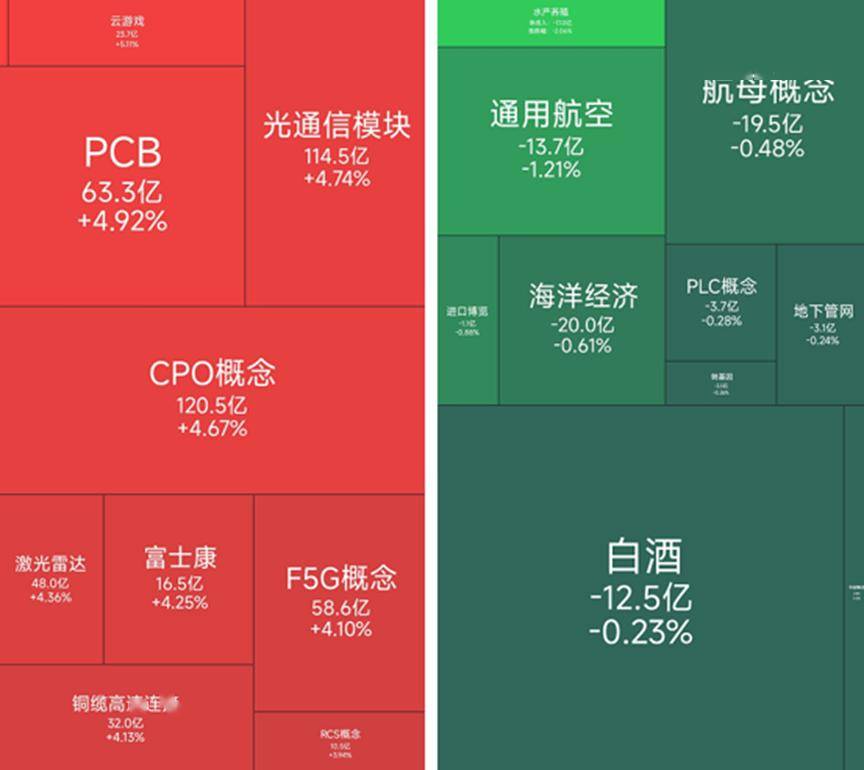
PCB、CPO概念板块走强,15位基金经理发生任职变动
Sou Hu Cai Jing· 2025-11-25 07:56
新基金经理上任方面,东方基金吴萍萍现任基金资产总规模为562.33亿元,管理过的基金多为债券型和指数型基金,任职 期间回报最高的产品是东方中债1-5年政策性金融债C(012404),为指数型基金,在任职的2年又242天时间内获得 156.66%的回报。新上任东方强化收益债券A、东方强化收益债券C这两只基金产品的基金经理。 | | | 基金代码 | 公告日期 | 3 | | | | --- | --- | --- | --- | --- | --- | --- | | | | 022638 | 2025/11/25 | 20: | | | | | 东方招益债券A | 022637 | 2025/11/25 | 2025/11/25 | 在职 | 开始任职 | | 杨贵宾 | 东方欣冉九个月持有期混合A | 014354 | 2025/11/25 | 2025/11/25 | 在眼 | 开始任职 | | | 东方欣冉九个月持有期混合C | 014355 | 2025/11/25 | 2025/11/25 | 在职 | 开始任职 | | 徐奥千 | 东方民丰回报赢安混合A | 004005 | 2025/11/25 ...
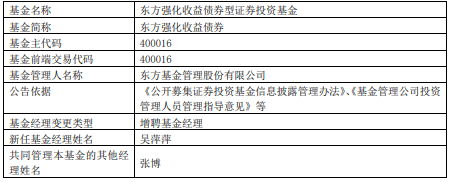
东方强化收益债券增聘吴萍萍
Zhong Guo Jing Ji Wang· 2025-11-25 07:52
东方强化收益债券A成立于2012年10月9日,截至2025年11月24日,其今年来收益率为4.60%,成立 来收益率为70.90%,累计净值为1.6210元。东方强化收益债券C成立于2025年11月18日。 | 基金名称 | 东方强化收益债券型证券投资基金 | | --- | --- | | 基金简称 | 东方强化收益债券 | | 基金主代码 | 400016 | | 基金前端交易代码 | 400016 | | 基金管理人名称 | 东方基金管理股份有限公司 | | 公告依据 | 《公开募集证券投资基金信息披露管理办法》、《基金管理公司投资 | | | 管理人员管理指导意见》等 | | 基金经理变更类型 | 增聘基金经理 | | 新任基金经理姓名 | 吴萍萍 | | 共同管理本基金的其他经 | 张博 | | 理姓名 | | (责任编辑:康博) 中国经济网北京11月25日讯 今日,东方基金公告,东方强化收益债券增聘吴萍萍。 吴萍萍,公司总经理助理、固定收益投资副总监、公募投资决策委员会副主任委员,中国人民大学 应用经济学硕士,14 年证券从业经历。曾任安信证券投资组资金交易员、民生加银基金管理有限公司 专户投资经 ...
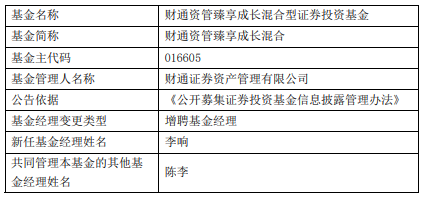
财通资管臻享成长混合增聘李响
Zhong Guo Jing Ji Wang· 2025-11-25 07:52
| 基金名称 | 财通资管臻享成长混合型证券投资基金 | | --- | --- | | 基金简称 | 财通资管臻享成长混合 | | 基金主代码 | 016605 | | 基金管理人名称 | 财通证券资产管理有限公司 | | 公告依据 | 《公开募集证券投资基金信息披露管理办法》 | | 基金经理变更类型 | 增聘基金经理 | | 新任基金经理姓名 | 李响 | | 共同管理本基金的其他基 | 陈李 | | 金经理姓名 | | 中国经济网北京11月25日讯 今日,财通证券资产管理公告,财通资管臻享成长混合增聘李响。 李响曾在东方证券股份有限公司、上海东方证券资产管理有限公司工作。2023年5月加入财通证券 资产管理有限公司,曾任权益研究部总经理,现任总经理助理兼权益投资总监。 财通资管臻享成长混合A/C成立于2023年3月2日,截至2025年11月24日,其今年来收益率为 27.11%、26.67%,成立来收益率为16.50%、15.24%,累计净值为1.1650元、1.1524元。 (责任编辑:康博) ...