仓储和邮政业

Search documents
1-4月,济南规模以上工业实现增加值同比增长9.0%
Qi Lu Wan Bao Wang· 2025-05-27 06:54
Economic Overview - Jinan's economy shows a stable and improving trend in the first four months of the year, supported by precise policies and macroeconomic coordination [1] Industrial Production - The city's industrial output increased by 9.0% year-on-year, with significant growth in the computer, communication, and electronic equipment manufacturing sector at 103.0%, and automotive manufacturing at 39.5% [1] - Equipment manufacturing grew by 27.2%, outperforming the overall industrial growth by 18.2 percentage points [1] - High-tech manufacturing also performed well, with a 26.1% increase in output, contributing 4.9 percentage points to the overall industrial growth [1] Fixed Asset Investment - Fixed asset investment rose by 1.4% year-on-year, with the primary industry seeing a substantial increase of 210.6% and the secondary industry growing by 14.7% [2] - Industrial investment grew by 13.8%, contributing 2.3 percentage points to the overall investment growth [2] - High-tech industry investment increased by 13.8%, while real estate development investment declined by 2.0% [2] Service Sector Performance - The service sector's revenue reached 1111.8 billion yuan, growing by 6.3% year-on-year, with nine out of ten major industries reporting revenue growth [3] - The transportation, storage, and postal services sector generated 469.5 billion yuan, accounting for 42.2% of the service sector's total revenue, and grew by 6.4% [3] - The rental and business services sector also performed well, with a revenue increase of 14.2% [3] Retail Sales and Consumer Behavior - Retail sales in Jinan reached 654.2 billion yuan, a 3.0% increase year-on-year, with urban retail sales growing by 3.2% [4] - The sales of communication equipment surged by 71.2% due to the "trade-in" policy, while new energy vehicle sales increased by 21.9% [4] - Online retail sales grew significantly by 32.7%, reaching 172.4 billion yuan [4] Fiscal and Financial Overview - Public budget revenue was 452.5 billion yuan, a 1.5% increase, while tax revenue decreased by 1.3% [4] - Financial institutions reported a 4.9% increase in deposits and a 10.6% increase in loans by the end of April [4] Foreign Trade - Jinan's total import and export value reached 793.4 billion yuan, a 22.4% increase, with exports growing by 10.4% and imports by 49.6% [5] - General trade accounted for 92.3% of the total trade volume, growing by 23.3% [5] Price Trends - Consumer prices rose by 0.5% cumulatively, with a 0.6% increase in April, showing a mixed trend across eight categories of goods and services [5]
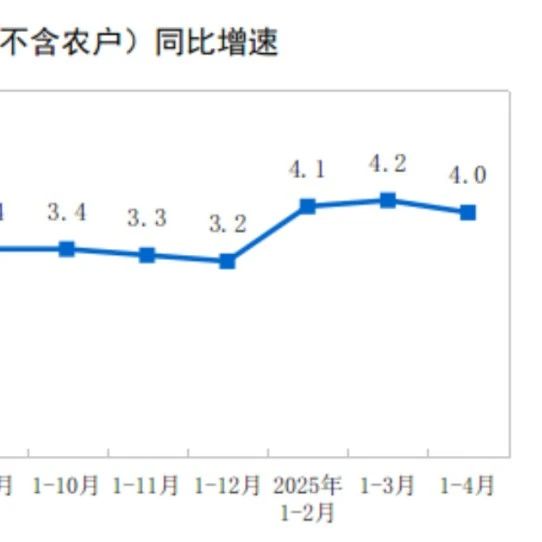
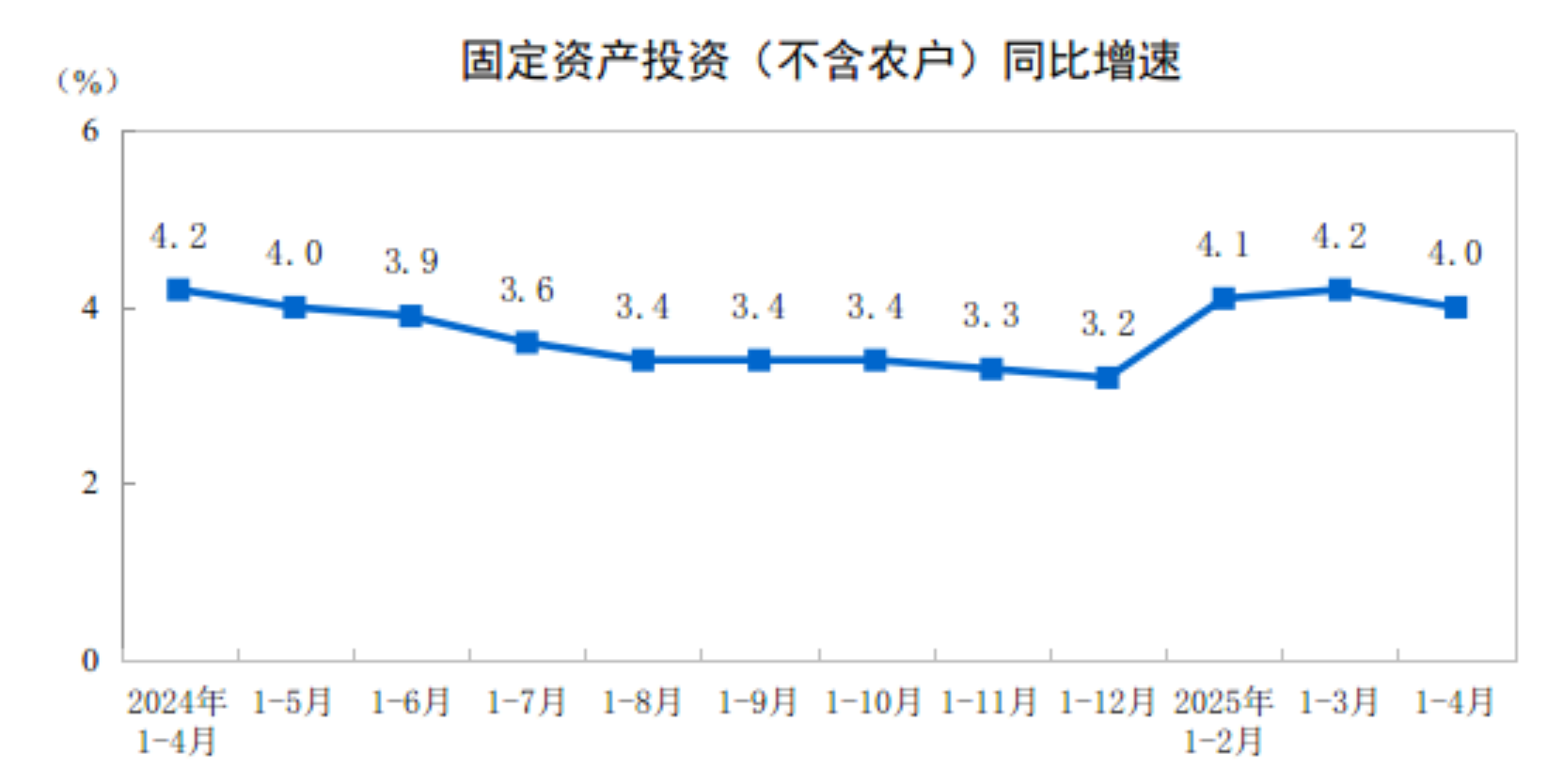
【数据发布】2025年1—4月份全国固定资产投资增长4.0%
中汽协会数据· 2025-05-19 07:11
Core Viewpoint - The fixed asset investment in China for January to April 2025 shows a year-on-year growth of 4.0%, with private investment growing only 0.2%, indicating a mixed recovery in investment across different sectors and regions [1][2]. Investment Overview - Total fixed asset investment (excluding rural households) reached 14,702.4 billion yuan, with a year-on-year increase of 4.0% [1][2]. - The industrial investment grew by 11.7%, with mining investment increasing by 6.3% and manufacturing investment by 8.8% [1][2]. - The service sector experienced a decline of 0.2% in investment, highlighting challenges in this area [1][2]. Sector Analysis - First industry investment was 297.1 billion yuan, up 13.2% year-on-year [1][2]. - Second industry investment totaled 51,778 billion yuan, with notable growth in electricity, heat, gas, and water production and supply at 25.5% [1][2]. - Third industry infrastructure investment (excluding power, heat, gas, and water) grew by 5.8%, with water management investment surging by 30.7% [1][2]. Regional Investment Trends - Eastern region investment grew by 1.3%, while the central region saw a 4.8% increase, and the western region grew by 5.3% [1][2]. - The northeastern region had the highest growth at 7.6%, indicating a regional disparity in investment performance [1][2]. Investment by Registration Type - Domestic enterprises' fixed asset investment increased by 3.9%, while investment from Hong Kong, Macau, and Taiwan enterprises rose by 9.2% [1][2]. - Foreign enterprises, however, saw a significant decline in investment by 11.4%, reflecting potential challenges in attracting foreign capital [1][2].

2025年1—4月份全国固定资产投资增长4.0%
Guo Jia Tong Ji Ju· 2025-05-19 02:01
Core Insights - In the first four months of 2025, China's fixed asset investment (excluding rural households) reached 14,702.4 billion yuan, showing a year-on-year growth of 4.0% [2][4] - Private fixed asset investment grew by only 0.2% year-on-year, indicating a sluggish performance in this sector [2][4] Investment by Industry - Investment in the primary industry was 297.1 billion yuan, with a year-on-year increase of 13.2% [3][4] - The secondary industry saw an investment of 51,778 billion yuan, growing by 11.7% year-on-year, with notable growth in manufacturing and energy sectors [3][4] - The tertiary industry experienced a decline of 0.2% year-on-year, with infrastructure investment (excluding energy sectors) increasing by 5.8% [3][4] Investment by Region - Eastern regions reported a year-on-year investment growth of 1.3%, while central, western, and northeastern regions grew by 4.8%, 5.3%, and 7.6% respectively [3][4] Investment by Ownership Type - Domestic enterprises' fixed asset investment increased by 3.9%, while investment from Hong Kong, Macau, and Taiwan enterprises rose by 9.2%. In contrast, foreign enterprises saw a significant decline of 11.4% [3][4][5]
多家公司密集公告赴港上市!年内新增A+H公司将创近年新高
Nan Fang Du Shi Bao· 2025-05-16 08:49
Core Viewpoint - The number of "A+H" companies is significantly increasing in 2025, driven by favorable policies supporting domestic companies to list in Hong Kong, with expectations that the total will exceed the number from 2022 [1][2][3] Group 1: A+H Company Listings - In 2025, 22 A-share companies have submitted applications to list on the Hong Kong Stock Exchange, with 11 of these submissions occurring in April alone [2] - As of now, 25 A-share companies have applied to list in Hong Kong, with 22 being first-time applicants this year [2] - Notable companies like Ningde Times and Heng Rui Pharmaceutical have passed the Hong Kong Stock Exchange's hearing and are expected to list soon [2][3] Group 2: Financing and Internationalization - Many A-share companies aim to leverage Hong Kong's financing capabilities to accelerate their internationalization process [3][5] - Companies like Midea Group and SF Holding have outlined their fundraising purposes to enhance global operations and logistics networks [3][5] Group 3: Regulatory Support - A series of supportive policies initiated in April 2024 has facilitated the surge in companies seeking to list in Hong Kong [6][7] - The China Securities Regulatory Commission has streamlined the approval process for companies looking to list abroad, reducing the time and requirements for applications [7][8] Group 4: Market Performance Post-Listing - Companies that have listed in Hong Kong have shown significant growth in overseas business and overall revenue, with Midea's overseas e-commerce sales increasing over 50% year-on-year [4][10] - The performance of A+H companies post-listing indicates a narrowing of the price difference between A-shares and H-shares, reflecting improved market conditions [10][11] Group 5: Future Outlook - Deloitte forecasts that the total amount raised from IPOs in Hong Kong could reach between 130 billion to 150 billion HKD in 2025, potentially placing it back among the top three global markets for new stock offerings [1][9] - The trend of A-share companies listing in Hong Kong is expected to continue, with an anticipated wave of IPOs in the second half of 2025 [2][9]



谈论休息权之前,请让我准时下班
Hu Xiu· 2025-05-14 12:24
Core Viewpoint - The article discusses the gap between the ideal of "rest rights" as a legal entitlement and the reality faced by workers in China, highlighting the challenges in achieving a balanced work-life dynamic in the context of evolving labor relations and economic conditions [3][4][16]. Group 1: Historical Context and Current Trends - John Maynard Keynes envisioned a future where people would only need to work 15 hours a week by the 21st century due to technological advancements [2]. - The implementation of the "8-hour workday" in China's Labor Law in 1995 has not led to the expected reduction in working hours, with average weekly hours rising to 49 in 2023 [3]. - Despite a slight decrease to 48.6 hours projected for 2024, the average workday still exceeds 8 hours, reflecting a stagnation in labor rights progress [3]. Group 2: The Concept of Rest Rights - The concept of "rest rights" is evolving, with traditional definitions becoming obsolete due to changes in labor dynamics brought about by technology and the gig economy [4][5]. - Rest rights are defined legally as a means to balance the interests of labor and capital regarding time allocation, but current practices show a significant gap between legal entitlements and actual worker experiences [6][8]. Group 3: Labor Relations and Legal Challenges - The rise of gig economy jobs complicates the recognition of labor relationships, making it difficult for workers to claim their rights under existing labor laws [10][11]. - Current legal frameworks struggle to protect flexible workers, as many platforms exploit complex employment models to evade obligations [11][12]. - The lack of clear legal recognition for new employment forms leads to inadequate protections for workers, relying instead on lower-tier guidelines from government agencies [11][12]. Group 4: Future Considerations and Cultural Shifts - The article suggests that to effectively promote rest rights, there needs to be a cultural shift towards integrating leisure and work, emphasizing the importance of both financial and time resources for consumers [17]. - The impact of AI on labor dynamics is discussed, with potential for both increased productivity and further alienation of workers, raising questions about the distribution of resources generated by AI [18][19].
一季度杭州GDP增长5.2%
Hang Zhou Ri Bao· 2025-04-29 02:31
4月28日,杭州市统计局、国家统计局杭州调查队发布一季度杭州经济运行情况,根据地区生产总 值统一核算结果,一季度全市生产总值5715亿元,按不变价格计算,同比增长5.2%,比上年全年、上 年一季度分别加快0.5和0.1个百分点。 "伴随着政策集成效应持续显现,新质生产力不断培养壮大,开年以来全市经济延续向新向好态 势,实现良好开局。"杭州市统计局相关负责人表示。"此外,第二产业增长5.8%,第三产业增长 5.0%,二三产业发展更加协调。" 出口较快增长,贸易结构继续优化。一季度,全市货物进出口总额2103亿元,同比增长10.8%,比 上年全年加快4.4个百分点,其中,出口1471亿元,增长18.7%。民营企业货物出口1115亿元,增长 19.3%,占货物出口的75.8%。新兴市场加快拓展,对共建"一带一路"国家出口712亿元,增长23.7%, 高于全部出口增速5.0个百分点。 一季度居民收入增加,农村居民收入增长快于城镇,城乡居民收入倍差继续缩小。一季度,全市居 民人均可支配收入25122元,同比增长4.3%。 此外,营商环境持续优化也在吸引更多创新力量在杭州集聚。一季度,杭州新设市场经营主体8.4 万户,同 ...
一季度湖北GDP为13543.49亿元 同比增长6.3%
Zhong Guo Jing Ji Wang· 2025-04-28 06:47
Economic Overview - In the first quarter, the province achieved a GDP of 13,543.49 billion yuan, with a year-on-year growth of 6.3% [1] - The primary industry added value was 828.69 billion yuan, growing by 3.2%; the secondary industry added value was 5,344.85 billion yuan, growing by 6.4%; and the tertiary industry added value was 7,369.95 billion yuan, growing by 6.5% [1] Agriculture - The agricultural sector's added value was 876.42 billion yuan, with a growth of 3.4% [1] - Key agricultural products showed stable production, with pork output at 968,400 tons, increasing by 6.2% [1] - Vegetable production reached 10,076,000 tons, growing by 3.8%, while fruit production increased by 10.1% to 284,500 tons [1] Industrial Production - The added value of large-scale industrial enterprises grew by 8.1%, accelerating by 0.4 percentage points compared to the previous year [1] - High-tech manufacturing saw a significant increase of 21.4%, contributing 36.4% to the growth of large-scale industry [1] - Major industries such as electrical, computer communication electronics, and chemicals experienced substantial growth rates, with electrical industry growing by 22.8% [1] Service Sector - The service sector's added value grew by 6.5%, with transportation and warehousing increasing by 13.7% [3] - The revenue of large-scale service enterprises reached 2,129.54 billion yuan, growing by 13.8% [3] - Financial institutions reported a deposit balance of 99,630.54 billion yuan, increasing by 8.7% year-on-year [3] Fixed Asset Investment - Fixed asset investment (excluding rural households) grew by 6.6%, with manufacturing investment increasing by 12.1% [4] - Infrastructure investment rose by 4.4%, while real estate development investment declined by 5.5% [4] - High-tech industry investment increased by 12.8%, with aerospace and computer equipment manufacturing seeing significant growth [4] Consumer Market - The total retail sales of social consumer goods reached 6,887.19 billion yuan, growing by 7.3% [5] - Sales of home appliances and furniture saw substantial increases, with growth rates of 21.1% and 26.3% respectively [5] - Online retail sales grew by 24.3%, indicating a strong shift towards e-commerce [6] Trade and Exports - The province's total import and export volume reached 1,743.1 billion yuan, with exports growing by 22.4% [7] - General trade accounted for 80.9% of the total trade volume, indicating a robust trade structure [7] - Machinery and electrical products exports increased by 19.2%, making up 54.7% of total exports [7] Employment and Income - The urban unemployment rate averaged 5.4%, remaining stable compared to the previous year [9] - The per capita disposable income for residents was 11,075 yuan, growing by 5.4% [10] - The income gap between urban and rural residents narrowed, with the ratio decreasing to 2.06 [10]
经济运行总体平稳、稳中有进 一季度广东GDP同比增长4.1%
Shen Zhen Shang Bao· 2025-04-22 22:39
Economic Overview - Guangdong's GDP for Q1 2025 reached 33,525.51 billion yuan, with a year-on-year growth of 4.1% [1] - The primary industry added value was 934.45 billion yuan (3.3% growth), the secondary industry was 12,002.53 billion yuan (3.7% growth), and the tertiary industry was 20,588.53 billion yuan (4.3% growth) [1] Industrial Performance - Industrial production showed steady growth, with the added value of large-scale industries increasing by 3.9%, accelerating by 1.1 percentage points compared to January-February [1] - Advanced manufacturing and high-tech manufacturing sectors grew by 5.9% and 5.3%, respectively, outpacing the overall industrial growth [1] - Production of high-tech products surged, with new energy vehicles, lithium-ion batteries for energy storage, industrial robots, and service robots increasing by 29.9%, 83.5%, 31.3%, and 10.8% respectively [1] Service Sector Growth - The added value of the service sector grew by 4.3%, accelerating by 1.5 percentage points compared to the previous year [2] - Key sectors such as information transmission, software and IT services, transportation, and finance saw growth rates of 7.4%, 7.1%, and 6.1% respectively, exceeding the overall service sector growth [2] - Revenue from large-scale service enterprises increased by 7.5%, with notable growth in transportation, IT services, and cultural sectors [2] Investment Trends - Fixed asset investment decreased by 6.2%, but the decline narrowed by 2.2 percentage points compared to January-February [2] - Infrastructure investment grew by 3.9%, with significant increases in railway and power supply investments at 11.0% and 8.9% respectively [2] - Industrial investment accounted for 38.0%, with automotive manufacturing investment soaring by 41.0% [2] Consumer Market Dynamics - Retail sales of consumer goods increased by 2.5%, with a notable acceleration in March at 5.8% [3] - Urban retail sales grew by 2.7%, while rural retail sales saw a modest increase of 0.5% [3] - Sales of upgraded and essential goods performed well, with significant growth in categories such as food, sports equipment, and daily necessities [3] Price Stability - The Consumer Price Index (CPI) fell by 0.4% year-on-year, with a slight decrease of 0.5% in March [4] - The Producer Price Index (PPI) decreased by 1.0%, with a 2.0% drop in the Industrial Producer Purchase Price Index (IPI) [4] Policy Implications - The Guangdong Provincial Bureau of Statistics indicated that the economy continues to recover, supported by proactive macroeconomic policies [4] - Emphasis on high-quality development and addressing external uncertainties is crucial for sustaining economic momentum [4]
一季度辽宁省固定资产投资同比增长7.8% 实现首季“开门红”
Sou Hu Cai Jing· 2025-04-21 08:24
Group 1 - The core viewpoint of the news is that Liaoning Province achieved a significant year-on-year growth of 7.8% in fixed asset investment in the first quarter of 2025, surpassing the national average of 4.2% by 3.6 percentage points, marking a strong start to the year [1][2][4] Group 2 - Investment performance in Liaoning is improving, with 10 cities showing investment growth rates higher than the national average. Cities such as Huludao, Fushun, and Jinzhou experienced growth rates exceeding 20%, while Fuxin, Chaoyang, Tieling, and Panjin exceeded 10% [2][3] - The investment structure is optimizing, with manufacturing investment increasing by 13.2%, accounting for 26.7% of total investment, up by 1.2 percentage points from the previous year. Notably, investment in the aerospace and equipment manufacturing sector surged nearly 2.4 times, and investment in electronic and communication equipment rose by 32.7% [2][3] - Infrastructure investment grew by 13.8%, making up 34.5% of total investment, an increase of 1.8 percentage points year-on-year. Road transport investment alone increased by 46.7%, contributing to an 8.3 percentage point rise in infrastructure investment [2][3] Group 3 - In key sectors, public service levels are improving, with wholesale and retail investment soaring by 70.1%. The rental and business services sector grew by 54.7%, and transportation, storage, and postal services increased by 35.7%. Education investment rose by 61.9%, and investment in health and social work grew by 18.9% [3] - As of now, Liaoning has over 17,000 reserve projects with a total investment exceeding 9.6 trillion yuan. In the first quarter of 2025, the number of construction projects reached 7,850, with investment growth of 14.9%. Projects with over 100 million yuan saw a 22% increase in investment [3][4] Group 4 - The government aims to achieve a fixed asset investment growth target of around 8% in the next phase, focusing on expanding effective investment and stimulating private investment to support comprehensive revitalization efforts [4][5]