医疗卫生

Search documents
莲花社区医院获评“江苏省工人先锋号”
Xin Lang Cai Jing· 2026-01-12 18:01
Core Viewpoint - The Lianhua Community Health Service Center's Children's Rehabilitation Department has been recognized as a "Pioneer Unit of Jiangsu Province," highlighting its role as a benchmark for children's rehabilitation in the Nanjing area [1] Group 1: Rehabilitation Services - The center provides specialized rehabilitation services for children with autism and intellectual disabilities, offering personalized rehabilitation plans that include language training, social skills training, and sensory integration training [2][3] - The center is recognized as a dual-featured specialty department at both the provincial and municipal levels, ensuring strong support for children's rehabilitation [3] Group 2: Achievements and Recognition - Since its establishment in 2017, the center has received multiple awards, including being named a "Pioneer Unit for Assisting the Disabled" in Nanjing and winning various accolades in national rehabilitation competitions [4] - The center is a designated rehabilitation institution for physical disabilities, intellectual disabilities, and autism in Nanjing, covering a wide range of rehabilitation training areas [4] Group 3: Professional Team - The center employs a team of 12 rehabilitation therapists and 1 psychological counselor, all of whom have undergone systematic training and possess extensive clinical experience [4] - Weekly consultations with experts from Nanjing Children's Hospital enhance the quality of care, allowing the center to implement advanced treatment concepts and optimize rehabilitation plans [4] Group 4: Future Commitment - The center's director emphasizes a commitment to continue providing compassionate and meticulous service to illuminate the rehabilitation path for more disabled children, aiming to restore hope and health [5]
让健康福祉扎根基层——定西市持续推进卫生健康事业高质量发展
Xin Lang Cai Jing· 2026-01-12 09:46
Group 1 - The core viewpoint of the article emphasizes the continuous advancement of health and wellness initiatives in Dingxi City, focusing on integrating traditional Chinese medicine with modern technology to enhance healthcare services [1][2][3] Group 2 - The Longchun Traditional Chinese Medicine Hospital in Dingxi is enhancing its services by developing traditional practices and integrating them with modern technologies, such as artificial intelligence, to improve diagnosis and treatment of complex diseases [1] - The Dingxi City Center for Disease Control and Prevention operates as a critical facility for monitoring and controlling infectious diseases, providing essential scientific data for public health decisions [2] - The city has implemented various public health reforms and initiatives, such as "Ten More Points" and "One Registration for Three Days," aimed at improving healthcare accessibility and increasing public satisfaction with health services [2][3] - The health system in Dingxi is aligned with national strategies to build a healthier China, focusing on addressing aging populations and ensuring a robust healthcare service framework to support economic and social development [3]
民生实事 件件暖心
Xin Lang Cai Jing· 2026-01-10 19:31
Group 1 - The core focus of the articles is on the significant investments and reforms made by the organization to improve living standards and healthcare services for workers and their families [1][2] - Since the beginning of the 14th Five-Year Plan, the organization has invested a total of 448.13 billion yuan, constructing and renovating 5,570 kilometers of pipelines and 366 gas stations and heat exchange stations, while also renovating 614 old urban residential communities, benefiting over 240,000 households [1] - The organization has established 17 integrated medical communities to enhance healthcare services, achieving a stable consultation rate of around 90% within the service area, while reducing the number of patients transferring to external facilities year by year [1] Group 2 - The organization has implemented convenient medical services such as "diagnosis and treatment first, payment later," and has introduced a unified service window and medical card system, significantly improving the patient experience [2] - The organization is advancing the "Road+" model to integrate transportation with industry and tourism, with the G3036 Aksu-Aral Expressway expected to open in June 2026, reducing travel time between Aksu and Aral to one hour and enhancing regional logistics and industrial development [2] - The organization is committed to continuous reforms and practical measures to enhance the quality of life for its workers, aiming to create a warmer and more substantial social welfare system [2]
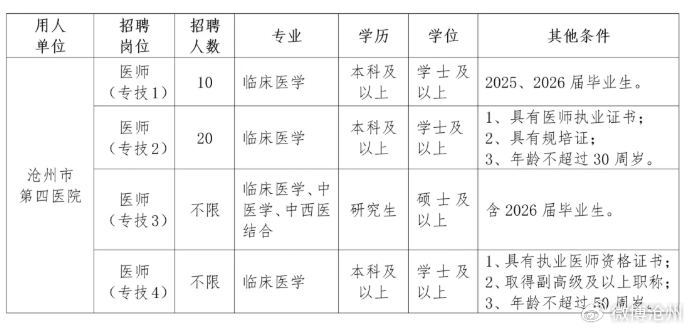
30名起!沧州市第四医院招聘卫生专业技术人员!
Xin Lang Cai Jing· 2026-01-10 10:15
(来源:微博沧州) 南皮县人民医院始建于1945年9月,是一所集医疗、教学、科研、预防保健、急救和康复为一体的三级 综合性医院,被授予全国精神文明建设工作先进单位、全国五四红旗团支部、河北省先进基层党组织、 省首批"百佳医院"等百余项殊荣。2019年1月被河北省卫健委纳入三级医院管理。2022年1月,被市政府 命名"沧州市第四医院"。自2020年参加国家二级公立医院绩效考核以来,连续四年获得A档的优异成 绩。医院建筑面积8.5万平方米,开放床位800张,年门诊量70万人次,出院病人量3.8万人次,年手术 12500例。神经内科、心血管内科、骨科、胃肠外科、神经外科、心脏大血管外科、泌尿外科、耳鼻咽 喉科、急诊医学科、麻醉科、影像中心、新儿科等12个专业被评为市级临床重点专科。 一、招聘原则 坚持面向社会、公开招聘、公平竞争、德才兼备、择优录用的原则。 二、基本条件 (三)招聘岗位和具体条件 (一)面向社会公开招聘工作人员,凡符合条件的各类人员均可报名应聘,应聘人员必须具备以下基本 条件: 1.具有中华人民共和国国籍; 2.热爱卫生事业,遵守宪法和法律,未参与过影响和危害社会安全的活动; 3.具有良好的品行和职 ...

【环球财经】美国新增非农就业岗位减少
Xin Hua Cai Jing· 2026-01-10 02:18
Group 1 - The core point of the article indicates that the U.S. labor market is showing signs of weakness, with non-farm payrolls for December 2025 falling short of expectations and previous months' data being revised downward [1] - In December 2025, the U.S. added 50,000 non-farm jobs, below the market consensus of 55,000, while November's job additions were revised down from 64,000 to 56,000, and October's figures were adjusted from a loss of 105,000 to a loss of 173,000 [1] - The sectors contributing to job growth in December included restaurants (27,000 jobs), healthcare (21,000 jobs), and social assistance (17,000 jobs), while retail jobs decreased by 25,000 [1] Group 2 - The average hourly wage for U.S. employees in December 2025 increased by 0.3% month-over-month and 3.8% year-over-year [1] - The unemployment rate in December 2025 was reported at 4.4%, with the previous month's rate revised from 4.6% to 4.5% [1] - The labor force participation rate decreased from 62.5% to 62.4%, with the number of unemployed individuals at 7.503 million, down from the revised figure of 7.781 million in the previous month [1]
云南公示2025年度老年友善医疗机构,149家在昆明
Xin Lang Cai Jing· 2026-01-09 20:47
| | (2家) | | --- | --- | | 省级 | 云南大学附属医院 | | 省级 | 云南中医药大学第二附属医院 | | | (147家) | | 呈贡区 | 呈贡区妇幼保健服务中心 | | 早気区 | 昆明呈贡汇贤中医医院 | 1月9日,健康君从云南省卫生健康委员会获悉,2025年度老年友善医疗机构公示名单已经发布,全省共592家拟入围。其中,位于昆明的共 有149家。 根据相关文件要求,云南省开展了2025年度老年友善医疗机构建设工作。经单位申报、县(市、区)级初评、州(市)级复核推荐、省级 审核,拟确定云南大学附属医院等592家医疗卫生机构为2025年度老年友善医疗机构。 省级和昆明市的医疗机构 公示时间:2026年1月9日—1月15日。 公示期间,对公示结果有异议的可通过来访、来电、来信等方式向云南省卫生健康委员会老龄健康处反映。 电话:(0871)68230882 邮箱:ynslljkc@163.com ↓ | 呈贡区 | 昆明城东医院 | | --- | --- | | 呈贡区 | 昆明市中医医院呈贡医院 | | 呈贡区 | 呈贡区雨花街道社区卫生服务中心 | | 呈贡区 | 呈贡朱 ...
枣庄2025年全面深化改革工作——发展出题目 改革做文章
Da Zhong Ri Bao· 2026-01-09 01:35
Group 1 - The core viewpoint highlights the significant reforms and economic transformation in Zaozhuang, with 46 provincial-level reform pilot projects established and 21 typical reforms promoted by national ministries [1] - In the past year, Zaozhuang held over 10 meetings related to reform, detailing 110 specific reform tasks and 208 achievement forms, creating a robust organizational framework for deepening reforms [1] Group 2 - By the end of November 2025, Zaozhuang is expected to have 14 out of 16 major economic indicators ranking in the top 10 of the province, with GDP projected to exceed 250 billion yuan and general public budget revenue surpassing 20 billion yuan [2] - The city has implemented the "Industrial Doubling" initiative and established a "6+3" industrial chain management mechanism, resulting in the addition of 699 new enterprises in the year [2] - Zaozhuang has enhanced its business environment by deepening national pilot programs, leading to a net increase of over 59,000 business entities since 2025 [2] Group 3 - The city has upgraded 270 model village clinics and supported 110 weak village clinics, achieving a standard of "five guarantees and three improvements" for all 1,565 village clinics [3] - Urban renewal efforts have included the renovation of 34 old residential communities and the addition of 3.77 square kilometers of sponge city area, benefiting over 1 million residents [3] - Zaozhuang has implemented innovative legislation in the democratic and legal fields, including the introduction of local regulations for managing the environment around schools, effective from January 1, 2026 [3] Group 4 - The city has initiated 2,302 grassroots governance projects led by party organization secretaries at various levels, addressing significant community issues through project-based and checklist management [4]
破解基层医疗“三难”
Xin Lang Cai Jing· 2026-01-08 20:05
Core Insights - The establishment of the National AI Application Pilot Base in Hefei aims to address challenges in the integration of AI technology within grassroots healthcare, focusing on the disconnection between healthcare services and AI, conflicts with existing information systems, and the low-level repetitive construction of vertical models in the medical field [1][2]. Group 1 - The pilot base will create an efficient data flow system, aggregating 5PB of medical data and integrating 34 specialized medical knowledge bases and 42 multimodal datasets to support grassroots healthcare [2]. - The initiative will focus on developing five major medical models and creating application toolchains for the healthcare industry, facilitating rapid service delivery in industry scenarios [2]. - The project will target ten grassroots healthcare service scenarios and eleven public health service scenarios, developing intelligent decision support systems for general practitioners and targeted health checkups to enhance grassroots healthcare service capabilities [2].
医疗机构可在养老院开设服务点
Xin Lang Cai Jing· 2026-01-08 17:59
Core Viewpoint - The city has launched a joint initiative to promote high-quality development of integrated medical and elderly care services, involving multiple government departments to enhance collaboration between healthcare institutions and elderly care facilities [1][2][3] Group 1: Policy Measures - The initiative supports the establishment of medical service stations within elderly care institutions and integrates these institutions into a close-knit medical alliance management system [1] - It encourages the transformation of underutilized secondary and lower-level medical institutions into rehabilitation hospitals, nursing homes, and palliative care centers [1] - Elderly care institutions can entrust their internal medical facilities to healthcare institutions for management, aiming to increase the number of nursing care beds [1] Group 2: Cooperation and Services - The policy emphasizes the establishment of cooperative agreements between healthcare institutions and elderly care facilities, promoting multi-level contracts and ensuring basic public health and medical services are provided [2] - It includes health service actions for disabled and cognitively impaired elderly individuals, offering health assessments and guidance, and integrating economically disadvantaged groups into social assistance programs [2] - The initiative supports extending services from healthcare institutions to community elderly care services, providing home visits and family beds for elderly individuals with various health needs [2] Group 3: Technological Integration - The city encourages collaboration between integrated care institutions and healthcare providers with internet diagnostic capabilities to offer remote consultations and chronic disease management [3] - It promotes the use of internet hospitals for home-based elderly patients to manage common and chronic diseases [3] - By the end of 2027, all eligible integrated care institutions will be included as designated medical insurance points [3]
非凡“十四五” 四川简阳交出温暖“健康答卷”
Zhong Guo Fa Zhan Wang· 2026-01-08 08:33
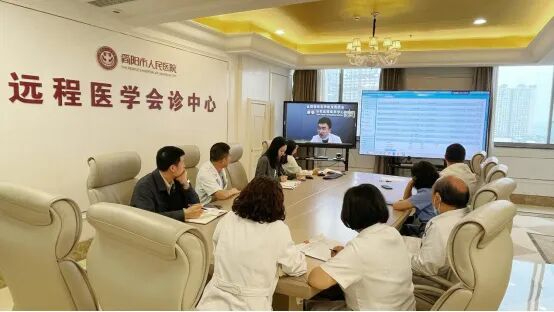
Core Insights - Since the "14th Five-Year Plan," Jianyang City has focused on health-centered reforms in the medical and health system, achieving significant progress in service capacity, system efficiency, and health security, laying a solid foundation for a modern urban-rural integrated demonstration city centered on people [1] Group 1: Enhanced Grassroots Service Capacity - Jianyang City has systematically strengthened its grassroots medical and health service network, establishing a tiered diagnosis and treatment system centered on a tightly-knit county medical community, promoting the extension of quality resources to grassroots levels through expert support and remote collaboration [2] - The successful completion of a complex surgery for a 76-year-old patient with multiple chronic diseases at He Feng Central Health Center demonstrates the effectiveness of this system, with expert assistance and remote multidisciplinary consultations ensuring safe and standardized treatment [2] Group 2: Breakthroughs in Emergency and Critical Care - Jianyang People's Hospital successfully treated a 43-year-old patient in critical condition using VA-ECMO technology, marking a significant advancement in its emergency and critical care capabilities [4] - The hospital has established a comprehensive emergency rescue system, including trauma, chest pain, stroke, and critical maternal and neonatal care centers, and has joined the National Trauma Rescue Alliance [4] - The city's smart emergency network operates efficiently, achieving a 98.24% average response rate within 3 minutes for emergency calls by 2025, ensuring seamless coordination between pre-hospital and in-hospital care [4] Group 3: Dual Track of Smart and Traditional Medicine - Jianyang People's Hospital and Jianyang Traditional Chinese Medicine Hospital have established internet hospitals, enabling online follow-ups and prescription transfers, with electronic medical record systems reaching level 4 across major hospitals [6] - The implementation of a "Health Card" allows for unified access across major medical institutions, promoting mutual recognition of examination and testing results [6] - The Traditional Chinese Medicine Hospital has developed key specialties and has made significant advancements in traditional medicine services, with over 55% of grassroots services in traditional medicine by 2025 [6] Group 4: Strengthening Health Security Foundations - Jianyang's Disease Control Center has achieved a tertiary level, significantly enhancing public health monitoring and emergency response capabilities [8] - The city has established two municipal-level key specialties and 25 county-level key specialties during the "14th Five-Year Plan," with a steady increase in residents' health literacy, reaching 35.5% by 2025 [8] - Jianyang has been recognized as a national sanitary city, with 22 towns awarded provincial-level sanitation status, indicating ongoing improvements in health environments [8] - The city aims to continue strengthening public health safety nets and promoting the construction of tightly-knit medical communities, enhancing comprehensive service capabilities in prevention, treatment, rehabilitation, and management [8]