
塑料

Search documents
今年我国聚乙烯产能将突破4500万吨
Zhong Guo Hua Gong Bao· 2026-02-26 01:49
Core Viewpoint - The domestic polyethylene market is expected to reach a significant milestone in 2026, with total production capacity surpassing 45 million tons, leading to a shift from scale expansion competition to value enhancement competition, indicating a structural adjustment in the industry [1] Group 1: Capacity Growth and Structure - The new polyethylene production capacity in 2026 is projected to be between 6.15 million and 7.29 million tons, with a growth rate of 15% to 18.5% [2] - The production rhythm shows a "low in the front, high in the back" characteristic, with limited new capacity in the first half of the year and increasing supply in the second half [2] - New capacity is primarily from oil-based facilities, with significant contributions from major refining enterprises like Huajin Amoco and China National Petroleum [2] - The product structure is optimizing, with the planned production of high-density polyethylene (HDPE) at 2.05 million tons and linear low-density polyethylene (LLDPE) growth slowing to an estimated 4% in 2026, down from 24% in 2025 [2] Group 2: Cost Trends and Profitability - The cost of polyethylene is showing significant differentiation, with profit margins varying greatly among companies based on production processes [4] - Oil-based polyethylene, which constitutes nearly two-thirds of total capacity, is closely tied to international oil prices, with expected pressure on profit margins due to high oil prices and declining polyethylene spot prices [4] - Coal-based polyethylene, accounting for about 20% of total capacity, is expected to benefit from a moderate decline in coal prices, maintaining profitability [4] - Light hydrocarbon processes are favored for their high yield and low cost, but face challenges due to high dependence on imported ethane, with an expected import dependency exceeding 95% [4] Group 3: Demand Dynamics - Domestic polyethylene apparent consumption is expected to reach approximately 41.5 million tons in 2026, reflecting a year-on-year growth of 7.8%, which is still lower than the growth rate of production capacity [5] - Traditional demand sectors such as packaging films and pipes are experiencing slow growth, with operating rates generally between 30% and 55% [5] - Emerging industries like photovoltaic backsheet films and lithium battery separators are seeing increased demand, but their overall consumption share remains low [6] Group 4: Export Trends - The compound annual growth rate of polyethylene exports from China over the past five years has been 34.5%, with steady growth expected in 2026 [7] - The share of polyethylene exports to Southeast Asia is increasing, with high-end product exports growing faster than general materials [7] - Factors such as infrastructure upgrades in Belt and Road Initiative countries and reduced shipping costs are creating favorable conditions for polyethylene exports [7]
PVC产业链全景透视
Bao Cheng Qi Huo· 2026-02-26 01:37
Report Industry Investment Rating - Not provided in the content Core Viewpoints of the Report - PVC is a hub variety connecting energy, chemicals, real estate, and infrastructure. The dual - process upstream determines cost elasticity, the mid - stream chlor - alkali co - production determines the supply rhythm, and the downstream real estate and infrastructure determine the demand level. Understanding the core framework of "coal - calcium carbide cost as the king, real estate demand as the soul, and inventory cycle as the rhythm" helps to understand PVC futures fluctuation rules [6]. Summary by Relevant Catalogs Upstream Raw Materials: Dual - Process Route Determines the Cost Background - China's PVC industry has a unique pattern with the calcium carbide method as the main process and the ethylene method as the auxiliary, matching the resource endowment of "rich in coal, poor in oil, and short in gas". The total domestic PVC production capacity is nearly 30 million tons, with the calcium carbide method accounting for about 72% and the ethylene method about 28%. The cost and fluctuation logic of the two routes are different [3]. - For the calcium carbide method, the upstream includes coal, limestone, and raw salt. Producing 1 ton of PVC consumes about 1.4 - 1.5 tons of calcium carbide. The cost of calcium carbide is directly determined by the price of steam coal, which in turn dominates the PVC cost center. Chlor - alkali co - production makes the prices of PVC and caustic soda often show a linkage effect [3]. - For the ethylene method, the upstream includes crude oil, naphtha, and ethylene. The cost is deeply linked to international oil prices. The raw materials ethylene and VCM account for 55% - 60% of the production cost. The ethylene - method devices are mostly distributed in the coastal areas of East and South China, and their costs are more affected by overseas energy and exchange - rate fluctuations [3]. Mid - stream Production: Chlor - Alkali Integration and Supply - Demand Pattern - The mid - stream is the core production link of PVC, including processes such as VCM synthesis, polymerization, and granulation. The industry features large production capacity, differentiated operating rates, and integration as the key. China's PVC production capacity accounts for nearly half of the world's, but the industry has long faced over - capacity pressure. Newly added production capacity is mainly of the ethylene method, while the expansion of the calcium carbide method is restricted by environmental protection and dual - carbon policies [4]. - The profit of production enterprises highly depends on the chlor - alkali balance. When caustic soda is profitable, enterprises tend to operate at high loads, leading to a passive increase in PVC supply; when caustic soda incurs losses, the devices reduce loads, and PVC supply contracts. This co - production mechanism makes the PVC supply elasticity weak, and the inventory cycle has a more significant impact on prices [4]. - Inventory is a key mid - stream indicator, including factory inventory, social inventory, and futures warehouse receipts. The periods around the Spring Festival, the maintenance season, and the real - estate peak season are key nodes for inventory fluctuations. The inventory accumulation cycle suppresses prices, while the de - stocking cycle boosts the market. Changes in PVC futures warehouse receipts directly affect market sentiment, and high warehouse - receipt levels often correspond to periodic pressure [4]. Downstream Demand: Dominated by Real Estate and Infrastructure, with Diverse Application Scenarios - PVC downstream is mainly composed of hard products, supplemented by soft products. The demand is highly concentrated in the construction and infrastructure fields, accounting for over 60% of the total, making it a typical "cyclical product" [5]. - The largest demand is for pipes and fittings, accounting for about 40%, which are used in municipal water supply and drainage, gas pipelines, and real - estate pipe networks, and are strongly related to real - estate completion and infrastructure investment. The second - largest demand is for profiles and doors and windows, accounting for about 20%, benefiting from affordable housing, old - building renovation, and energy - saving window replacement. Soft products, including cable materials, artificial leather, films, and floors, account for about 20%, with relatively stable demand. Other fields such as packaging, medical, and industrial products account for about 10%, providing demand resilience [5]. - The demand rhythm shows obvious seasonality: the spring resumption of work and the autumn rush to complete projects are the two peak seasons, while winter and the rainy season are the off - seasons. Exports are also important, with Southeast Asia, the Middle East, and Africa as the main destinations. Export tax rebates, international price differences, and shipping prices directly affect export volumes, serving as an important channel for clearing domestic over - capacity [5].
【冠通期货研究报告】塑料日报:震荡运行-20260225
Guan Tong Qi Huo· 2026-02-25 11:13
Report Industry Investment Rating - Not provided Core Viewpoints - The plastics market is expected to oscillate. The supply - demand pattern of plastics has limited improvement, but there are still expectations for the chemical industry to counter the involution. Attention should be paid to the resumption of production progress of downstream enterprises after the Spring Festival. Due to the recent commissioning of new plastic production capacity, the operating rate is higher than that of PP, and the L - PP spread should continue to be narrowed as the concentrated demand for plastic mulch has not yet started [1]. Summary by Directory Market Analysis - On February 25, the number of overhauled devices changed little, and the plastics operating rate remained at around 93%, which is at a moderately high level. As of the week of February 13, the downstream operating rate of PE decreased by 13.93 percentage points to 19.8% on a week - on - week basis. During the Spring Festival, most downstream enterprises shut down for holidays, and the overall downstream operating rate of PE declined seasonally. During the Spring Festival, petrochemical inventory increased by 480,000 tons to 940,000 tons. On Wednesday, the early petrochemical inventory decreased by 65,000 tons to 875,000 tons, 65,000 tons lower than the same period of last lunar year, and basically the same as in previous years. Currently, petrochemical inventory is at a neutral level in recent years. In terms of cost, the market is worried about the situation in Iran. The data from the U.S. Energy Information Administration shows that U.S. crude oil inventory decreased by 9.014 million barrels, and refined oil inventories declined across the board. Overseas crude oil prices rose during the Spring Festival. In terms of supply, BASF (Guangdong) with a new production capacity of 500,000 tons/year of FDPE and Yulong Petrochemical with 300,000 tons/year of LDPE/EVA were put into operation in January 2026. The plastics operating rate has increased slightly recently [1]. Futures and Spot Market Conditions - **Futures**: The plastics 2605 contract increased in positions and oscillated. The lowest price was 6,766 yuan/ton, the highest was 6,846 yuan/ton, and it finally closed at 6,777 yuan/ton, above the 60 - day moving average, with a decline of 0.13%. The position increased by 25,621 lots to 507,855 lots [2]. - **Spot**: Most of the PE spot market rose, with price changes ranging from - 100 to + 150 yuan/ton. LLDPE was quoted at 6,620 - 6,970 yuan/ton, LDPE at 8,230 - 8,960 yuan/ton, and HDPE at 6,800 - 8,040 yuan/ton [3]. Fundamental Tracking - **Supply**: On February 25, the number of overhauled devices changed little, and the plastics operating rate remained at around 93%, which is at a moderately high level [4]. - **Demand**: As of the week of February 13, the downstream operating rate of PE decreased by 13.93 percentage points to 19.8% on a week - on - week basis. During the Spring Festival, most downstream enterprises shut down for holidays, and the overall downstream operating rate of PE declined seasonally [4]. - **Inventory**: During the Spring Festival, petrochemical inventory increased by 480,000 tons to 940,000 tons. On Wednesday, the early petrochemical inventory decreased by 65,000 tons to 875,000 tons, 65,000 tons lower than the same period of last lunar year, and basically the same as in previous years. Currently, petrochemical inventory is at a neutral level in recent years [4]. - **Raw Materials**: The Brent crude oil 05 contract fell below $71/barrel. The price of Northeast Asian ethylene remained flat at $705/ton on a week - on - week basis, and the price of Southeast Asian ethylene remained flat at $685/ton on a week - on - week basis [4].
【冠通期货研究报告】PVC日报:震荡运行-20260225
Guan Tong Qi Huo· 2026-02-25 11:12
Report Industry Investment Rating - No information provided Core Viewpoint - The PVC market is currently in a situation of weak reality and strong expectations, with expected volatile operation. Attention should be paid to the resumption of production progress of downstream industries after the Spring Festival [1] Summary by Relevant Catalogs Market Analysis - The calcium carbide price in the upstream northwest region is stable. Before the Spring Festival, the PVC operating rate increased by 0.83 percentage points to 80.09%, continuing a slight increase and remaining at a neutral level compared to the same period in recent years. During the Spring Festival, most downstream PVC industries shut down. In terms of exports, after the price increase before the Spring Festival, domestic export orders decreased month-on-month, but previous rush exports reduced the sales pressure on enterprises. The FOB price of Formosa Plastics' PVC exports for March shipments increased by $40/ton compared to February. Social inventories increased significantly during the Spring Festival holiday and remain high, with significant inventory pressure. In 2025 from January to December, the real estate market was still in the adjustment phase, with significant year-on-year declines in investment, new construction, construction, and completion areas, and further decreases in year-on-year growth rates of investment, sales, and completion. The weekly sales area of commercial housing in 30 large and medium-sized cities decreased month-on-month, and sales were sluggish during the Spring Festival. The real estate market needs more time to improve. The comprehensive gross profit of chlor-alkali is under pressure, and the operating expectations of some production enterprises are decreasing, but the current production decline is limited, and the futures warehouse receipts are still at a high level. February is the traditional off-season for domestic PVC demand, and spot transactions are light after the Spring Festival, with social inventories continuing to increase. However, the Ministry of Ecology and Environment stated that it will focus on key aspects such as research and development of mercury-free catalysts to accelerate the mercury-free transformation of the PVC industry. Coupled with the expected continuation of rush exports after the festival, the market still has expectations for policies and maintenance after the Spring Festival [1] Futures and Spot Market - The PVC2605 contract increased in position and fluctuated. The lowest price was 4,932 yuan/ton, the highest was 4,984 yuan/ton, and it finally closed at 4,963 yuan/ton, near the 20-day moving average, with a gain of 0.65%. The position increased by 55,463 lots to 1,129,874 lots [2] Basis - On February 25, the mainstream price of calcium carbide-based PVC in the East China region remained stable at 4,770 yuan/ton. The futures closing price of the V2605 contract was 4,963 yuan/ton. The current basis was -193 yuan/ton, weakening by 15 yuan/ton, and the basis was at a relatively low level [3] Fundamental Tracking - On the supply side, affected by installations such as Shaanxi Jintai and Henan Yuhang, the PVC operating rate increased by 0.83 percentage points to 80.09%, continuing a slight increase and remaining at a neutral level compared to the same period in recent years. In terms of new production capacity, Wanhua Chemical with an annual capacity of 500,000 tons, Tianjin Bohua with 400,000 tons, Qingdao Gulf with 200,000 tons, and Gansu Yaowang with 300,000 tons were all put into production in the second half of 2025. Jiaxing Jiahua with an annual capacity of 300,000 tons started trial production in December 2025 [4] - On the demand side, the real estate market is still in the adjustment phase, with significant year-on-year declines in investment, new construction, and completion areas, and further decreases in year-on-year growth rates of investment, sales, construction, and completion. From January to December 2025, the national real estate development investment was 827.88 billion yuan, a year-on-year decrease of 17.2%. From January to December, the commercial housing sales area was 881.01 million square meters, a year-on-year decrease of 8.7%; among them, the residential sales area decreased by 9.2%. The commercial housing sales volume was 839.37 billion yuan, a decrease of 12.6%, and the residential sales volume decreased by 13.0%. From January to December, the new construction area of housing was 587.7 million square meters, a year-on-year decrease of 20.4%; among them, the new construction area of residential housing was 429.84 million square meters, a decrease of 19.8%. From January to December, the construction area of real estate development enterprises was 6.5989 billion square meters, a year-on-year decrease of 10.0%. From January to December, the completion area of housing was 603.48 million square meters, a year-on-year decrease of 18.1%; among them, the completion area of residential housing was 428.3 million square meters, a year-on-year decrease of 20.2%. Overall, the real estate market needs more time to improve. As of the week of February 22, the commercial housing sales area in 30 large and medium-sized cities decreased by 92.37% month-on-month, and sales were sluggish during the Spring Festival. Attention should be paid to whether real estate favorable policies after the festival can boost commercial housing sales [5] - In terms of inventory, as of the week of February 20, the PVC social inventory increased by 7.16% month-on-month to 1.3434 million tons, a 55.31% increase compared to the same period last year. Social inventories increased significantly during the Spring Festival holiday and remain high (Longzhong increased the social storage capacity in East and South China from 21 to 41) [6]
金发科技:公司已组建专门的材料研发团队并与行业头部企业开展协同开发合作
Zheng Quan Ri Bao· 2026-02-25 11:09
Core Viewpoint - The company has established a dedicated materials research and development team and is collaborating with leading industry players for joint development, with some materials already being supplied in bulk to customers [2] Group 1 - The new materials business currently represents a very small proportion of the company's revenue, indicating potential uncertainty for future growth [2] - The company emphasizes confidentiality regarding specific customer collaborations and will disclose significant developments in accordance with relevant regulations [2]


聚乙烯:步入深度调整期
Zhong Guo Hua Gong Bao· 2026-02-25 02:44
Core Viewpoint - The domestic polyethylene market in China is expected to reach a significant milestone in 2026, with total production capacity surpassing 45 million tons, leading to a shift from scale expansion competition to value enhancement competition, indicating a structural adjustment in the industry [1] Group 1: Capacity Growth and Structure - New polyethylene production capacity in China is projected to reach between 6.15 million to 7.29 million tons in 2026, with a growth rate of 15% to 18.5% [2] - The production capacity will be primarily driven by oil-based facilities, with major contributions from large refining and chemical enterprises like Huajin Amoco and Zhongsha Gulei, alongside a significant increase in coal-based production [2] - The product structure is showing an optimization trend, with the planned production capacity for high-density polyethylene (HDPE) at 2.05 million tons and linear low-density polyethylene (LLDPE) growth slowing to an estimated 4% in 2026, down from 24% in 2025 [2] Group 2: Supply and Demand Dynamics - The polyethylene industry is expected to experience ongoing adjustments in supply and demand, characterized by a phase of seeking balance and rapid price fluctuations [3] - The first half of 2026 will see limited new capacity release, while the second half will face market pressure as capacity expansion comes online [3] Group 3: Cost Trends and Profitability - There will be significant differentiation in cost structures, leading to widening profitability gaps among companies based on their production processes [4] - Oil-based polyethylene, which constitutes nearly two-thirds of total capacity, will face profit pressures due to high crude oil prices and declining polyethylene spot prices [4] - Coal-based polyethylene, accounting for about 20% of total capacity, is expected to benefit from a moderate decline in coal prices, maintaining a specific profitability level [4] Group 4: Domestic Demand and Export Challenges - Domestic apparent consumption of polyethylene is projected to reach approximately 41.5 million tons in 2026, reflecting a year-on-year growth of 7.8%, which is still lower than the growth rate of production capacity [5] - Traditional demand sectors such as packaging films and pipes are experiencing slow growth, while new industries like photovoltaic backsheet films and lithium battery separators are expanding, albeit still representing a small portion of overall consumption [6] - The export of polyethylene from China has seen a compound annual growth rate of 34.5% over the past five years, with expectations for steady growth in 2026, particularly in Southeast Asia [6]
【图】2025年8月云南省初级形态的塑料产量数据分析
Chan Ye Diao Yan Wang· 2026-02-25 00:40
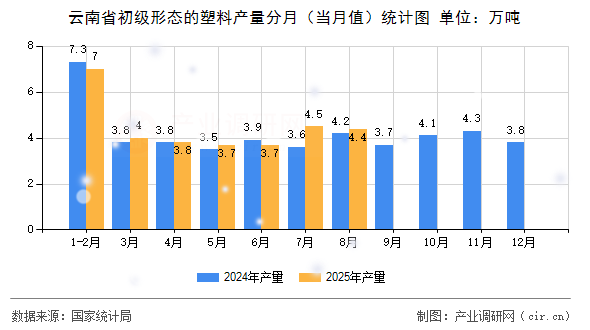
Group 1 - The core point of the article highlights that the plastic production in Yunnan Province for August 2025 reached 44,000 tons, reflecting a year-on-year growth of 6.8%, although the growth rate has slowed down by 0.1 percentage points compared to the previous year [1] - The cumulative plastic production from January to August 2025 in Yunnan Province was 312,000 tons, with a year-on-year growth of 4.0%, which is a decrease of 6.1 percentage points from the previous year [1] - The growth rate of plastic production in Yunnan is significantly lower than the national average, with a difference of 6.0 percentage points for August and 7.6 percentage points for the January to August period [1]
PVC日报:震荡运行-20260224
Guan Tong Qi Huo· 2026-02-24 11:23
Report Industry Investment Rating - Not provided Core Viewpoint - The PVC market shows a situation of weak reality and strong expectations. It is expected to operate in a volatile manner, and attention should be paid to the resumption of production progress of downstream industries after the Spring Festival [1] Summary by Relevant Catalogs Market Analysis - The calcium carbide price in the upstream northwest region has dropped significantly by 165 yuan/ton compared to before the Spring Festival. Before the Spring Festival, the PVC开工率 increased by 0.83 percentage points to 80.09%, and it continued to increase slightly, being at a neutral level in the same period in recent years. During the Spring Festival, most downstream PVC industries shut down. In terms of exports, after the price increase before the Spring Festival, the domestic export orders decreased month - on - month, but the previous rush to export reduced the sales pressure on enterprises. The FOB price of Formosa Plastics' PVC export shipments in March increased by 40 US dollars/ton compared to February. The social inventory increased significantly during the Spring Festival holiday and is still relatively high, with large inventory pressure. The real estate is still in the adjustment stage, and the improvement of the real estate market still takes time. The comprehensive gross profit of chlor - alkali is under pressure, and the production of some enterprises is expected to decrease, but the current output decline is limited, and the futures warehouse receipts are still at a high level. February is the traditional off - season for domestic PVC demand, and the spot trading is light after the Spring Festival, and the social inventory continues to increase. However, the Ministry of Ecology and Environment will promote the mercury - free transformation of the PVC industry, and the post - festival export rush is expected to continue. There are also policy and maintenance expectations after the Spring Festival, and the rise in crude oil prices boosts chemical products [1] Futures and Spot Market - The PVC2605 contract increased in positions and operated in a volatile manner, with a minimum price of 4835 yuan/ton, a maximum price of 5011 yuan/ton, and finally closed at 4948 yuan/ton, near the 20 - day moving average, with a gain of 0.59%. The position increased by 56146 lots to 1074411 lots [2] - On February 24, the mainstream price of calcium carbide - based PVC in the East China region rose to 4770 yuan/ton, and the futures closing price of the V2605 contract was 4948 yuan/ton. The current basis was - 178 yuan/ton, strengthening by 2 yuan/ton, and the basis was at a relatively low level [3] Fundamental Tracking - On the supply side, affected by devices such as Shaanxi Jintai and Henan Yuhang, the PVC开工率 increased by 0.83 percentage points to 80.09%, and continued to increase slightly, being at a neutral level in the same period in recent years. In terms of new production capacity, Wanhua Chemical with an annual capacity of 500,000 tons, Tianjin Bohua with 400,000 tons/year, Qingdao Gulf with 200,000 tons/year, and Gansu Yaowang with 300,000 tons/year were all put into production in the second half of 2025. Jiaxing Jiahua with an annual capacity of 300,000 tons started trial production in December 2025 [4] - On the demand side, the real estate is still in the adjustment stage, and the year - on - year decline in investment, new construction, and completion areas is still large, and the year - on - year growth rates of investment, sales, construction, and completion have further declined. From January to December 2025, the national real estate development investment was 827.88 billion yuan, a year - on - year decrease of 17.2%. From January to December, the commercial housing sales area was 881.01 million square meters, a year - on - year decrease of 8.7%; among them, the residential sales area decreased by 9.2%. The commercial housing sales volume was 839.37 billion yuan, a decrease of 12.6%, and the residential sales volume decreased by 13.0%. From January to December, the new construction area of housing was 587.7 million square meters, a year - on - year decrease of 20.4%; among them, the new construction area of residential housing was 429.84 million square meters, a decrease of 19.8%. From January to December, the construction area of real estate development enterprises was 6.5989 billion square meters, a year - on - year decrease of 10.0%. From January to December, the completion area of housing was 603.48 million square meters, a year - on - year decrease of 18.1%; among them, the completion area of residential housing was 428.3 million square meters, a year - on - year decrease of 20.2%. As of the week of February 22, the weekly commercial housing transaction area in 30 large and medium - sized cities decreased by 92.37% month - on - month, and the commercial housing transactions were sluggish during the Spring Festival [5] - In terms of inventory, as of the week of February 20, the PVC social inventory increased by 7.16% month - on - month to 1.3434 million tons, 55.31% higher than the same period last year. The social inventory increased significantly during the Spring Festival holiday and is still relatively high [6]
塑料日报:震荡上行-20260224
Guan Tong Qi Huo· 2026-02-24 11:23
1. Report Industry Investment Rating - Not provided in the report 2. Core View of the Report - The supply - demand pattern of plastics has limited improvement, but there are still expectations for the chemical industry to counter the involution. Attention should be paid to the resumption of production progress of downstream enterprises after the Spring Festival. Due to the recent new plastic production capacity coming on - stream, the operating rate is higher than that of PP, and the concentrated demand for mulch film has not started yet, so continue to shrink the L - PP spread [1] 3. Summary by Relevant Catalogs 3.1. Market Analysis - On February 24, the restart of overhauled devices such as Qilu Petrochemical's LDPE drove the plastic operating rate up to about 93%, which is at a moderately high level. As of the week of February 13, the downstream operating rate of PE decreased by 13.93 percentage points to 19.8% on a week - on - week basis. During the Spring Festival, most downstream enterprises shut down for holidays, leading to a seasonal decline in the overall downstream operating rate of PE. The petrochemical early - stage inventory increased by 480,000 tons to 940,000 tons during the Spring Festival, 20,000 tons lower than the same period of last lunar year, and is at a neutral level compared with previous years. The market is worried about the situation in Iran, and the US Energy Information Administration data shows a decrease of 9.014 million barrels in US crude oil inventory and a full - line decline in refined oil inventory, causing a significant increase in overseas crude oil prices [1] 3.2. Futures and Spot Market Conditions - **Futures**: The plastic 2605 contract reduced positions and fluctuated upward, with a minimum price of 6,707 yuan/ton, a maximum price of 6,855 yuan/ton, and finally closed at 6,820 yuan/ton, above the 60 - day moving average, with a gain of 2.08%. The position decreased by 1,960 lots to 482,234 lots [2] - **Spot**: The PE spot market mostly rose, with price changes ranging from - 100 to + 150 yuan/ton. LLDPE was quoted at 6,620 - 6,970 yuan/ton, LDPE at 8,230 - 8,960 yuan/ton, and HDPE at 6,800 - 8,040 yuan/ton [3] 3.3. Fundamental Tracking - **Supply**: On February 24, the restart of overhauled devices such as Qilu Petrochemical's LDPE drove the plastic operating rate up to about 93%, which is at a moderately high level [1][4] - **Demand**: As of the week of February 13, the downstream operating rate of PE decreased by 13.93 percentage points to 19.8% on a week - on - week basis. During the Spring Festival, most downstream enterprises shut down for holidays, leading to a seasonal decline in the overall downstream operating rate of PE [1][4] - **Inventory**: The petrochemical early - stage inventory increased by 480,000 tons to 940,000 tons during the Spring Festival, 20,000 tons lower than the same period of last lunar year, and is at a neutral level compared with previous years [1][4] - **Raw Materials**: The Brent crude oil 05 contract rose above $71 per barrel. The price of Northeast Asian ethylene remained flat at $705 per ton on a week - on - week basis, and the price of Southeast Asian ethylene remained flat at $685 per ton on a week - on - week basis [4]
综合晨报-20260224
Guo Tou Qi Huo· 2026-02-24 03:36
1. Report Industry Investment Ratings No relevant content provided. 2. Core Views - During the Spring Festival, international oil prices continued to rise, with Brent and WTI crude oil reaching new highs since August 2025. Geopolitical risks, especially the tense situation between the US and Iran, are the main drivers of the oil price increase. The next two weeks will be a critical window for the situation, and geopolitical factors will continue to dominate the oil market [1]. - Precious metals showed strong performance during the Spring Festival. With the US - Iran negotiation making no substantial progress and the possibility of US strikes on Iran, the strength of precious metals may continue in the short - term [2]. - For most commodities, the market is affected by various factors such as geopolitical risks, supply - demand relationships, and seasonal patterns. Some commodities are expected to have price fluctuations, while others are likely to maintain a range - bound trend [3][4][5]. 3. Summary by Commodity Categories Energy Commodities - **Crude Oil**: During the Spring Festival, international oil prices rose significantly. Geopolitical risks, especially the tense US - Iran situation, are the main factors. The next two weeks are crucial for the situation, and oil prices will be dominated by geopolitical factors [1]. - **Fuel Oil & Low - sulfur Fuel Oil**: Due to the sharp rise in geopolitical risks between the US and Iran during the festival, oil prices soared. Fuel oil is expected to follow the upward trend. High - sulfur fuel oil is strongly supported by geopolitical factors, while low - sulfur fuel oil is relatively weak and mainly follows the trend of crude oil [21]. - **Asphalt**: International oil prices strengthened during the holiday, and asphalt is expected to start a catch - up rise on the first trading day after the festival. The asphalt market has a pattern of weak supply and demand, and its price follows the trend of crude oil [22]. Metal Commodities - **Copper**: LME copper prices were basically the same as before the holiday. During the domestic holiday, investment and physical demand were weak, and copper prices fluctuated. Copper inventories increased, and the copper market may strengthen the positive market structure. There is a risk that the unilateral copper price will adjust to the MA60 moving average to attract buyers [3]. - **Aluminum**: LME aluminum had limited fluctuations and a slight increase during the Spring Festival. After the festival, Shanghai aluminum is expected to have high - level oscillations. Attention should be paid to the inventory accumulation, demand recovery, and the impact of the US - Iran situation on the supply side [4]. - **Zinc**: LME zinc had high - level oscillations during the festival, with limited guidance for Shanghai zinc. After the festival, Shanghai zinc has weak rebound momentum due to short - term oversupply, but strong cost support. It is expected to oscillate between 24,000 - 25,000 yuan/ton. In the long - term, the oversupply situation remains, and the recovery of TC can be regarded as an opportunity for short - selling at high levels [7]. - **Lead**: The decline of LME lead slowed down near the cost line. After the festival, domestic lead prices are at a low level. Downstream purchases may increase, and recycled lead production has decreased. However, due to the opening of the import window, demand lacks an increase expectation. Shanghai lead is expected to have low - level oscillations between 16,500 - 17,500 yuan/ton [8]. - **Nickel & Stainless Steel**: Shanghai nickel is expected to open higher and then oscillate on the first trading day. During the holiday, the external market was generally strong, and factors such as the US tariff policy and economic data affected the market [9]. - **Tin**: LME tin had a slight increase compared to before the holiday and basically oscillated. The internal and external tin prices are supported by the MA60 moving average. LME tin inventories continued to increase slightly during the festival, and the spot discount narrowed. Tin prices are expected to continue to oscillate, and attention should be paid to the resumption of supply in the main production areas [10]. - **Carbonate Lithium**: Carbonate lithium still has optimistic sentiment in the short - term and is expected to have a strong - biased oscillation. The external market was strong during the holiday, and factors such as the US tariff policy and economic data are favorable [11]. - **Industrial Silicon**: Before the holiday, industrial silicon rebounded slightly after breaking through the previous low. After the holiday, it is expected to continue to oscillate. The supply side may see the resumption of production of large factories in Xinjiang, while the downstream demand is weak, and the social inventory is at a high level [12]. - **Polysilicon**: During the Spring Festival, spot trading was stagnant. Before the holiday, polysilicon futures had a slight increase and narrowed fluctuations. Although there is cost support, the market is expected to maintain an oscillating trend due to factors such as production reduction and inventory accumulation [13]. Ferrous Metals - **Steel (Thread & Hot - rolled Coil)**: During the Spring Festival, the external market generally rose, while the domestic spot market was on holiday. The demand for steel decreased, and the inventory accumulated. Due to factors such as poor steel mill profits and weak downstream demand, the iron - water output remained at a relatively low level. With the improvement of the financial market sentiment, the steel price has a certain rebound momentum after the festival [14]. - **Iron Ore**: During the holiday, overseas iron ore swaps weakened. The supply is relatively strong, and the market is worried about oversupply. Although the demand is expected to improve marginally, the supply pressure is greater, and the price is still under pressure [15]. - **Coke & Coking Coal**: During the holiday, the increase in oil prices may have an indirect impact on the black - series commodities. The inventory of coke increased slightly, and the purchasing willingness of traders was average. The carbon element supply is abundant, and the downstream demand is in the off - season. The prices of coke and coking coal are expected to oscillate in a range [16][17]. - **Manganese Silicon**: The increase in oil prices during the holiday may have an indirect impact. The spot price of manganese ore increased slightly, and the downward space of the disk is relatively small. The inventory of manganese ore in ports may start to increase slowly, and the demand side is at a seasonal low level. The price is affected by oversupply and policy expectations [18]. - **Silicon Ferrosilicon**: The increase in oil prices during the holiday may have an indirect impact. Some production areas have a decrease in power costs, and the demand side is at a low level. The export demand is stable, and the supply changes little. The price is affected by oversupply and policy expectations [19]. Chemical Commodities - **Urea**: During the Spring Festival, the supply of urea remained at a high level, and production enterprises are expected to accumulate inventory seasonally. With the increase in temperature, the demand for agricultural fertilizer preparation is expected to start, and the production enterprises are expected to reduce inventory after the festival. The short - term market is likely to oscillate and rebound [23]. - **Methanol**: The overseas methanol plant operating rate remains low, and the import volume is expected to decrease after the Spring Festival. The coastal MTO plant operating rate is low, and attention should be paid to the profit repair and restart expectations after the festival. The traditional downstream will resume work one after another, and the inventory in the inland and ports is expected to decrease [24]. - **Pure Benzene**: The instability of the US - Iran situation provides support for the cost of pure benzene. The supply during the Spring Festival is relatively high, and the inventory in the East China port is expected to remain at a high level. The downstream demand is expected to improve, and the port inventory may decrease slowly [25]. - **Styrene**: The increase in international oil prices during the holiday boosted the cost of styrene, and it may open higher. However, the supply is expected to increase significantly after the festival, while the downstream demand recovery needs time, and the fundamental contradiction is intensified [26]. - **Polypropylene & Plastic**: The increase in international oil prices during the holiday may boost the opening price after the festival. However, due to the inventory accumulation of polyolefin petrochemical enterprises during the Spring Festival and the slow recovery of downstream production enterprises, the fundamental contradiction is intensified [27]. - **PVC & Caustic Soda**: The PVC industry is in the seasonal inventory accumulation stage. The cost support is strengthened, and the demand for export is strong. The price is expected to rise. The profit of caustic soda has declined significantly, and the cost support is strengthened. The supply may decrease, and the price is expected to operate near the cost [28]. - **PX & PTA**: The strong oil price provides cost support. PX has new capacity in the second half of the year, while PTA has none. In the first half of the year, it is advisable to take a long position. Based on the PX maintenance and polyester production increase expectations in the second quarter, opportunities for long - term PX processing spreads and positive spreads after the decline of the month - spread can be considered [29]. - **Ethylene Glycol**: Ethylene glycol is under long - term pressure due to new capacity, but the supply is expected to shrink, and the downward space is limited. In the second quarter, the supply - demand situation may improve due to centralized maintenance and increased demand [30]. - **Short - fiber & Bottle - grade Chips**: Before the holiday, the production of short - fiber and bottle - grade chips decreased, and the inventory was at a low level. After the holiday, the production is expected to increase. Attention should be paid to the terminal production resumption and inventory preparation rhythm [31]. Agricultural Commodities - **Soybean, Soybean Meal & Rapeseed Meal**: During the Spring Festival, US soybeans continued to be strong. The export and crushing data were good, which boosted the price. The supply - demand balance sheet for the 26/27 US soybean season shows a tightening supply - demand structure [35][37]. - **Soybean Oil, Palm Oil & Rapeseed Oil**: During the Spring Festival, US soybean oil and Malaysian palm oil continued to be strong. The increase in the price of US RIN has a strong driving effect on US soybean oil. The supply - demand balance sheet for the 26/27 US soybean season shows a tightening structure. The short - term upward movement of palm oil has resistance. The export of Canadian rapeseed has improved, and attention should be paid to the policy orientation [36]. - **Corn**: During the Spring Festival, the US is expected to plant less corn in 2026. The US corn futures price oscillated during the holiday. In China, some enterprises in the Northeast started purchasing after the Spring Festival. The trading volume of Dalian corn futures may increase, and attention should be paid to risks [38]. - **Pigs**: After the Spring Festival, the average price of live pigs decreased compared to before the festival. The supply in the spot market is sufficient, and the futures price is expected to continue to weaken. Attention should be paid to the implementation of the pig production capacity reduction logic in the medium - term [39]. - **Eggs**: After the Spring Festival, the egg price decreased slightly. Considering the expected decline in supply in spring, there is a possibility of the futures price continuing to strengthen. It is recommended to go long on the near - month contract at a low price [40]. - **Cotton**: During the Spring Festival, US cotton was strong. The global supply in the 25/26 season is relatively loose, but there is an expectation of supply contraction in the 26/27 season. The domestic cotton market has a good sales situation, and the medium - term Zhengzhou cotton price may be strong [41]. - **Sugar**: During the holiday, US sugar oscillated. In the international market, India's sugar production increased, while Thailand's production was lower than expected. In the domestic market, the market focus is on the expected difference in production. Although the production in Guangxi is currently slow, there is a strong expectation of production increase in the 25/26 season [42]. - **Apples**: The futures price oscillated. The cold - storage trading volume decreased, and the market focus is on the demand side. The high purchase price and the strong reluctance to sell of traders and fruit farmers may affect the inventory reduction speed [43]. - **Wood**: The futures price is at a low level. The supply is expected to decrease in the short - term, and the demand has declined. The low inventory provides certain support, and it is advisable to wait and see for the time being [44]. - **Paper Pulp**: The domestic paper pulp port inventory is still at a high level. The overseas quotation is strong, providing cost support, but the demand is average. The downstream paper mills are cautious about high - price raw material inventory, and attention should be paid to the demand performance after the festival [45]. Financial Products - **Stock Index**: Before the long holiday, A - share major indexes fell by more than 1%, and stock index futures were all at a discount. During the Spring Festival, the Hong Kong stock market was strong, while the overseas stock markets fell. There are uncertainties in trade policies and geopolitical situations. After the festival, the market may maintain a strong - biased oscillation, and attention should be paid to the performance of the technology - growth and cyclical sectors [46]. - **Treasury Bonds**: On February 13, 2026, the treasury bond futures showed a differentiated trend. The long - term contracts are over - priced, and the central bank's bond - buying has not ended, with a strong willingness to maintain the capital market. The TL06 contract has a certain safety margin for long - position trading, and it is appropriate to participate in the unilateral trading of TL or flatten the yield curve [47].