
轨道交通

Search documents
国家发改委国际合作中心在长沙召开专家座谈会共商中非合作
Xin Lang Cai Jing· 2026-01-24 10:17
如强化顶层设计与精准对接,建议在国家层面加强统筹协调,制定更加精细化、差异化的对非产业合作 国别指引。有专家建议国家应支持湖南等省份深入调研非洲目标国家的资源禀赋、产业规划、法律政策 和具体需求,实现"一园一策"、"一国一策"的精准对接,避免同质化竞争。推动将符合条件的对非合作 园区项目纳入双边合作框架,防范风险提升政治和法律保障,培育特色园区。 同时有专家建议,要创新投融资模式与风险防控:破解资金瓶颈需要多元化的金融支持。专家呼吁充分 发挥中非发展基金、中非产能合作基金等政策性资金的引导作用,同时鼓励开发性、商业性金融机构创 新金融产品,努力构建跨部门的风险评估、预警和应对机制,为企业"走出去"保驾护航。(完) 有专家建议,要聚焦重点领域,打造产业链增长极。园区可吸引中非企业集群式发展,形成上下游配 套,降低运营成本,提升整体竞争力。同时,可以利用湖南在物流通道(如中欧班列联动)和跨境电子商 务方面的探索,优化中非之间的供应链效率。 专家们既分析了湖南在中非合作中的产业、物流等优势,又直面当前中非产业园区合作中面临的挑战, 提出了诸多具有针对性和操作性的建议: 中新网北京1月24日电 记者24日从国家发展和 ...
多个首次!我国科技再迎密集突破
Yang Shi Xin Wen Ke Hu Duan· 2026-01-24 08:18
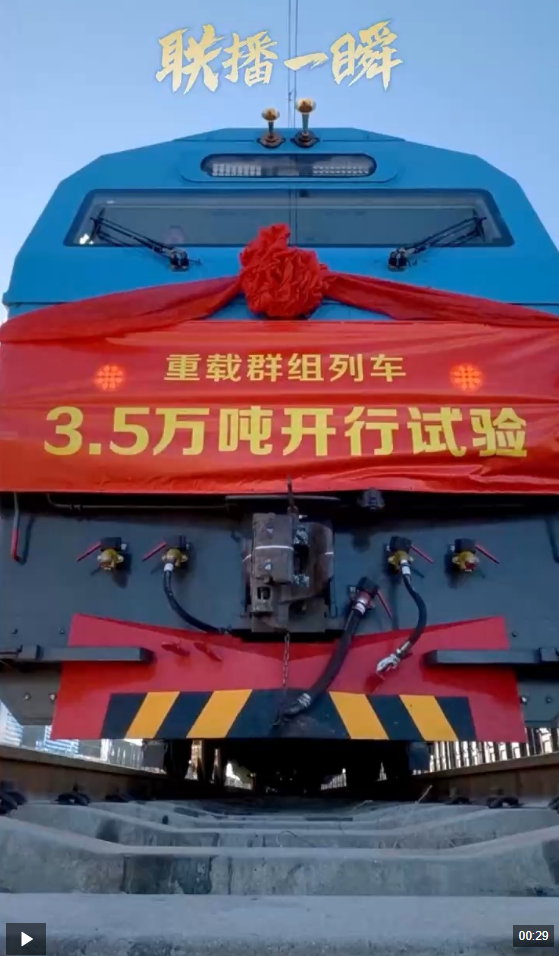
Group 1: Breakthroughs in Technology - China's first successful automatic formation trial of heavy-duty trains marks a significant advancement in railway freight, achieving a 50% increase in comprehensive capacity through wireless communication technology [1] - The successful launch of 19 low-orbit satellites for satellite internet represents a milestone in digital process integration, enhancing efficiency through automated testing and intelligent assembly [1] - The first realization of space metal 3D printing signifies a major leap in space manufacturing technology, transitioning from ground validation to space engineering verification [3] Group 2: Energy Sector Developments - The full-capacity operation of the Zhejiang Anji power plant, the largest and most efficient gas power plant in China, supports winter electricity demand in East China with a total installed capacity of 1686 megawatts and an efficiency of 64.15% [4] - The Anji power plant is expected to generate up to 7 billion kilowatt-hours annually, sufficient to meet the electricity needs of 6 million residents for a year [4] Group 3: Scientific Research Advancements - Chinese scientists have presented the dynamic process of gold nanoparticle formation at the nanoscale, challenging traditional views on gold sources and providing new insights for green gold extraction processes [2]
视频丨多个首次!本周,我国科技再迎密集突破
Yang Shi Xin Wen Ke Hu Duan· 2026-01-24 00:45
本周,我国科技再迎密集突破 轨道交通、能源电力、商业航天、 基础科学、航天制造等领域 成果接连涌现 多个首次 彰显中国科技自主创新的强劲动能 世界首次! 1月19日15时48分,我国在海南商业航天发射场使用长征十二号运载火箭,成功将卫星互联网低轨19组卫星发射升空,卫星顺利进入预定轨道,发射任务获 得圆满成功。此次发射的卫星用于低轨卫星互联网星座建设,由银河航天承担研制,搭载了多项核心技术产品。 相关负责人表示,此次卫星发射任务首次实现数字化全流程贯通,针对批量生产的特点进行了自动化测试、智能装配与检测、发射场流程优化等工作,大幅 提升了效率。 我国科学家首次呈现 纳米尺度黄金形成的动态过程 我国重载群组列车自动编队运行试验成功 1月21日,我国自主研发的万吨级重载列车完成世界首次自动编队驾驶试验,7列5000吨级的货运列车通过无线通信"对话",实现"随到随装、随编随走"的柔 性运输,像"搭积木"一样自由组合。 本次试验实现从"硬连接"到"虚拟连挂"的本质跨越,综合运能提升50%以上,打破了百年铁路货运的控制模式,未来将对我国铁路货运带来根本性的变革。 卫星互联网低轨19组卫星发射成功 首次实现数字化全流程贯 ...

一体化发展战略是重大机遇 杨帅委员谈沪苏(州)交通合作
Su Zhou Ri Bao· 2026-01-23 23:50
昨天(1月23日),苏报融媒记者带着机器人搭档"小能",采访了市政协委员、苏州工学院商学院 副院长杨帅,围绕在长三角一体化发展国家战略下的苏州机遇进行了对话。 杨帅委员:可从三个方面入手:打造轨道交通互联标杆,加速线路衔接落地,加密11号线高峰班 次;打通快速路断点堵点,构建"无界化"公路网络,优化路网功能布局,推进客货分流;完善智慧交通 系统,建设沪苏交通数据共享平台,整合两地信息,实现跨省通行"零障碍"。 记者&"小能":苏州与上海加强交通对接合作,将带来哪些效益? 杨帅委员:通过上述措施,预计苏州与上海跨区通勤时间将明显缩短,物流成本将明显降低。交通 一体化将加速上海高端人才、研发资源向苏州溢出,推动"上海研发+苏州制造"深度融合,助力苏州电 子信息、生物医药等产业向价值链高端攀升。同时,苏州的先进制造业优势将为上海提供更坚实的产业 支撑。 记者&"小能":苏州在区域协调发展承担着重大使命,围绕这一方面您做了哪些调研、带来了什么 提案? 杨帅委员:今年,我带来了《关于全面融入和服务长三角一体化发展、长江经济带发展,主动加强 与上海交通对接合作的建议》,建议苏州与上海在交通方面强化协同机制,进一步构建立体 ...
外国徒弟取经忙
Mei Ri Shang Bao· 2026-01-23 22:18
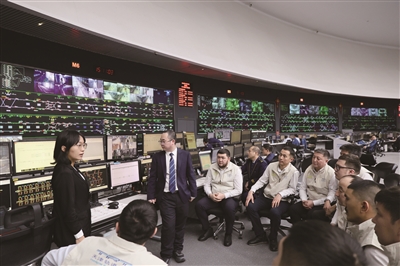
1月23日,哈萨克斯坦学员在天津轨道交通集团调度指挥中心学习。近日,天津轨交集团阿斯塔纳轻轨 调度学员在津培训班全面进入核心实操阶段,来自哈萨克斯坦的约20名专家学员通过实操培训、跟岗实 习、模拟演练等方式来掌握中国标准调度技术与实操规范。阿斯塔纳轻轨项目是中亚地区首个完整落 地"中国方案"的轨交工程。 ...
2025年雄安新区固定资产投资同比增长14%
Zhong Guo Xin Wen Wang· 2026-01-22 15:34
此外,2025年,河北工业生产较快增长。从经济类型看,国有控股企业增加值同比增长6.0%;股份制 企业同比增长8.1%,外商及港澳台投资企业同比增长10.0%;私营企业同比增长8.9%。从产品产量看, 工业机器人同比增长29.3%,城市轨道车辆同比增长67.6%,食品制造机械同比增长29.5%。(完) 通报称,2025年,雄安新区功能疏解落地加力提速,成功举办第二届雄安未来之城场景汇,278项京 雄"同城化"政务服务应用场景全面落地。同时,京津冀协同发展走深走实。京唐城际铁路全线贯通,北 京大兴国际机场临空经济区蓄力深耕,"河北福嫂"服务万千京津家庭,"河北净菜"北京市场占有率保持 四成以上。 2025年,河北固定资产投资同比增长6.1%。亿元人民币以上建设项目完成投资同比增长9.6%,拉动全 省投资增长6.5个百分点。 中新社石家庄1月22日电 (王夏菲赵丹媚韩冰)河北省政府新闻办22日举行新闻发布会通报,2025年,雄 安新区固定资产投资同比增长14%。 (文章来源:中国新闻网) ...
轨道交通排行:北京领跑,南京有变化
Jing Ji Ri Bao· 2026-01-22 10:20
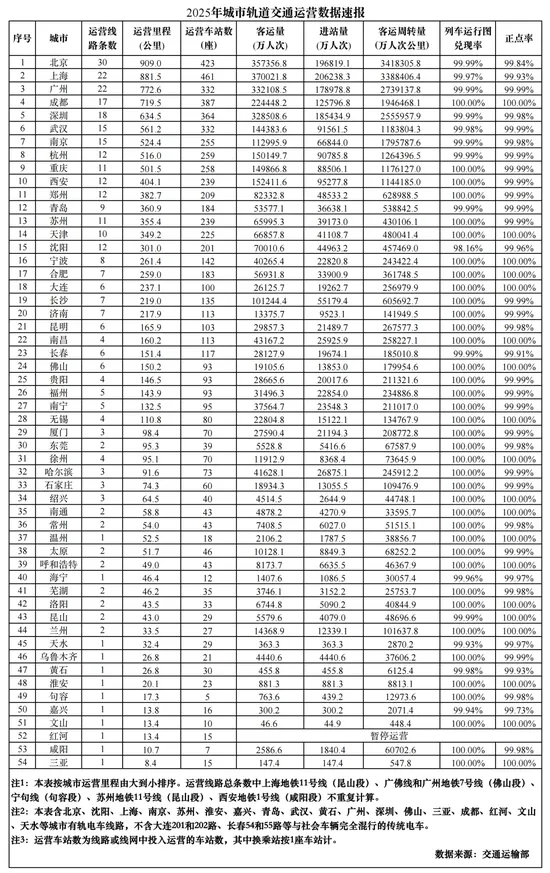
Group 1 - The core viewpoint of the article highlights the growth and changes in urban rail transit systems across major Chinese cities, with a specific focus on Nanjing's rising ranking in operational mileage [3][4]. - As of December 31, 2025, a total of 54 cities in China will have 343 urban rail transit lines in operation, covering 11,710.3 kilometers and 6,680 stations, with an addition of 18 new lines and 764.7 kilometers of new operational mileage in 2025 [2]. - Beijing continues to lead the nation in urban rail transit operational mileage, with 30 lines and 909 kilometers, while Nanjing has moved up to the seventh position, surpassing Hangzhou and Chongqing, due to the opening of new lines [4]. Group 2 - Several major cities are set to open new rail transit lines this year, including Beijing's first interprovincial line, which will span approximately 81.2 kilometers, and Shanghai's line expected to be operational by the end of the year [5]. - Nanjing is preparing for the opening of two lines, the 6th line and the Ningma line, which will connect Jiangsu and Anhui provinces, with the 6th line measuring about 32.35 kilometers and the Ningma line about 54.23 kilometers [5]. - The urban rail transit landscape is expected to continue evolving as cities announce progress on ongoing projects, potentially leading to further changes in rankings by the end of the year [6].
报告解读:轨道建设聚焦广佛全域同城化与城市主轴核心功能
Nan Fang Du Shi Bao· 2026-01-22 05:05
Core Insights - The Guangzhou government work report for 2026 emphasizes "deepening the connectivity of the Greater Bay Area," with a focus on rail transit construction as a key initiative [1] - The report highlights the completion of the Guangzhou-Foshan Ring Line West and the expected opening of the second phase of Guangzhou Metro Line 13 this year as significant projects [1][2] - These projects aim to enhance the integration of the Greater Bay Area and establish a one-hour living circle, reinforcing Guangzhou's role as a regional development engine [1] Rail Transit Development - The Guangzhou-Foshan Ring Line West is set to achieve full closure this year, significantly impacting the integration of Guangzhou and Foshan [2] - This line will connect critical hubs such as Baiyun Airport, South Railway Station, and the central business district, facilitating deeper integration between the two cities [2] - The second phase of Guangzhou Metro Line 13 will connect key districts and improve east-west traffic efficiency, with over 95% of the construction already completed [3] Infrastructure Optimization - The report outlines plans for optimizing the infrastructure system by 2026, including the expansion of Baiyun Airport and the development of major projects in Nansha Port [4] - The focus will also be on enhancing the air transport capacity and developing the airport industry cluster [4] - Additional projects include the construction of high-speed railways and highways to strengthen connectivity with surrounding cities [3][4]
济南市属国有企业资产总额突破1.4万亿元
Xin Hua Wang· 2026-01-22 03:47
Group 1 - The total assets of state-owned enterprises in Jinan are expected to exceed 1.4 trillion yuan, with operating income surpassing 200 billion yuan by the end of the 14th Five-Year Plan, indicating continuous growth in scale [1] - Four enterprises have assets exceeding 100 billion yuan, six enterprises have annual operating income over 10 billion yuan, and five enterprises have been recognized as national "Science and Technology Reform Enterprises" and "Double Hundred Enterprises," reflecting accelerated development of first-class enterprises and significant enhancement of core competitiveness [1] - During the 14th Five-Year Plan, state-owned enterprises have taken on social responsibilities, achieving notable results in urban functional area development, major infrastructure construction, and urban service guarantees, laying a solid foundation for the construction of a modern strong provincial capital [1] Group 2 - The total investment of approximately 138.5 billion yuan in seven subway lines, including Line 3 and Line 4, has been completed, increasing the operational mileage to over 240 kilometers, improving the city's ranking from 27th to the top 20 nationally [1] - The total investment of about 206 billion yuan for the "Four Bridges" across the Yellow River has been completed, and two of the "Four Tunnels" have been opened, providing strong transportation support for Jinan as an important center in the Yellow River Basin [1] - The actual investment in land consolidation, demolition, and infrastructure construction in the initial area has reached nearly 40 billion yuan, supporting the establishment of a national-level new area [1] Group 3 - The total designed water supply capacity in the city has reached 2.546 million cubic meters per day, with water supply security and standards ranking among the top in the country [2] - The heating and cooling capacity has steadily improved, with heating coverage reaching 400 million square meters and heating pipelines exceeding 11,000 kilometers, creating a new model for combined heating and cooling supply [2] - State-owned enterprises have established a rigid growth mechanism for R&D investment, with R&D expenditure reaching 3.401 billion yuan, an increase of 9.67%, and key manufacturing enterprises achieving an R&D intensity exceeding 5% [2] Group 4 - During the 14th Five-Year Plan, 43 municipal-level state-owned enterprises have been consolidated into 13 municipal enterprise groups, optimizing resource integration [3] - The establishment of the Industrial Control Group has accelerated the optimization and integration of municipal industrial enterprise resources [3] - More than 60 reorganizations of subsidiaries and business segments with similar industries and business operations have been implemented, effectively improving resource allocation efficiency [3]
千万人口城市迈进地铁“环线时代”
3 6 Ke· 2026-01-22 02:42
Core Insights - Wuhan is a large city with a land area of 8,569 square kilometers, ranking ninth in built-up area in China at 885 square kilometers, slightly higher than Nanjing but lower than Shenzhen [1][3] - The Wuhan Metro Line 12, set to be completed this year, will become the second longest circular metro line in the world and the longest in Asia, connecting 18 transit lines and featuring approximately 70% transfer stations [1][4] - The circular metro design aims to improve transportation efficiency by allowing peripheral areas to connect without routing through the city center, thus alleviating congestion [1][6] Urban Development - The circular metro line connects the three historical towns of Wuhan—Wuchang, Hankou, and Hanyang—addressing the unique spatial layout of the city and enhancing cross-regional transportation [3][4] - The development of the circular metro is part of a broader strategy to promote transportation integration and attract population and industry to Wuhan, positioning it as a leader in the central region of China [4][5] Infrastructure and Connectivity - The circular metro will complement existing high-speed rail connections, such as the recently completed high-speed rail loop that links Wuhan, Xiangyang, and Yichang, facilitating regional economic development [6] - The metro line is designed to enhance network accessibility and passenger attraction by creating an interwoven rail network in the central urban area [6][8] National Trends - Circular metro lines are increasingly being implemented in major cities across China, with a total of 9 circular lines in operation across 8 cities, indicating a trend towards multi-center urban structures [7][8] - By 2030, it is projected that at least 12 cities will have circular metro lines, reflecting the correlation between urban scale, economic development, and the need for efficient transportation systems [8][10] Economic Implications - The presence of circular metro lines is often associated with cities that have a population exceeding 10 million and are part of the trillion GDP club, highlighting the economic significance of such infrastructure [9][10] - As cities evolve from single-center to multi-center structures, circular metro lines play a crucial role in optimizing urban spatial organization and reducing congestion in central areas [10][11]