
光模块

Search documents
000917,直线涨停!
中国基金报· 2025-10-20 05:02
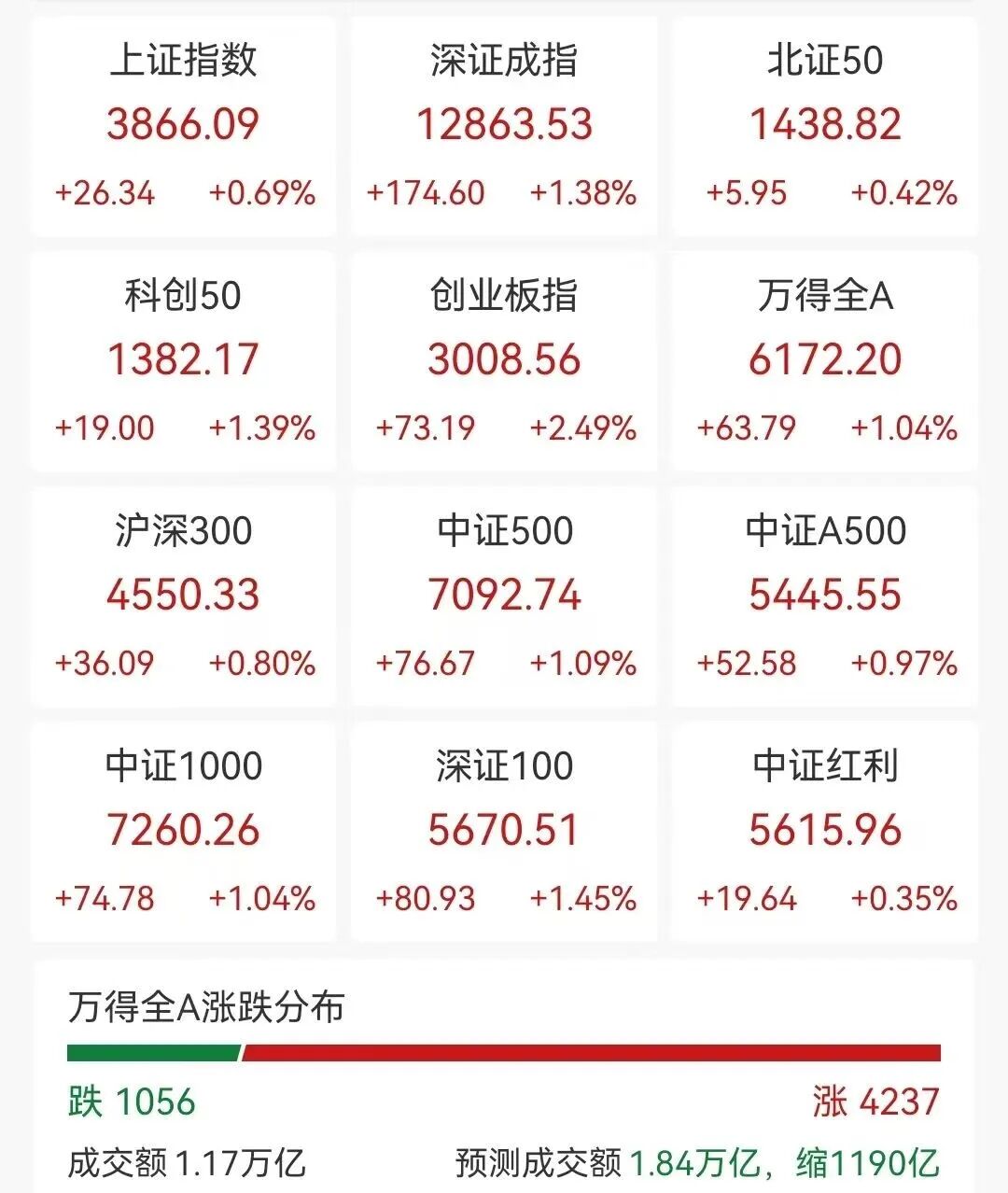
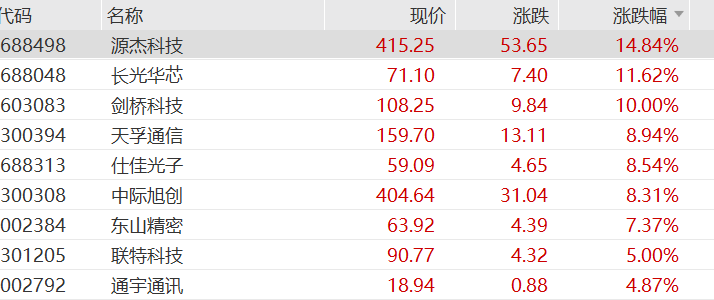
Market Overview - On October 20, the A-share market showed a strong rebound, with the ChiNext Index rising over 3% at one point. The Shanghai Composite Index closed at 3866.09 points, up 0.69%, while the Shenzhen Component Index rose 1.38% and the ChiNext Index increased by 2.49% [1][2]. Trading Volume and Stock Performance - The total trading volume exceeded 1.1 trillion yuan, slightly down from the previous trading day. A total of 4237 stocks rose, with 75 hitting the daily limit, while 1056 stocks declined [2]. Sector Performance - Most sectors were in the green, with the top-performing sectors including optical modules (CPO), lithium battery electrolyte, optical communication, and optical chip concepts, which saw gains of 5.70%, 4.71%, 4.05%, and 3.99% respectively. Conversely, the precious metals sector led the decline, with rare earths and banking sectors also experiencing pullbacks [2][3]. CPO Sector Highlights - The optical module (CPO) sector experienced a strong rebound, with related indices rising over 7%. Notable stocks included: - Zhongji Xuchuang, up 8.31%, with a market cap of 449.6 billion yuan [5]. - New Yisheng, up 4.86%, with a market cap of 329.7 billion yuan [6]. - Tianfu Communication, up 8.94%, with a market cap of 124.2 billion yuan [7]. - Source Jie Technology surged 14.84%, with a market cap of 35.7 billion yuan [10]. Semiconductor Sector Developments - The semiconductor chip sector also showed strength, with companies like Silan Microelectronics hitting the daily limit, reporting a market cap of 54.8 billion yuan. The company announced plans to invest 20 billion yuan in a new 12-inch high-end analog chip manufacturing line [11][13]. Financial Sector Performance - The financial sector exhibited mixed results, with Agricultural Bank of China reaching a new high, up over 1% and achieving a market cap of 2.61 trillion yuan. Insurance stocks saw a comprehensive rise, with China Life Insurance increasing nearly 4% [15][21]. Precious Metals Sector Decline - The precious metals sector faced significant declines, with stocks like Hunan Silver hitting the daily limit down, and West Gold dropping over 8%. The international gold price remained volatile, reported at 4265.61 USD per ounce, up 0.35% [24][25][27].



知名国际投行释放利好,“易中天”大涨!海外机构近期关注这些股,多股业绩预增
Zheng Quan Shi Bao· 2025-10-20 04:37
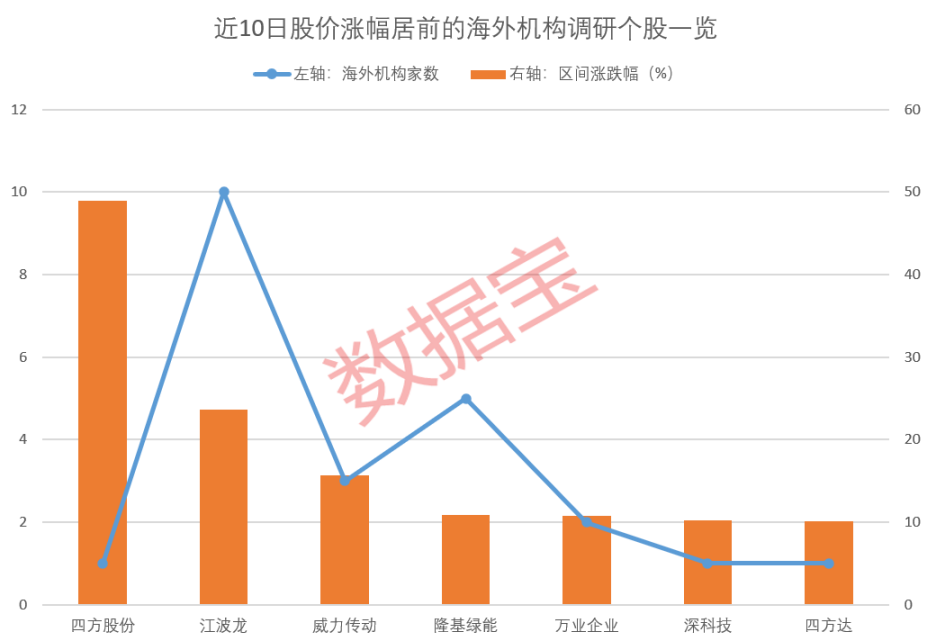
Core Insights - The overseas institutional research stocks have shown significant interest, with 321 companies being investigated in the past 10 days, indicating a robust market engagement [3] - The storage chip sector is experiencing a supply shortage, which is viewed as a positive signal for the industry, especially following Micron Technology's announcement to cease supplying server chips to Chinese data centers [2][6] - Several companies have reported positive earnings forecasts for the third quarter, with six out of seven companies expecting improved performance [6] Group 1: Market Trends - The A-share market has seen a rise in sectors such as computing hardware and quantum technology, while precious metals and certain food sectors have declined [1] - The optical module industry is anticipated to experience increased demand, with potential growth in industry requirements from 8 million units to over 20 million units by 2026 [1] - Citibank has highlighted that the optical module sector may present buying opportunities due to recent price adjustments [1] Group 2: Company Performance - Mindray Medical has attracted the most attention from overseas institutions, with 124 firms participating in its research, and it expects positive revenue growth by Q3 2025 [3] - Inovance Technology has introduced a new energy management platform, which aims to optimize electricity usage and reduce costs significantly [4] - Seven overseas-researched stocks have released earnings forecasts, with notable predictions from GigaDevice Semiconductor, expecting a net profit increase of approximately 57% to 86% compared to the previous year [6]


A50猛拉,A股超4200股上涨,亚太股市集体反攻
2 1 Shi Ji Jing Ji Bao Dao· 2025-10-20 04:24
今日,亚太股市大反攻! 10月20日,A股三大指数强势反弹,截至午盘收盘,创业板指大涨2.5%。 热门科技股普涨,"易中天"光模块三巨头领涨,源杰科技大涨超15%,天孚通信、中际旭创、中石科技等涨超10%,剑桥科技涨停;机器人概念活跃,华 瑞股份、中威电子双双20cm涨停。下跌方面,贵金属板块弱势震荡,湖南白银跌停;稀土永磁板块下挫,新莱福领跌;银行板块跌幅居前,渝农商行领 跌。 | 上证指数 | 深证成指 | 北证50 | | --- | --- | --- | | 3866.09 | 12863.53 | 1438.82 | | +26.34 +0.69% +174.60 +1.38% +5.95 +0.42% | | | | 科创50 | 创业板指 | 万得全A | | 1382.17 | 3008.56 | 6172.20 | | +19.00 +1.39% +73.19 +2.49% +63.79 +1.04% | | | | 沪深300 | 中证500 | 中证A500 | | 4550.33 | 7092.74 | 5445.55 | | +36.09 +0.80% +76.67 +1.09% ...
A50猛拉,A股超4200股上涨,阿里巴巴涨5%,亚太股市集体反攻
2 1 Shi Ji Jing Ji Bao Dao· 2025-10-20 04:20
Market Performance - The Asia-Pacific stock markets experienced a strong rebound on October 20, with A-shares' three major indices showing significant gains, particularly the ChiNext Index which surged by 2.5% [1] - In the technology sector, leading companies such as SourceJ Technology saw a rise of over 15%, while Tianfu Communication, Zhongji Xuchuang, and Zhongshi Technology all increased by over 10% [1] - The Hang Seng Technology Index opened high, with notable gains from companies like Alibaba, which rose over 5%, and Baidu, JD.com, and NIO also showing strong performance [2][3] Sector Trends - The robotics sector was notably active, with Huari Technology and Zhongwei Electronics both hitting the daily limit up of 20% [1] - Conversely, the precious metals sector faced weakness, with companies like Hunan Silver hitting the daily limit down [1] - The rare earth permanent magnet sector also saw declines, with Xinlaifu leading the drop [1] Trading Volume and Activity - The trading volume in A-shares for the first three quarters increased significantly, with a year-on-year growth of 106.8%, indicating a boost in market confidence [8] - The number of active users on securities-related apps reached approximately 175 million, marking a 0.74% increase from the previous month and a 9.73% increase year-on-year [8] Future Outlook - Analysts suggest that technology growth and core assets may outperform in the post-National Day period, with trends in artificial intelligence and robotics expected to continue rising [4] - The long-term investment strategy of "regular investment and buying on dips" is recommended as a stable approach for market entry [6]


A50猛拉,A股超4200股上涨,阿里巴巴涨5%,亚太股市集体反攻
21世纪经济报道· 2025-10-20 04:08
Market Performance - The Asia-Pacific stock market experienced a strong rebound on October 20, with the A-share indices showing significant gains, particularly the ChiNext Index which surged by 2.5% [1] - Major indices such as the Shanghai Composite Index and Shenzhen Component Index also reported increases of 0.69% and 1.38% respectively, indicating a broad-based market recovery [2] Sector Highlights - Technology stocks saw widespread gains, with leading companies in the optical module sector, such as Yuanjie Technology, rising over 15%, and others like Tianfu Communication and Zhongji Xuchuang increasing by more than 10% [2] - The robotics sector was notably active, with Huazhi Co. and Zhongwei Electronics both hitting the daily limit up [2] Precious Metals - Precious metals experienced a pullback but later rebounded, with gold prices reaching as high as $4,263 per ounce in London and $4,266 per ounce on COMEX, marking a 1.3% increase [5] - Despite the recent highs, analysts caution that short-term investment risks are increasing, particularly if U.S. economic data exceeds expectations, which could pressure gold prices [5] Trading Activity - The trading volume in the A-share market saw a significant year-on-year increase of 106.8% in the first three quarters, reflecting a boost in market confidence due to supportive policies [5] - The number of active users on securities trading apps reached approximately 175 million in September 2025, marking a 9.73% year-on-year growth and setting a new monthly record [5] Future Outlook - Analysts from Huajin Securities suggest that technology growth and core assets may dominate the market post-National Day, with sectors like artificial intelligence and robotics expected to continue their upward trend [3]

创50ETF(159681)盘中净申购7200万份,CPO概念大幅走高
Xin Lang Cai Jing· 2025-10-20 03:43
Group 1 - The core viewpoint of the articles highlights the significant increase in demand for 1.6T optical modules, with global demand revised from 7-10 million units to 20 million units for 2026, indicating potential for further upward adjustments [1] - The CPO concept has seen a substantial rise, with leading companies adjusting their profit expectations significantly due to the demand revision [1] - The technological iteration cycle in the optical module industry has shortened, with the transition from 100G to 400G taking about 4-5 years, while the current shift from 800G discussions in 2023 to 1.6T is expected to occur in less than 2 years [1] Group 2 - The AI-driven computing power industry is experiencing strong demand and sustained prosperity, with a recommendation to invest in the AI computing power sector from a medium to long-term perspective despite potential short-term market fluctuations [2] - The 创50ETF closely tracks the ChiNext 50 Index, which consists of the 50 stocks with the highest average daily trading volume in the ChiNext market, reflecting the overall performance of well-known, large-cap, and liquid companies [2] - As of September 30, 2025, the top ten weighted stocks in the ChiNext 50 Index account for 69.36% of the index, with notable companies including 宁德时代 (CATL), 中际旭创, and 东方财富 [2]


A股突变!000626,罕见“天地天”
Zhong Guo Ji Jin Bao· 2025-10-20 03:35
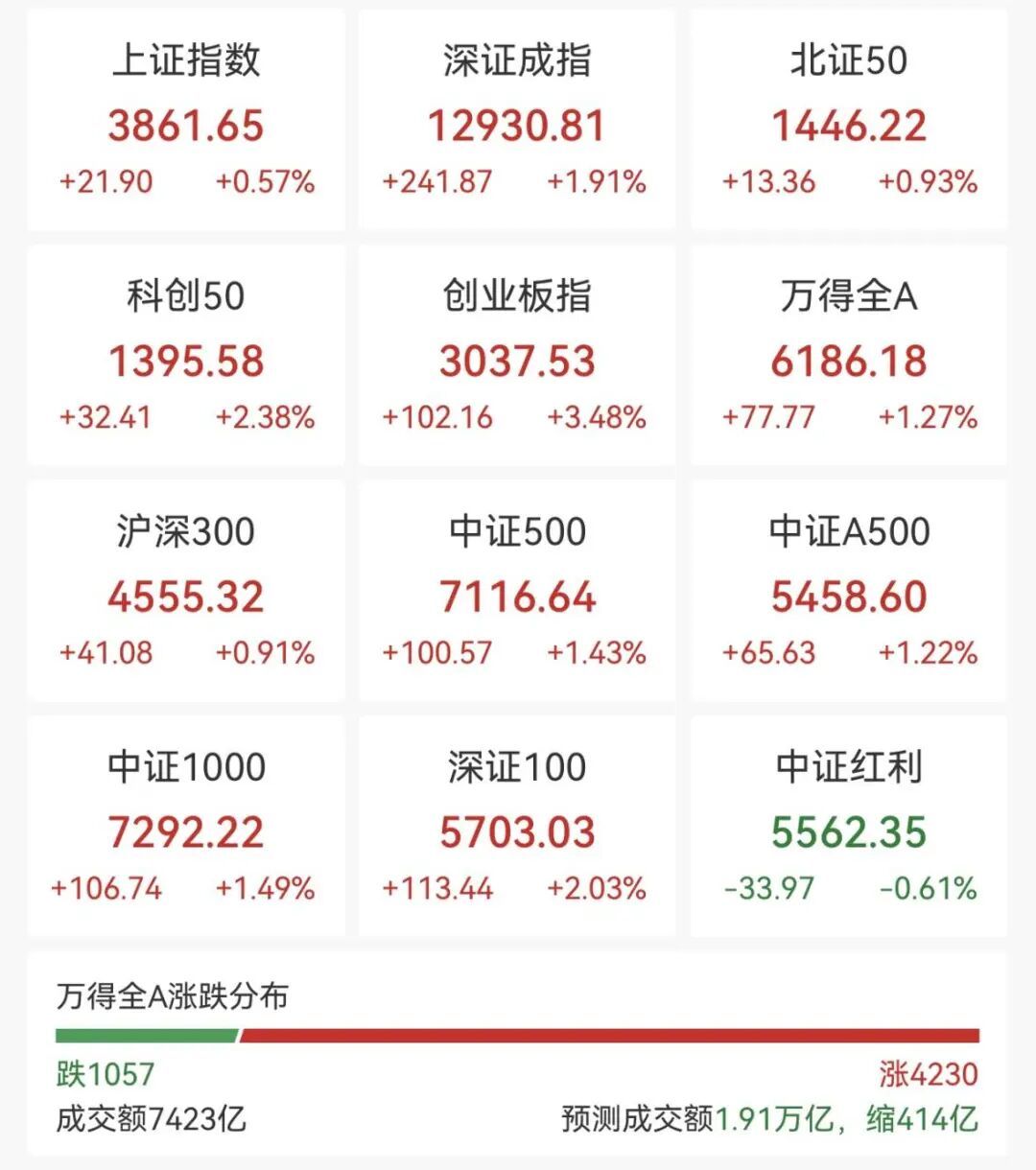
Market Overview - On October 20, A-shares opened higher with all three major indices rising, the ChiNext Index increased by over 3%, and the Shenzhen Component Index rose nearly 2% [1] - The Shanghai Composite Index closed at 3861.65, up 21.90 points or 0.57%, while the Shenzhen Component Index closed at 12930.81, up 241.87 points or 1.91% [2] Sector Performance - The computing hardware sector led the market, with significant gains in CPO, electronic components, and semiconductor sectors, while precious metals, banking, and agriculture sectors experienced fluctuations [4] - Over 4200 stocks rose during the trading session [4] Notable Stocks - CPO concept stocks saw a surge, with Yuanjie Technology hitting a 20% limit up, and Tianfu Communication and Zhongji Xuchuang also showing strong gains [8][11] - In the communication equipment and electronic components sectors, Zhongwei Electronics and Jingwei Huikai both reached a 20% limit up [12][13] - Solid-state battery concept stocks also performed well, with Haike Xinyuan hitting a 20% limit up, and other companies like Huasheng Lithium and Tianqi Materials following suit [14][17] Hong Kong Market - The Hong Kong market also saw gains, with the Hang Seng Technology Index rising over 3%, and notable increases in stocks such as NetEase, NIO, and Alibaba, all rising over 4% [5][6][7]


大数据ETF(159739)涨超3.4%,龙头企业上调明年1.6T光模块总需求
Xin Lang Cai Jing· 2025-10-20 03:03
Core Insights - The demand for 1.6T optical modules has been revised upwards from 7-10 million units to 20 million units for 2026, indicating potential for further upward adjustments [1] - This demand increase is expected to significantly boost profits for leading companies beyond market expectations [1] - The technology iteration cycle in the optical module industry has shortened, with the transition from 800G discussions in 2023 to 1.6T expected by 2025, reducing the cycle to less than 2 years [1] Industry Performance - As of October 20, 2025, the CSI Cloud Computing and Big Data Theme Index (930851) rose by 3.31%, with notable increases in constituent stocks such as Zhongji Xuchuang (300308) up 10.01% and Xinyi Sheng (300502) up 6.86% [1] - The Big Data ETF (159739) also saw a rise of 3.45%, with the latest price reported at 1.5 yuan [1] Index Composition - The CSI Cloud Computing and Big Data Theme Index includes 50 listed companies involved in cloud computing services, big data services, and related hardware, reflecting the overall performance of these sectors [2] - As of September 30, 2025, the top ten weighted stocks in the index accounted for 60.8% of the total, including Zhongji Xuchuang (300308) and Xinyi Sheng (300502) among others [2]
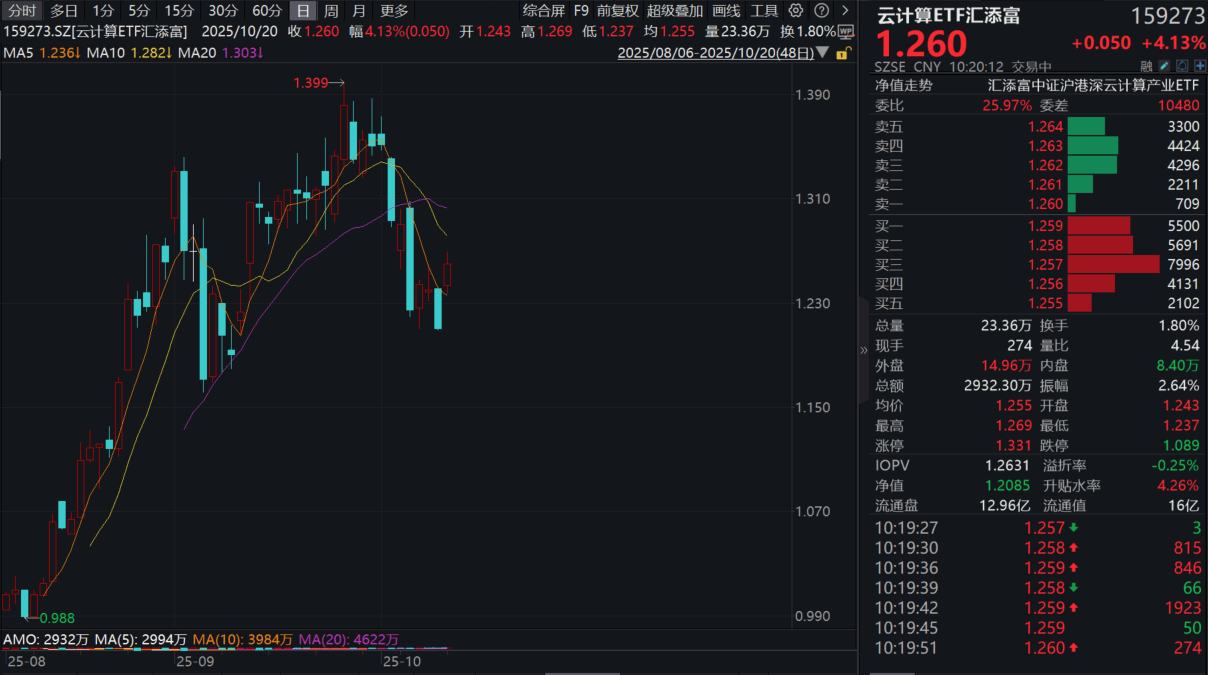
“易中天”再度狂飙,中际旭创涨超11%!云计算ETF汇添富(159273)大涨超4%!机构:光模块需求可见度再提升!底层逻辑是什么?
Sou Hu Cai Jing· 2025-10-20 02:56
Group 1: Market Performance - Cloud computing ETF Huatai (159273) surged over 4%, with a trading volume exceeding 31 million yuan, and its latest scale reached over 1.56 billion yuan as of October 17, leading its peers [1][4] - Major index constituents of the cloud computing ETF showed positive performance: Zhongji Xuchuang up 11%, Xinyi Sheng up over 8%, Alibaba up over 4%, Tencent up over 3%, and Zhongke Shuguang up over 2% [4][5] Group 2: Industry Insights - The demand visibility for optical modules has improved, with projections for 2025-2027 indicating demand for 50 million, 75 million, and 100 million units respectively [6] - The optical module market is experiencing rapid growth driven by AI computing demand, with price changes reflecting technological iterations and cost control rather than simple supply-demand dynamics [7][8] - The competitive focus in the optical module industry has shifted from price to continuous innovation and comprehensive solutions, emphasizing product upgrades and technological advancements [8][9] Group 3: Company Performance - TSMC's Q3 2025 profit margin exceeded expectations, with a gross margin of 59.5%, driven by strong AI demand, and the company provided a positive outlook for Q4 2025 [10] - ByteDance reported a significant increase in daily token usage, indicating robust domestic computing demand, with daily usage rising from 120 billion in May 2024 to over 30 trillion by September 2025 [10]
暴涨近7%!光模块再现骤升式行情,高“光”159363盘中量价齐升涨逾6%
Mei Ri Jing Ji Xin Wen· 2025-10-20 02:29
Group 1 - The core viewpoint of the news highlights a significant rebound in the optical module and computing hardware sector, with the AI-themed ChiNext ETF experiencing a jump of nearly 7% [1] - Major companies such as Zhongji Xuchuang and Tianfu Communication saw their stock prices increase by over 10%, while Xinyi Sheng rose by more than 7% [1] - The largest and most liquid AI-themed ChiNext ETF (159363) opened significantly higher, with a price increase of over 6% and a real-time transaction volume exceeding 500 million yuan, indicating a notable increase in trading activity [1] Group 2 - According to a report from Industrial Securities, overseas major clients have revised their procurement plans for 1.6T optical modules for 2026, increasing the forecast from 10 million to 20 million units, driven by the rapid growth in bandwidth demand for AI training and inference networks [1] - Guosheng Securities noted that the optical module market is experiencing rapid growth and technological iteration due to the continuous explosion of AI computing demand, with leading companies in the sector expected to maintain strong profitability and competitive advantages [1] - The first ChiNext AI ETF (159363) and its corresponding off-market connection (023407) have over 70% of their portfolio allocated to computing power and more than 20% to AI applications, with a focus on leading optical module company "Yizhongtian," which constitutes over 51% of the ETF [2]