Semiconductors

Search documents
This "Magnificent Seven" Stock Is Historically Cheap and Begging to Be Bought (Hint: It's Not Nvidia)
Yahoo Finance· 2026-03-24 09:26
Group 1: Magnificent Seven Overview - The "Magnificent Seven" have significantly contributed to the rise of all three major stock indexes, showcasing their influential role in the stock market [1] - These companies possess sustainable competitive advantages or moats, making them pivotal players in their respective industries [1] Group 2: Nvidia Analysis - Nvidia is a leader in the AI sector, holding a virtual monopoly in enterprise data centers with its GPUs, which offer clear compute advantages over competitors [6] - Despite Nvidia's dominance, its forward price-to-earnings (P/E) ratio is currently at 16, which is relatively low compared to historical standards [7] - Concerns exist regarding Nvidia's valuation, as its price-to-sales (P/S) ratio briefly exceeded 30, indicating potential valuation bubbles, and it remains above 20 [9] - The company faces competition as major customers are developing their own AI chips, which, while not superior, are cheaper and more accessible [9] Group 3: Amazon Analysis - Amazon is currently viewed as inexpensive relative to its projected cash flow, despite not appearing cheap based on traditional P/E ratios [11] - The company is positioned uniquely in the market, suggesting potential investment opportunities based on its cash flow metrics [11]


我国微电子领域泰斗吴德馨院士逝世
是说芯语· 2026-03-24 09:21
Core Viewpoint - The article highlights the significant contributions of Wu Dexin, a pioneer in China's semiconductor and integrated circuit field, who passed away at the age of 90. Her work laid the foundation for China's chip independence and the development of domestic integrated circuit research systems [1][3]. Group 1: Contributions to Semiconductor Technology - Wu Dexin was a key figure in the development of semiconductor devices and integrated circuits in China, having dedicated 65 years to the microelectronics field. She was instrumental in overcoming critical technological challenges and establishing a domestic research framework [1][3]. - In the early 1960s, she led the development of the silicon planar high-speed switching transistor, which provided essential support for the "Two Bombs, One Satellite" project, solidifying the foundation of national defense electronics [3][4]. - By the late 1970s, she and her team successfully developed the MOS 4K dynamic random-access memory chip, introducing advanced microfabrication techniques such as positive photoresist and dry etching to improve yield rates in domestic integrated circuit production [4]. Group 2: Leadership and Institutional Development - From 1986, Wu Dexin served as the director of the Chinese Academy of Sciences Microelectronics Center, where she coordinated the discipline's layout and resource integration, focusing on "independent control and industry-academia-research collaboration" [4][5]. - Under her leadership, the Microelectronics Center became a core platform for tackling key technologies in integrated circuits and facilitating the transformation of research outcomes, which was crucial for the subsequent domestic substitution process [4][5]. Group 3: Legacy and Impact on Talent Development - Throughout her career, Wu Dexin emphasized the importance of precision in chip manufacturing, famously stating that "a deviation of one micron renders the entire process void," reflecting her rigorous scientific approach [5]. - She was dedicated to nurturing future talent in the microelectronics field, instilling a spirit of independent innovation and training numerous professionals who continue to contribute to China's semiconductor industry [5].


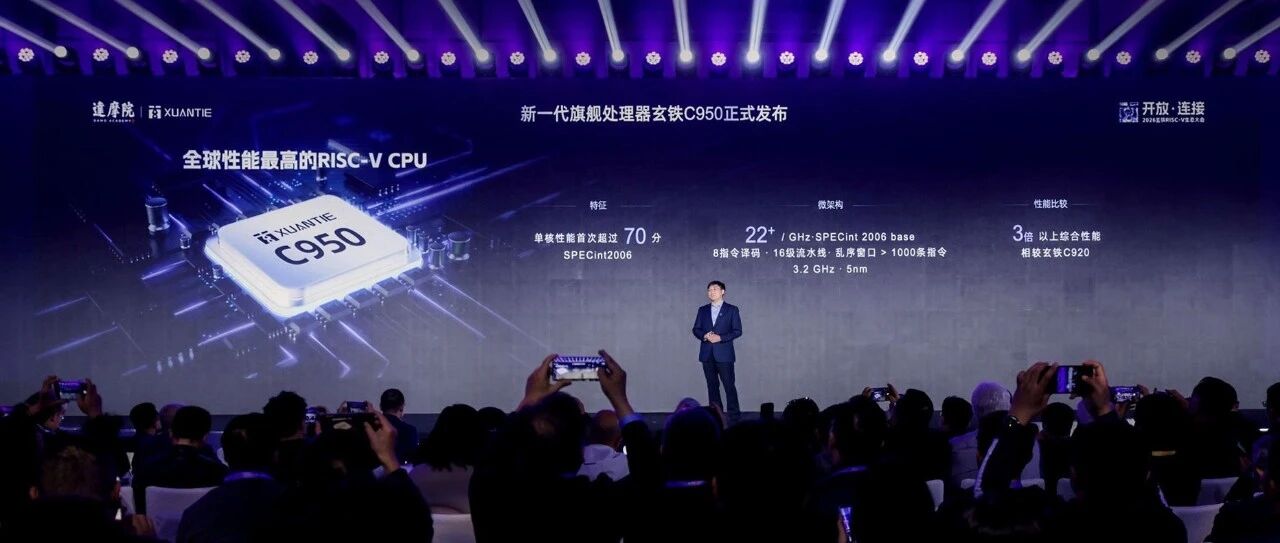
全球RISC-V CPU性能新纪录——玄铁C950,正式发布!
半导体行业观察· 2026-03-24 09:13
Core Insights - RISC-V has evolved over the past 15 years in three phases: initial open-source exploration, establishment of international standards and commercial IP in IoT, and recent large-scale adoption across various sectors including automotive and AI [1][2][4] - The RISC-V ecosystem is projected to see significant growth, with an estimated 36 billion devices by 2031 and IP sales exceeding $1.9 billion, reflecting a compound annual growth rate of 31.7% and 39.7% respectively [1] - Despite its widespread adoption, RISC-V has yet to penetrate high-performance computing markets, often being associated with low-end applications [2][4] RISC-V's High-Performance Breakthrough - The launch of the XuanTie C950 marks a significant advancement for RISC-V, allowing it to shed its low-end image and enter the high-performance computing arena [4][5] - The C950 achieves a clock speed of over 3.2 GHz and a SPECint2006 score exceeding 70, positioning it alongside leading CPUs from Intel, Arm, and AMD [6][9] - The C950's performance in real-world workloads like MySQL and Redis demonstrates its viability for industry applications, indicating a shift from theoretical benchmarks to practical usability [7][9] Product Line and Market Strategy - The XuanTie product line includes the C950, C930, and C925, creating a tiered performance structure that addresses various market needs from high-performance servers to edge computing [14][16] - The C925 fills a performance gap between 10 to 12 points, catering to clients focused on efficiency and cost [16] - This tiered approach allows RISC-V to offer a comprehensive solution that spans from high-performance terminals to edge servers, enhancing its competitive edge [17] AI and CPU Evolution - The rise of AI necessitates a shift in CPU design, with RISC-V aiming to integrate native AI capabilities directly into its architecture rather than relying on external accelerators [19][21] - The C950's ability to run large AI models like Qwen3 and DeepSeek V3 showcases RISC-V's potential to serve as a central processing unit in AI systems [21][22] - The focus on inference rather than training aligns with market demands, allowing RISC-V to establish a foothold in the AI landscape [22][23] Flex Platform and Customization - The introduction of the Flex platform allows clients to customize RISC-V CPUs without starting from scratch, facilitating differentiation in specific applications [27][28] - This model promotes a collaborative relationship between RISC-V and its clients, enabling ongoing innovation and adaptation to market needs [28] - The Flex platform exemplifies RISC-V's core appeal of customization, moving beyond the notion of simply being a free architecture to offering tailored solutions [28] Ecosystem Development - RISC-V's current challenge lies in the need for more standardized, competitive general-purpose chips to foster a robust ecosystem [30][31] - The C950 and similar products are crucial for creating a foundation that can be repeatedly adapted and optimized, driving ecosystem growth [31] - Collaborative initiatives like the Wu Jian Alliance aim to bridge the gap between technology and practical application, enhancing RISC-V's market presence [32] Conclusion - RISC-V is transitioning from a niche player to a competitive force in the semiconductor industry, with the C950 and Flex platform positioning it for significant market impact [34][35] - The evolution of RISC-V reflects a broader paradigm shift in computing, establishing it as a viable alternative alongside x86 and Arm in the high-performance computing landscape [35]

外媒称英伟达发布MGX ETL开放机架,可兼容多品牌AI芯片
Huan Qiu Wang Zi Xun· 2026-03-24 08:38
Core Insights - Nvidia has introduced the MGX ETL open standardized rack at the GTC 2026 conference, enabling mixed deployment of its own chips with third-party AI chips for the first time [1][3] - This design allows customers to integrate AI XPUs from companies like Google and AMD, while the standardized architecture resolves issues related to bundled sales [1] Group 1 - The mixed deployment and efficient interconnection MGX ETL rack is part of Nvidia's Vera Rubin POD system, which includes five specialized rack-level expansion systems, all utilizing the third-generation MGX design [3] - The Vera Rubin NVL72, based on the MGX NVL rack, supports up to 256 chips and employs Spectrum-X Ethernet or Groq 3 LPU direct chip-to-chip link copper spine connection [3] - The other four systems are based on the MGX ETL rack, and if customers use third-party chips, they will only support Spectrum-X Ethernet connections [3] Group 2 - Nvidia will not restrict partners from using alternative components in the MGX, allowing customers to mix and deploy Google and AMD's AI XPUs with Nvidia's network chips in the MGX NVL [3]

一口气买20台EUV光刻机!
是说芯语· 2026-03-24 08:28
Core Viewpoint - SK Hynix announced the purchase of advanced chip manufacturing equipment worth 12 trillion KRW (approximately 55.4 billion RMB) from ASML to meet the growing demand for storage chips [1] Group 1: Investment and Equipment Acquisition - SK Hynix is acquiring extreme ultraviolet (EUV) lithography machines, which are expected to be delivered by December 2027, to enhance its next-generation production processes [1] - The acquisition aligns with SK Hynix's strategy to ramp up production of storage chips, including high bandwidth memory (HBM), in response to strong demand from the artificial intelligence (AI) sector [2] - The estimated cost of one EUV lithography machine is around 500 billion KRW, suggesting that SK Hynix will acquire approximately 20 machines, thereby increasing its total to about 40 EUV machines [3] Group 2: Technological Advancements - The new EUV machines will facilitate the transition to the 1c process technology, which will be applied to key product lines including next-generation DDR5, LPDDR6, and HBM [2] - The 1c process technology is expected to improve semiconductor production efficiency, energy efficiency, and data processing speed [2] Group 3: Market Positioning - SK Hynix aims to respond to the global demand for storage chips and strengthen its market leadership position [3] - With this contract, SK Hynix is poised to narrow the gap with Samsung Electronics, which currently operates around 60 EUV machines [3]

傅里叶(03625):IPO点评
国投证券(香港)· 2026-03-24 08:09
Investment Rating - The report assigns a cautious investment rating for the company, suggesting a careful subscription to the IPO due to its current financial state and market conditions [10]. Core Insights - The company, Fourier, specializes in audio amplifier chips and haptic feedback chips, focusing on low-power and medium-to-high power audio chip design, with a projected revenue growth from 130 million in 2022 to 355 million in 2024 [1]. - The Chinese audio amplifier chip market is expected to grow from 41 billion in 2024 to 99 billion by 2029, with a CAGR of 19.4%, indicating a robust growth potential compared to the global market [2]. - Fourier has several first-to-market products and a strong R&D team, which positions it well for future growth, particularly in the consumer electronics and smart automotive sectors [3]. Company Overview - Fourier's core products include low-power audio chips, medium-to-high power audio chips, haptic feedback chips, and power management chips [1]. - The company has faced continuous net losses since its establishment, with losses of 66 million, 94 million, 57 million, and 52 million from 2022 to the first ten months of 2025 [4]. - The company has received significant intent orders from new energy vehicle manufacturers, amounting to 37.2 million, which could confirm revenue by 2026 [3]. Financial Data - Revenue projections for Fourier are 130 million in 2022, 150 million in 2023, and 355 million in 2024, with 281 million reported for the first ten months of 2025 [1]. - The gross margin is showing signs of improvement, with a reported gross margin of 20.0% for the first ten months of 2025 [3]. IPO Information - The IPO is scheduled from March 23 to March 26, 2026, with a share price range of 40.0 to 50.0 HKD, leading to a market capitalization between 4.48 billion and 5.6 billion HKD [5]. - The net proceeds from the IPO are estimated at approximately 480 million HKD, with significant allocations for R&D and operational enhancements [7][9].
Should You Buy Micron Stock While It's Under $500?
The Motley Fool· 2026-03-24 07:59
Core Insights - Micron Technology is experiencing unprecedented demand for its high-bandwidth memory (HBM) solutions, leading to a significant revenue increase [2][7] - The company's stock has surged by 330% over the past year, with a current trading price of $444.27, and analysts suggest it could exceed $500 soon [3][11] - Micron's HBM products are critical for AI workloads, as they alleviate bottlenecks in data processing, enhancing user experience for AI applications [3][4] Revenue and Earnings Performance - Micron reported a record revenue of $23.8 billion in the fiscal 2026 second quarter, marking a 196% increase year-over-year, surpassing management's forecast [7] - The cloud memory segment contributed $7.7 billion in revenue, up 163% year-over-year, while the mobile and client segment also generated $7.7 billion, reflecting a 245% increase [8] - GAAP earnings soared by 756% to $12.07 per share in the second quarter, indicating strong pricing power due to high demand for AI-related memory solutions [9] Future Outlook - Micron anticipates a revenue of $33.5 billion and earnings of $18.90 per share for the fiscal 2026 third quarter, representing year-over-year increases of 260% and 1,025%, respectively [10] - Analysts project earnings of $36.67 per share for fiscal 2026 and $57.31 per share for fiscal 2027, suggesting forward P/E ratios of 12.1 and 7.7 [13] - To maintain its current P/E ratio of 20.9, Micron's stock would need to increase by 171% over the next 18 months, potentially reaching a price of $1,203 [14] Competitive Positioning - Micron's HBM3E solution offers 50% more capacity than competitors while consuming 30% less energy, and the upcoming HBM4 solution will provide a further 60% capacity increase with improved energy efficiency [4] - The company is a key supplier for both data centers and consumer electronics, with increasing memory requirements in PCs and smartphones driving additional revenue [6] - Micron's valuation remains attractive compared to Nvidia, which has a higher P/E ratio, despite Micron supplying critical components for Nvidia's GPUs [11][12]

SK Hynix may raise up to $10 billion from US listing, Korea Economic Daily says
Reuters· 2026-03-24 07:43
Core Viewpoint - South Korea's SK Hynix is considering raising 10 trillion to 15 trillion won ($10.03 billion) through a potential U.S. listing to expand production capacity for advanced memory chips [1] Company Summary - SK Hynix aims to enhance its production capabilities specifically for advanced memory chips, indicating a strategic move to strengthen its position in the semiconductor market [1] - The potential U.S. listing is part of a broader strategy to secure funding for expansion, reflecting the company's commitment to growth in a competitive industry [1] Industry Summary - The semiconductor industry is experiencing increased demand for advanced memory chips, prompting companies like SK Hynix to seek additional capital for production capacity [1] - A successful U.S. listing could provide significant financial resources, enabling SK Hynix to better compete with global rivals in the memory chip sector [1]

Why is Broadcom warning of tighter supply in AI hardware?
Invezz· 2026-03-24 07:34
Core Insights - Broadcom warns of tightening supply in AI hardware due to increased demand for AI chips, which is straining the global semiconductor ecosystem [1][2][3] - The company highlights that Taiwan Semiconductor Manufacturing Company (TSMC) is nearing its production limits, affecting the overall supply chain [3][4] Supply Chain Constraints - TSMC's capacity constraints are now impacting production timelines, with demand for advanced AI-related chips outpacing available production [3][4] - The supply strain is not limited to chip fabrication but is spreading to other critical components essential for AI systems [6][9] - PCB suppliers in Taiwan and China are experiencing longer lead times, indicating a bottleneck in the supply chain [7][8] Long-term Contract Trends - Companies are increasingly entering long-term supply agreements lasting three to five years to secure access to critical components [10][11] - This shift reflects a broader strategy to manage supply-demand imbalances and ensure stability during high-demand periods [12] Industry-wide Implications - The current situation underscores how the AI boom is reshaping not only demand patterns but also the dynamics of the supply chain across the technology sector [12][13] - As companies adapt their procurement strategies and expand capacity, managing these constraints remains a significant challenge for the industry [13]


【买卖芯片找老王】260324 华邦/MPS/安世/NXP/ALTERA/YAGEO
芯世相· 2026-03-24 06:53
Core Viewpoint - The article discusses the challenges of managing excess inventory in the semiconductor industry, highlighting the financial burden of storage and capital costs associated with unsold materials, while promoting a service that facilitates quick sales of surplus stock [1][8]. Group 1: Inventory Management - A significant amount of excess inventory, specifically 100,000 units, is incurring monthly storage and capital costs of at least 5,000, leading to a potential loss of 30,000 over six months [1]. - The company offers a platform, "Chip Superman," which has served 22,000 users and can complete transactions in as little as half a day, aiming to alleviate the burden of unsold inventory [8]. Group 2: Inventory Listings - The article lists various semiconductor components available for sale, including: - 6,000 units of W988D6FBGX6I25+ from Winbond - 90,000 units of W25Q16JVBYIQ22+ from Winbond - 10,000 units of BTS724G from Infineon, among others [4][5]. - The total inventory includes over 1,000 models from 100 brands, with a total of 50 million chips valued at over 100 million [7]. Group 3: Purchase Requests - The company is actively seeking specific components, such as: - 3,000 units of MA5332MS from Infineon - 20,000 units of LSM6DSOTR from ST - 2,000 units of STM32H743VIH6 from ST [6]. Group 4: Service and Accessibility - The company promotes its services through a mini-program for easy access to surplus materials, emphasizing the ability to find and sell components that may otherwise be difficult to move [9]. - Users can also access the service via a web platform, enhancing the convenience of inventory management [10].