
光伏设备

Search documents
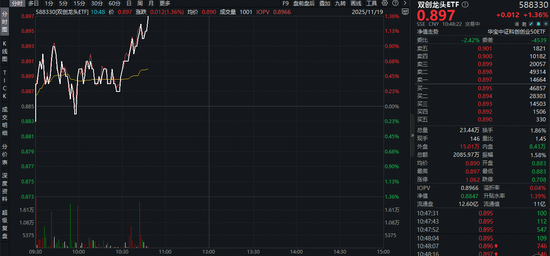
光模块+新能源携手上攻!中际旭创领涨超5%,百分百布局新质生产力的——双创龙头ETF(588330)盘中拉升1.3%
Xin Lang Ji Jin· 2025-11-19 03:03
今日(11月19日)科技自主可控方向强势崛起,百分百布局新质生产力的硬科技宽基——双创龙头ETF (588330)震荡上扬,场内价格现涨1.36%。 细分方向来看,光模块三巨头强势上攻,中际旭创涨超5%,新易盛涨逾3%,天孚通信涨超2%;新能源 亦有亮眼表现,宁德时代涨超2%,亿纬锂能、阳光电源涨逾1%。 图:双创龙头 ETF 标的指数涨幅前 10 大成份股 | 序号 | 名称 | 液洗帽 ▼ | 两日图 | 申万一级行业 | 申万二级行业 | 申万三级行业 | 总市値 | 成交領 | | --- | --- | --- | --- | --- | --- | --- | --- | --- | | 1 | 中后船倒 | 5.09% | Non | 通信 | 通信设备 | 通信网络设备及器件 | 55225 | 103.91亿 | | 2 | 新易签 | 3.31% | m | 通信 | 通信设备 | 通信网络设备及器件 | 3254Z | 59.6965 | | 3 | 宁德时代 | 2.82% | m- | 电力设备 | 电池 | 煙电池 | 18186亿 | 51.064Z | | 4 | 天孚通信 | ...


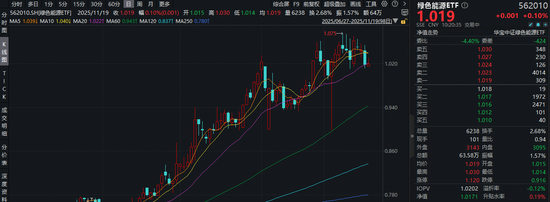
储能政策密集落地!绿色能源ETF(562010)摸高0.88%!机构:新型储能或迎加速发展期
Xin Lang Ji Jin· 2025-11-19 02:29
Core Viewpoint - The green energy ETF (562010) shows stable performance with a slight increase, while key stocks in the sector exhibit mixed results, indicating ongoing market dynamics in the green energy space [1][3]. Market Performance - The green energy ETF reached a peak increase of 0.88% during trading, currently up by 0.1% [1]. - Key stocks such as Ganfeng Lithium, Tianqi Lithium, and Zhongmin Resources showed strong performance with increases of 3.52%, 3.42%, and 3.11% respectively [1]. - Conversely, stocks like Trina Solar, JinkoSolar, and Jinglong Electric experienced declines of 2.22%, 1.43%, and 1.28% respectively [1]. Policy and Industry Developments - The National Development and Reform Commission and the Energy Administration issued guidelines on November 16 to promote the consumption and regulation of new energy, including the integration of new energy storage into the capacity price mechanism [3]. - Longi Green Energy announced the acquisition of Suzhou Jingkong Energy to enter the energy storage sector, expanding its business layout [3]. - The 2025 New Energy Battery Industry Development Conference highlighted that China's new energy storage installed capacity accounts for over 40% of the global total, indicating rapid industry innovation [3]. Future Outlook - Zheshang Securities expresses optimism about the potential in the green energy sector due to several factors: 1. A synchronized increase in both domestic and international demand, leading to a favorable period for energy storage [3]. 2. Efficiency improvements and cost reductions benefiting the photovoltaic industry, supported by favorable policies and technological advancements [3]. 3. Expanding overseas market opportunities, opening up new profit growth spaces for the industry [3]. ETF Composition - The green energy ETF passively tracks the green energy index, with the top three sectors being batteries, photovoltaic equipment, and electricity, collectively accounting for over 75% of the index weight as of the end of October [3]. - The top ten weighted stocks in the index include CATL, Sungrow Power Supply, Changjiang Electric, BYD, Longi Green Energy, Yiwei Lithium Energy, Huayou Cobalt, Ganfeng Lithium, Tongwei Co., and Xianlead Intelligent [3].
通威股份跌2.01%,成交额3.83亿元,主力资金净流出2649.49万元
Xin Lang Cai Jing· 2025-11-19 02:06
Core Viewpoint - Tongwei Co., Ltd. has experienced a decline in stock price and significant changes in shareholder structure, alongside a decrease in revenue and net profit for the first nine months of 2025 [1][2][3]. Financial Performance - As of October 20, 2025, Tongwei Co., Ltd. reported a revenue of 646.00 billion yuan, a year-on-year decrease of 5.38% [2]. - The company recorded a net profit attributable to shareholders of -52.70 billion yuan, reflecting a year-on-year decrease of 32.64% [2]. Stock Market Activity - On November 19, 2025, Tongwei's stock price fell by 2.01%, trading at 24.38 yuan per share with a total market capitalization of 1097.59 billion yuan [1]. - The stock has increased by 10.27% year-to-date, but has seen a decline of 2.87% over the last five trading days [1]. Shareholder Structure - As of October 20, 2025, the number of shareholders decreased to 249,200, a reduction of 12.13% from the previous period [2]. - The average number of circulating shares per shareholder increased by 13.81% to 18,065 shares [2]. Dividend Distribution - Since its A-share listing, Tongwei has distributed a total of 251.92 billion yuan in dividends, with 169.23 billion yuan distributed over the last three years [3]. Institutional Holdings - As of September 30, 2025, the second-largest circulating shareholder is Hong Kong Central Clearing Limited, holding 136 million shares, a decrease of 27.91 million shares from the previous period [3]. - Other notable institutional shareholders include Huatai-PB CSI 300 ETF and E Fund CSI 300 ETF, both of which have also seen reductions in their holdings [3].

固德威跌2.28%,成交额4019.55万元,主力资金净流出178.05万元
Xin Lang Cai Jing· 2025-11-19 01:56
Core Viewpoint - Gudewei's stock price has experienced fluctuations, with a recent decline of 2.28% and a year-to-date increase of 45.50%, indicating volatility in the market [1]. Financial Performance - For the period from January to September 2025, Gudewei achieved a revenue of 6.194 billion yuan, representing a year-on-year growth of 25.30% [2]. - The net profit attributable to shareholders for the same period was 811.198 million yuan, showing a significant increase of 837.57% compared to the previous year [2]. Shareholder Information - As of September 30, 2025, the number of Gudewei's shareholders increased to 18,700, up by 17.17% from the previous period [2]. - The average number of circulating shares per shareholder decreased by 14.59% to 12,972 shares [2]. Dividend Distribution - Gudewei has distributed a total of 538 million yuan in dividends since its A-share listing, with 327 million yuan distributed over the past three years [3]. Institutional Holdings - As of September 30, 2025, major institutional shareholders include HSBC Jintrust Low Carbon Pioneer Fund, which holds 4.9758 million shares, a decrease of 60,300 shares from the previous period [3]. - Other notable shareholders include Hong Kong Central Clearing Limited and GF High-end Manufacturing Fund, which also saw reductions in their holdings [3].

天合光能跌2.22%,成交额1.23亿元,主力资金净流出342.35万元
Xin Lang Cai Jing· 2025-11-19 01:51
Core Viewpoint - Trina Solar's stock has experienced fluctuations, with a recent decline of 2.22%, and the company is facing significant financial challenges, including a substantial drop in revenue and net profit [1][2]. Group 1: Stock Performance - As of November 19, Trina Solar's stock price was 20.27 CNY per share, with a market capitalization of 44.176 billion CNY [1]. - Year-to-date, the stock has increased by 5.03%, but it has seen a decline of 1.98% over the last five trading days [1]. - Over the past 20 days, the stock has risen by 16.23%, and over the last 60 days, it has increased by 25.43% [1]. Group 2: Financial Performance - For the period from January to September 2025, Trina Solar reported a revenue of 49.970 billion CNY, a year-on-year decrease of 20.87% [2]. - The company recorded a net profit attributable to shareholders of -4.201 billion CNY, representing a significant year-on-year decline of 396.22% [2]. Group 3: Business Overview - Trina Solar, established on December 26, 1997, operates in three main business segments: photovoltaic products, photovoltaic systems, and smart energy [1]. - The revenue composition of the company includes photovoltaic products (64.66%), system solutions (21.23%), other services (5.54%), digital energy services (4.42%), and energy storage (4.14%) [1]. Group 4: Shareholder Information - As of October 20, 2025, Trina Solar had 46,900 shareholders, an increase of 0.73% from the previous period [2]. - The average number of circulating shares per shareholder was 46,472, a decrease of 0.72% [2]. Group 5: Dividend Information - Trina Solar has distributed a total of 3.487 billion CNY in dividends since its A-share listing, with 2.410 billion CNY distributed over the last three years [3].

钧达股份涨2.16%,成交额1.69亿元,主力资金净流入827.64万元
Xin Lang Zheng Quan· 2025-11-19 01:49
Core Viewpoint - The stock of JunDa Co., Ltd. has shown fluctuations with a recent increase of 2.16%, while the company faces a year-to-date decline of 13.89% in its stock price, indicating potential volatility in the market [1]. Company Overview - JunDa Co., Ltd. is primarily engaged in the research, production, and sales of photovoltaic cells, with its main products including 210-N N-type TOPCon monocrystalline cells and 182-P PERC monocrystalline cells [2]. - The company's revenue composition is heavily reliant on photovoltaic cells, accounting for 99.79% of total revenue, with minimal contributions from other sources [2]. Financial Performance - For the period from January to September 2025, JunDa Co., Ltd. reported a revenue of 5.682 billion yuan, reflecting a year-on-year decrease of 30.72%, while the net profit attributable to shareholders was -419 million yuan, a slight decrease of 0.48% [3]. - The company has distributed a total of 319 million yuan in dividends since its A-share listing, with 255 million yuan distributed over the past three years [4]. Shareholder Information - As of September 30, 2025, the number of shareholders for JunDa Co., Ltd. stood at 45,200, with an average of 4,976 circulating shares per person [3]. - The top ten circulating shareholders include significant entities such as Hong Kong Central Clearing Limited and various ETFs, with changes in their holdings noted [4].

拉普拉斯11月18日获融资买入483.90万元,融资余额1.64亿元
Xin Lang Cai Jing· 2025-11-19 01:39
Group 1 - The core viewpoint of the news is that Laplace has shown a decline in stock price and significant changes in financing activities, indicating a high level of financing balance relative to its market value [1] - On November 18, Laplace's stock price fell by 1.54%, with a trading volume of 94.04 million yuan. The financing buy amount was 4.839 million yuan, while the financing repayment was 11.1053 million yuan, resulting in a net financing buy of -6.2663 million yuan [1] - As of November 18, the total financing and securities lending balance for Laplace was 164 million yuan, with the financing balance accounting for 8.05% of the circulating market value, indicating a high level compared to the past year [1] Group 2 - As of September 30, the number of shareholders for Laplace was 8,774, a decrease of 8.38% from the previous period, while the average circulating shares per person increased by 9.14% to 4,138 shares [2] - For the period from January to September 2025, Laplace achieved an operating income of 4.321 billion yuan, representing a year-on-year growth of 0.43%, and a net profit attributable to shareholders of 588 million yuan, with a year-on-year increase of 2.07% [2] - Laplace has distributed a total of 150 million yuan in dividends since its A-share listing [3]
全国卫星导航定位基准站将被纳入统一监管;道指、纳指收跌逾1%丨盘前情报
2 1 Shi Ji Jing Ji Bao Dao· 2025-11-19 00:36
Market Overview - On November 18, the A-share market experienced fluctuations, with the Shanghai Composite Index and Shenzhen Component Index both dropping over 1% during the day. The Shanghai Composite Index closed down 0.81% at 3939.81 points, while the Shenzhen Component Index fell 0.92% to 13080.49 points, and the ChiNext Index decreased by 1.16% to 3069.22 points [2][3] - The total trading volume in the Shanghai and Shenzhen markets reached 1.93 trillion yuan, an increase of 15.3 billion yuan compared to the previous trading day [2] Sector Performance - The market showed mixed performance across sectors, with over 4100 stocks declining. Notably, AI application concepts rose against the trend, while semiconductor and robotics sectors showed active performance. Conversely, popular themes recently faced corrections, with the Fujian sector experiencing significant declines and the lithium battery sector showing weakness [2] - Sectors with notable gains included AI applications and software development, while battery, coal, and steel sectors faced the largest declines [2] International Market - On the same day, U.S. stock indices collectively fell, with the Dow Jones down 1.07%, the S&P 500 down 0.83%, and the Nasdaq down 1.21%. Major tech stocks like Amazon and AMD dropped over 4%, while Microsoft and Nvidia fell more than 2% [4][5] - European markets also saw declines, with the FTSE 100 down 1.27%, the CAC 40 down 1.86%, and the DAX down 1.74% [4][5] - International oil prices increased, with WTI crude oil rising by 1.39% to $60.74 per barrel [4][5] Policy and Development Initiatives - The Ministry of Industry and Information Technology aims to establish around 200 high-standard digital parks by 2027, focusing on digital transformation and management improvements for industrial enterprises [7] - The National Development and Reform Commission approved five inter-regional power mutual assistance projects, with a total investment of 24.4 billion yuan, enhancing cross-regional power supply capabilities [9][10] - Beijing plans to incubate 3,000 technology-based enterprises and 600 specialized and innovative enterprises by 2027, aiming to form a robust technology transfer system [11] Company Announcements - Several companies reported significant developments, including: - Furi Shares' third-largest shareholder transferring 6.36% of shares [15] - Xianhui Technology receiving contracts worth approximately 796 million yuan from CATL [15] - Jiemai Technology signing a cooperation agreement with CATL for lithium battery composite materials [15] - Hongbo Shares won an arbitration case, receiving over 243 million yuan in compensation [16] Fund Flow Analysis - The internet services sector saw a net inflow of 4.186 billion yuan, while the battery sector experienced a significant net outflow of 10.625 billion yuan [17] - Notable stocks with net inflows included Liou Shares and N Hengkun, while Sunshine Power and CATL faced substantial net outflows [17]


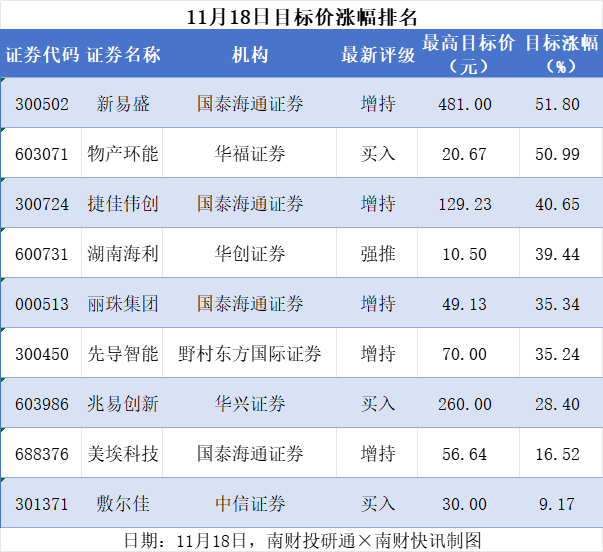
新易盛目标价涨幅达51.8% 43家公司获推荐|券商评级观察
2 1 Shi Ji Jing Ji Bao Dao· 2025-11-19 00:31
Core Insights - On November 18, 2023, brokerage firms provided target prices for listed companies, with notable increases for companies such as Xinyi Technology, Wuchan Energy, and Jiejia Weichuang, showing target price increases of 51.80%, 50.99%, and 40.65% respectively, across the communication equipment, coal mining, and photovoltaic equipment industries [1][2]. Group 1: Target Price Increases - Xinyi Technology received a target price of 481.00 yuan, reflecting a 51.80% increase [2]. - Wuchan Energy's target price is set at 20.67 yuan, indicating a 50.99% increase [2]. - Jiejia Weichuang has a target price of 129.23 yuan, with a 40.65% increase [2]. - Hunan Haili's target price is 10.50 yuan, showing a 39.44% increase [2]. - Lijun Group's target price is 49.13 yuan, reflecting a 35.34% increase [2]. - Xian Dao Intelligent's target price is 70.00 yuan, indicating a 35.24% increase [2]. - Zhaoyi Innovation has a target price of 260.00 yuan, with a 28.40% increase [2]. - Meike Technology's target price is set at 56.64 yuan, reflecting a 16.52% increase [2]. - Fulejia's target price is 30.00 yuan, indicating a 9.17% increase [2]. Group 2: First Coverage Ratings - Nine companies received initial coverage on November 18, with Jin Guo Co. rated "Buy" by Zhongyou Securities [3][4]. - Wuchan Energy received a "Buy" rating from Huafu Securities [3][4]. - Dacenglin was rated "Outperform" by Guoxin Securities [3][4]. - Haisheng Pharmaceutical received an "Increase" rating from Kaiyuan Securities [3][4]. - Xian Dao Intelligent was rated "Increase" by Nomura Orient International Securities [3][4]. - Other companies receiving initial coverage include Anlian Ruishi, Shuguang Shuchuang, Kaidi Co., and Yuanjie Technology, with various ratings across different sectors [4].


任丘市立灿照明电器有限公司成立 注册资本8万人民币
Sou Hu Cai Jing· 2025-11-18 22:11
Core Viewpoint - Recently, Renqiu City Lican Lighting Electrical Co., Ltd. was established with a registered capital of 80,000 RMB, focusing on various lighting and solar energy products and services [1] Company Summary - The legal representative of the newly established company is Han Pengfei [1] - The registered capital of the company is 80,000 RMB [1] - The company's business scope includes manufacturing and sales of lighting fixtures, photovoltaic equipment, and solar energy products [1] Industry Summary - The company operates in the lighting and solar energy sectors, indicating a focus on renewable energy solutions and energy-efficient products [1] - The business activities include general projects such as lighting fixture manufacturing, sales of solar energy utilization products, and solar power technology services [1]