生物医药

Search documents
辽宁成大(600739.SH):拟1亿元共同投资设立成大生物医药产业投资基金
Ge Long Hui A P P· 2026-01-26 09:58
Core Viewpoint - Liaoning Chengda (600739.SH) plans to establish a biopharmaceutical investment fund to enhance its competitiveness and seize market opportunities, with a total fund size not exceeding 100 million yuan, and an initial size of 50.2 million yuan [1][2] Group 1: Fund Structure and Contributions - The fund will be managed by Chengda Coastal as the general partner, contributing 1 million yuan, which accounts for 0.1992% of the initial fund size [1] - Shenzhen Chengda Biotech will also act as a general partner, contributing 1 million yuan, representing 0.1992% of the initial fund size [1] - Liaoning Chengda will contribute 10 million yuan as a limited partner, making up 19.9203% of the initial fund size [1] - Chengda Biotech will contribute 40 million yuan as a limited partner, accounting for 79.6813% of the initial fund size [1] Group 2: Fund Investment Focus and Future Plans - The fund will focus on the life and health industry during its investment period, with plans to raise the total contribution to 100 million yuan within three years [2] - Shenzhen Chengda Biotech and Chengda Medical plan to increase their investment in Gene Qiming, with Shenzhen Chengda Biotech contributing 40 million yuan and Chengda Medical contributing 10 million yuan [2] - After the fund is legally established, it will acquire all shares of Gene Qiming held by Shenzhen Chengda Biotech and Chengda Medical, allowing the company to indirectly enjoy related rights through the fund [2]

辽宁成大:拟1亿元共同投资设立成大生物医药产业投资基金
Ge Long Hui· 2026-01-26 09:48
Core Viewpoint - Liaoning Chengda (600739.SH) plans to establish a biopharmaceutical investment fund to enhance its competitiveness and seize market opportunities, with a total fund size not exceeding 100 million yuan, and an initial size of 50.2 million yuan [1][2] Group 1: Fund Structure and Contributions - The fund will be managed by Chengda Coastal as the general partner and will have contributions from various subsidiaries, with Liaoning Chengda contributing 10 million yuan (19.92% of the initial fund) and Chengda Biological contributing 40 million yuan (79.68% of the initial fund) [1] - Chengda Coastal and Shenzhen Chengda Biological will each contribute 1 million yuan, representing approximately 0.1992% of the initial fund [1] Group 2: Fund Focus and Future Plans - The fund will focus on the life and health sector during its investment period, with plans to raise the total contributions to 100 million yuan within three years [2] - Shenzhen Chengda Biological and Chengda Medical plan to increase their investment in Gene Qiming, with contributions of 40 million yuan and 10 million yuan respectively, to be transferred to the fund after its establishment [2]
上海三大先导产业母基金第三批子基金遴选结果公示
Di Yi Cai Jing· 2026-01-26 09:34
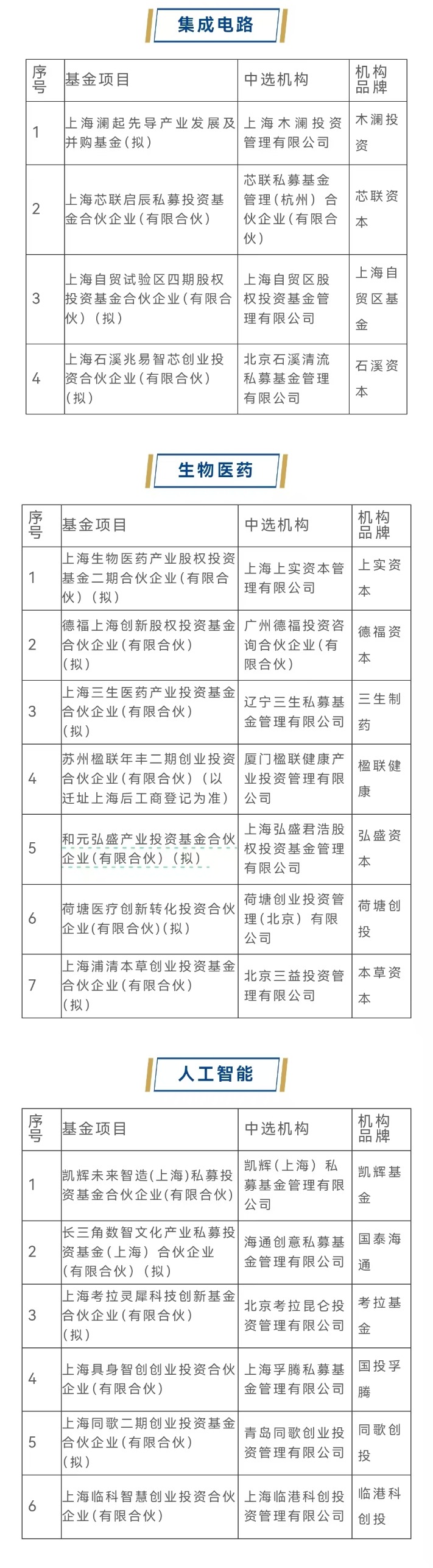
第一财经从上海国投先导基金获悉,上海三大先导产业母基金于1月26日发布第三批子基金遴选结果公 示,共有17只子基金入选,其中集成电路4只、生物医药7只、人工智能6只。拟投资金额共47.1亿元, 基金总规模228.9亿元,放大倍数4.86倍。截至目前,上海三大先导产业母基金(2024年7月设立)累计 投决金额约410亿元,以约5倍的杠杆效应,撬动近2000亿元社会资本。 人工智能 | 를 | 基金项目 | 中选机构 | 机 秒 | | --- | --- | --- | --- | | | 凯辉未来智造(上海)私募投 资基金合伙企业(有限合伙) | 凯辉(上海) 私 募基金管理有限 | 凯辉基 ਵੇ | | | | 公司 | | | | 上二名 粘知 寸 儿 立 山 升 首 也 | | | | 2 | △二用蚁自人化厂业似药仅 资基金(上海) 合伙企业 | 海通创意私募基 | 圆泰酒 | | --- | --- | --- | --- | | | | 金管理有限公司 | 通 | | | (有限合伙)(拟) | | | | 3 | 上海考拉灵犀科技创新基金 合伙企业(有限合伙) | 北京考拉昆仑投 | 考拉基 | ...

上海三大先导产业母基金公示第三批17只子基金
Zheng Quan Shi Bao Wang· 2026-01-26 09:19
人民财讯1月26日电,1月26日,上海三大先导产业母基金第三批子基金遴选结果正式公示,共有17只子 基金入选,其中集成电路4只、生物医药7只、人工智能6只。证券时报记者获悉,该批子基金总规模 228.9亿元,上海三大先导产业母基金拟投资47.1亿元,放大倍数4.86倍。截至目前,上海三大先导产业 母基金累计投决金额约410亿元,以约5倍的杠杆效应,撬动近2000亿元社会资本。 ...
JPM2026观察:超百亿巨额并购降温、AI投资热情飙升,中国药企变“台上主角”
Cai Jing Wang· 2026-01-26 08:16
Core Insights - The JPMorgan Global Healthcare Conference serves as a significant platform for the biopharmaceutical industry, influencing capital flows and industry dynamics for the year ahead [1] - This year's conference highlighted the increasing presence of Chinese biotech companies, marking a shift from being mere spectators to key players in the global market [2][3] Group 1: Chinese Biotech Companies - Seven Chinese companies, including WuXi AppTec and BeiGene, presented on the main stage, with an additional 17 companies showcasing in the Asia-Pacific session [2] - The transformation of Chinese companies from the periphery to the center of the conference reflects their substantial innovation value, evidenced by numerous licensing deals announced during the event [3] Group 2: Licensing Deals and Collaborations - Notable licensing agreements included a $650 million upfront payment from AbbVie to Rongchang Biopharma for the global rights to its PD-1/VEGF dual-specific antibody, with a total potential deal value of up to $5.6 billion [3] - Other significant collaborations involved Zhongsheng Peptide and Sai Shen Pharmaceutical partnering with Novartis, with the latter's deal valued at approximately $1.665 billion [3] Group 3: MNCs and Market Dynamics - The cautious approach of multinational corporations (MNCs) towards acquisitions is driven by the impending "patent cliff," with over $320 billion in market potential products set to lose patent protection in the next decade [3][5] - MNCs are increasingly favoring "asset-based acquisitions" over full company buyouts, allowing them to efficiently acquire core assets without the burdens of integrating entire companies [4] Group 4: AI in Drug Development - AI's integration into drug development emerged as a central theme, with Eli Lilly and NVIDIA announcing a partnership to establish a $1 billion AI innovation lab aimed at addressing long-standing challenges in the pharmaceutical industry [5][6] - The acquisition of Modella AI by AstraZeneca further emphasizes the growing importance of AI in enhancing drug discovery and clinical development processes [6] Group 5: Future Outlook - The 2026 JPM conference is expected to reflect a new paradigm where Chinese innovation becomes essential, and AI evolves from a supportive tool to a foundational infrastructure in drug development [8][9]
AI赋能+专利集中到期,2026年将是医疗保健私募激动人心的一年!
Hua Er Jie Jian Wen· 2026-01-26 08:12
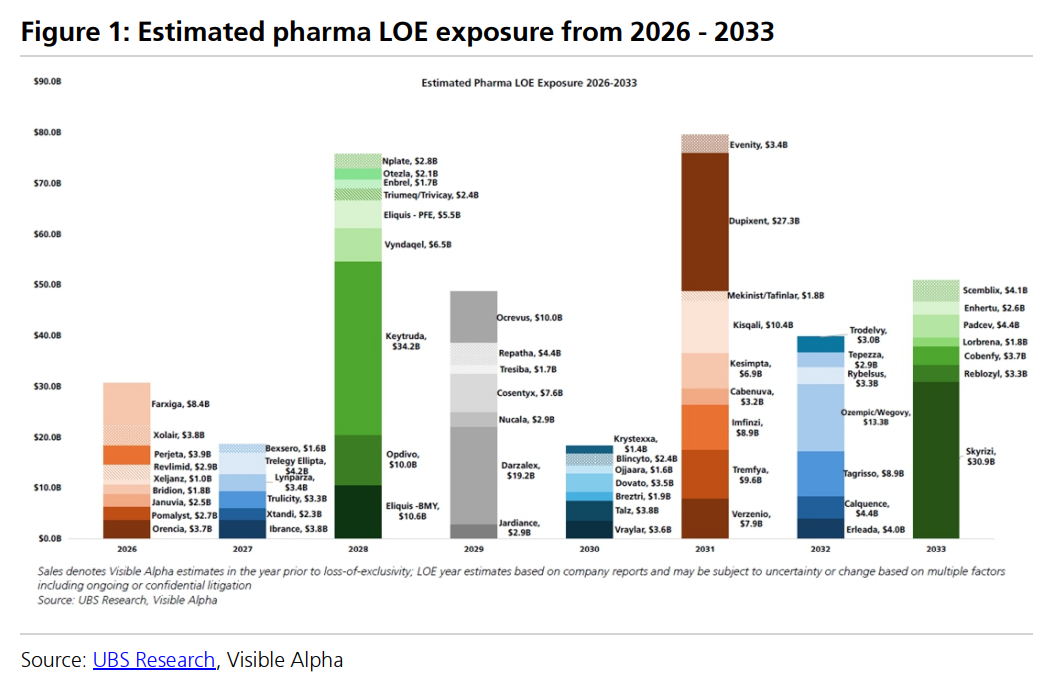
Core Viewpoint - The U.S. healthcare private equity market is at a critical turning point, with expectations for a revival in 2026 driven by macroeconomic clarity, advancements in AI technology, and the impending expiration of pharmaceutical patents [1][4]. Market Sentiment Recovery - The healthcare sector faced significant pressure in 2025 due to drug price reforms, insurance policy adjustments, FDA approval uncertainties, and high interest rates, leading to a decline in risk appetite across most sub-industries [2]. - Signs of recovery began to emerge in the second half of 2025, with expectations that stabilization in interest rates and gradual resolution of policy uncertainties could sustain this momentum into 2026 [3]. Patent Expiration and M&A Dynamics - A key structural factor for the anticipated recovery in private healthcare in 2026 is the upcoming expiration of patents for major pharmaceutical companies, with UBS estimating a concentrated period of patent expirations from 2026 to 2033 [4]. - The demand for strategic acquisitions of high-quality private biotech assets is expected to rise as multinational pharmaceutical companies increasingly rely on external innovation [4][7]. M&A Trends and Exit Strategies - In 2025, private biotech company acquisitions reached $16.4 billion, a year-on-year increase of approximately 150%, indicating a shift towards M&A as a primary exit strategy for private equity funds [7]. - The competitive landscape for acquisitions is likely to intensify in 2026, focusing on differentiated mechanisms and late-stage clinical assets as the patent cliff approaches [7]. Key Therapeutic Areas for Private Equity - UBS highlights three therapeutic areas that may serve as catalysts for private equity in 2026: - Psychedelics are entering a critical validation phase, with multiple Phase III clinical data expected to be disclosed in 2026, making it suitable for defensive capital allocation [8]. - The KRAS target may undergo paradigm validation, particularly if RVMD's Phase III data in pancreatic cancer is positive, potentially reshaping market perceptions of the KRAS pathway's commercial potential [10]. - Weight loss and metabolic diseases remain high-interest areas for acquisitions, with new oral GLP-1 and long-acting weight loss drugs expected to drive continued M&A activity [10]. AI's Evolving Role in Healthcare - AI is transitioning from a concept-driven valuation tool to a direct influence on cost structures within the healthcare sector, particularly in medical IT and managed care [11]. - The current phase of AI is expected to benefit private equity and growth assets more than creating uniform valuation premiums in the secondary market [11]. Exit Activity and Market Dynamics - In 2025, healthcare VC investments showed a pattern of early stability followed by late recovery, with a notable increase in PE-led exit activities, primarily through M&A [12]. - The number and quality of IPOs in healthcare are expected to marginally improve in 2026, enhancing risk appetite in both primary and private markets, although UBS does not foresee a comprehensive boom year [13].
部分医药股午后拉升 康希诺生物超10% 君实生物涨超5%
Zhi Tong Cai Jing· 2026-01-26 07:31
公开资料显示,尼帕是人畜共患的RNA病毒,主要由果蝠和猪携带,死亡率在40%至75%之间,潜伏期 一般为4天至14天。目前尚无专门的疫苗和有效疗法,治疗侧重于控制症状和提供支持性护理。 部分医药股午后拉升。截至发稿,康希诺生物(06185)涨10.13%,报40.86港元;君实生物(01877)涨 5.19%,报23.92港元;复旦张江(01349)涨4.11%,报3.29港元。 消息面上,1月26日,印度出现尼帕病毒疫情相关话题冲上热搜,引发关注。据新华社报道,印度出现 尼帕病毒疫情。邻近国家正严阵以待。感染者集中在印度西孟加拉邦。截至本文发稿,确诊感染病例已 达5例,至少一人病情危重,另有近百人被要求居家隔离。 ...

南京:构建战新产业集群矩阵
Xin Lang Cai Jing· 2026-01-26 06:51
Core Viewpoint - The Nanjing Municipal Government has issued policies aimed at accelerating the cultivation of new productive forces to promote high-quality development, focusing on building advanced manufacturing clusters and providing financial support for various innovative projects [1] Group 1: Advanced Manufacturing Clusters - The policy emphasizes the construction of competitive advanced manufacturing clusters in smart grids, software and information services, special steel materials, and large aircraft [1] - Financial support of up to 5 million yuan is available for recognized scene construction tasks [1] Group 2: Innovation and Technology Support - Funding support is provided for projects related to information technology application innovation, open-source commercialization, software application adaptation, and industrial software [1] - Newly recognized national and provincial manufacturing innovation centers will receive matching support up to 100 million yuan, based on national and provincial funding [1] Group 3: Biopharmaceutical Industry Development - The policy aims to accelerate the development of the biopharmaceutical industry, offering up to 2 million yuan for projects achieving breakthroughs in preclinical technology [1] - Companies conducting clinical research on innovative drugs can receive rewards of up to 1 million yuan per product [1] Group 4: Key Industries and Platforms - The initiative seeks to enhance the capabilities of key industries such as smart manufacturing equipment, intelligent connected new energy vehicles, and integrated circuits [1] - Plans include the establishment of pilot verification platforms and demonstration bases for emerging industries [1] Group 5: Low-altitude Economy - The policy promotes the development of the low-altitude economy, providing rewards of up to 5 million yuan for companies that open new low-altitude flight routes for logistics and delivery [1] Group 6: Specialty Industry Development - Implementation of action plans for the development of specialty advantageous industries, supporting the construction of characteristic industrial clusters and parks in various districts [1] - Support is also available for newly approved national emerging industry development demonstration bases and key parks recognized at the provincial level [1]

在“一线”与“二线”之间,生长出新海口
2 1 Shi Ji Jing Ji Bao Dao· 2026-01-26 06:44
Core Viewpoint - The establishment of a unique institutional space in Haikou, as the Hainan Free Trade Port enters its operational phase, is fostering a more open and vibrant "New Haikou" [1] Group 1: Policy Mechanism - The core policy mechanism of Hainan's Free Trade Port is "one line open, one line controlled," allowing for high levels of liberalization with international trade while maintaining precise regulation with the mainland [2] - Haikou has begun to enjoy dual advantages as a core city in this high-level open area, facilitating the free flow of international goods and resources [2] Group 2: Trade and Economic Data - In the first month of operation, Haikou imported zero-tariff goods worth 29.94 million yuan, primarily medical devices and production equipment [2] - The international passenger traffic at Meilan Airport saw a 28.5% increase, with 1,226 flights and 189,000 international passengers, reflecting a 50% year-on-year growth [2] - Approximately 80,399 domestic trucks passed through inspection to leave the island, averaging about 2,590 vehicles per day, with inspection times reduced from 2 minutes to 70 seconds [3] - Haikou's four "second-line ports" processed 219 tickets for value-added goods exempt from tariffs, totaling 41.42 million yuan, accounting for 48.2% of the province's total [4] Group 3: Business and Talent Attraction - The first month of operation saw 15,785 new business entities established in Haikou, a 12.62% increase, representing 57.92% of the province's total [5] - Notable companies such as China-Singapore United Network Import and Export Co., China Resources Beverage, and Guoyin Financial Leasing have signed agreements to operate in Haikou [5] - Haikou processed 828 high-level talent recognitions, including 19 expedited visa applications for A-class talents [5] Group 4: Consumer Activity - Haikou's duty-free shops reported sales of 2.24 billion yuan, a 44.4% increase year-on-year, indicating strong consumer activity [6] - The implementation of new duty-free policies has led to a 5% increase in international visitors, primarily from Southeast Asia, Russia, North America, and Europe [6] Group 5: Future Outlook - "New Haikou" represents not just a geographical concept but a new development model underpinned by institutional innovation, balancing global attraction of high-end resources with domestic economic connections [6]
中国明确新兴产业创新中心八项任务 龙头引领构建全链条创新生态体系
Chang Jiang Shang Bao· 2026-01-26 06:07
Core Insights - The National Development and Reform Commission has released the "Management Measures for National Emerging Industry Innovation Centers," which outlines eight main tasks for these centers, focusing on strategic industry development and collaboration among leading enterprises, academia, and research institutions [2][3] - By 2025, the added value of high-tech manufacturing in China is projected to account for 17.1% of the total industrial added value, indicating a significant shift towards new productive forces and technological advancements [2][6] Group 1: Innovation Center Framework - The innovation centers are positioned as platforms for technological innovation, aimed at nurturing future industries and enhancing new productive forces, forming a crucial part of the national innovation system [3] - The measures emphasize the integration of innovation ecosystems, promoting collaboration among government, industry, academia, and research to tackle key technological challenges [3][5] - The centers will also encourage local and social capital participation, establish stable R&D funding mechanisms, and support the establishment of investment funds for innovation and entrepreneurship [3][5] Group 2: Economic Growth and Industry Development - In 2025, the number of newly established enterprises in the "8+9" emerging and future industries reached 1.01 million, a 9.0% increase from the previous year, reflecting strong entrepreneurial enthusiasm in innovation-driven sectors [6] - The added value of high-tech manufacturing and equipment manufacturing reached 17.1% and 36.8% of the total industrial added value, respectively, showcasing the growth of high-tech and strategic emerging industries [7] - The production of new energy vehicles exceeded 16 million units in 2025, maintaining a global leadership position for 11 consecutive years, driven by supportive policies and market demand [7]