
Securities

Search documents
10万亿化债资金快速落地:地方债务风险缓释,专家建言强化监管
Di Yi Cai Jing· 2025-09-19 07:37
Core Viewpoint - The overall risk of local government debt is controllable, with the government strengthening debt management and rapidly implementing a 10 trillion yuan debt resolution plan to alleviate risks and enhance local development momentum [1][5][6]. Group 1: Debt Management and Risks - A report from the National People's Congress highlights ongoing difficulties in government debt management, including issues with the use of debt resolution funds and the emergence of new hidden debts [1][2]. - The Ministry of Finance has disclosed cases of local governments incurring new hidden debts, with Chengdu, Sichuan, adding 61.408 billion yuan in hidden debt through state-owned enterprises [2][3]. - There are instances of "false debt resolution," where local governments misrepresent debt repayments, such as in Siping, Jilin, where 2.85 million yuan was falsely reported as resolved [2][3]. Group 2: Misuse of Debt Funds - Audits reveal that 651.8 billion yuan of local special bond funds have been misappropriated across 92 regions, primarily for "three guarantees" and repaying state-owned enterprise debts [3][4]. - Experts suggest that the misuse of debt resolution funds manifests in three ways: misallocation to new projects, false debt resolution practices, and inefficiencies in fund disbursement [3][4]. Group 3: Future Plans and Recommendations - The Ministry of Finance plans to issue 10 trillion yuan in local government bonds from 2024 to 2028 to replace existing hidden debts, with over 5 trillion yuan already issued [4][5]. - Recommendations include implementing comprehensive monitoring of debt resolution funds, enhancing audit and supervision efforts, and imposing strict penalties for misuse [5][6]. - The government aims to maintain a "zero tolerance" approach to new hidden debts and enforce lifelong accountability for local government borrowing [6].
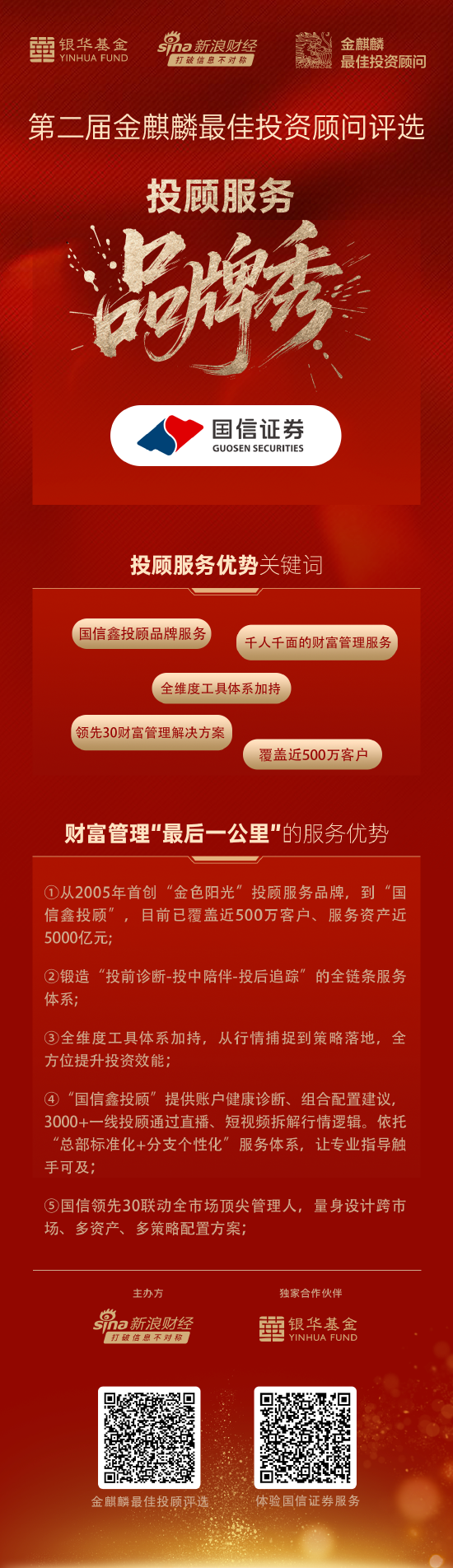
国信证券投顾服务品牌秀丨锻造“投前诊断-投中陪伴-投后追踪”的全链条投顾服务体系
Xin Lang Zheng Quan· 2025-09-19 03:05
Core Insights - The "Second Golden Unicorn Best Investment Advisor Selection" event is actively seeking outstanding investment advisors to enhance wealth management services [1] - The event includes a "Brokerage Investment Advisor Service Brand Show" to showcase innovative advisory services and AI-enabled solutions [1] Group 1: Investment Advisory Services - Guosen Securities has developed a comprehensive investment advisory service system, including "pre-investment diagnosis, in-process support, and post-investment tracking" [1][5] - The "Guosen Xin Youxuan" advisory service employs a dual screening mechanism from both quantitative and qualitative perspectives, ensuring high-quality investment options [1][5] Group 2: Client Coverage and Asset Management - Guosen Securities has covered nearly 5 million clients and manages assets close to 500 billion yuan [1][5] - The company offers a full-dimensional tool system to enhance investment efficiency, from market analysis to strategy implementation [5] Group 3: Wealth Management Solutions - The company provides personalized wealth management services tailored to individual client needs [4] - Guosen Securities collaborates with top market managers to design multi-asset and multi-strategy investment solutions [5]

东吴证券股份有限公司 2024年度第十三期短期融资券 兑付完成的公告
Zhong Guo Zheng Quan Bao - Zhong Zheng Wang· 2025-09-19 00:24
Core Points - Dongwu Securities successfully issued its 13th short-term financing bond for 2024, with a total issuance amount of RMB 2 billion and a coupon rate of 2.02% [1] - The bond has a maturity period of 320 days, with the repayment date set for September 17, 2025 [1] - On September 17, 2025, the company completed the repayment of the principal and interest for this short-term financing bond, totaling RMB 2,035,419,178.08 [1] Summary by Sections - **Issuance Details** - The total amount issued for the 13th short-term financing bond is RMB 2 billion [1] - The coupon rate for the bond is set at 2.02% [1] - The bond has a maturity period of 320 days [1] - **Repayment Information** - The repayment date for the bond is September 17, 2025 [1] - The total amount repaid, including principal and interest, is RMB 2,035,419,178.08 [1]

承销债券违约“拖累”国都证券卷入4.75亿巨额诉讼纠纷
2 1 Shi Ji Jing Ji Bao Dao· 2025-09-18 23:06
Core Viewpoint - Guodu Securities is embroiled in a significant bond default dispute involving a claim of 475 million yuan from Wukuang International Trust due to the default of the "20 Fusheng 01" bond issued by Fujian Fusheng Group [1][3][4] Financial Performance - Guodu Securities reported a revenue of 749 million yuan for the first half of the year, a year-on-year decrease of 4.42%, and a net profit attributable to shareholders of 358 million yuan, down 8.1% [1][10] - In contrast, Zheshang Securities, which has recently become the controlling shareholder of Guodu Securities, achieved a net profit of 1.149 billion yuan, a year-on-year increase of 46.49%, but its revenue fell by 23.66% [10] Legal Proceedings - The lawsuit filed by Wukuang Trust claims that Guodu Securities, as the lead underwriter, failed to fulfill its due diligence obligations, leading to the bond default [3][6] - The court has accepted the case, but no hearing has been scheduled yet [4] - Legal experts suggest that Guodu Securities may bear 10% to 30% of the liability based on past similar cases, with the possibility of a full compensation being low due to the absence of fraud allegations against the firm [2][7][8] Industry Context - The bond default case is part of a broader trend of increasing bond defaults in the real estate sector, which has been under significant financial strain [4][6] - The regulatory environment has become stricter for intermediary institutions, with recent cases establishing precedents for liability in bond issuance [6][8] Business Segments - Guodu Securities' business lines showed mixed results, with brokerage income increasing by 6.73% to 125 million yuan, while proprietary trading and investment banking revenues fell significantly [11] - The firm is also facing additional lawsuits related to contract disputes and alleged false statements in bond underwriting, which could further impact its financial standing and reputation [11]
Margin Debt Has Soared. It's the Skunk at Wall Street's Garden Party.
Barrons· 2025-09-18 20:23
Core Viewpoint - The amount of dollars that investors borrow to purchase stocks has reached $1.1 trillion, causing concern on Wall Street about a potential significant market drop [1] Group 1 - The current borrowing level of $1.1 trillion indicates a substantial increase in leverage among investors [1] - This increase in borrowing is contributing to heightened anxiety within the financial markets regarding future market stability [1]
北京市落地首单柜台债券借贷业务
Xin Hua Cai Jing· 2025-09-18 12:55
Group 1 - The core viewpoint of the article highlights the successful completion of Beijing's first over-the-counter bond lending business by Pudong Development Bank's Beijing branch in collaboration with Shouchao Securities, marking a significant breakthrough in the local over-the-counter bond market [1] - This initiative is expected to effectively activate the existing bond assets in the over-the-counter market and enhance the liquidity management capabilities of small and medium-sized financial institutions [1] - The People's Bank of China, Beijing branch, has been focusing on promoting the development of a multi-tiered bond market, implementing a special promotion plan for the steady expansion of over-the-counter bond business [1]


大象论股|午后大跳水!明天能反弹吗?
Sou Hu Cai Jing· 2025-09-18 12:23
指数放量大跌,市场成交量达到3.1万亿,相较于昨天放量7500亿,而市场大跌,也就意味着,这波新冲进来的资金悉数套牢,今天这波大跌,主要还是 银行证券等权重股砸盘,上午反弹的方向其实跟美联储降息关系不大,因为降息直接利好的有色和金融早盘就开始大跌,而上午指数冲击3900点的主要原 因还是受到国产替代消息的影响。 。 美联储降息靴子落地,大盘冲高回落午后开始跳水! 从技术走势来看,今天指数可能会在金融的带动下走出调整的走势,重点关注30分钟级别的20均线3860点的支撑,从今天来看,指数在午后的跳水已经跌 破,所以今天适当减仓,更重要的是收盘指数已经来到3830点,还跌破了日线级别的20日均线的支撑,代表指数中期也有走弱的趋势,明天市场如果不能 重回20日均线上方,指数可能走出继续调整的走势。 但当上午指数反弹的过程中成交量其实并没有明显放大,而且相关消息早在上周就已经有所传闻,所以当寒王等科技股再度爆发引爆市场情绪后,由于仅 仅是消息面的刺激,午后在科技金融等权重的带动下指数迎来跳水。 。 ...
投教热点背后:如何共建互动新模式?这场活动要这么做
Nan Fang Du Shi Bao· 2025-09-18 08:28
投教内容总是枯燥难懂,难以引发共鸣?市场信息纷繁复杂,令人无所适从?别担心!这场分享会将为 你带来满满干货! 9月24日,广东证券期货业协会联合南方都市报社、湾财社举办投教微视频创作分享交流会活动。届 时,将对广东证券期货业首届微视频比赛获奖单位进行表彰,并由获奖单位代表分享创作心得。同时, 南都湾财社还将围绕投资领域热点舆情事件展开深度交流与探讨,帮助投资者增强风险辨识能力,助力 机构投教内容更具针对性和前瞻性。 19部投教微视频作品获奖 为破解"自说自话"的投教视频宣传情况,助力机构投教工作更好地"走出去",2024年11月,由广东证券 期货业协会、南方都市报社、湾财社主办的广东证券期货业首届微视频比赛在广州启动。活动获得广东 (不含深圳)证券期货业金融机构积极响应,踊跃参与。这些机构围绕服务实体经济、践行投资者保 护、履行社会责任等比赛主题类别创作了近百部微视频作品。 经过专家评审,最终19部作品脱颖而出。其中,《老吴期遇记 陪伴是最好的防范常回家看看》(广发期 货有限公司)获一等奖;《AI算法?人性算法!》(中粮期货有限公司广东分公司)、《学投资,找正规军 投教基地》(广发证券股份有限公司)、《擦亮双 ...


上证指数冲刺3900点!机构热议美联储降息:利好A股慢牛长牛行情
Hua Xia Shi Bao· 2025-09-18 07:01
2025年9月18日凌晨,美联储公布议息会议结果,将联邦基金利率目标区间下调25个基点至4.00%– 4.25%,符合市场广泛预期。 本报(chinatimes.net.cn)记者帅可聪 北京报道 当天早盘,A股三大指数小幅震荡走强,上证指数盘中一度逼近3900点关口。截至午间收盘,上证指数 涨0.45%,报3893.95点;深证成指涨0.79%,报13319.7点;创业板指涨0.49%,报3162.9点。 前海开源基金首席经济学家杨德龙向《华夏时报》记者表示,美联储降息可能会引发全球央行降息潮, 中国央行有较大的货币政策宽松的空间,有望通过降息降准来提振经济,稳住楼市股市。这对于当前已 经开启一轮牛市的资本市场会形成利好推动。 粤开证券首席经济学家、研究院院长罗志恒分析称,美联储降息对中国股市、债市和人民币汇率偏利 好。全球流动性宽松有助于为中国股市提供增量资金,中国货币政策空间增大将带动债券收益率下行, 美元承压有利于人民币汇率稳定。 预计年内还有两次降息 这是美联储自2024年12月以来时隔9个月重启降息,25个基点的降息幅度符合市场普遍预期。 罗志恒认为,美联储此次重启降息周期有助于托底需求与就业,但 ...

Wedbush's Ives Sees 'Bright Green Light' for Tech Stocks
Yahoo Finance· 2025-09-17 21:19
Dan Ives, Wedbush Securities managing director and global head of technology research, says the Federal Reserve's rate cut cycle will "turbocharge" the rally in tech stocks. Speaking with Romaine Bostick on "Bloomberg The Close," Ives says tech stocks could be up another 10% between now and the end of the year. ...