农业科技

Search documents
农业农村部:将持续推动人工智能等在农业领域应用
Xin Lang Cai Jing· 2026-01-22 02:49
1月22日,农业农村部副部长张兴旺在国新办新闻发布会上表示,目前现代科技在农业领域的应用越来 越广泛,农业农村部将持续推动人工智能在农业领域的应用,拓展无人机、互联网机器人等应用场景, 让农业生产更精准更高效。 ...
发现、突破、成果 2025年全国农业科技有这三个“重大”
Xin Lang Cai Jing· 2026-01-22 02:37
Core Insights - The Chinese government aims to enhance the overall effectiveness of the agricultural science and technology innovation system by 2025, with a target contribution rate of over 64% for agricultural technological progress [1] Group 1: Research Achievements - Significant discoveries in basic research include revealing the secrets of transforming individual cells into complete plants, providing new theoretical support for crop genetic improvement and efficient regeneration [1] - The first high-temperature resistant rice gene has been cloned, offering new solutions for maintaining stable yields and quality in high-temperature environments [1] Group 2: Technological Breakthroughs - Major breakthroughs in frontier research include original advancements in agricultural bio-manufacturing and accelerated integration of artificial intelligence in agriculture, with continuous iterations of smart agricultural models [1] Group 3: Industry Innovations - The development of the new wheat variety "Yangmai 53" addresses challenges related to resistance to fusarium head blight, yield, and quality improvements [1] - Breakthroughs in the research and application of new energy agricultural machinery have been achieved, effectively addressing issues in hilly areas where traditional machinery is either unavailable or ineffective [1] - The development and application of agricultural robots are accelerating, contributing to significant advancements in the sector [1]
新华社权威快报|向新向智!2025年我国农业现代化水平持续提升
Xin Hua She· 2026-01-22 02:20
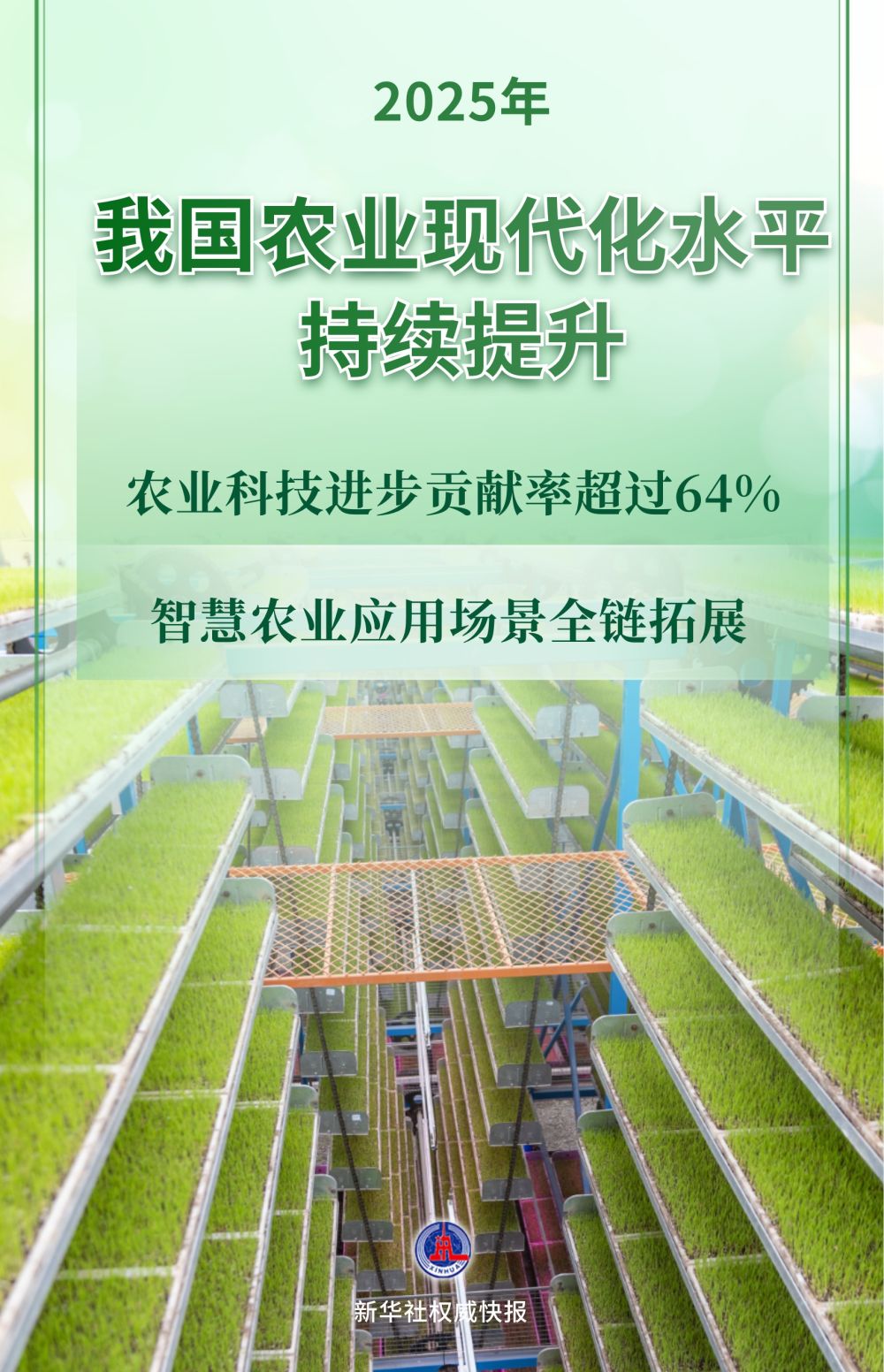
2025年 我国农业现代化水平 指数量 农业科技进步贡献率超过64% 海报制作:韩佳诺 新华社国内部出品 农业农村部1月22日在国新办举行的新闻发布会上发布信息显示,2025年我国农业现代化水平持续提升,农业科技进步贡献率超过64%。 2025年我国支持新建和改造提升高标准农田7568万亩,累计建成超10亿亩。种业振兴行动扎实推进,农机装备研发应用加快发展,智慧农业应 用场景全链拓展,农业绿色转型步伐加快。 记者:古一平、韩佳诺 智慧农业应用场景全链拓展 ...

科技e贷” 为企业数字化转型按下“快进键
Jin Rong Shi Bao· 2026-01-22 02:03
Core Insights - The article highlights the successful digital transformation of Ruijia Biotechnology, a modern agricultural technology company, through innovative financing and technology integration [1][2][3][4] Group 1: Company Overview - Ruijia Biotechnology, established in 2022, focuses on oilseed and oil processing, holding 26 patents and 10 software copyrights [1] - The company collaborates with local universities for research and development, emphasizing the importance of digital transformation in enhancing product quality [1] Group 2: Financial Support and Transformation - After facing challenges in securing loans due to low tangible assets, Ruijia received support from Agricultural Bank's "Technology e-loan," designed for tech-oriented SMEs [2] - The funding enabled the company to implement a 5G digital control center, enhancing real-time monitoring and reducing manual intervention in production processes [3] Group 3: Operational Improvements - The introduction of a big data monitoring platform improved the stability of raw material quality and yield, while AI systems replaced traditional quality checks, achieving a 99% product pass rate [3] - Operational costs were significantly reduced, with labor costs dropping by over 50% and energy consumption decreasing by 40%, saving over one million yuan annually [3] Group 4: Regional Impact - Ruijia's transformation has inspired surrounding agricultural enterprises to adopt similar digital practices, creating new technical job opportunities and enhancing local employment structures [4] - The company achieved ISO 14001 certification, positioning itself as a model for green manufacturing, supported by collaborative efforts from banks, enterprises, and government [4]
增长目标顺利实现 创新生发新鲜动能——海外人士热议全年经济数据背后的中国信心
Xin Hua Wang· 2026-01-21 08:34
Core Insights - China's GDP has surpassed 140 trillion yuan for the first time, growing by 5% compared to the previous year, indicating resilience and confidence in the economy [1] - The total value of goods trade has exceeded 45 trillion yuan, with manufacturing value added remaining the highest in the world for 16 consecutive years [1] - The contribution of final consumption expenditure to economic growth has surpassed 50%, showcasing a robust internal driving force [2] Economic Stability - The Chinese economy in 2025 is characterized by stability, effectively responding to external challenges through proactive macroeconomic policies [2] - The proportion of high-tech manufacturing value added in total industrial value added has risen to 17.1%, reflecting structural optimization [2] - China's economic growth is expected to contribute approximately 30% to global economic growth, positioning it as a reliable source of stability [3] Innovation and High-Quality Development - R&D expenditure intensity reached 2.8%, surpassing the OECD average for the first time, indicating a strong focus on innovation [4] - The manufacturing value added of digital products grew by 9.3%, with significant increases in the production of servers and industrial robots [5] - China is becoming a key player in global innovation, particularly in fields like artificial intelligence and quantum technology, enhancing its long-term competitiveness [5] Global Cooperation and Openness - China is expected to maintain a significant contribution to global economic growth, with an average contribution rate of around 30% during the 14th Five-Year Plan period [6] - The import scale is projected to reach 18.5 trillion yuan, providing vast market opportunities for other countries [6] - Trade with Belt and Road Initiative countries has increased by 6.3%, highlighting China's commitment to expanding international cooperation [6][7]
西贝获新荣记、“一米八”等机构A轮投资,贾国龙持股比例降至26%
Sou Hu Cai Jing· 2026-01-21 08:16
Group 1 - The core point of the article is that Xibei Catering Group has completed a new round of financing, attracting investments from several well-known enterprises [2] - The company has raised its registered capital from 89.90 million yuan to 101.68 million yuan, an increase of approximately 13.10% [4] - The investors include Taizhou Xinrongtai Investment Co., Hohhot Collective Co-Creation Enterprise Management Center, Chengdu Xunda Optoelectronics Co., and Hangzhou Zhouxuan Equity Investment Management Partnership, among others [4][6] Group 2 - The total equity held by the new investors in Xibei Catering Group is approximately 11.58%, while the direct shareholding of founder Jia Guolong has decreased from 29.59% to 26.16%, maintaining control of the company [9] - This financing round is seen as a crucial step towards Xibei's IPO plans, with the company aiming to complete its IPO by 2026 and achieve a market value of 100 billion yuan [10]

海外人士:用“韧性”概括2025年中国经济表现最为贴切
Xin Lang Cai Jing· 2026-01-21 08:13
Group 1 - China's GDP reached 140 trillion yuan, marking a 5% increase from the previous year, with foreign trade exceeding 45 trillion yuan [1] - The manufacturing value added has maintained the world's top position for 16 consecutive years, while the service sector's contribution to GDP rose to 57.7% [1] - The economic structure has been optimized, with high-tech manufacturing's value added accounting for 17.1% of industrial value added, and final consumption contributing over 50% to economic growth [2] Group 2 - China's economy is projected to contribute approximately 30% to global economic growth in 2025, positioning it as a stable and reliable source of growth amid global economic challenges [3] - The diversification of foreign trade has accelerated, with China becoming a major trading partner for over 150 countries, focusing on high-tech and high-value products [3] - International organizations have raised their growth forecasts for China, reflecting confidence in its economic prospects [3] Group 3 - Research and development investment intensity in China reached 2.8%, surpassing the OECD average for the first time, with significant advancements in innovation and green transformation [4] - The manufacturing value added of digital products grew by 9.3%, with substantial increases in the production of servers and industrial robots [4] - China is becoming a key player in global innovation, particularly in strategic fields such as quantum technology and biotechnology [4] Group 4 - China's average annual contribution to global economic growth during the 14th Five-Year Plan period is around 30%, providing stability to global supply chains [6] - In 2025, China's goods imports are expected to reach 18.5 trillion yuan, expanding market opportunities for various countries [6] - Trade with Belt and Road Initiative countries increased by 6.3%, highlighting closer industrial cooperation [6] Group 5 - China's commitment to high-level opening-up is evident through the reduction of the negative list for foreign investment and the expansion of visa-free travel [6][7] - The country is integrating into global supply chains, enhancing resilience and reliability, benefiting all participants in the world economy [7] - China's ability to adapt and innovate in a changing environment is seen as a key factor in maintaining stability and growth in the global economy [7]
【高端访谈】中国农业创新提速 AI将带来颠覆性影响——访先正达集团首席执行官洛文杰
Xin Hua She· 2026-01-21 07:04
新华财经瑞士达沃斯1月21日电(记者康逸张兆卿)在瑞士达沃斯举行的世界经济论坛2026年年会期 间,先正达集团首席执行官洛文杰接受新华社记者专访时表示,在农业领域,中国不仅是全球重要的销 售市场,也日益成为关键的创新研发基地。当前,人工智能(AI)与数字化技术正深刻改变农业生产 方式,将在实现更高效农业生产、辅助农民决策、推动精准农业落地以及助力退化土地修复等方面产生 重要影响。 洛文杰表示,过去十多年他多次访问中国,亲眼见证了中国农业的跨越式发展。他将这一过程归纳为三 个方面:生产效率持续提高,农产品质量不断改善,创新步伐显著加快。 面对全球贸易摩擦加剧、供应链"去风险"等带来的不确定性,洛文杰强调,"各国可以在诸多议题上存 在分歧,但粮食不应成为其中之一。"他认为,中国持续致力于提升农业生产率,推动农业技术升级, 维护粮食自由贸易,这对全球具有重要意义。 洛文杰说,在粮食产量持续增长的同时,"中国农产品质量也在稳步提升,这对生产者和消费者都至关 重要"。"农业比很多人想象得更需要创新推动,而中国对新技术的接纳速度非常快。"他特别指出,中 国在农业数字化方面投入巨大,正在构建更完善的解决方案,既惠及农民和消 ...

全市巴渝和美乡村建成率达65%
Xin Lang Cai Jing· 2026-01-20 18:52
Core Viewpoint - The Chongqing Municipal Agricultural and Rural Committee has outlined ten key highlights for promoting comprehensive rural revitalization by 2025, showcasing a positive trend in agricultural and rural development in the region. Group 1: Agricultural Production - Grain production has reached a 20-year high with a total output of 11.125 million tons and a planting area of 30.509 million acres; rapeseed production has increased for 18 consecutive years, reaching 642,000 tons [1] - The "Bayu Good Land" digital supervision system has been fully launched, ensuring high-standard farmland construction through innovative public participation mechanisms [1] Group 2: Poverty Alleviation and Income Growth - The achievements in poverty alleviation are being consolidated, with over 80% of the impoverished population employed and rural residents' per capita disposable income growth outpacing the national average [2] Group 3: Agricultural Innovation - A robust agricultural technology innovation system is taking shape, with significant contributions from institutions like the Yazhou Bay National Laboratory and the China Rice Research Institute, leading to an agricultural technology progress contribution rate of 64% [3] Group 4: Agricultural Industry Development - The establishment of the "36316" modern high-quality ecological agriculture industry cluster is underway, with the first batch of 40 local specialty products being evaluated [4] - The food and agricultural processing industry is expected to achieve a scale output value of 148.88 billion yuan by 2025, with a year-on-year growth of 5.2% [5] Group 5: Environmental Protection - Agricultural environmental protection efforts are yielding results, with a product quality safety monitoring pass rate of 99.51% and effective measures in place for the Yangtze River ecological protection [6] Group 6: Digital Transformation - The pace of agricultural digital transformation is accelerating, with the launch of six industry brain systems and the introduction of the first AI platform for rural leisure tourism [7] Group 7: Rural Construction and Urban-Rural Integration - The construction of beautiful rural areas is progressing, with 2,500 new "Bayu and Beautiful Villages" established, achieving a completion rate of 65% [8][9] - Reforms promoting urban-rural integration are being implemented, aiming to narrow the income gap between urban and rural residents to a ratio of 2.22:1 [10][11]
AI如何升级现代农业?达沃斯讨论中的中国经验
第一财经· 2026-01-20 11:54
Core Viewpoint - The article emphasizes the growing importance of agriculture in discussions at the World Economic Forum, particularly in the context of AI as a key driver for productivity and resilience in food systems amid global economic and environmental challenges [3][4]. Group 1: AI in Agriculture - AI in agriculture is not hindered by technology but is approached with caution due to the complexity and sensitivity of real-world production systems [4]. - Unlike finance or internet sectors, agriculture lacks scalable applications despite having numerous concept validation projects. The challenges vary significantly between developed and emerging markets, with data fragmentation and infrastructure costs being major issues in developed regions, while usability for smallholders is critical in emerging economies [5]. - The low tolerance for error in agricultural technology adoption leads to a slower acceptance of new technologies compared to other industries, making caution a norm in the expansion of agricultural AI [5]. Group 2: Shift from Yield to Resilience - The focus of agricultural AI is shifting from merely increasing production to enhancing system resilience, as agriculture contributes significantly to greenhouse gas emissions and environmental degradation [7]. - Advanced data analysis and decision support technologies are beginning to reconcile the trade-off between increasing yields and reducing environmental impact, moving from a binary choice to a more manageable range of options [7]. - The discussion around food security is evolving from simply having food available to ensuring stability in food supply amidst various global risks [9]. Group 3: China's Role in Agricultural AI - China is viewed as a significant case study for agricultural AI practices, with a focus on systemic thinking that integrates technology, breeding, chemicals, machinery, and data into a cohesive production logic [11]. - The Chinese approach emphasizes practical applications of AI in specific scenarios like pest identification and weather risk assessment, making it more relevant to farmers' daily decisions [11]. - China's advancements in agricultural digitalization provide a practical testing ground for AI, with improved infrastructure and data accessibility facilitating the transition from demonstration projects to everyday decision-making [11].