
家政服务

Search documents
商务部:家政服务机构可享免征增值税等优惠政策延期至明年底
Nan Fang Du Shi Bao· 2026-01-29 08:52
Core Viewpoint - The Ministry of Commerce announced the continuation of tax and fee preferential policies for community family service industries, including elderly care, childcare, and domestic services, until the end of 2027, highlighting the importance of these services for consumer spending, employment stability, and public welfare [3]. Group 1: Policy Overview - The preferential policies include exemptions from value-added tax, deed tax, property tax, urban land use tax, real estate registration fees, land reclamation fees, land idle fees, urban infrastructure fees, and underground civil defense construction fees [3]. - Corporate income tax will be calculated with a 90% reduction in taxable income, significantly lowering the tax burden for community service providers [3]. Group 2: Impact and Future Plans - The implementation of these policies has effectively reduced tax burdens and promoted the development of the domestic service industry, receiving positive feedback from various sectors of society [3]. - The Ministry of Commerce plans to continue collaborating with relevant departments to ensure the effective implementation of these tax and fee preferential policies and to enhance public awareness, aiming to benefit a broader range of domestic service enterprises [3].


商务部:加快推动家政服务业高质量发展
Zhong Guo Xin Wen Wang· 2026-01-29 08:42
商务部:加快推动家政服务业高质量发展 中新网1月29日电 1月29日,商务部举行例行新闻发布会。会上,商务部新闻发言人何咏前表示,商务 部将继续配合相关部门,落实落细税费优惠政策,做好政策宣传解读,让更多含金量高的支持政策惠及 更广大的家政企业,加快推动家政服务业高质量发展。 何咏前称,家政等社区家庭服务业事关"一老一小"和民生福祉,与老百姓生活息息相关,党中央、国务 院高度重视家政服务业发展。2019年,财政部、商务部等六部门印发《关于养老、托育、家政等社区家 庭服务业税费优惠政策的公告》,为社区提供家政服务的机构,按照规定可享受免征增值税、契税、房 产税、城镇土地使用税、不动产登记费、耕地开垦费、土地复垦费、土地闲置费、城市基础设施配套 费、防空地下室易地建设费,企业所得税应纳税所得额减按90%计入收入总额等优惠。该政策的实施, 有效降低了税费负担,促进了家政服务业发展,受到了社会各界好评。 何咏前表示,2025年,商务部、财政部、国家税务总局等部门充分考虑家政服务业在促消费、稳就业、 惠民生中的重要作用,并结合行业实际反映,推动继续将上述5税6费优惠政策延期至2027年底。下一 步,商务部将继续配合相关 ...
商务部召开例行新闻发布会(2026年1月29日)
Shang Wu Bu Wang Zhan· 2026-01-29 07:51
Group 1 - Finnish Prime Minister Orpo's recent visit to China resulted in practical cooperation outcomes in the economic and trade sectors, with a focus on deepening mutual cooperation in energy transition, circular economy, agriculture, forestry, and technological innovation [2] - A memorandum of understanding was signed between the Chinese Ministry of Commerce and the Finnish Ministry of Economic Affairs and Employment to strengthen the work of the China-Finland Innovation Enterprise Cooperation Committee, which held its sixth meeting during the visit [2] - Over 50 companies from both countries participated in discussions on cooperation in innovation, green technology, and digital fields, leading to multiple business agreements in sectors such as mining machinery, healthcare, papermaking, and green construction [2] Group 2 - The Ministry of Commerce plans to work with Finland to implement the important consensus reached by the leaders of both countries, utilizing bilateral economic and trade committees to enhance policy communication [3] - The Ministry will support Finnish companies in expanding their high-quality products and services exports to China and encourage continued investment in the Chinese market [3] Group 3 - The Ministry of Commerce highlighted the importance of community family services, including home care, childcare, and domestic services, which are crucial for public welfare [4] - A tax and fee reduction policy for community family service providers was initially introduced in 2019, allowing exemptions from various taxes and a 90% reduction in taxable income for corporate income tax [4] - The policy is set to be extended until the end of 2027, reflecting the sector's role in promoting consumption, stabilizing employment, and benefiting people's livelihoods [5] Group 4 - The Ministry of Commerce expressed a willingness to maintain communication and cooperation with the United States, emphasizing the importance of equal dialogue to resolve economic and trade differences [7] - The ministry noted that five rounds of economic and trade consultations have taken place under the strategic guidance of the leaders of both countries, yielding positive results [7]
郑州市代表团举行会议继续审议省人大常委会和法检两院工作报告
Zheng Zhou Ri Bao· 2026-01-29 00:38
1月28日,省十四届人大四次会议郑州市代表团举行代表小组会议,继续审议省人大常委会工作报 告、省高级人民法院工作报告、省人民检察院工作报告。省委常委、市委书记安伟出席并发言。 庄建球、周富强、路云、王治安、李党生、朱河顺等参加审议。陈殿福、张道伟、陈南、李圆方、 鲁胜芳等代表发言。 坚定信心 保持定力 勠力同心 坚持以高效能治理促进高质量发展和高水平安全良性互动 安伟表示,省人大常委会工作报告和省法检两院工作报告通篇贯彻习近平新时代中国特色社会主义 思想,一体贯彻坚持党的领导、人民当家作主、依法治国有机统一和"两高四着力"重大要求,总结工作 全面客观、数据翔实,部署任务精准有力、贴合实际,既体现了全省人大、法院、检察系统的政治担 当,也彰显了服务全省高质量发展、高效能治理的务实举措,是高举旗帜、求真务实、凝心聚力的好报 告。 安伟代表郑州市委、市政府,向省人大常委会、省高院、省检察院长期以来对郑州工作的关心支持 表示感谢。他说,郑州作为国家中心城市、全省发展的龙头,过去一年的发展进步,离不开省委、省政 府的坚强领导,也离不开省人大常委会、省高院、省检察院的指导支持。省人大常委会始终关心郑州地 方立法和人大工作 ...
零零后育婴师带来育儿新理念
Zhong Guo Qing Nian Bao· 2026-01-28 23:15
"带孩子"正变得越来越专业化、职业化,这已成为许多年轻家庭的切身感受。 育婴师,是2021年被人力资源社会保障部认证的新职业工种,在国家职业标准中被称为"婴幼儿发展引 导员(育婴员)"。 他们既不同于专注3岁以上幼儿教育的幼儿园老师,也有别于主要从事家务的保姆或专事母婴护理的月 嫂。其核心职责,是聚焦0-3岁婴幼儿的早期发展,需系统掌握该阶段婴幼儿生理、心理发展知识,能 够制定个性化教学计划,并实施动作训练、智力开发等早期教育活动。 在武汉某家政公司品控负责人王女士看来,当下行业对"婴幼儿早教"技能的要求已十分普遍,2025年有 65%的雇主明确提出了此项需求。"一名合格的育婴师,需经正规培训,精通专业知识,更像是'家庭育 儿顾问'。"她表示。 2000年出生的何易(化名),学前教育专业毕业,于2024年从幼儿园转入家庭,成为一名入户育婴师。 吸引她的,是这份职业独特的"在场感"与价值认同。 "能亲手将一个襁褓中的婴儿,带到会走会跑、会说会笑,见证他成长的每一个'第一次',这种被需 要、被信任的温暖是无价的。"这是她的从业初心。 工作中,她注重引导而非包办,例如在亲子乐园,她会先排查安全隐患,再鼓励孩子自主探 ...
新职业何以成为青海两会焦点?
Xin Lang Cai Jing· 2026-01-28 19:57
Group 1 - The government work report of Qinghai's two sessions highlights emerging service sectors and new professions such as professional deep cleaning, organization and storage, nutrition consulting, travel photography customization, and long-term care specialists [1][2] - The "Mutual Assistance Housekeeping" brand has become a significant industry with annual labor income in the billions, creating employment for over ten thousand people, predominantly women, through specialized training and digital platforms [1] - Qinghai has trained 808 professional nutrition consultants, leading the nation in the number of consultants per ten thousand people, addressing the growing demand for nutrition services [1] Group 2 - The emergence of these new professions addresses structural employment issues in Qinghai, where there is a coexistence of job vacancies and unutilized labor, with skilled workers making up only 16% of the workforce [2] - The demand for specialized services in maternal and infant care, home-based elderly care, and long-term care is increasing due to aging demographics and changes in birth policies, transforming social needs into growth opportunities [2] - The development of these professions leverages Qinghai's unique ecological and cultural resources, turning them into modern service industry advantages, exemplifying the transformation of "green mountains and clear waters" into "golden mountains and silver mountains" [2][3] Group 3 - The focus on new professions during the two sessions is not merely a trend but a strategic response to Qinghai's development challenges, emphasizing the need for both large-scale industrial planning and specific supportive measures [3] - Policies should empower workers through "order-based training," brand development, and standardization, enabling new professionals in Qinghai to gain dignity and respect through their skills [3]
贵州今年将落实职工带薪错峰休假制度 山西林草局后勤中心多收居民电费
Xin Lang Cai Jing· 2026-01-28 19:57
【贵州】政府工作报告:今年将落实职工带薪错峰休假制度 【甘肃】迭部县5.5级地震受损供暖管网经抢修已开始注水 据央视新闻客户端消息,1月26日14时56分,甘肃省甘南州迭部县(北纬34.06度,东经103.25度)发生 5.5级地震,震源深度10千米。记者从甘南州迭部县"1.26"地震抗震救灾指挥部了解到:经持续核查灾 情,截至27日4时30分,迭部县市政管网、道路等基础设施受损25处;供水公司办公楼受损,供水设施 正常运转、蓄水池无破损;供暖公司办公楼受损,锅炉烟道破裂,换热站2处水箱开裂,厂区水箱渗 漏,经全力抢修,全县的一级管网已开始注水加压;全县电力线路和通信均正常;30家企业车间、厂房 等设施不同程度受损;部分景区游客服务中心、观景栈道、旅游厕所等基础设施不同程度受损。此外, 9个乡镇20个村组均出现不同程度的蓄水池开裂及管道受损。目前,道路通畅,11座隧道无明显裂缝, 184座桥梁无垮塌中断。 【内蒙古】2026年"春风行动" 将提供12.4万个工作岗位 据央视新闻客户端消息,内蒙古自治区2026年度春风行动暨就业援助季活动近日全面启动,将总计提供 12.4万个工作岗位。作为全区活动的重要组成部分 ...

2025年北京消费市场量质齐升
Bei Jing Shang Bao· 2026-01-28 16:20
Core Insights - Beijing's total market consumption is projected to grow by 1.6% year-on-year in 2025, with service consumption showing strong performance, increasing by 5% [1][3] - The city is focusing on innovation in business formats, expanding consumption scenarios, and upgrading quality to strengthen its foundation as an international consumption center [1][3] Service Consumption as a Core Engine - Service consumption is becoming the dominant force in Beijing's market, with a 5% year-on-year increase in service consumption [3] - The integration of online and offline channels is accelerating, with 51.9% of businesses in wholesale, retail, accommodation, and catering sectors having an online presence, up by 2.4 percentage points [3] - Online retail sales reached 581.53 billion yuan, accounting for 42.5% of total social retail sales, an increase of 1.4 percentage points [3] - Retail sales of certain upgraded and essential goods are performing well, with jewelry, cosmetics, and grain and oil products increasing by 39.5%, 12.6%, and 5.7% respectively [3] Structural Adjustments in Consumption Market - The total retail sales of social consumer goods in Beijing decreased by 2.9% year-on-year, but the decline has narrowed by 2.2 percentage points compared to the previous three quarters [3][4] - The consumption market is undergoing structural adjustments influenced by changes in business models, consumer demand, and lifestyle transformations [4] Diverse Business Formats and Night Economy - The number of new flagship stores in Beijing exceeded 1,000 for the first time, reaching 1,068, a year-on-year increase of 11.3% [5] - The night economy has expanded significantly, with the number of consumption points increasing from 22 in 2019 to 139 in 2025 [6] - Nighttime consumer activities are thriving, with a 23.3% year-on-year increase in foot traffic during the National Day holiday [6] Quality and Fashion Leading Consumption - The cultivation of Beijing as an international consumption center is enhancing the leading role of service consumption, providing a "Beijing model" for the national market [8] - The focus on quality, style, and brand development is becoming increasingly important in the competitive market landscape [8] - Fashion consumption is expected to emerge as a significant growth point during the 14th Five-Year Plan period, driven by innovation and cultural significance [9]
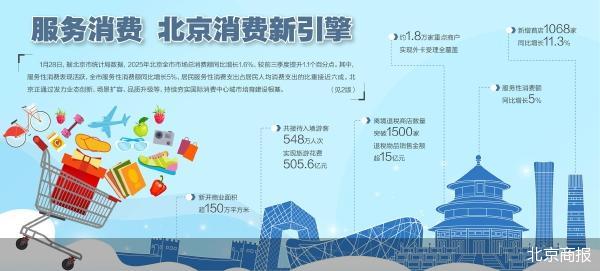
服务消费领航 多元业态赋能 2025年北京消费市场韧性十足
Bei Jing Shang Bao· 2026-01-28 14:13
Group 1 - The core viewpoint of the articles highlights the significant growth and transformation of Beijing's consumer market, particularly emphasizing the role of service consumption as a key driver of economic activity [1][2][10] - In 2025, Beijing's total market consumption is projected to grow by 1.6% year-on-year, with service consumption increasing by 5%, indicating a shift towards a more service-oriented economy [1][4] - The integration of online and offline retail channels is accelerating, with the penetration rate of enterprises in wholesale and retail, accommodation, and catering sectors reaching 51.9%, up by 2.4 percentage points year-on-year [2][4] Group 2 - The retail sales of social consumer goods in Beijing are expected to decline by 2.9% year-on-year, although the decline is narrowing compared to previous quarters, reflecting a structural adjustment in the consumption market [4] - Certain categories, such as gold and jewelry, cosmetics, and staple food, have shown positive growth, with retail sales increasing by 39.5%, 12.6%, and 5.7% respectively [4] - The penetration rate of new energy vehicles is rising, with retail sales of these products increasing by 13.2% year-on-year, driven by policies promoting consumption and the popularity of new models [4] Group 3 - The emergence of new retail formats and the "first store economy" is becoming a key indicator of urban commercial attractiveness, with over 1,068 new first stores opened in 2025, marking an 11.3% increase [5][8] - The night economy is expanding, with the number of night economy consumption points increasing from 22 in 2019 to 139 in 2025, indicating a growing demand for nighttime activities [8] - The integration of traditional cultural elements with modern consumption trends is evident, as seen in the rise of local brands and international brands adapting to local culture [8][12] Group 4 - The focus on quality and fashion in consumption is becoming more pronounced, with the development of a diverse range of consumer experiences that cater to high-quality and multi-faceted lifestyles [10][12] - The concept of "fashion consumption" is evolving, with expectations that it will become a significant growth point in the market, driven by innovation and cultural resonance [12][13] - The importance of fashion consumption as a commercial and social value is highlighted, indicating its potential to drive consumer trends and create substantial market value [13]

北京将加快家政服务业数智化创新 扩大优质服务供给
Xin Lang Cai Jing· 2026-01-28 13:38
Core Viewpoint - Beijing aims to accelerate digital and intelligent innovation in the home service industry, promoting high-quality development and industry transformation through new business models and scenarios [1] Group 1: Industry Development - The home service industry connects consumer needs with social employment, becoming a crucial link for improving residents' quality of life and job security [1] - There is a rising demand for specialized services such as elderly care, maternal and infant care, and detailed cleaning, which are driving new growth in service consumption and enhancing family happiness [1] - By 2025, Beijing will focus on diversifying and improving the quality of home services, transitioning the industry from a "extensive" to a "high-quality" model [1] Group 2: Policy and Collaboration - Beijing has issued guidelines to develop a "home service + elderly care" model, establishing a collaborative mechanism across seven areas including policy, standards, and talent [2] - The city plans to integrate home services into community activities, connecting home service companies with 100 communities to provide convenient services [1][2] Group 3: Professionalization and Training - The "Beijing Home Service" skill brand has been created, with the first batch of seven vocational assessment standards and training materials developed, training over 10,000 individuals [2] - Agreements have been signed with ten provinces to expand professional training channels, and a citywide home service skills competition has been held to enhance service quality [2] Group 4: Standardization and Management - A model contract for home service in Beijing has been published to clarify the rights and responsibilities of service providers and consumers, reducing disputes [2] - The Beijing Home Service Association has launched a self-regulation charter with over 70 key platforms to promote industry integrity and compliance [2] Group 5: Digital Innovation - Home service platforms are rapidly adopting new technologies to enhance service experiences, such as JD Home Service's intelligent dispatch system that optimizes service assignments based on various data points [3] - 58 Daojia has implemented AI technologies to improve job matching for service personnel, increasing customer acquisition efficiency by 1.5 times compared to traditional methods [3] Group 6: Future Outlook - By 2026, the home service sector is expected to play a significant role in enhancing social welfare and expanding service consumption, with a focus on professional training, standardized management, and the integration of home services with elderly and childcare services [3]