美妆护肤

Search documents
护肤赛道新突破:海璞诺获评种子独角兽,剑指百亿免疫抗老市场
Zhong Guo Chan Ye Jing Ji Xin Xi Wang· 2025-08-08 12:10
Core Insights - The latest "GEI China Unicorn Enterprises Research Report 2025" indicates that China's unicorn companies have entered a new stage of high-quality development, showcasing distinct characteristics of hard technology and innovation vitality [1] - By 2024, the number of unicorn companies in China reached 372, with a total valuation exceeding $1.2 trillion [1] Group 1: Seed Unicorn Enterprises - Seed unicorn enterprises are defined as newly established startups with high growth potential and technological innovation capabilities, possessing the potential to exceed a valuation of $1 billion [1] - These companies have core independent intellectual property rights and market competitiveness, aligning their main business and core technologies with national and local strategic development directions [1] - To support the development of seed unicorn enterprises, various policies and measures have been introduced by national and local governments to ensure sustainable growth [1] Group 2: Shenzhen Haichuang Biotechnology Co., Ltd. - Shenzhen Haichuang Biotechnology Co., Ltd. was awarded the title of "Seed Unicorn Enterprise" at the China (Shenzhen) Unicorn Enterprise Conference held in July 2025 [2] - The company focuses on strategic industries such as artificial intelligence, integrated circuits, and biomedicine, and is recognized for its innovative or disruptive technologies [2] - With over 30 years of research and development achievements, Haichuang has significant growth potential and innovation capabilities, currently aiming for a valuation of 100 billion [2][3] Group 3: Product Development and Innovation - Haichuang's brand "Haipuno" specializes in skin immune anti-aging products, supported by over 60 high-value patents and extensive clinical trial results [3] - The company has launched new products such as "95 Black Gold Essence" and "Award-Winning Eye Cream," with the latter winning the "APAAACI International Science and Technology Gold Award" in December 2024 [4] - The innovative ingredient HEPRO-GABA developed by Haipuno addresses common eye area issues, while HEPRO-6A enhances the immune cell's ability to eliminate aging cells [4][5] Group 4: Market Position and Future Plans - In a challenging economic environment, the skincare market is experiencing polarization, with brands lacking core R&D capabilities gradually exiting the market [4] - Haichuang has successfully completed two rounds of funding, indicating a market shift towards valuing core competitiveness over marketing prowess [5] - The company plans to develop a professional skincare line for children, with products targeting eczema set to launch in 2025 [5]
与润本堂达成战略合作?爱茉莉太平洋发布声明:纯属虚构
Nan Fang Du Shi Bao· 2025-08-07 11:15
南都·湾财社记者搜索发现,截至发稿,在互联网上仍有多篇名为《重磅启动:润本堂×爱茉莉太平洋集 团战略项目全面内测!全国渠道同步招募中,震撼来袭!》文章。 上述文章称,"亚洲美妆巨头——爱茉莉太平洋集团正式携手中国护肤新锐品牌润本堂,开启一场横跨 中韩、引爆全渠道的深度战略合作!三年内推出5大功能护肤系列,重塑中国肌肤护理标准打造中韩共 研研发中心,专注敏感肌、抗老、男士护理等高潜细分市场携手爱茉莉原有全球销售体系,共同拓展东 南亚、日韩、中东等国际渠道。全国开放城市联营体验店、旗舰合作、供应链合伙人机制。" 8月5日,爱茉莉太平洋集团发布《关于网络不实信息的严正声明》称,近期,网络平台出现多篇关 于"润本堂与爱茉莉太平洋集团达成战略合作"的不实信息,对爱茉莉太平洋声誉造成严重的不良影响。 我司与"哈尔滨润本堂日用品有限公司"从未有过任何业务往来,所谓的"战略合作"纯属虚构。 爱茉莉太平洋在声明中表示,鉴于该不实信息可能存在误导公众、被不法分子利用的风险,我司已依法 向相关监督部门进行举报,并将通过法律途径维护企业合法权益。"我们敬请媒体朋友和广大消费者提 高警惕,避免因误信虚假信息而蒙受损失。" 天眼查显示, ...

佳云科技股价微涨0.86% 董事会通过多项人事调整议案
Jin Rong Jie· 2025-08-06 17:56
Group 1 - The stock price of Jiayun Technology reached 4.69 yuan on August 6, 2025, with an increase of 0.04 yuan, representing a rise of 0.86% compared to the previous trading day [1] - The company's main business includes mobile internet services and beauty skincare, with mobile internet services accounting for over 90% of its revenue [1] - Jiayun Technology's concept sectors include cultural media, Guangdong sector, and Xiaohongshu concept [1] Group 2 - On August 6, Jiayun Technology held its sixth board meeting, where several resolutions were passed, including the appointment of Qin Lili as the vice president and the change of the accounting institution head from Liu Chaoxiong to Duan Dongyun [1] - A temporary shareholders' meeting is scheduled for August 7 to discuss matters such as the transfer of subsidiary equity and the change of the company's name [1] Group 3 - On August 6, the net outflow of main funds was 1.078 million yuan, with a cumulative net outflow of 13.1514 million yuan over the past five days [1]

佳云科技:聘任覃荔荔为公司副总经理
Mei Ri Jing Ji Xin Wen· 2025-08-06 09:36
Group 1 - The core point of the article is the announcement by Jiayun Technology regarding the appointment of a new deputy general manager and changes in the accounting department, reflecting internal adjustments within the company [1] - Jiayun Technology's revenue composition for the year 2024 is as follows: mobile internet business accounts for 91.15%, beauty and skincare business accounts for 6.29%, and other businesses account for 2.56% [1] - As of the report, Jiayun Technology has a market capitalization of 3 billion yuan [1] Group 2 - The company appointed Ms. Tan Lili as the new deputy general manager after a review by the board's nomination committee [1] - The head of the accounting department has been changed from Mr. Liu Chaoxiong to Ms. Duan Dongyun, who meets the qualifications required by the Accounting Law of the People's Republic of China [1]
上美股份预计上半年净利润同比增长30.9%—35.8%
Zheng Quan Shi Bao Wang· 2025-08-06 00:35
Group 1 - The performance growth is primarily attributed to the multi-channel and multi-category layout of the Han Shu brand and the significant revenue increase from Newpage [1] - The company continues to implement a "single focus, multiple brands, globalization" strategy, establishing a multi-brand matrix consisting of "Han Shu + Newpage + Nth Curve Brands" [1] - The main brand Han Shu achieved a GMV of 3.63 billion yuan on Douyin, maintaining the top position in the beauty sales ranking on the platform, with product breakthroughs in various categories such as Hong Man Yao, Bai Man Yao, X Peptide series, and secondary throwaway products [1] Group 2 - The professional skincare brand An Min You has entered the sensitive skin market with the "Qinghao Oil AN+" ingredient, enhancing the professional skincare portfolio [1] - The company's layout in the hair care sector includes brands like Ji Fang and Han Shu Hair Care, precisely targeting the "functional hair care" and "scalp anti-aging" niche markets [1] Group 3 - The company expects its net profit for the first half of 2025 to be between 540 million yuan and 560 million yuan, representing a year-on-year growth of 30.9% to 35.8% [3] - The expected revenue for the company is between 4.09 billion yuan and 4.11 billion yuan, with a year-on-year growth of 16.8% to 17.3% [3]

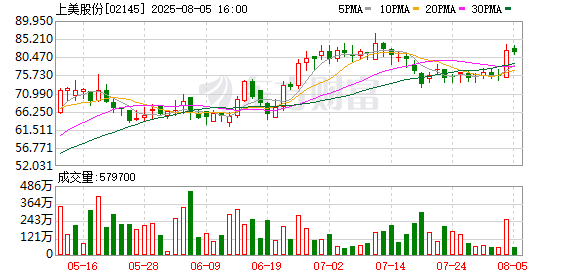
上美股份现涨超9% 7月抖音护肤韩束稳居第一 多渠道布局有助于公司扩大市场份额
Zhi Tong Cai Jing· 2025-08-04 06:24
Core Viewpoint - The stock of Shangmei Co., Ltd. (02145) has seen a significant increase, with a rise of over 10% during trading, attributed to strong growth in domestic beauty brands and successful performance on platforms like Douyin [1] Group 1: Company Performance - Shangmei Co., Ltd. reported a stock price increase of 9.12%, reaching HKD 82.55, with a trading volume of HKD 152 million [1] - The brand Han Shu achieved a remarkable growth of 58% in July, while other brands like Proya and Marubi also showed substantial growth rates of 23% and 72% respectively [1] - The company's GMV (Gross Merchandise Volume) for Han Shu is projected to reach 6.749 billion in 2024, representing a year-on-year growth of 102%, making it the top-ranked beauty brand on Douyin [1] Group 2: Market Trends - The domestic beauty brand market is experiencing a significant upward trend, with platforms like Douyin contributing to the growth of these brands [1] - The online self-operated channel revenue share for Shangmei Co., Ltd. is expected to rise from 39.6% in 2022 to 78.2% in 2024, indicating a shift towards online sales [1] - The company is also diversifying its e-commerce channels, with projected GMV growth rates for Han Shu during the Double Eleven shopping festival in 2024 of 57% on Tmall and 115% on JD.com [1]
一周新消费NO.319|GODIVA歌帝梵与LABUBU联名冰品发布;日本运动品牌鬼塚虎跨界推出香水系列
新消费智库· 2025-07-27 13:05
New Consumption Highlights - WonderLab launched a new probiotic chewing gum product, combining probiotics and postbiotics with mint and green coffee complex [2][3] - MANNER collaborated with Shanghai Pudong Art Museum to introduce a new iced Americano inspired by Van Gogh's artwork [5] - Mengniu introduced a new live bacteria yogurt ice cream, made with at least 65% fresh milk and 100% live bacteria fermentation, recently awarded a silver prize for health innovation [3][5] - PepsiCo announced a new prebiotic soda, marking the first new flavor addition in 20 years, available in original and cherry vanilla [3] - Sun Valley launched a new fried product series, including flavors like crayfish and honey onion chicken sticks [3] - Asahi Group began trial sales of a yeast-based non-dairy milk product, LIKE MILK, which is free from 28 common allergens [7] - Xueji Chaohuo partnered with Yili to launch a new yogurt product made with fresh milk from Yili's farms [7] - Fi xXBody introduced a new air-puffed rice snack available in sea salt and barbecue beef flavors, containing a mix of ten grains and seeds [7] - Lee Kum Kee launched a low-sodium soy sauce with 25% less salt content, suitable for dipping and cooking [7] Industry Events - GODIVA announced a collaboration with LABUBU to launch a new ice cream series featuring various chocolate flavors [10] - Northeast retail giant Biyoute partnered with RELEX Solutions for supply chain planning [10] - Nike announced Karina from Aespa as a new brand ambassador, emphasizing diversity and female representation [10] - Keen launched its first trail running shoe, Seek, after two years of development [10] - Italian sportswear brand Hydrogen is entering the Chinese market, set to launch in Spring/Summer 2026 [10][13] - Taiwanese matcha brand "Yuqian Shangcha" opened its first store in Shanghai, focusing on high-end matcha products [10] - PAGEONE bookstore opened its first store in Jiangsu, continuing its expansion in China [10] - Popeyes announced the opening of five new stores in Shanghai [10] - Baosheng became the general agent for DYNAFIT in China, enhancing its outdoor brand portfolio [10] Investment and Financing Trends - Yangtuo Technology Inc., a maternal and infant e-commerce platform, applied for an IPO on the Hong Kong Stock Exchange [16] - Little Sesame, a US hummus brand, completed an $8.5 million Series A financing round [16] - Theo Health, a Scottish smart sportswear company, raised £1.2 million in funding [16] - Tianwei Food's major shareholder transferred 21.2 million shares, representing 1.99% of the company's total shares [18] - XPeng Huitian completed a $250 million Series B financing round to accelerate the development of its flying car [20] - Korean makeup brand Jungsaemmool received investment from CLSA Capital Partners, amounting to 500 million KRW (approximately 26 million RMB) [20] - Ulta Beauty is set to acquire UK beauty retailer Space NK, with the deal exceeding £300 million (approximately 2.9 billion RMB) [20] - Chanel acquired a 20% stake in Italian leather manufacturer Nuova Impala, strengthening its investment in the Italian supply chain [22] Food Industry Developments - Nongfu Spring's parent company launched "Birch Tree Juice," a 100% natural juice product sourced from high-quality birch trees [23] - Emerging health brand Ozzi introduced a natural drink aimed at controlling evening appetite [23] - if launched a limited edition jasmine rice-flavored coconut water to celebrate the 50th anniversary of China-Thailand diplomatic relations [24] - Qiaqia partnered with Taier to launch a new flavor of sunflower seeds inspired by sour fish soup [24] - UK candy brand Ruly introduced a caffeine-infused candy series [24] - Shiyan Studio launched new spicy flavors of crispy corn chips [24] - Yili's subsidiary Xu Jinhui collaborated with Haier Brothers to launch a new ice cream product [25] - Ganyuan introduced a Sam's Club exclusive freeze-dried hazelnut product [25] - Asahi launched Japan's first yeast-based milk product, LIKE MILK, with a 38% reduction in fat content [25] - Buzhu launched a new mint-flavored electrolyte water [25] Beauty Industry Updates - Chinese makeup brand Ju Duo plans to launch its first nourishing foundation line [28] - Tatcha is entering the Spanish market through Sephora [28] - Amorepacific's Ryo brand released a new scalp essence product [28] - Louis Vuitton introduced a new signature handbag, Express, in its Fall/Winter 2025 collection [28] - Aveda opened its first concept flagship store in China, located in Shanghai [32] - JD Health launched its first offline medical beauty clinic in Beijing [32] - Jaeger-LeCoultre released a new dating series watch featuring intricate floral designs [32] - Tiffany & Co. opened its largest flagship store in Asia in Tokyo [32] - Zhenyan launched a multi-dimensional protein repair system for skincare [32] - Onitsuka Tiger announced the launch of a new perfume series, marking its entry into the beauty sector [32]






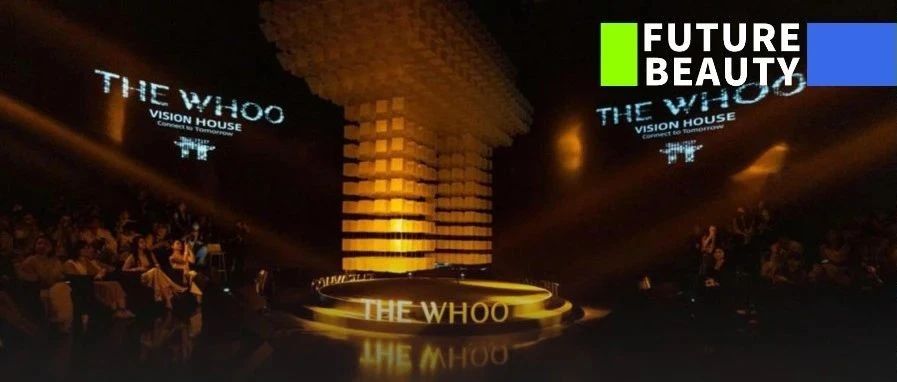
高端美妆在中国“犯难”,THE WHOO为何“常青”?
FBeauty未来迹· 2025-07-21 09:45
Core Viewpoint - The article highlights the impressive performance of THE WHOO, a high-end skincare brand, during the 2025 618 sales event, showcasing its market leadership and strategic initiatives that contribute to its growth in the competitive beauty industry [2][36]. Sales Performance - The total online sales for skincare reached 43.2 billion yuan during the 618 event, a year-on-year increase of 65.52% from 26.1 billion yuan in 2024. The fragrance and makeup category generated 14.3 billion yuan, up 57.14% from 9.1 billion yuan, leading to a combined growth of 63.35% [2][3]. - THE WHOO achieved a GMV of 3.94 billion yuan, ranking 9th among beauty brands on Douyin during the 618 period [4][10]. - On Kuaishou, THE WHOO ranked 3rd in skincare sales during the same period, maintaining its position among the top high-end skincare brands [6][10]. Brand Strategy - THE WHOO's success is attributed to its four strategic pillars: cultural marketing, technological empowerment, celebrity endorsements, and immersive offline experiences [12][36]. - Cultural marketing efforts include collaborations with traditional Chinese art forms, such as Dunhuang murals and Peking opera, enhancing the brand's cultural resonance and emotional connection with consumers [12][14][16]. - Technological advancements are evident in the launch of the weather-dan PRO series, which incorporates innovative ingredients aimed at addressing modern skincare concerns [17][19]. - The brand has optimized its celebrity endorsement strategy, featuring well-known figures like Li Xian and Kim Ji-won to broaden its appeal across different demographics [20][23]. Market Trends - The high-end beauty market in China has experienced a compound annual growth rate decline of 3% from 2021 to 2024, with a market size reduction from 257.8 billion yuan to 236.4 billion yuan [27][30]. - THE WHOO's approach to maintaining its market position involves a focus on scientific research and understanding consumer needs, particularly in the context of anti-aging trends [35][36]. Conclusion - THE WHOO's strong performance during the 618 sales event and its strategic initiatives reflect its commitment to leading the high-end skincare market in China. The brand's ability to adapt to market changes and consumer preferences positions it as a benchmark for international beauty brands [36].
一周新消费NO.318|瑞幸×多邻国推出新品;舒淇成为爷爷不泡茶品牌代言人
新消费智库· 2025-07-20 13:00
New Product Launches - Bright Dairy launched the new organic milk ice cream "Guangming Youbei," containing 55% organic milk, with protein content not less than 4.5g/100g [4] - Xueji Snacks and Yili Group introduced a new yogurt product featuring a "milk skin" layer, made from fresh milk sourced from Yili's professional farms [4] - Joyoung released a new red date soy milk powder, made from non-GMO soybeans and red dates, containing 28g of protein per 100g [6] - Yi Bao launched a new 5L packaging of its bottled drinking water, designed for multiple consumption scenarios [6] - Luckin Coffee and Duolingo collaborated to launch a new product, "Green Sand Latte," made with high-quality green beans and IAC award-winning coffee beans [22] Industry Events - Anta opened a new brand experience space called "Anta Home" in Jinjiang, featuring appearances by Olympic champions [9] - Mengniu's high-end ice cream brand Tilan Shengxue officially entered the Hong Kong and Macau markets, becoming the first high-end ice cream brand approved by local authorities [10] - Yuanji Cloud Dumplings announced its first store in Thailand, maintaining its original recipe without local adaptations [12] - Grandpa's Tea appointed actress Shu Qi as its brand ambassador, marking a significant step in brand influence [12] Investment and Financing - The smart beverage retail brand "Pengbei Station" completed a financing round of 50 million yuan, focusing on AIOT solutions for unmanned retail [16] - Qunxing Toys secured 159.47 million yuan in financing, representing 26.25% of the day's buying amount [17] - Jujitang completed a 10 million yuan angel round financing, focusing on health food supply chains [18] - Three Squirrels announced an investment of up to 200 million yuan to upgrade its snack supply chain [19] Food Industry Developments - The new "Shang Jian Wang" tea beverage series from Shan Zha Shu Xia Group features oolong and jasmine tea, with zero sugar, fat, and calories [6] - Farmer Spring launched a new birch tree juice product, currently available only through Sam's Club [24] - DolCas Biotech introduced a chocolate bar containing fish collagen peptides, targeting joint and skin health [26]




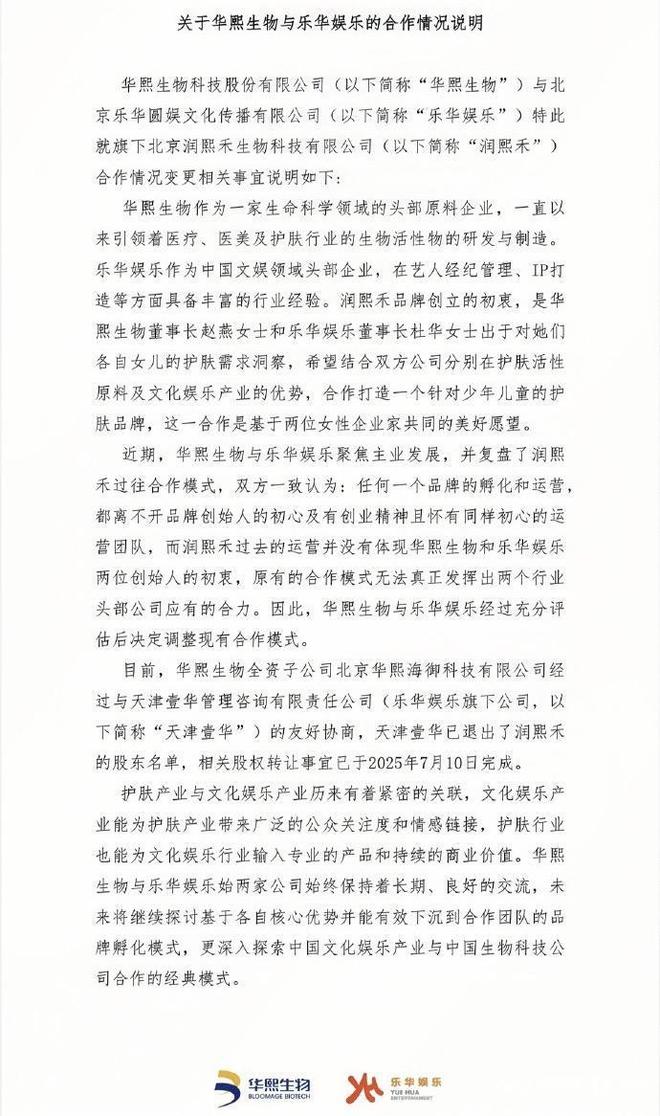
杜华和赵燕拆伙了!乐华娱乐退出与华熙合资的儿童护肤品牌
Nan Fang Du Shi Bao· 2025-07-18 13:25
Core Viewpoint - Lehua Entertainment has quietly exited its partnership with Huaxi Biological, with the latter announcing the withdrawal of Tianjin Yihua Management Consulting Co., Ltd. from the shareholder list of the children's skincare brand Runxihe, effective July 10, 2025. The collaboration was initially based on the founders' insights into their daughters' skincare needs, but the operational model did not meet expectations, prompting the decision to part ways [1][13]. Company Summary - Huaxi Biological's announcement highlighted that the original intention behind the Runxihe brand was to leverage the strengths of both companies in skincare active ingredients and cultural entertainment to create a children's skincare brand. However, the operational model failed to reflect the founders' original vision, leading to the decision to adjust the partnership [1][13]. - Lehua Entertainment confirmed its focus on core business development and IP expansion following the amicable agreement with Huaxi Biological. The company previously held a 50% stake in Runxihe [4][13]. - The Runxihe brand, launched in 2019, was part of a joint venture established in 2023, coinciding with Lehua Entertainment's IPO in Hong Kong. The brand aimed to tap into the beauty market, which was seen as a potential growth area for Lehua [16][17]. Industry Summary - The children's skincare segment has emerged as a lucrative area for domestic beauty brands, with several companies entering the market, including Betaini with "Winona Baby" and Shanghai Jahwa with "Qichu." The market has seen rapid growth, with brands like "Turtle Dad" and "Kangaroo Mom" gaining significant traction [18]. - Despite the initial promise, Runxihe's performance has not met expectations, as indicated by Huaxi Biological's recent quarterly reports, which did not mention the brand's performance or product lines. The company has been undergoing significant organizational changes since late 2022, which may have influenced the decision to exit the partnership [17][18].