制造业

Search documents
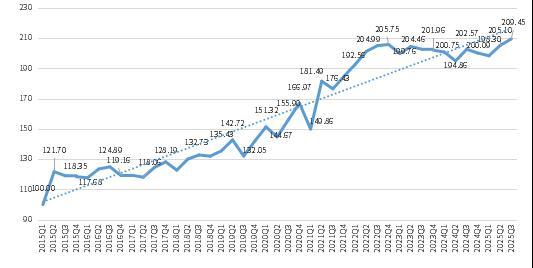
莱茵生物:12月22日召开董事会会议
Mei Ri Jing Ji Xin Wen· 2025-12-23 13:23
2025年1至6月份,莱茵生物的营业收入构成为:制造业占比98.71%,其他行业占比1.29%。 (记者 曾健辉) 截至发稿,莱茵生物市值为65亿元。 每经AI快讯,莱茵生物(SZ 002166,收盘价:8.7元)12月23日晚间发布公告称,公司第七届第十次董 事会会议于2025年12月22日在公司四楼会议室以现场方式召开。会议审议了《关于本次交易相关议案暂 不提交股东会审议的议案》等文件。 每经头条(nbdtoutiao)——地产"优等生"受困20亿元到期债务,首次债务展期仍在博弈,明年还有超 百亿元公开债到期 ...

深圳:持续加大面向隐形冠军、制造业龙头等企业外资招引力度
Zheng Quan Shi Bao Wang· 2025-12-23 11:14
人民财讯12月23日电,深圳市人民政府印发《深圳市进一步加大吸引和利用外资实施办法》,其中提 出,加大制造业外资项目支持。持续加大面向隐形冠军、制造业龙头等企业外资招引力度。对于2023— 2027年间,年新增实际外资金额合计达5000万美元及以上的制造业企业予以奖励,其中高技术制造业企 业按不高于新增实际外资金额3%的比例予以奖励,其他制造业企业按不高于新增实际外资金额2%的比 例予以奖励。单个企业年度最高奖励人民币5000万元,累计最高奖励人民币1.5亿元。 ...
胜蓝股份:公司及其控股子公司的担保额度总金额为8.4亿元
Mei Ri Jing Ji Xin Wen· 2025-12-23 11:05
每经AI快讯,胜蓝股份(SZ 300843,收盘价:52.93元)12月23日晚间发布公告称,本次提供担保后, 公司及其控股子公司的担保额度总金额为8.4亿元,占公司最近一期经审计净资产的55.31%;公司为子 公司提供担保总余额为3.2亿元,占公司最近一期经审计净资产的21.07%。 2024年1至12月份,胜蓝股份的营业收入构成为:制造业占比100.0%。 截至发稿,胜蓝股份市值为87亿元。 每经头条(nbdtoutiao)——地产"优等生"受困20亿元到期债务,首次债务展期仍在博弈,明年还有超 百亿元公开债到期 (记者 曾健辉) ...

2025年11月中国企业信用指数162.66 持续稳中有进
Zhong Guo Jing Ji Wang· 2025-12-23 10:29
Group 1 - The corporate credit index in China for November is 162.66, indicating a steady improvement in corporate credit levels [1] - The corporate credit index increased by 1.11 points from October, reaching a peak for the second half of the year, reflecting a positive change in corporate credit levels amid stable economic performance [2] - Most regions in China showed positive growth in credit indices, with notable increases in Guangdong and Shandong, indicating enhanced self-discipline among enterprises and effective credit repair mechanisms [3] Group 2 - Nearly 80% of industries saw an increase in credit indices compared to the previous month, with the finance and manufacturing sectors leading the growth [4] - The credit index for the real estate industry has shown a continuous upward trend for four months, indicating a recovery in credit levels [4]
2025年11月中国企业信用指数较10月上升1.11点 攀升至下半年峰值
Bei Jing Shang Bao· 2025-12-23 10:17
Core Insights - The corporate credit index in China reached 162.66 in November 2025, marking an increase of 1.11 points from October, indicating a positive change in corporate credit levels amid stable economic growth [1] Industry Summary - Nearly 80% of industries experienced a month-on-month increase in their credit indices, with the top five performing sectors being finance, manufacturing, water conservancy, environmental and public facilities management, and electricity, heat, gas, and water production and supply [1] - The credit index for the resident services, repair, and other service industries saw the highest growth among all sectors, while the manufacturing sector ranked second in terms of credit index growth [1] - The real estate industry has maintained a month-on-month increase in its credit index for four consecutive months, indicating a recovery trend in credit levels [1] Regional Summary - The top five provinces in terms of credit index rankings are Anhui, Shaanxi, Tianjin, Shandong, and Chongqing, with Shandong making its first appearance in the national top five in 2025 [1]
2025年科尔尼行业系列回顾|战略运营和绩效提升
科尔尼管理咨询· 2025-12-23 09:54
Core Insights - In 2025, corporate operations will enter a phase of systematic restructuring due to intensified geopolitical tensions and tariff disputes, leading to a rebalancing of manufacturing and procurement models alongside the accelerated integration of generative AI into core operational processes [1][2] Group 1: COO Role Evolution - The role of the COO is transitioning from a "firefighter" to a "strategic navigator" as generative AI reshapes operational processes, while skill shortages and ESG implementation delays pose significant challenges to operational upgrades [3][4] - The "15th Five-Year Plan" emphasizes the need for group enterprises to navigate eight key battles to achieve systematic breakthroughs amid rising strategic complexity [2][3] Group 2: Supply Chain Dynamics - A new round of tariff disputes is reshaping global supply chains, compelling companies to rebalance between cost, resilience, and geopolitical risks, accelerating the shift towards regionalization and diversification of supply chain layouts [3][5] - The momentum for manufacturing return to the U.S. is expected to significantly slow down in 2024, highlighting constraints in capacity and labor, prompting companies to reassess the roles of nearshoring and low-cost Asian regions in their global manufacturing networks [5] Group 3: Strategic Execution and Upgrades - Many enterprises have clarified their strategic directions, yet they struggle to effectively translate these into organizational, process, and capability frameworks, resulting in challenges in executing strategies consistently [10][12] - The global supply chain is shifting from a focus on efficiency and cost to a balanced emphasis on resilience, efficiency, and sustainability, necessitating a comprehensive upgrade across strategic models, operational systems, and support mechanisms [12][13] Group 4: Revenue Growth Management - Revenue Growth Management (RGM) has evolved into a core strategic tool at the CEO and board levels, essential for fulfilling profit commitments and boosting shareholder confidence, with a focus on scaling RGM capabilities through organizational and AI empowerment [16]


振江股份(603507.SH):暂未向商业航天类企业供货
Ge Long Hui· 2025-12-23 09:02
Group 1 - The company, Zhenjiang Co., Ltd. (603507.SH), has stated on its interactive platform that it has not yet supplied products to commercial aerospace enterprises [1]

【宏观经济】一周要闻回顾(2025年12月17日-12月23日)
乘联分会· 2025-12-23 08:40
Core Viewpoint - The article discusses the performance of China's general public budget revenue and expenditure for the first eleven months of the year, highlighting a modest growth in revenue and various trends in fiscal spending across different sectors [6]. Group 1: General Public Budget Revenue - In the first eleven months, the national general public budget revenue reached 200,516 billion yuan, reflecting a year-on-year growth of 0.8% [6]. - Tax revenue amounted to 164,814 billion yuan, showing a growth of 1.8%, while non-tax revenue was 35,702 billion yuan, which represents a decline of 3.7% [6]. - Central government budget revenue was 88,464 billion yuan, down by 1%, while local government budget revenue increased by 2.2% to 112,052 billion yuan [6]. Group 2: General Public Budget Expenditure - Total general public budget expenditure for the first eleven months was 248,538 billion yuan, marking a growth of 1.4% [6]. - Central government expenditure was 38,232 billion yuan, up by 6.2%, while local government expenditure grew by 0.6% to 210,306 billion yuan [6]. - Key expenditure areas included education (37,856 billion yuan, +4.4%), social security and employment (40,721 billion yuan, +8.1%), and health (18,687 billion yuan, +4.7%) [6]. Group 3: Government Fund Budget - National government fund budget revenue was 40,274 billion yuan, down by 4.9%, while expenditure increased by 13.7% to 92,124 billion yuan, driven by accelerated use of bond funds [7]. Group 4: E-commerce Development - In the first eleven months, online retail sales grew by 9.1%, with significant increases in digital product sales (8.2%) and online service consumption (21.7%) [9]. - The agricultural and industrial sectors saw a boost in digital transformation, with rural online retail sales increasing by 9.8% [10]. - The e-commerce sector is enhancing innovation, with major platforms achieving an average R&D intensity of 8.3% [10]. Group 5: Foreign Investment - In the first eleven months, foreign direct investment amounted to 693.18 billion yuan, a decrease of 7.5%, although November saw a 26.1% increase year-on-year [11]. - The manufacturing sector attracted 171.72 billion yuan, while the service sector received 506.29 billion yuan in foreign investment [11]. - High-tech industries, particularly e-commerce services, saw substantial growth in foreign investment, with increases of 127% in e-commerce services [11].

爱沙尼亚2025年11月工业生产者价格指数同比上涨1.1%
Shang Wu Bu Wang Zhan· 2025-12-23 04:38
Core Insights - The industrial producer price index in Estonia increased by 1.1% year-on-year in November 2025, with a month-on-month rise of 0.2% [1] Group 1: Energy and Mining - The price index for energy production, including electricity, rose by 10.7% year-on-year [1] - The mining industry saw a production price increase of 6.3% year-on-year [1] Group 2: Manufacturing Sector - The manufacturing price index experienced a modest increase of 0.2% year-on-year [1] - Within manufacturing, clothing production prices increased by 6.3% year-on-year [1] - Wood and wood products processing prices rose by 4.2% year-on-year [1] - Basic pharmaceuticals and drug formulations saw a price increase of 2.7% year-on-year [1] - Food production prices increased by 1.5% year-on-year [1] - Conversely, basic metals manufacturing prices decreased by 11.3% year-on-year [1] - Textile production prices fell by 7.3% year-on-year [1] - Paper and paper products manufacturing prices declined by 5% year-on-year [1] - Repair and installation prices for machinery and equipment decreased by 1.8% year-on-year [1] Group 3: Trade Prices - The export price index in Estonia increased by 1.9% year-on-year in November [1] - The import price index rose by 1% year-on-year [1]
新华指数|三季度小微企业融资成本稳步下降 金融服务可得性和效率均有所提升
Xin Hua She· 2025-12-23 02:12
Core Insights - The "Inclusive Finance - Micro and Small Enterprises Index" indicates a significant decrease in financing costs for micro and small enterprises by Q3 2025, with a continuous increase in funding supply and improved accessibility and quality of financial services [1][3] - The balance of inclusive micro and small loans reached 36.09 trillion yuan, reflecting a year-on-year growth of 12.2% as of the end of September 2025 [1] - Over 70% of micro and small enterprises reported that their financing needs were met, indicating a high level of satisfaction with financing availability [1] Financing Cost and Efficiency - The financing price index decreased to 65.32 points, a decline of 4.92% from the previous period, indicating a stable reduction in comprehensive financing costs for micro and small enterprises [2] - The weighted average interest rate for newly issued loans in September was approximately 3.1%, down about 40 basis points year-on-year [2] - The financing efficiency index rose to 215.09 points, with nearly 60% of micro and small enterprises able to receive loans in a timely manner, reflecting improved financing efficiency [2] Financial Service Quality - The inclusive finance service system and capabilities are continuously improving, with a focus on enhancing coverage and accessibility while reducing overall costs [3] - The service availability index reached 203.47 points, increasing by 3.02%, and the quality index rose to 111.76 points, up by 0.31% [6] - The inclusive finance development index remained stable at 52.48 points, with the micro and small business environment showing steady improvement [7] Sector-Specific Insights - The financing price index for five major sample industries (wholesale and retail, manufacturing, leasing and business services, construction, and scientific research and technical services) showed a decline, indicating the effectiveness of the accommodative monetary policy [7] - The service availability and quality indices for these industries also increased, with construction, manufacturing, and scientific research sectors experiencing over 2% growth in availability [7] Index Overview - The Inclusive Finance - Micro and Small Enterprises Index, launched by the China Economic Information Service and China Construction Bank, serves as a "barometer" and "guideline" for inclusive financial services to micro and small enterprises [8]