资产管理

Search documents
摩根资管白博文:中国故事是一场长期叙事,投资中国就是投资未来
2 1 Shi Ji Jing Ji Bao Dao· 2025-11-12 13:28
Core Viewpoint - The 2025 Shanghai Stock Exchange International Investor Conference highlighted the investment and merger opportunities in China's capital market from the perspective of international investors [1] Group 1: Policy Impact - Since the implementation of a comprehensive financial policy package on September 24, 2024, the A-share market has experienced significant growth, with major indices achieving substantial increases [3] - The policies introduced are based on a deep understanding of the issues that need to be addressed, rather than calls for large-scale fiscal stimulus [3] - The recently released "14th Five-Year Plan" outlines a clear roadmap for China's next stage of development, emphasizing a commitment to high-quality growth and prioritizing investments in people's livelihoods [3] Group 2: Capital Market Reforms - High-quality development and openness are key principles reflected in China's capital market reforms, aimed at enhancing the quality of listed companies and protecting small investors [4] - The comprehensive reform plan for the public fund industry established by the China Securities Regulatory Commission is expected to improve investor returns and enhance long-term stability and public trust [5] Group 3: Investment Opportunities - The slogan "Investing in China is investing in the future" is increasingly relevant for global investors, as the Chinese stock market is expected to show greater stability and lower volatility [5] - Recent trading activities in the Chinese market have been driven by index funds and ETFs, indicating a shift towards more efficient market dynamics [5] - The introduction of actively managed ETFs in China is seen as a timely opportunity to enhance liquidity and differentiation in the capital market [5] Group 4: Long-term Perspective - Morgan Asset Management has maintained a strategic focus on China for 20 years, managing over 240 billion RMB in client assets [6] - Concerns among global investors about missing investment opportunities in the A-share market are viewed as misplaced, as the long-term narrative of China's growth remains strong [6]

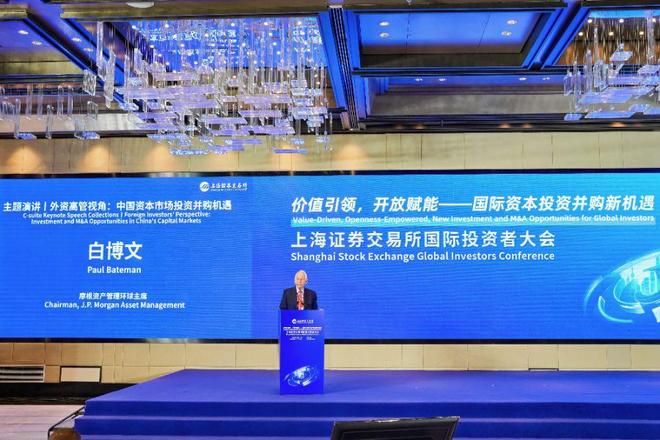
投资中国、携手共赢 2025年上交所国际投资者大会传递投资强信心
Shang Hai Zheng Quan Bao· 2025-11-12 13:05
Core Insights - The 2025 Shanghai Stock Exchange International Investor Conference opened on November 12, focusing on "Value Leadership, Open Empowerment - New Opportunities for International Capital Investment and Mergers" [1] - The conference attracted over 100 renowned investment institutions and nearly 400 representatives from regions including Europe, America, Asia-Pacific, and the Middle East, discussing new opportunities in Chinese investment and mergers, technology innovation, and high-level capital market openness [1][2] - Global asset management leaders expressed optimism about the long-term investment value in China, citing a stable macroeconomic environment, improved policy conditions, and accelerated technological innovation [1][2] Market Developments - China's capital market is steadily expanding its institutional openness, with ongoing optimization of the Qualified Foreign Institutional Investor (QFII) system, which has received high recognition for its stability, transparency, and predictability [2] - The Shanghai Stock Exchange and Singapore Exchange launched the China Securities Index Singapore Exchange Asia 100 Index series during the conference, marking a significant step in international cooperation [2] - The conference highlighted the achievements of the Shanghai Stock Exchange in supporting technological innovation and the development of new productive forces, particularly in the context of the seventh anniversary of the Sci-Tech Innovation Board [2] Future Outlook - The Shanghai Stock Exchange aims to enhance market inclusivity and adaptability while improving its attractiveness and competitiveness in response to complex internal and external changes in the capital market [3] - The exchange plans to leverage favorable opportunities for open cooperation to promote the long-term and stable development of the capital market in collaboration with global investors [3]
摩根资产管理环球主席白博文:现在是投资中国资本市场的良好时机
Xin Lang Zheng Quan· 2025-11-12 11:06
Group 1 - The core viewpoint is that the Chinese M&A market is undergoing transformation, with significant opportunities in the healthcare and consumer sectors due to factors like an aging population driving innovation in healthcare [1] - The healthcare industry is highlighted as particularly attractive for M&A activities, driven by the need for innovation related to China's aging population [1] - The consumer sector is also experiencing substantial opportunities, with some American companies entering the Chinese market through acquisitions [1] - The current state of the Chinese capital market is described as a critical moment, indicating that now is a good time for investment [1]
路博迈亚太区负责人刘颂:高端制造、科技创新、绿色转型将是中国核心引擎
Guo Ji Jin Rong Bao· 2025-11-12 10:24
Core Viewpoint - Recent international capital allocation to Chinese assets has significantly and continuously increased, driven by profound structural changes in the economy [1] Group 1: Investment Opportunities - China's economy is transitioning from real estate-driven growth to high-end manufacturing and service consumption, creating numerous new investment opportunities in sectors like AI, renewable energy, and innovative pharmaceuticals [1] - The attractiveness of A-share valuations, improving policies in the Chinese capital market, and the rising appeal of non-US dollar assets are contributing to foreign capital's growing interest in the Chinese market [1] Group 2: Future Industry Development - The future industrial development in China will focus on "new quality productivity" and "Chinese-style modernization," with green and low-carbon transformation as a long-term development goal [1] - High-end manufacturing, technological innovation, and green transformation are expected to be the core engines of growth over the next five years [1] Group 3: Company Strategy - The company plans to focus on cross-border product areas and intends to apply for QDII (Qualified Domestic Institutional Investor) quotas next year to leverage its group advantages [1] - The goal is to introduce innovative investment products with successful overseas experiences to Chinese investors [1]
景顺投资黄婉君:境估值洼地与创新驱动并行,中国资产正迎境外长期资金机遇
Xin Lang Zheng Quan· 2025-11-12 09:04
Core Insights - The interest of foreign investors in the Chinese market is continuously increasing, with Chinese assets being attractive in terms of global valuation and investment value [1][3]. Group 1: Investor Sentiment - Foreign institutional investors, such as pension funds, are focusing more on the fundamentals and long-term growth potential of companies [3]. - After market fluctuations, investor sentiment has become more stable, emphasizing company quality, growth, and sustainability [3]. Group 2: Market Stability - The key to the Chinese market lies in "stability and sustainability," with an expectation that foreign capital inflow will accelerate if the market maintains a stable trend [3]. - Many overseas institutions are closely monitoring the performance and volatility of the Chinese stock market [3]. Group 3: Structural Opportunities - China is transitioning from a "global manufacturing center" to a "global innovation center," with significant potential in innovation sectors such as AI and semiconductors [3]. - There is a need for improved understanding of China's technological innovations in foreign markets [3]. Group 4: Risk Management - It is suggested to enhance risk hedging mechanisms at the product level, such as introducing index futures, ETF futures, and options to help investors reduce systemic risks [3].

【有本好书送给你】百年资管巨头柏基的投资哲学:专注长期,聚焦成长
重阳投资· 2025-11-12 07:32
Core Viewpoint - The article emphasizes the importance of reading as a pathway to growth and wisdom, highlighting the investment philosophy of long-term growth and the significance of understanding changes in the market [2][10][15]. Group 1: Investment Philosophy - The article introduces the investment philosophy of Baillie Gifford, which focuses on long-term growth and understanding market changes rather than short-term gains [10][15]. - Baillie Gifford's investment strategy has successfully identified and invested in high-growth companies like Amazon, Tesla, and Nvidia, leading to exceptional returns [10][19]. - The philosophy is rooted in the belief that true competitive advantages take at least five years to manifest, and that long-term investments can maximize returns through compounding effects [19][20]. Group 2: Long-Term Investment Strategy - Long-term investment is defined as investments held for more than five years, with a focus on patience and understanding the future potential of companies [17][20]. - The article discusses the challenges of maintaining a long-term perspective in a market driven by short-term information and pressures [16][17]. - Baillie Gifford's approach includes low turnover in portfolios and continuous engagement with company management to ensure alignment with long-term goals [18][19]. Group 3: Growth Investment Focus - The article categorizes growth companies into three types: transformative growth companies, vibrant growth companies, and enduring growth companies, each with distinct characteristics and investment potential [22][23]. - Baillie Gifford prioritizes non-linear growth and exceptional returns, often investing in private companies that are not yet publicly traded [22][23]. - The firm emphasizes the importance of management quality and corporate culture in sustaining long-term growth [24][25]. Group 4: Global Investment Perspective - Baillie Gifford's investment strategy is globally oriented, seeking opportunities across various regions and sectors, particularly in rapidly growing markets [26]. - The firm has a historical commitment to global investment, leveraging its long-standing presence in the market to identify growth opportunities worldwide [26].

嘉信理财披露持有 1,712,780 股 BMNR,市值约 8890 万美元
Xin Lang Cai Jing· 2025-11-12 06:06
Group 1 - The core point of the article is that Charles Schwab Investment Management has disclosed its holdings in BMNR, indicating significant investment interest from a major asset management firm [1] Group 2 - Charles Schwab Investment Management holds 1,712,780 shares of BMNR [1] - The market value of these holdings is approximately 88.9 million USD [1]

江苏省国金集团资产管理有限公司成立
Zheng Quan Ri Bao Wang· 2025-11-12 03:42
本报讯(记者袁传玺)天眼查App显示,近日,江苏省国金集团资产管理有限公司成立,法定代表人为单 翔,注册资本10亿元,经营范围包括自有资金投资的资产管理服务、以自有资金从事投资活动、土地使 用权租赁、股权投资等。股东信息显示,该公司由江苏省国金投资集团有限公司全资持股。 ...
瑞银傅钰:AI非泡沫,投资会多元化配置防风险
Sou Hu Cai Jing· 2025-11-12 02:16
Core Viewpoint - UBS Asset Management believes that AI is a genuine growth engine and not a bubble, emphasizing that corporate AI capital expenditures are directed towards productive uses rather than unproductive ones [1] Group 1: AI Investment Perspective - The manager asserts that AI is not on the verge of a bubble burst, depending on the belief that AI can drive the next phase of global growth [1] - Even if there are signs of a bubble in the stock market, it may still be years away from bursting [1] Group 2: Investment Strategy - The manager plans to continue investing until signs of a bubble appear, while emphasizing the importance of diversification in investment strategies to maintain risk awareness [1]

【首席对话】全球资管巨头霸菱眼中的投资锚点
经济观察报· 2025-11-12 02:14
Core Insights - The article emphasizes the shift from traditional economic logic to a focus on identifying "certainty premiums" in a volatile market environment, as highlighted by Barings Asset Management's approach [2][3] - It discusses the importance of deep fundamental analysis and cash flow considerations in investment decisions, especially in the context of a changing global economic landscape [2][20] Investment Environment - The global financial market is experiencing a structural reshaping rather than a simple cyclical rotation, with a focus on the rebalancing of supply chains and capital flows [2][5] - Despite apparent economic resilience, there are underlying shifts in the financial health of different sectors, necessitating careful asset selection and research [5][18] High Yield Bonds - Barings' strategy in high yield bonds focuses on high-quality, mature markets, with a cautious approach to cyclical and tariff-sensitive sectors to mitigate volatility [8][9] - The overall return from high yield bonds remains attractive compared to government and investment-grade bonds, especially for institutional investors seeking stable cash flows [9] Fixed Income Strategy - The fixed income market is characterized by shorter durations, higher credit quality, and improved liquidity, with a notable shift in the composition of high yield bonds towards better quality [12][13] - Emerging market local currency bonds present a value opportunity due to their higher nominal yields compared to U.S. bonds, supported by potential capital gains from central bank rate cuts [12][13] Investment in China - China is positioned as a key player in building a comprehensive AI ecosystem, with significant investment opportunities in technology sectors such as AI, semiconductors, and automation [15] - The article stresses the importance of transparency and market recognition in attracting foreign investment, highlighting mechanisms like Stock Connect as vital for increasing foreign allocation to A-shares [15] Capital Flow Trends - There has been a significant accumulation of savings in the U.S. and China, leading to a reallocation of funds towards higher-yielding assets as interest rates decline [18] - The migration of funds from money market funds to "certainty assets" reflects a cautious pursuit of returns in the current environment [18] AI and Gold - The dialogue between AI and gold represents contrasting narratives, with AI symbolizing future potential and gold serving as a historical anchor against risks and monetary expansion [19][20] - Investors are encouraged to diversify across markets and assets, with a focus on identifying companies that combine technological innovation with commercial viability [19][20]