银行业

Search documents
经济日报财经早餐【2月10日星期二】
Jing Ji Ri Bao· 2026-02-09 22:43
Group 1 - On February 9, Xi Jinping visited the National Innovation Park in Beijing to understand the application of information technology and the acceleration of building an international technology innovation center [1] - The Ministry of Human Resources and Social Security, along with six other departments, conducted administrative guidance on labor rights for 16 companies, emphasizing the need for these companies to fulfill their labor management responsibilities [1] - The Ministry of Finance and the Ministry of Housing and Urban-Rural Development issued a notice on the construction of traditional village protection areas, aiming to summarize previous efforts and enhance central guidance [1] Group 2 - On February 9, the Shanghai and Shenzhen Stock Exchanges announced a package of measures to optimize refinancing for quality listed companies, revising rules to enhance flexibility and oversight in the refinancing process [2] - The China Futures Association reported that in January, the national futures market saw a trading volume of 912 million contracts and a turnover of 100.26 trillion yuan, marking year-on-year increases of 65.09% and 105.14% respectively [2] - Data from online platforms indicated that the pre-sale box office for new films during the 2026 Spring Festival exceeded 60 million yuan, with "Flying Life 3," "Silent Awakening," and "Bounty Hunter: Wind Rises in the Desert" leading the pre-sale rankings [2] Group 3 - The Japan Ministry of Health, Labour and Welfare reported a 1.3% year-on-year decrease in real wages for 2025, marking the fourth consecutive year of negative growth [4] - On February 9, it was estimated that over 230 million people would travel across regions during the Spring Festival, with a 3.4% increase from the previous period [4] - The National Disaster Reduction and Relief Committee warned of high risks of low-temperature rain, snow, and ice disasters in Northeast and North China, urging enhanced emergency preparedness [4]
个人消费贷贴息新政实施以来——消费者参与度明显提高
Zhong Guo Jing Ji Wang· 2026-02-09 22:35
Core Viewpoint - The Ministry of Finance, the People's Bank of China, and the Financial Regulatory Administration have jointly issued a notice to optimize the implementation of the personal consumption loan interest subsidy policy, focusing on extending the policy period, expanding the support scope, increasing the subsidy standards, and adding more financial institutions to the program [1] Group 1: Policy Optimization Details - The policy period has been extended to the end of 2026 [1] - The support scope has been expanded to include all consumer spending, with credit card installment payments now eligible for subsidies [1] - The subsidy standard has been raised, removing previous limits of 500 yuan per transaction and 1,000 yuan per institution, now allowing up to 3,000 yuan per institution annually [1] - The number of eligible financial institutions has increased from 23 to over 500, including city commercial banks, rural cooperative financial institutions, foreign banks, consumer finance companies, and auto finance companies [1][3] Group 2: Impact on Financial Institutions - Several banks, including China Construction Bank, have already implemented the new subsidy policy and reported increased customer engagement, with 1.82 million customers signing subsidy service agreements and 8.97 million transactions recorded by January 27 [2] - Ant Financial is leveraging its Huabei installment service to provide state subsidy services, combining policy subsidies with financial support and merchant discounts [2] - The inclusion of credit card installment payments is expected to enhance consumer access to credit support without the need for separate loan applications, thus stimulating consumption [2][3] Group 3: Broader Economic Implications - The new policy is expected to effectively cover daily consumption scenarios, particularly in sectors like dining and tourism, which were previously underrepresented [3] - The 1% subsidy rate is seen as a reasonable measure to lower consumer credit costs while ensuring fiscal sustainability [3] - The involvement of local financial institutions is anticipated to facilitate the efficient delivery of policy benefits to rural and lower-tier markets, enhancing consumer willingness and capacity [3][4]
紫云菜农北上宁夏赚翻了
Xin Lang Cai Jing· 2026-02-09 22:25
Core Insights - The article highlights the significant economic impact of the vegetable industry in Ningxia, particularly for the workforce from Ziyun Autonomous County, with a projected wage distribution of 4.52 billion yuan by 2025 [1] Group 1: Economic Impact - The vegetable industry in Ningxia has established a comprehensive labor system encompassing seed selection, planting, harvesting, and management, employing over ten thousand workers from Ziyun Autonomous County [1] - Workers from Ziyun, referred to as "Ziyun vegetable farmers," have become key contributors to the industry, with monthly salaries for ordinary workers ranging from 6,000 to 10,000 yuan, and management positions exceeding 10,000 yuan [1] Group 2: Employment Initiatives - The local government has implemented policies to support "leading talents" who can create jobs for over 20 people, providing incentives to encourage employment growth [1] - The county plans to optimize the recognition of "leading talents" and implement differentiated policy support to further enhance employment and entrepreneurial opportunities for the local population [2]
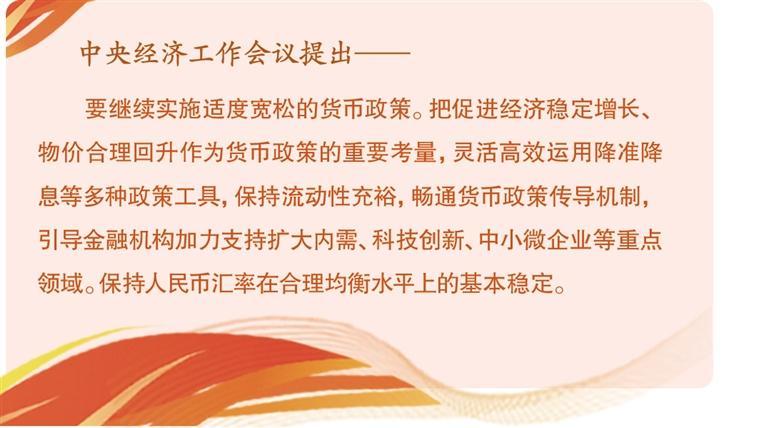
用好用足适度宽松的货币政策
Xin Lang Cai Jing· 2026-02-09 22:25
Group 1 - The core viewpoint of the news is that the Central Economic Work Conference in 2025 emphasizes the need for a moderately loose monetary policy to promote stable economic growth and reasonable price recovery, marking a new requirement for monetary policy in response to changing internal and external environments [1][4]. - The implementation of a moderately loose monetary policy reflects continuity and stability in policy, enhancing the targeting and flexibility of economic regulation amid increasing external pressures and internal difficulties [1][2]. - The People's Bank of China has taken measures such as lowering the 7-day reverse repurchase rate by 0.1 percentage points and the reserve requirement ratio by 0.5 percentage points, providing approximately 1 trillion yuan in long-term liquidity to support the real economy [2]. Group 2 - In 2025, China's GDP reached 14,018.79 billion yuan, growing by 5.0% year-on-year, but quarterly growth rates showed a declining trend, indicating increasing pressure on stable economic operation [3]. - The Consumer Price Index (CPI) has remained below 1% since March 2023, and the Producer Price Index (PPI) has been in negative growth since October 2022, reflecting insufficient effective demand and other structural challenges [3]. - The Central Economic Work Conference identified the prominent contradiction of strong supply and weak demand, emphasizing the importance of monetary policy in guiding price levels back to reasonable ranges [4][6]. Group 3 - The need for innovative and improved policy tools and methods is highlighted, along with the importance of coordinating monetary and fiscal policies to achieve effective macroeconomic governance [6][8]. - The government plans to increase fiscal spending in 2026 to support key tasks such as expanding domestic demand, while ensuring that fiscal policies are effectively transmitted to the real economy [8]. - There is a focus on enhancing the consistency and effectiveness of macroeconomic policies to promote reasonable price recovery, addressing both demand insufficiency and structural issues [9].

金融支持消费重在精准落地
Xin Lang Cai Jing· 2026-02-09 22:25
Group 1 - The core viewpoint of the articles emphasizes the need for financial institutions to adapt to the evolving consumer landscape, particularly in the service consumption sector, which is increasingly important in China's economy [1][2] - The recent government initiatives, including the "Accelerating the Cultivation of New Growth Points in Service Consumption Work Plan," highlight the importance of financial support for consumption, aiming to translate policy intentions into tangible benefits for businesses and consumers [1][2] - The shift in consumer behavior towards service consumption, characterized by a rise in personalized and experiential demands, necessitates innovative financial services that are deeply integrated into consumption scenarios [1][2] Group 2 - Service consumption differs from traditional goods consumption due to its intangibility, strong experiential nature, and complex supply-demand matching, which challenges traditional risk management models based on collateral [2] - Financial institutions are increasingly focusing on data-driven approaches for risk assessment, utilizing information such as tax data and utility payment records to provide credit loans to small and micro enterprises [2] - Policy collaboration, including fiscal subsidies and tax incentives, is crucial for optimizing the consumption finance environment, with significant financial support already allocated to pilot cities to stimulate investment in new growth areas [2] Group 3 - A dynamic balance between risk prevention and innovation is essential for the healthy development of financial support in the consumption sector, requiring financial institutions to manage the relationship between business expansion and risk control [3] - The use of advanced technologies like big data and artificial intelligence is recommended to create multi-dimensional risk control models based on actual consumer capabilities and needs, preventing predatory lending practices [3] - The future of financial services should focus on precise integration into micro-consumption scenarios, enhancing the connection between financial mechanisms and consumer activities to foster a resilient and warm consumption ecosystem [3]
工资秒到更安心 数字人民币智能合约守护农民工“钱袋子”
Zhong Guo Zheng Quan Bao· 2026-02-09 22:04
Core Insights - The digital RMB wallet has been successfully implemented for migrant workers' salary payments in Chengdu, showcasing the convenience and security it offers to users [1][2] - The initiative represents a significant innovation in leveraging technology to enhance livelihood security, with multiple stakeholders collaborating to ensure effective implementation [2][3] Group 1: Implementation and Impact - The digital RMB smart contract for salary payments allows for precise and direct payment to workers, addressing concerns related to traditional payment methods [2][3] - The initiative has been positively received by migrant workers, who express increased confidence in the payment process due to the transparency and security provided by the digital RMB [2][3] Group 2: Technological Framework - The digital RMB smart contract operates on a digital infrastructure that ensures automated execution and prevents human intervention, facilitating cross-institutional interactions [3] - The digital RMB operation management center provides an ecosystem service platform that allows banks to integrate their systems and create tailored solutions for various applications [3] Group 3: Future Applications and Expansion - Beyond salary payments, the digital RMB smart contract is being tested in areas such as prepayment fund management, supply chain finance, and subsidy distribution [5] - As of January 2026, there have been 486,400 contracts signed under the digital RMB smart contract, with a total transaction amount of 316 million yuan, indicating a growing adoption across various sectors [6]


数字人民币智能合约守护农民工“钱袋子”
Zhong Guo Zheng Quan Bao· 2026-02-09 20:25
Core Insights - The implementation of digital RMB (Renminbi) for wage payments to migrant workers represents a significant innovation in financial services, enhancing convenience and security in salary disbursement [1][2][3] - The collaboration among the People's Bank of China, financial institutions, and technology companies has led to the successful deployment of digital RMB smart contracts for wage payments, addressing long-standing issues in the traditional payment system [1][2] Group 1: Digital RMB Implementation - The first nationwide application of digital RMB for migrant worker salary payments was launched in Chengdu, showcasing a major technological advancement in financial services [1] - Digital RMB smart contracts ensure precise salary payments directly to workers' mobile wallets, eliminating concerns over fund misappropriation and providing clear transaction details [1][3] Group 2: Technological Collaboration - The success of the digital RMB wage payment system is attributed to the collaboration between various stakeholders, including banks and technology firms, which has led to the creation of a robust digital contract ecosystem [2][3] - The digital RMB operational management center has established a service platform that allows banks to integrate their systems with smart contract functionalities, enhancing the security and efficiency of wage payments [2][3] Group 3: Broader Applications - Beyond wage payments, digital RMB smart contracts are being tested in various sectors, including prepayment fund management, supply chain finance, and subsidy distribution, indicating a wide range of potential applications [3][4] - As of January 2026, there have been 486,400 contracts signed under the digital RMB smart contract framework, with a total transaction amount of 316 million yuan, highlighting the growing adoption of this technology [4]
铁流股份有限公司关于预计日常关联交易的公告
Shang Hai Zheng Quan Bao· 2026-02-09 19:00
Core Viewpoint - The announcement details the expected daily related transactions between the company and Zhejiang Hangzhou Yuhang Rural Commercial Bank, emphasizing that these transactions are necessary for the company's operational funding and business development, and do not harm the interests of the company or minority shareholders [2][9]. Group 1: Daily Related Transactions Overview - The board of directors approved the expected daily related transactions on February 9, 2026, with the exception of related directors who abstained from voting, and the matter does not require shareholder meeting approval [3]. - The independent directors unanimously approved the expected daily related transactions, affirming that they are necessary and reasonable for the company's normal operations, adhering to principles of fairness, voluntariness, and integrity [3]. Group 2: Expected Amounts and Categories of Transactions - The company plans to engage in daily related transactions with Zhejiang Hangzhou Yuhang Rural Commercial Bank, involving deposits, wealth management, acceptance bills, discounting, and financing, with a deposit balance not exceeding 14 million yuan and a total of 70 million yuan for other services [5]. Group 3: Related Party Information - Zhejiang Hangzhou Yuhang Rural Commercial Bank was established on June 30, 2005, and is located in Hangzhou, Zhejiang Province, with a legal representative named Zhu Xiaolong [6]. - The bank's main shareholders include several companies, each holding 5% of the shares, indicating a diversified ownership structure [7]. Group 4: Pricing Policy for Transactions - The transaction prices will follow market fair prices and align with those of non-related parties, ensuring that pricing is reasonable and based on government pricing or guidance where applicable [8]. Group 5: Purpose and Impact of Related Transactions - The purpose of the daily related transactions is to meet the company's operational funding and business development needs, ensuring that the transactions do not create dependency on related parties and maintain the company's independence [9].

拉加德呼吁改革以增强欧洲经济韧性
Jin Rong Jie· 2026-02-09 18:09
Core Viewpoint - The European Central Bank (ECB) is committed to maintaining controlled inflation as part of strengthening the European economy, urging lawmakers to implement necessary reforms [1] Group 1: ECB's Commitment and Economic Stability - ECB President Christine Lagarde emphasized the bank's clear commitment to price stability and the promotion of a stronger Europe [1] - The resilience and competitiveness of Europe ultimately depend on a broader policy framework [1] Group 2: Economic Concerns and Calls for Action - ECB officials express concerns over low productivity and sluggish economic growth, indicating that the EU's economic foundation needs further strengthening [1] - Ahead of the summit, the ECB has urged national leaders to take "urgent collective action" to establish a savings and investment union, introduce a digital euro, deepen the single market, promote innovation, and simplify laws and regulations [1] Group 3: Importance of Reforms - Lagarde stated that these reforms are not abstract concepts but are the real foundation of resilience and sovereignty in a world where economic strength is increasingly reflected through finance, technology, and trade [1]
避险黄金
Bei Jing Shang Bao· 2026-02-09 17:07
Core Viewpoint - The global gold market has experienced significant volatility since 2026, with soaring gold prices igniting widespread investment enthusiasm among consumers, leading to a surge in both offline and online gold trading [1][3]. Market Dynamics - Gold prices have seen dramatic fluctuations, with London gold reaching a high of nearly $5,600 per ounce before experiencing a sharp decline [3]. As of February 9, the price stabilized around $5,009.42 per ounce, reflecting a daily increase of 0.86% [3]. - The investment landscape has shifted towards short-term trading strategies, with consumers expressing anxiety over the rapid price changes [1][3]. Regulatory Adjustments - In response to the volatility, major financial institutions, including the Shanghai Gold Exchange and various banks, have implemented measures to tighten trading limits, increase transaction thresholds, and enhance risk assessments to promote rational investment behavior [1][5][6]. - Banks have raised the minimum investment amounts for gold accumulation products, with some institutions adjusting their thresholds from 1,000 yuan to 1,500 yuan [5]. Risk Management Strategies - The adjustments made by banks and trading platforms aim to mitigate risks associated with high leverage and liquidity constraints, as well as to protect both consumers and institutions from potential losses during extreme market conditions [6][7]. - The increase in margin requirements and the tightening of trading channels are part of a broader strategy to reduce market leverage and prevent settlement risks due to price volatility [6][7]. Consumer Behavior - The tightening of buyback policies by major gold retailers has led to increased interest in "trade-in" programs, as consumers seek to navigate the heightened trading risks [10][11]. - Consumers are advised to approach gold purchases with caution, particularly during the upcoming holiday season, and to differentiate between investment and consumption motives when acquiring gold [15][18]. Future Outlook - Analysts predict that gold prices may continue to experience fluctuations, with short-term trading expected to remain volatile during the holiday period, while long-term factors such as potential interest rate cuts and geopolitical uncertainties could support higher gold prices in the future [18].