
乘用车

Search documents
60大热门赛道:哪些拥挤度仍在低位?
Sou Hu Cai Jing· 2026-01-05 23:59
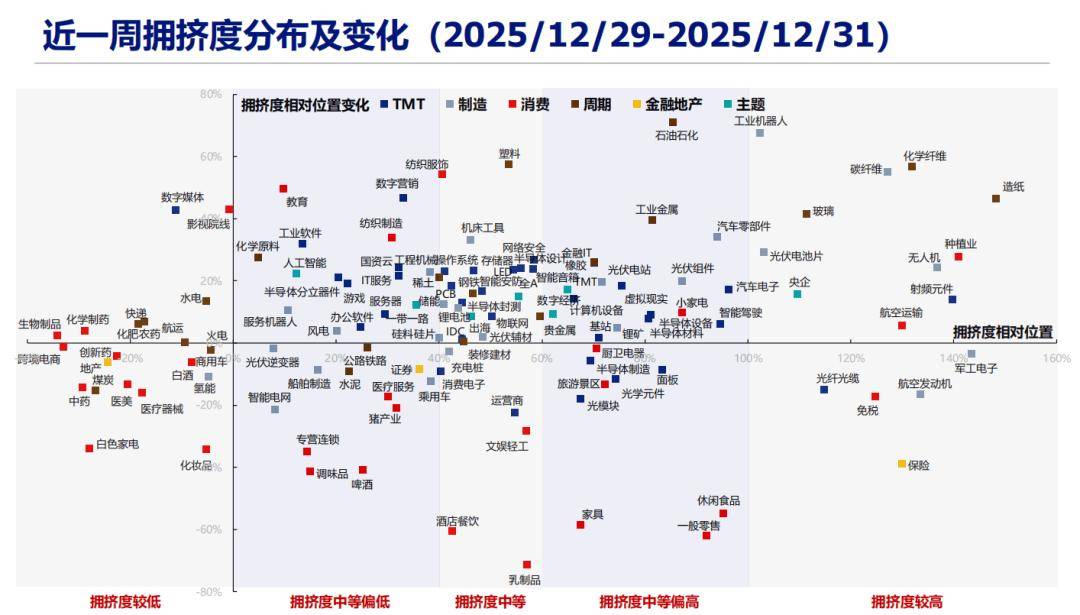
Core Viewpoint - The congestion index, developed by the Xingsheng Strategy Team, reflects the trading sentiment in popular sectors through four dimensions: volume, price, funds, and analyst forecasts, providing strong indications for short-term stock price movements [1] Market Overview - The market has shown an upward trend led by certain themes, with profit effects concentrated in a few sectors. While some theme-driven sectors have reached high congestion levels, most sectors remain at moderate or low levels, indicating that there are still many opportunities to explore [6] Sector Summaries - **Optical Modules**: Congestion level is moderately high [7] - **Servers**: Congestion level is moderately low [9] - **Optical Fiber and Cables**: Congestion level is relatively high [12] - **IDC**: Congestion level is moderate [15] - **Computer Equipment**: Congestion level is moderately high [17] - **Optical Components**: Congestion level is moderately high [20] - **RF Components**: Congestion level is relatively high [23] - **PCB**: Congestion level is moderate [26] - **State-owned Cloud**: Congestion level is moderately low [28] - **IT Services**: Congestion level is moderately low [30] - **Financial IT**: Congestion level is moderately high [32] - **Internet of Things**: Congestion level is moderate [34] - **Semiconductor Materials**: Congestion level is moderately high [36] - **Semiconductor Equipment**: Congestion level is moderately high [39] - **Semiconductor Testing**: Congestion level is moderate [41] - **Semiconductor Design**: Congestion level is moderate [44] - **Semiconductor Manufacturing**: Congestion level is moderately high [47] - **Semiconductor Discrete Devices**: Congestion level is moderately low [51] - **Memory**: Congestion level is moderate [53] - **Consumer Electronics**: Congestion level is moderate [56] - **Smart Driving**: Congestion level is moderately high [58] - **Gaming**: Congestion level is moderately low [61] - **Digital Media**: Congestion level is relatively low [64] - **Operators**: Congestion level is moderate [67] Manufacturing Sector - **Automotive Parts**: Congestion level is moderately high [69] - **Passenger Cars**: Congestion level is moderately low [72] - **Lithium Batteries**: Congestion level is moderate [74] - **Hydrogen Energy**: Congestion level is relatively low [76] - **Energy Storage**: Congestion level is moderate [78] - **Wind Power**: Congestion level is moderately low [80] - **Smart Grid**: Congestion level is moderately low [81] - **Photovoltaic Inverters**: Congestion level is moderately low [84] - **Photovoltaic Cells**: Congestion level is relatively high [86] - **Photovoltaic Modules**: Congestion level is moderately high [89] - **Silicon Materials and Wafers**: Congestion level is moderate [91] - **Industrial Robots**: Congestion level is relatively high [94] - **Shipbuilding**: Congestion level is moderately low [96] - **Drones**: Congestion level is relatively high [99] - **Aerospace Engines**: Congestion level is relatively high [101] Consumer and Pharmaceutical Sector - **White Goods**: Congestion level is relatively low [105] - **Baijiu**: Congestion level is relatively low [106] - **Textiles and Apparel**: Congestion level is moderate [107] - **Hotel and Catering**: Congestion level is moderate [110] - **Tourism and Scenic Areas**: Congestion level is moderately high [113] - **Air Transport**: Congestion level is relatively high [116] - **Pig Industry**: Congestion level is moderately low [119] - **Traditional Chinese Medicine**: Congestion level is relatively low [122] - **Innovative Drugs**: Congestion level is relatively low [123] - **Medical Services**: Congestion level is moderately low [125] Financial and Real Estate Sector - **Real Estate**: Congestion level is relatively low [128] - **Banking**: Congestion level is relatively low [130] - **Insurance**: Congestion level is relatively high [132] - **Securities**: Congestion level is moderately low [134] Cyclical Sector - **Coal**: Congestion level is relatively low [136] - **Oil and Petrochemicals**: Congestion level is moderately high [138] - **Steel**: Congestion level is moderate [139] - **Thermal Power**: Congestion level is relatively low [141] - **Industrial Metals**: Congestion level is moderately high [143] - **Chemical Raw Materials**: Congestion level is moderately low [146]

博腾股份:接受长江证券等投资者调研
Mei Ri Jing Ji Xin Wen· 2026-01-05 16:02
每经AI快讯,博腾股份发布公告称,2026年1月5日,博腾股份接受长江证券等投资者调研,公司董事 会秘书、副总经理皮薇等人参与接待,并回答了投资者提出的问题。 (记者 张明双) 每经头条(nbdtoutiao)——原指导价34.99万的宝马裸车价22.5万元,多家车企还补贴购置税!2026开 年车市火爆,销售从早到晚忙到没空吃饭 ...


乘用车板块1月5日跌0.02%,海马汽车领跌,主力资金净流出5.24亿元
Zheng Xing Xing Ye Ri Bao· 2026-01-05 08:59
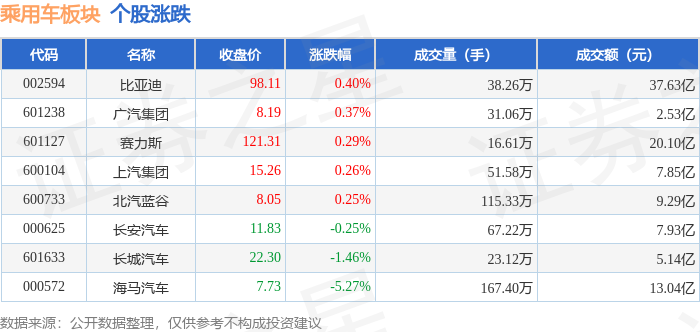
Market Overview - The passenger car sector experienced a slight decline of 0.02% on January 5, with Haima Automobile leading the drop [1] - The Shanghai Composite Index closed at 4023.42, up by 1.38%, while the Shenzhen Component Index closed at 13828.63, up by 2.24% [1] Individual Stock Performance - BYD (002594) closed at 98.11, with a gain of 0.40% and a trading volume of 382,600 shares, amounting to 3.763 billion yuan [1] - GAC Group (601238) closed at 8.19, up by 0.37%, with a trading volume of 310,600 shares, totaling 253 million yuan [1] - Seres (601127) closed at 121.31, increasing by 0.29%, with a trading volume of 166,100 shares, amounting to 2.010 billion yuan [1] - SAIC Motor (600104) closed at 15.26, up by 0.26%, with a trading volume of 515,800 shares, totaling 785 million yuan [1] - BAIC Blue Valley (600733) closed at 8.05, increasing by 0.25%, with a trading volume of 1.1533 million shares, amounting to 929 million yuan [1] - Changan Automobile (000625) closed at 11.83, down by 0.25%, with a trading volume of 672,200 shares, totaling 793 million yuan [1] - Great Wall Motors (601633) closed at 22.30, down by 1.46%, with a trading volume of 231,200 shares, totaling 514 million yuan [1] - Haima Automobile (000572) closed at 7.73, down by 5.27%, with a trading volume of 1.674 million shares, amounting to 1.304 billion yuan [1] Fund Flow Analysis - The passenger car sector saw a net outflow of 524 million yuan from institutional investors, while retail investors contributed a net inflow of 425 million yuan [1] - Notable fund flows for individual stocks include: - SAIC Motor: Institutional net inflow of 14.6084 million yuan, retail net outflow of 29.7881 million yuan [1] - GAC Group: Institutional net inflow of 5.9313 million yuan, retail net inflow of 503.72 million yuan [1] - Great Wall Motors: Institutional net inflow of 1.8031 million yuan, retail net outflow of 2.81908 million yuan [1] - BAIC Blue Valley: Institutional net outflow of 41.4566 million yuan, retail net inflow of 178.232 million yuan [1] - Changan Automobile: Institutional net outflow of 76.5608 million yuan, retail net inflow of 566.669 million yuan [1] - Seres: Institutional net outflow of 86.9124 million yuan, retail net inflow of 78.6812 million yuan [1] - BYD: Institutional net outflow of 131 million yuan, retail net inflow of 87.1496 million yuan [1] - Haima Automobile: Institutional net outflow of 211 million yuan, retail net inflow of 238 million yuan [1]






零跑汽车(09863):一汽溢价入股助力零跑新征程
HTSC· 2026-01-05 06:34
Investment Rating - The report maintains a "Buy" rating for the company [7] Core Insights - The company aims to become a world-class automotive enterprise, targeting sales of 1 million units in 2026 and 4 million units in the long term [4][5] - The company has established a comprehensive self-research and platform-based manufacturing system, achieving a sales volume of approximately 597,000 units in 2025, marking a significant improvement in its fundamentals [2][3] - The strategic investment from FAW Group, acquiring approximately 5% equity for about HKD 3.74 billion, highlights the recognition of the company's long-term strategy [3] Sales and Financial Projections - The company expects to achieve sales of 600,000, 1,040,000, and 1,420,000 units in 2025, 2026, and 2027 respectively, with corresponding revenues of RMB 68.3 billion, RMB 123.5 billion, and RMB 168.8 billion [5][11] - The net profit attributable to the parent company is projected to be RMB 6.6 million, RMB 51.1 million, and RMB 82.5 million for the years 2025, 2026, and 2027 respectively [5][11] Strategic Developments - The company has signed a powertrain cooperation agreement with FAW, focusing on the joint development of range-extended and plug-in hybrid vehicles, with the first model expected to be mass-produced in 2026 [3] - The D-series models, including D19 and D99, are set to launch in 2026, enhancing the company's high-end product lineup [3][4] Market Expansion - The company plans to leverage Stellantis' distribution channels to export over 60,000 vehicles in 2025, entering 35 countries with more than 800 overseas stores [2][4] - The strategic cooperation with FAW and Stellantis is expected to drive growth and profitability during the upcoming new vehicle cycle [4]

整车主线周报:2026年以旧换新政策落地,景气度向上-20260105
Soochow Securities· 2026-01-05 05:12
Investment Rating - The industry investment rating is "Overweight," indicating an expected outperformance of the industry index relative to the benchmark by more than 5% over the next six months [35]. Core Insights - The implementation of the vehicle trade-in policy in 2026 is expected to boost the industry's outlook, particularly for passenger vehicles, heavy trucks, and buses, with a focus on high-end electric vehicles and established export-oriented companies [2][26]. - The heavy truck segment is anticipated to see a sales volume of 800,000 to 850,000 units in 2026, reflecting a year-on-year increase of 3% [30]. - The bus segment is projected to maintain growth, with an estimated sales volume of 40,000 units in 2026, a 5% increase year-on-year [30]. - The motorcycle industry is expected to achieve total sales of 19.38 million units in 2026, a 14% increase, with large-displacement motorcycles projected to grow by 31% [27]. Summary by Sections Passenger Vehicles - The short-term outlook is positive due to the new subsidy policies, with expectations for a recovery in demand in Q1 2026. Key companies to watch include Jianghuai Automobile, Geely, Great Wall Motors, and BYD [2][26]. - The 2026 subsidy budget is projected at 125 billion yuan, which could drive an additional sales increase of 780,000 to 1.54 million units [15]. Heavy Trucks - The 2026 trade-in policy for heavy trucks has exceeded expectations, with subsidies remaining at previous levels. The anticipated sales volume for 2026 is optimistic, with a target of 800,000 to 850,000 units [30][19]. - Recommended companies in this segment include China National Heavy Duty Truck Group, Weichai Power, and FAW Jiefang [30]. Buses - The bus segment's policy has also exceeded expectations, with a projected sales volume of 40,000 units in 2026, reflecting a 5% year-on-year increase [30][18]. - Key recommendations include Yutong Bus and King Long [30]. Motorcycles - The motorcycle industry is expected to see a total sales volume of 19.38 million units in 2026, with large-displacement motorcycles projected to grow significantly [27]. - Recommended companies include Chunfeng Power and Longxin General [27].



长城汽车跌2.03%,成交额2.11亿元,主力资金净流出2996.72万元
Xin Lang Cai Jing· 2026-01-05 02:38
Core Viewpoint - Great Wall Motors' stock price has experienced a decline of 2.03% as of January 5, 2025, with a market capitalization of 189.73 billion yuan, indicating a challenging market environment for the company [1]. Financial Performance - For the period from January to September 2025, Great Wall Motors achieved a revenue of 153.58 billion yuan, reflecting a year-on-year growth of 7.96%. However, the net profit attributable to shareholders decreased by 17.20% to 8.64 billion yuan [2]. - Cumulatively, the company has distributed a total of 34.70 billion yuan in dividends since its A-share listing, with 8.95 billion yuan distributed over the past three years [3]. Shareholder Structure - As of September 30, 2025, the number of shareholders for Great Wall Motors stood at 137,500, a decrease of 22.95% from the previous period. The average number of circulating shares per shareholder remained at 0 [2]. - The top ten circulating shareholders include China Securities Finance Corporation, holding 197 million shares, and Hong Kong Central Clearing Limited, which reduced its holdings by 27.42 million shares to 58.10 million shares [3].
五维度看2025中国乘用车发展之“术”
Xin Lang Cai Jing· 2025-12-31 16:01
Core Insights - The Chinese passenger car market is experiencing unprecedented vitality and resilience due to various transformative forces, with a focus on the industry's ability to identify and solve problems [1][2]. Group 1: New Energy Vehicle Market - The penetration rate of new energy vehicles (NEVs) in China reached 53.6% in the first 11 months of 2025, indicating a shift from policy-driven to market-driven growth [4]. - The number of new car models launched in 2025 exceeded 200, showcasing the industry's strength and providing diverse options for consumers [5]. - Major NEV manufacturers have established comprehensive product platforms, enabling rapid iteration and performance enhancement across various models [6]. Group 2: Technological Advancements - Significant advancements in foundational technologies, such as intelligent chassis systems, are enhancing the overall level of the NEV industry [7]. - The performance of pure electric vehicles has improved, with extended driving ranges and enhanced safety features, addressing consumer concerns [8]. - Range-extended vehicles have also seen performance improvements, with some models achieving over 1000 kilometers of range [9]. Group 3: Autonomous Driving and AI Integration - The first batch of Level 3 conditional autonomous driving vehicle licenses was issued, marking a new phase in the commercialization of autonomous driving in China [10]. - AI technology is being integrated into smart cockpit systems, enhancing user interaction and experience [11]. - The automotive industry is witnessing a shift towards cognitive intelligence, allowing vehicles to understand and respond to complex commands [23]. Group 4: Domestic Brand Performance - Domestic brands captured a market share of 69.6% in the first 11 months of 2025, reflecting their growing competitiveness [13]. - High-end NEV sales have been dominated by domestic brands, indicating their increasing strength in the premium segment [14]. - Domestic brands are expanding internationally, with significant export growth and market penetration in Europe and Southeast Asia [15]. Group 5: Brand Image and Communication - Automotive leaders are increasingly engaging with consumers through relatable narratives, moving away from traditional high-end marketing [39]. - The industry is addressing issues of "involution" and promoting high-quality development to avoid harmful price competition [40][41]. - Companies are adopting transparent communication strategies to build trust and address safety concerns following incidents involving autonomous driving technologies [44][46].




乘用车板块12月31日跌0.74%,比亚迪领跌,主力资金净流出7.47亿元
Zheng Xing Xing Ye Ri Bao· 2025-12-31 08:59
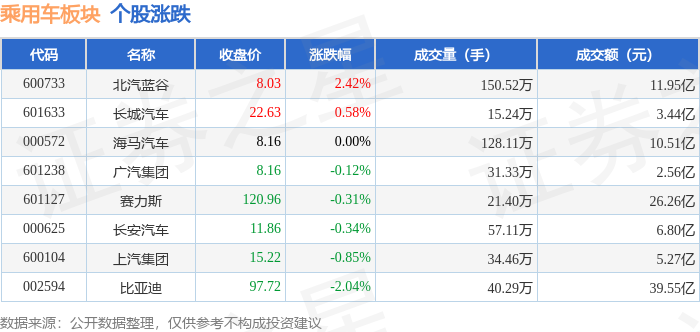
Group 1 - The passenger car sector experienced a decline of 0.74% on December 31, with BYD leading the drop [1] - The Shanghai Composite Index closed at 3968.84, up 0.09%, while the Shenzhen Component Index closed at 13525.02, down 0.58% [1] - Major stocks in the passenger car sector showed mixed performance, with notable declines in BYD and SAIC Motor [1] Group 2 - The passenger car sector saw a net outflow of 747 million yuan from institutional investors, while retail investors contributed a net inflow of 568 million yuan [1] - Specific stock performances included a 2.04% drop for BYD, closing at 97.72 yuan, and a 13.79% net outflow from institutional investors [1] - The trading volume for major stocks varied, with BAIC Blue Valley achieving a closing price of 8.03 yuan and a 2.42% increase [1]
沥青开工率明显改善——每周经济观察第52期
一瑜中的· 2025-12-30 13:55
Economic Overview - The Huachuang Macro WEI index has shown a slight recovery, reaching 5.22% as of December 21, up 0.06 percentage points from the previous week [2] - Real estate sales are improving, with the year-on-year decline in residential property transaction area narrowing to -19% for the week ending December 26, compared to -34% in November [2][3] - Infrastructure construction is seeing improvements, with the operating rate of asphalt plants rising to 31.3%, an increase of 3.7 percentage points from the previous week [2][3] Price Trends - Prices of major commodities have increased, with COMEX gold closing at $4546.2 per ounce (up 4.6%), LME copper at $12218 per ton (up 4.1%), and Brent crude oil at $60.6 per barrel (up 1.4%) [2][34] - The price of second-hand homes has decreased by 0.2% in first-tier cities and nationwide, with a cumulative decline of 6.3% in first-tier cities this year [37] Consumer Demand - Retail sales of passenger cars remain low, with a year-on-year growth rate of -11% in the third week of December, compared to -17% previously [13] - The average land premium rate across 100 cities was 1.6% in December, down from 2.7% in November [13] Production Insights - The operating rates in various industries are weak, with notable declines in Jiangsu and Zhejiang weaving machines and full-steel tires [15] - The asphalt plant operating rate has improved, indicating a slight recovery in infrastructure [15] Trade Dynamics - Port container throughput has decreased by 5.9% week-on-week as of December 21, with a year-on-year increase of 9.1% [19] - The shipping market is showing positive trends, with the Shanghai export container freight index rising by 6.7% [20] Interest Rates - The yield on 1-year, 5-year, and 10-year government bonds are reported at 1.2872%, 1.5948%, and 1.8376% respectively, with mixed changes compared to the previous week [47]

乘联分会:11月全国乘用车市场零售销量为222.5万辆
Xin Lang Cai Jing· 2025-12-30 11:04
来源:上海证券报·中国证券网 上证报中国证券网讯 据乘联分会微信公众号12月30日消息,2025年11月全国乘用车市场零售销量为 222.5万辆,同比下降8.1%,环比下降1.1%,其中新能源车市场零售132万辆,同比增长4.2%,环比增长 3.0%。 来源:上海证券报·中国证券网 上证报中国证券网讯 据乘联分会微信公众号12月30日消息,2025年11月全国乘用车市场零售销量为 222.5万辆,同比下降8.1%,环比下降1.1%,其中新能源车市场零售132万辆,同比增长4.2%,环比增长 3.0%。 ...