水电

Search documents
新能源板块震荡调整,资金逆势布局,储能电池ETF易方达(159566)半日净申购达2500万份
Mei Ri Jing Ji Xin Wen· 2026-01-27 05:13
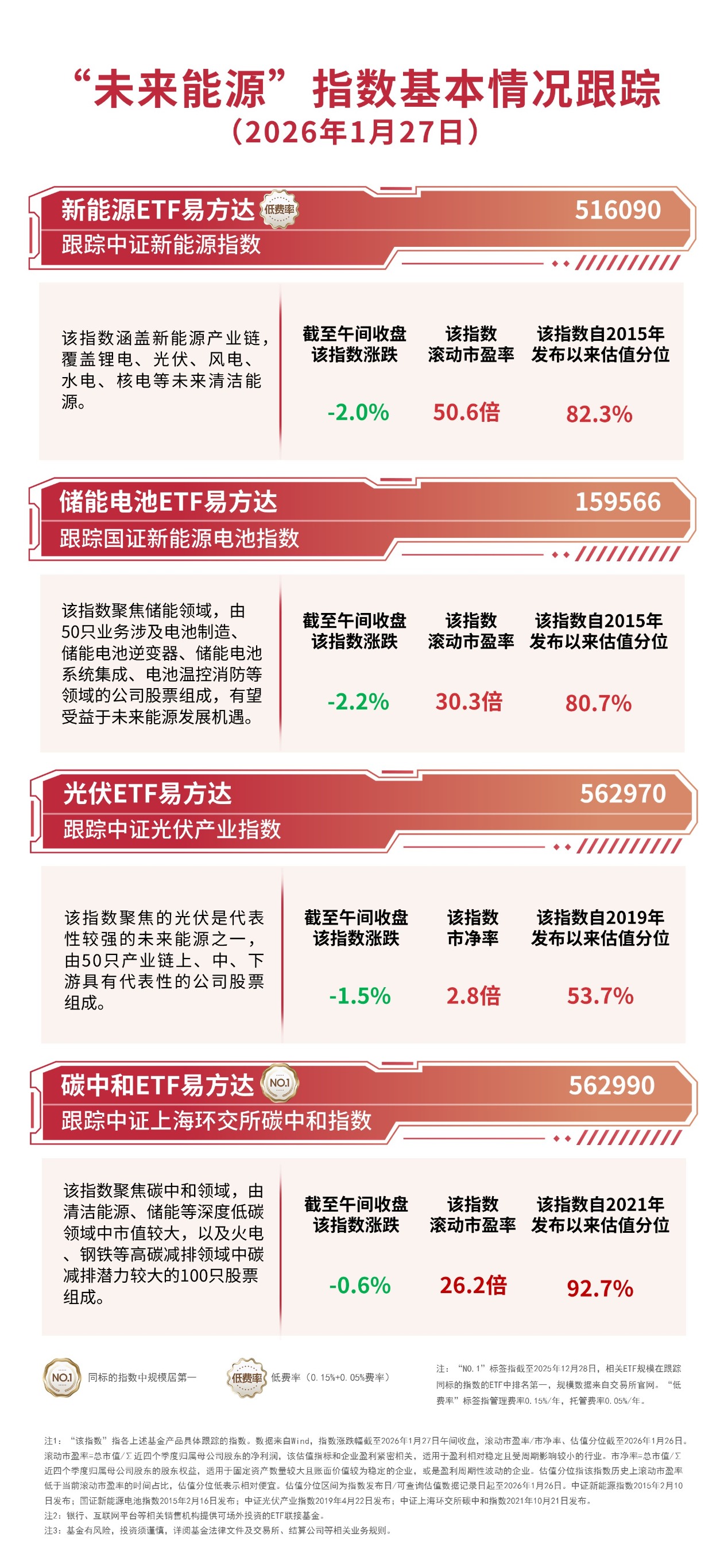
今日早盘,新能源板块震荡调整。截至午间收盘,中证新能源指数下跌2%,国证新能源电池指数下跌2.2%,中证光伏产业指数下跌1.5%,中证上海环交所 碳中和指数下跌0.6%,资金逆势布局,储能电池ETF易方达(159566)半日净申购达2500万份。 | 该指数聚焦的光伏是代表 | 截至午间收盘 | 该指数 | 该指数自20 | | --- | --- | --- | --- | | 性较强的未来能源之一, | 该指数涨跌 | 市净率 | 发布以来估值 | | 由50只产业链上、中、下 | | | | | 游具有代表性的公司股票 组成。 | -1.5% | 2.8倍 | 53.7% | (文章来源:每日经济新闻) | 新能源ETF易方达 雙 | | | 5160 | | --- | --- | --- | --- | | 跟踪中证新能源指数 | | | | | | | | .. ///// | | 该指数涵盖新能源产业链, | 截至午间收盘 | 该指数 | 该指数自20. | | 覆盖锂电、光伏、风电、 | 该指数涨跌 | 滚动市盈率 | 发布以来估值 | | 水电、核电等未来清洁能 | | | | | 濃。 | ...

【公用事业】25年市场化交易电量同比+7.4%,寒潮导致全国用电负荷持续创新高——公用事业行业周报(20260125)(殷中枢/宋黎超)
光大证券研究· 2026-01-26 23:03
点击注册小程序 查看完整报告 特别申明: 本订阅号中所涉及的证券研究信息由光大证券研究所编写,仅面向光大证券专业投资者客 户,用作新媒体形势下研究信息和研究观点的沟通交流。非光大证券专业投资者客户,请勿 订阅、接收或使用本订阅号中的任何信息。本订阅号难以设置访问权限,若给您造成不便, 敬请谅解。光大证券研究所不会因关注、收到或阅读本订阅号推送内容而视相关人员为光大 证券的客户。 报告摘要 本周行情回顾: 本周SW公用事业一级板块上涨2.27%,在31个SW一级板块中排名第15;沪深300下跌0.62%,上证综指上 涨0.84%,深证成指上涨1.11%,创业板指下跌0.34%。细分子板块中,火电上涨2.71%,水电下跌0.89%, 光伏发电上涨7.21%,风力发电上涨2.82%,电能综合服务上涨4.56%,燃气上涨7.21%。 复。26年电力供需预期延续25年偏宽松态势,板块电价继续承压,但在绿电装机增长加持下,基荷电源火 电仍具备装机需求;因此我们认为火电、绿电投资回报应匹配社会的综合投资回报水平,进而满足两者可 融资性;若年度长协电价签署不及预期,依然有望提供其他措施(容量补贴提升、度电成本下行等)满足 板 ...
阿布扎比推进水电行业低碳与智能化发展
Shang Wu Bu Wang Zhan· 2026-01-26 16:14
Core Viewpoint - The meeting chaired by Sheikh Mansour bin Zayed emphasizes the importance of diversifying energy and water resources, increasing the application of low-carbon, clean, and renewable energy, and enhancing efficiency through technology and artificial intelligence to support sustainable development goals [1] Group 1 - The meeting was held to review the latest developments and future plans in the water and electricity sector in Abu Dhabi [1] - The focus is on reducing waste and supporting economic, environmental, and social sustainability through improved energy and water resource utilization [1] - The initiative aims to promote low-carbon and smart development in the water and electricity industry [1]
周道2026-当前时点-如何看待周期板块
2026-01-26 15:54
Summary of Key Points from Conference Call Records Industry Overview Steel Industry - Iron ore supply is expected to become more relaxed, with Australian shipments projected to reach a historical high of 960 million tons in 2026, an increase of 24 million tons year-on-year. Brazilian shipments are also expected to rise by approximately 10 million tons. This supply increase supports the cost reduction logic for steel companies, leading to further profit recovery in the steel industry [2][1]. Non-Ferrous Metals - The non-ferrous metals sector shows significant signs of valuation recovery, with silver leading the charge. Industrial metals are in the early stages of recovery, while basic and energy metals are at the initial stage of bottom reversal. Short-term recommendations include increasing allocations to copper and aluminum [3][4]. Glass Fiber Sector - The glass fiber sector is experiencing price increases for electronic fabrics due to improved supply-demand dynamics. The unit profit forecast for China Jushi's electronic fabric is expected to rise from 0.7 yuan in 2025 to 1.3 yuan in 2026, potentially reaching 1.5 yuan. This could lead to an annual performance of 4.5 to 5 billion yuan for China Jushi [5][1]. Oil Shipping Sector - The oil shipping sector has seen a significant year-on-year increase in LCC freight rates, now exceeding $110,000, a rise of 87%. This is driven by increased production from South American deep-sea oil fields, OPEC's production policies, and a rebound in China's crude oil imports. The sector is entering a strong prosperity phase [8][1]. Chemical Industry - The chemical industry is witnessing a significant repair in the supply-demand balance. In 2026 and 2027, attention should be paid to sub-industries with high operating rates and limited new capacity, such as chlor-alkali, organic silicon, and PTA polyester filament. Major polyester filament manufacturers have initiated production cuts to alleviate inventory pressure [10][1]. Additional Insights Soda Ash Market - The soda ash market currently faces low price expectations due to overproduction, but demand is better than anticipated. The price has dropped below 1,100 yuan, indicating an oversold condition. Companies like Boyan Chemical are recommended due to their cost advantages and strong growth potential [11][1]. Dual Carbon Policy Impact - The dual carbon policy significantly impacts the chemical industry, with local governments tightening energy consumption limits for new projects. This affects high-energy-consuming sectors like chlor-alkali and organic silicon. Companies benefiting from this policy include Jiahua Energy and Junzheng Group [12][1]. Coal Industry - The coal sector is viewed positively under the backdrop of resource inflation, with a high probability of a bottom reversal by the end of 2026. Key recommendations include Yanzhou Coal and China Coal Energy [19][1]. Price Trends in Coal - As of last week, thermal coal prices have stabilized around 695 yuan, while coking coal prices have increased by 150 yuan to 1,770 yuan. The prices are expected to remain stable due to winter stocking demands [20][1]. Import Trends - In 2025, China’s coal imports fell to 490 million tons, a nearly 10% decrease. The outlook for 2026 suggests continued challenges in increasing imports due to rising domestic costs and supply vulnerabilities from major exporting countries like Indonesia and Australia [21][22][23]. This summary encapsulates the key insights and projections from the conference call records, providing a comprehensive overview of the current state and future expectations across various industries.
川投能源:股票走势与水电板块的整体长期趋势基本保持一致
Zheng Quan Ri Bao· 2026-01-26 13:46
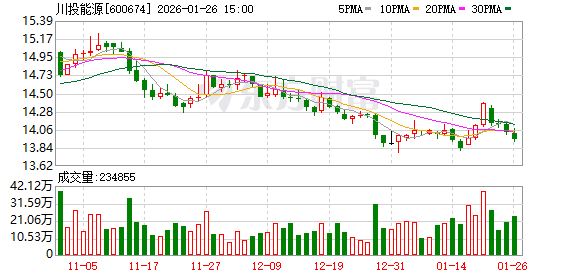
(文章来源:证券日报) 证券日报网讯 1月26日,川投能源在互动平台回答投资者提问时表示,公司股票走势与水电板块的整体 长期趋势基本保持一致,二级市场股价受多种因素共同作用影响,具有不确定性,敬请注意投资风险。 ...

四川水电装机规模突破1亿千瓦 带来的电能如何消纳
Jing Ji Ri Bao· 2026-01-26 02:41
水电开发有力推动了四川能源结构的持续优化,助力四川加快构建以水电为基础、风电和光伏为重要补 充的清洁能源"双主体"电源结构。在四川水电装机突破1亿千瓦之际,依托两河口超级水库电站打造 的"绿电+算力"融合项目——两河口算电融合示范项目在甘孜州正式投运,这是国投集团雅砻江公司探 索新能源与新兴产业融合互促的重要举措。"雅砻江流域处于成渝地区国家枢纽节点周边,建设智算产 业与'东数西算'工程布局高度契合,公司将以两河口算电融合示范项目为契机,探索'源网荷储'一体化 绿电直供,积极承接'东数西算'等国家重大战略,推动公司从能源供应商向'能源+算力'综合服务商转 型。"国投集团雅砻江公司党委书记、董事长孙文良说。 业内人士介绍,四川水电仍有一定可开发空间,未来其功能定位将逐渐从单一电量供应转向电量供应与 灵活调节并重。作为全国清洁电力供给枢纽,四川还将持续推动清洁能源结构优化升级,从"水电大 省"向清洁能源强省和绿色低碳产业高地跨越。(责任编辑:朱赫) "千河之省"四川,水电资源技术可开发量居全国首位,水电开发已走过百年历程。近期,随着攀枝花银 江水电站最后一台机组顺利并网,四川水电装机规模突破1亿千瓦,约占全国水电 ...
一亿千瓦装机带来的电能如何消纳
Jing Ji Ri Bao· 2026-01-25 21:55
水电开发有力推动了四川能源结构的持续优化,助力四川加快构建以水电为基础、风电和光伏为重要补 充的清洁能源"双主体"电源结构。在四川水电装机突破1亿千瓦之际,依托两河口超级水库电站打造 的"绿电+算力"融合项目——两河口算电融合示范项目在甘孜州正式投运,这是国投集团雅砻江公司探 索新能源与新兴产业融合互促的重要举措。"雅砻江流域处于成渝地区国家枢纽节点周边,建设智算产 业与'东数西算'工程布局高度契合,公司将以两河口算电融合示范项目为契机,探索'源网荷储'一体化 绿电直供,积极承接'东数西算'等国家重大战略,推动公司从能源供应商向'能源+算力'综合服务商转 型。"国投集团雅砻江公司党委书记、董事长孙文良说。 业内人士介绍,四川水电仍有一定可开发空间,未来其功能定位将逐渐从单一电量供应转向电量供应与 灵活调节并重。作为全国清洁电力供给枢纽,四川还将持续推动清洁能源结构优化升级,从"水电大 省"向清洁能源强省和绿色低碳产业高地跨越。 "千河之省"四川,水电资源技术可开发量居全国首位,水电开发已走过百年历程。近期,随着攀枝花银 江水电站最后一台机组顺利并网,四川水电装机规模突破1亿千瓦,约占全国水电装机总量的四分之 ...
我国西部首个城市中心抽水蓄能电站全面开工
Xin Lang Cai Jing· 2026-01-25 13:04
Core Viewpoint - The Guangxi Guigang Pumped Storage Power Station, a key project in China's pumped storage planning, has commenced construction, aiming to ensure stable electricity supply and promote clean energy consumption in urban areas [1][2]. Group 1: Project Overview - The Guigang pumped storage power station will install four 300,000 kW units, with a total regulation capacity of 2.4 million kW, addressing peak load demands in proximity to urban centers [1]. - The station is strategically located at a key hub for the West-to-East electricity transmission corridor, surrounded by abundant clean energy resources, facilitating local consumption and long-distance delivery of green electricity [1]. Group 2: Environmental Considerations - The environmental investment for the power station is expected to reach 340 million yuan, accounting for over 4% of the total project cost, promoting the implementation of green construction technologies [2]. - The project will utilize excavated materials from the construction process for dam filling and concrete pouring, achieving a balance between excavation and filling while maintaining urban aesthetics [2]. Group 3: Future Implications - The Guigang pumped storage power station is expected to be fully operational by the end of 2029, capable of consuming 2.52 billion kWh of clean energy annually, which will reduce carbon dioxide emissions by approximately 2.2 million tons [2]. - The station will meet the annual electricity needs of about 1.15 million residents and ensure stable delivery of green electricity from 8 million kW of wind power, 4.7 million kW of solar power, and 6.9 million kW of nuclear power in southern Guangxi [2].

广发证券:预计水电行业将维持多个季度利润提升,关注资产证券化进程
Xin Lang Cai Jing· 2026-01-22 23:32
广发证券研报指出,蓄能高位保障电量,关注装机投产与资产证券化。25下半年珠江、长江来水偏丰带 动电量增长,长电已发布业绩快报,25年实现归母净利润342亿元(同比+5%),其中Q4达60亿元(同 比+34%),预计水电整体业绩亦有良好表现。25年末偏高蓄能将保障26上半年枯水期电量,汛期电量 低基数,水电有望维持多个季度利润提升。水电投产高峰期来临,大渡河等流域多座电站将陆续投产, 此外各集团仍有水电资产未证券化,亦可关注证券化进程。 ...

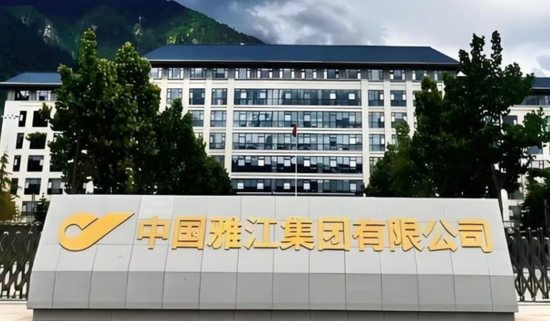
雅江集团注册资本2400亿超三峡集团,这家新央企藏着中国能源的后手
Xin Lang Cai Jing· 2026-01-22 11:29
炒股就看金麒麟分析师研报,权威,专业,及时,全面,助您挖掘潜力主题机会! 来源:能见 据企查查显示,新能源央企中国雅江集团有限公司注册资本为2400亿元,注册地址位于西藏自治区林芝 市工尊中路368号,注册资本规模已超越中国长江三峡集团的2132亿元。 这家位列国资委央企名录第22位的新势力,诞生即巅峰。集团成立当日,雅鲁藏布江下游水电工程同步 开工,中共中央政治局常委、国务院总理李强亲临西藏,既出席开工仪式宣布工程启动,又深入米林水 电站坝址调研考察,在听取工程开发、科技攻关等工作汇报时强调,"雅下水电工程体量大、周期长、 影响远,堪称世纪工程"。这句定性,给这个被业内称作"水电界终局之战"的项目定了调。 总理口中的"世纪工程",分量从不虚言。雅下水电总投资达1.2万亿元,相当于五个三峡工程的体量; 规划的五座梯级电站,总装机容量约6000万千瓦,年发电量可达3000亿千瓦时。这般量级的布局,容不 得半分拖沓,雅江集团的开局速度,恰恰印证了这份战略紧迫性,自成立之日起便按下快进键,每一步 都踩得又准又狠。 炒股就看金麒麟分析师研报,权威,专业,及时,全面,助您挖掘潜力主题机会! 2025年7月刚揭牌,便火速 ...