铁矿石开采

Search documents
巴西ETF“杀疯了”!超51亿资金抢购,跨境投资为何如此火热?
Sou Hu Cai Jing· 2025-11-05 08:15
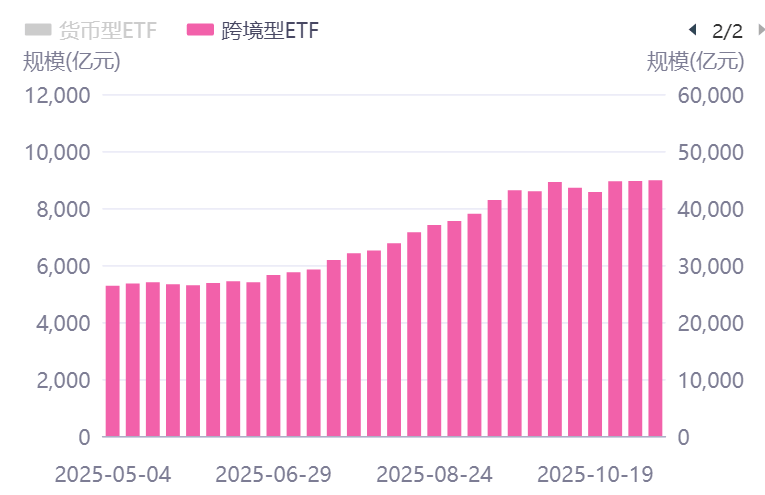
Core Insights - The recent surge in cross-border ETFs, particularly Brazilian ETFs, has attracted significant investor interest, with two ETFs being fully subscribed within a day, raising a total of approximately 5.137 billion yuan [1][3]. Group 1: Market Performance - The Brazilian IBOVESPA index has shown a 10-year annualized return exceeding 12%, comparable to the S&P 500, and has increased by 24.98% year-to-date [5]. - The total scale of cross-border ETFs has approached 900 billion yuan, with a rapid growth from approximately 565.5 billion yuan at the end of Q2 to about 884 billion yuan at the end of Q3 this year [3]. Group 2: Investment Trends - The popularity of Brazilian ETFs is part of a broader trend, with previous ETFs like the Southern Fund's Saudi Arabia ETF also experiencing significant subscription success [3]. - Investors are increasingly looking to global markets for opportunities, as evidenced by the strong performance of the Brazilian stock market compared to the Chinese market over the past decade [7]. Group 3: Economic Factors - Brazil's high interest rates, currently at 15%, are among the highest globally, attracting foreign investment despite potential economic growth constraints [10][12]. - The Brazilian ETF market is projected to see a cumulative net inflow of approximately 6.25 billion reais (about 1.167 billion USD) by 2025, with fixed income ETFs contributing significantly to this inflow [9].

铁矿石:三季度四大矿山产销平稳
Wu Kuang Qi Huo· 2025-11-05 01:48
Report Summary 1. Investment Rating There is no information about the industry investment rating in the provided content. 2. Core Viewpoints - In Q3 2025, the production and sales of the four major iron ore mines were generally stable. Vale's production and sales increased year - on - year and quarter - on - quarter, Rio Tinto remained basically flat, FMG declined quarter - on - quarter due to the first quarter of the new fiscal year, and BHP decreased both year - on - year and quarter - on - quarter [1]. - The total iron ore production/processing volume of the four major mines in Q3 was 299.5 million tons, basically flat quarter - on - quarter and up 1.63% year - on - year. In terms of sales, the total sales volume was 291 million tons, up 0.52% quarter - on - quarter and 1.86% year - on - year [1]. - For the first three quarters of 2025, the total production of the four major mines increased by about 10 million tons year - on - year, with FMG showing a significant increase. The total sales volume decreased by about 500,000 tons year - on - year, mainly due to Rio Tinto's reduced shipments [1]. - Overall, the four major mines were stable in the first three quarters. Rio Tinto may face some pressure to boost shipments in Q4. It is expected that the annual shipment volume of the four major mines will increase by 3.5 - 6 million tons year - on - year, with relatively limited overall growth [1]. 3. Summary by Company Rio Tinto - In Q3 2025, production in the Pilbara region remained high at about 84.1 million tons (100% equity), with year - on - year and quarter - on - quarter stability. Shipments were 84.3 million tons, basically flat year - on - year and up about 5.51% quarter - on - quarter, reaching the second - highest Q3 record since 2019 [6]. - The Gudai - Darri mine achieved its highest quarterly production, with an annualized production capacity of 51 million tons. The IOC mine in Canada produced about 2.348 million tons in Q3, up 11% year - on - year but down 6% quarter - on - quarter [9]. - Since July, Rio Tinto has been shipping adjusted PB fines. It maintains its 2025 shipment guidance of 323 - 338 million tons, but considering the early - year losses, the annual shipment is expected to be at the lower end of the guidance range [9]. BHP - In Q3 2025 (Q1 of FY2026), BHP's WAIO production was 62.01 million tons (equity basis), down about 2% year - on - year and 9% quarter - on - quarter; 70.25 million tons on a 100% equity basis, down about 2% year - on - year. Planned maintenance affected short - term production, but the Samarco project's output increased significantly [12]. - Sales were basically flat, with a slight year - on - year decline of about 1%. The sales of lump ore increased by 5% year - on - year. BHP maintains its FY2025 production guidance of 258 - 269 million tons (284 - 296 million tons on a 100% equity basis) [12]. FMG - In Q3 2025 (Q1 of FY2026), FMG's iron ore shipments were 49.7 million tons (including 2.1 million tons from the Iron Bridge project), up about 4% year - on - year, setting a record for the same period. Due to seasonal maintenance, shipments decreased by about 10% quarter - on - quarter. Ore processing volume was 50.8 million tons, up about 6% year - on - year [16]. - The proportion of Super Special Fines and Blend Fines is about 78%. FMG maintains its FY2026 shipment guidance of 195 - 205 million tons, with the Iron Bridge project contributing about 10 - 12 million tons [16]. Vale - In Q3 2025, Vale's iron ore production reached 94.4 million tons, up 3.8% year - on - year and 12.9% quarter - on - quarter, the highest for the same period since 2018. Sales were 86 million tons, up 5.1% year - on - year and 11.2% quarter - on - quarter [18][23]. - Inventory increased by about 4.5 million tons in Q3, mainly due to more in - transit concentrate products in China. The pellet production in Q3 was 7.997 million tons, down 22.8% year - on - year [23]. - Assuming Q4 production is the same as the previous year, Vale's annual production is expected to be slightly higher than the mid - point of the guidance range of 325 - 335 million tons [24].



Fortescue Ltd (FSUGY) Shareholder/Analyst Call Transcript
Seeking Alpha· 2025-11-04 00:06
PresentationNavdeep GillCompany Secretary Good morning, ladies and gentlemen. My name is Mona Gill, and I'm Fortescue's Company Secretary. Before we begin, I would like to acknowledge the traditional custodians of the land on which we're meeting today, the Whadjuk people of the Noongar Nation, and I pay my respects to elders past, present and emerging. It's my pleasure to welcome you to Fortescue's 2025 Annual General Meeting of Shareholders. And before we begin today, I would just like to take you through ...

美媒:中国从未拥有过这般程度的海运铁矿石定价权,将开始掌控局面
Guan Cha Zhe Wang· 2025-11-03 14:44
Core Viewpoint - The commencement of operations at the Simandou iron ore project in Guinea is set to reshape the global iron ore market, enhancing China's pricing power and reducing reliance on foreign mining giants [1][3][10]. Group 1: Project Overview - The Simandou project is the largest undeveloped iron ore mine globally, with reserves of at least 3 billion tons [2]. - The total investment for the project is estimated at $23 billion, making it the largest mining project in Africa's history [2]. - The project aims to significantly boost Guinea's economy, potentially making it the second-largest mineral exporter in Africa [2]. Group 2: Economic Impact - The project is expected to increase Guinea's GDP by over 25% within the next decade [11]. - The first shipments of iron ore are anticipated to begin this month, with plans to export approximately 200,000 tons by the end of the year [10]. - Once fully operational, the combined output from the Simandou project is projected to account for about 5% of global iron ore production in 2024 [10]. Group 3: Market Dynamics - The start of production at Simandou is likely to disrupt the existing iron ore pricing structure, with predictions that prices could drop to $85 per ton within three years [10]. - The project is expected to enhance China's influence over iron ore pricing, as it will provide a significant supply of high-grade iron ore [3][10]. - The involvement of Chinese companies in the project has been highlighted as a key factor in its development, showcasing China's engineering capabilities [6][9]. Group 4: Historical Context - The Simandou project has faced numerous challenges over the years, including political instability and changes in ownership, but has now reached a critical turning point with Chinese investment [7][8]. - The project has been a focal point for various stakeholders, including the Guinean government, which aims to leverage the mine for long-term economic prosperity [11].
国运来了!我国将入手50亿吨世界级铁矿,澳美破防:铁矿牌废了
Sou Hu Cai Jing· 2025-11-03 06:11
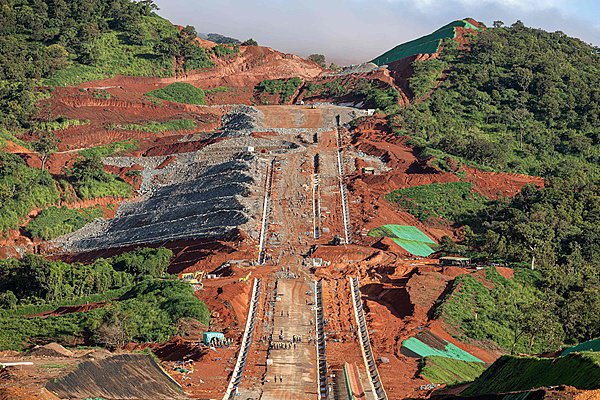
Core Viewpoint - The development of the Simandou iron ore project in Guinea, a collaboration between China Aluminum Corporation and Rio Tinto, is set to significantly impact the global iron ore market and enhance Guinea's economic position, while also challenging the dominance of Australian and Brazilian suppliers [1][5][6]. Group 1: Project Overview - The Simandou iron ore project has a total reserve of 5 billion tons, making it one of the largest undeveloped high-quality iron ore resources globally [1]. - The project includes a 600-kilometer railway and deep-water port, with an estimated investment of $13.3 billion to $21 billion, half of which is funded by Chinese investments [2][5]. - The first shipment of iron ore, totaling 150,000 tons, is expected to begin in October, with sea transport starting in November [2]. Group 2: Economic Impact - The International Monetary Fund predicts that the Simandou project will boost Guinea's GDP by 26% by 2030, positioning it as a key player in the global iron ore market [5]. - China is expected to receive approximately 27 million tons from the projected annual output of 60 million tons from the Simandou project [5]. Group 3: Market Dynamics - The commencement of the Simandou project may lead to downward pressure on iron ore prices, particularly affecting Australian and Brazilian suppliers [6][8]. - The project is anticipated to reduce Australia's share of iron ore exports to China from 60% in 2024 to 45% in 2025, diminishing its bargaining power in the iron ore sector [8]. - The shift towards the Simandou project and the use of RMB for transactions may disrupt the existing pricing dominance held by Australian suppliers [10].
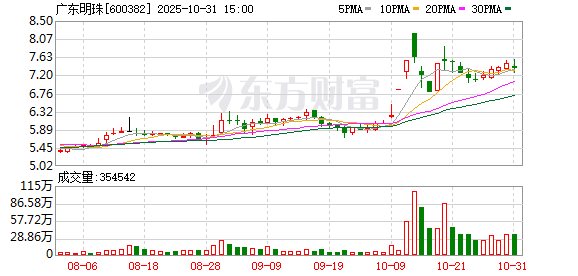
广东明珠2025年前三季度净利润同比大增941.09%
Zheng Quan Ri Bao· 2025-10-31 09:12
Core Viewpoint - Guangdong Mingzhu Group Co., Ltd. reported significant growth in its financial performance for the first three quarters of 2025, with a notable increase in both revenue and net profit compared to the previous year [2] Financial Performance Summary - The company achieved a revenue of 673 million yuan, representing a year-on-year increase of 150.74% [2] - The net profit attributable to shareholders reached 234 million yuan, a staggering increase of 941.09% year-on-year [2] - The net profit after deducting non-recurring items was 239 million yuan, reflecting a growth of 487.53% [2] - In the third quarter alone, revenue was 299 million yuan, up 481.05% year-on-year, with net profit at 118 million yuan and net profit after non-recurring items at 121 million yuan [2] - The net cash flow from operating activities was 109 million yuan, marking a turnaround from a net loss in the same quarter of the previous year and achieving a new quarterly performance high [2] Business Segment Analysis - The core mining segment of Guangdong Mingzhu demonstrated robust profitability, primarily driven by its wholly-owned subsidiary, Mingzhu Mining [2] - Mingzhu Mining increased its ore production capacity through expansion projects, resulting in a 212.49% year-on-year surge in iron concentrate sales [2] - The rising prices in the iron ore market contributed to the overall increase in both revenue and profit for the company [2] - For the first three quarters, Mingzhu Mining generated 670 million yuan in revenue and 271 million yuan in net profit, accounting for over 110% of the net profit attributable to the listed company, thus becoming the key driver of performance growth [2]

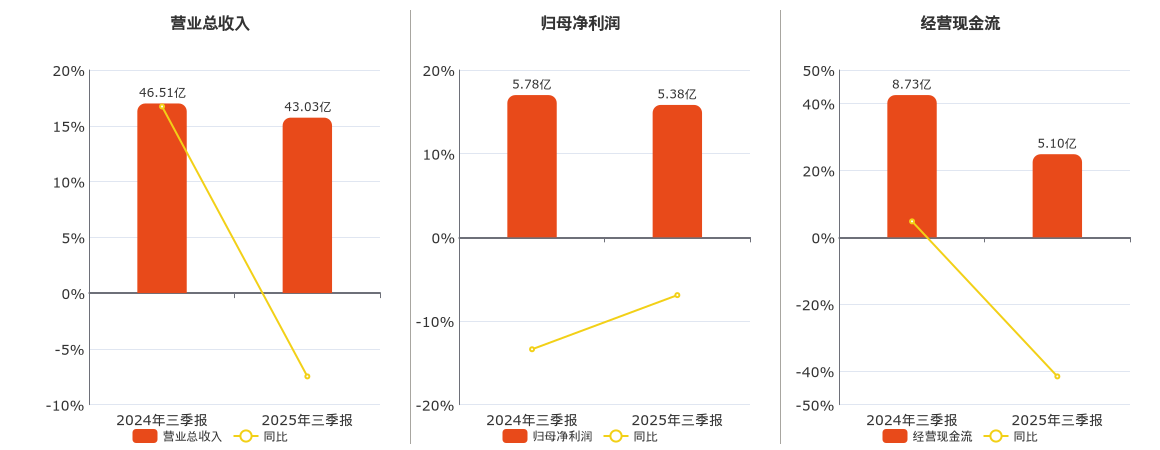
河钢资源(000923.SZ):2025年三季报净利润为5.38亿元、同比较去年同期下降6.91%
Xin Lang Cai Jing· 2025-10-31 01:28
Core Insights - The company reported a total operating revenue of 4.303 billion yuan for Q3 2025, ranking 3rd among disclosed peers, which is a decrease of 348 million yuan or 7.47% year-on-year [1] - The net profit attributable to shareholders was 538 million yuan, also ranking 3rd among peers, reflecting a decline of 39.92 million yuan or 6.91% compared to the same period last year [1] - The net cash inflow from operating activities was 510 million yuan, ranking 5th among peers, down by 363 million yuan or 41.57% year-on-year [1] Financial Ratios - The latest debt-to-asset ratio stands at 24.43%, ranking 5th among peers, with a slight decrease of 0.12 percentage points from the previous quarter but an increase of 0.43 percentage points year-on-year [3] - The gross profit margin is reported at 60.06%, ranking 2nd among peers, down by 1.33 percentage points from the previous quarter and 2.41 percentage points year-on-year [3] - The return on equity (ROE) is 5.24%, ranking 5th among peers, which is a decrease of 0.78 percentage points compared to the same period last year [3] Earnings Per Share and Turnover Ratios - The diluted earnings per share (EPS) is 0.82 yuan, ranking 1st among peers, which is a decrease of 0.06 yuan or 6.92% year-on-year [3] - The total asset turnover ratio is 0.25 times, ranking 4th among peers, down by 0.03 times or 11.80% year-on-year [3] - The inventory turnover ratio is 2.16 times, ranking 8th among peers, reflecting a decrease of 0.84 times or 27.87% year-on-year [3] Shareholder Information - The number of shareholders is 28,300, with the top ten shareholders holding 348 million shares, accounting for 53.24% of the total share capital [3] - The largest shareholder is Hebei Iron and Steel Group Co., Ltd., holding 35.6% of the shares [3]

铁矿石专题:四大矿山三季度产销数据简析
Hua Tai Qi Huo· 2025-10-29 01:57
Report's Investment Rating for the Industry There is no information provided regarding the report's investment rating for the industry. Core Views of the Report - Vale: In Q3, production and sales increased year-on-year, and the annual production target remained unchanged. The quarterly iron ore production was 94.4 million tons, a 12.9% increase quarter-on-quarter and a 3.8% increase year-on-year. The quarterly iron ore sales were 86 million tons, a 11.2% increase quarter-on-quarter and a 5.1% increase year-on-year. The company maintained its 2025 production target of 325 - 335 million tons [4][5]. - Rio Tinto: In Q3, production and sales were flat year-on-year, and the Simandou iron ore started loading in October. The iron ore production of Pilbara operations was 84.1 million tons, with a 0.4% quarter-on-quarter increase. The company expects to supply 50 - 100 million tons from Simandou this year [6][7]. - BHP: In Q3, iron ore production and sales were below expectations, and the fiscal year 2026 target was slightly raised. The iron ore production of Pilbara operations was 70.25 million tons, a 9.3% decrease quarter-on-quarter and a 1.9% decrease year-on-year. The fiscal year 2026 target was maintained at 284 - 296 million tons, an increase of 2 million tons from the previous fiscal year [8][9]. - FMG: In Q3, production and sales increased year-on-year, and shipments in Q4 are expected to remain at a high level. The total iron ore processing volume was 50.8 million tons, a 6.6% decrease quarter-on-quarter and a 5.8% increase year-on-year. The iron ore shipments reached 49.7 million tons, a 10% decrease quarter-on-quarter and a 4.2% increase year-on-year. The fiscal year 2026 shipment target was set at 195 - 205 million tons [10][11]. Summary by Company Vale - Production: Q3 production was 94.4 million tons, a 12.9% increase quarter-on-quarter and a 3.8% increase year-on-year. The production in the first three quarters of 2025 increased by 3.27 million tons or 1.3% year-on-year [4][17]. - Sales: Q3 sales were 86 million tons, a 11.2% increase quarter-on-quarter and a 5.1% increase year-on-year. The sales from January to September increased by 1.8% year-on-year [4][5]. - Shipping: As of October 17, the cumulative year-on-year increase in shipments was 200,000 tons, a decrease of nearly 2.2 million tons from the peak. The cumulative year-on-year decrease in arrivals at Chinese ports narrowed to about 930,000 tons [27][30]. Rio Tinto - Production: Q3 production of Pilbara operations was 84.1 million tons, a 0.4% increase quarter-on-quarter and flat year-on-year. The company expects to supply 50 - 100 million tons from Simandou this year [6][7]. - Sales: Q3 sales of Pilbara operations were 90.81 million tons, a 5.0% increase quarter-on-quarter and a 4.0% increase year-on-year. The 2025 shipment target for Pilbara iron ore remains unchanged at 323 - 338 million tons [36]. - Shipping: As of October 17, the cumulative year-on-year decrease in shipments was 2 million tons, a recovery of 3.2 million tons from the low point. The cumulative year-on-year increase in shipments to China was 2.59 million tons, a recovery of 4.65 million tons from the low point. The cumulative year-on-year increase in arrivals at Chinese ports was 610,000 tons [44]. BHP - Production: Q3 production of Pilbara operations was 70.25 million tons, a 9.3% decrease quarter-on-quarter and a 1.9% decrease year-on-year. The fiscal year 2026 target was maintained at 284 - 296 million tons, an increase of 2 million tons from the previous fiscal year [8][9]. - Sales: Q3 total sales of Pilbara operations were 70.59 million tons, an 8.0% decrease quarter-on-quarter and a 1.3% decrease year-on-year [9]. - Shipping: As of October 17, the cumulative year-on-year decrease in shipments was 2.27 million tons, a decrease of 800,000 tons from early July. The cumulative year-on-year decrease in shipments to China was 2.87 million tons, a decrease of 1.4 million tons from early July. The cumulative year-on-year decrease in arrivals at Chinese ports was 10.61 million tons [57]. FMG - Production: Q3 total iron ore processing volume was 50.8 million tons, a 6.6% decrease quarter-on-quarter and a 5.8% increase year-on-year. The Iron Bridge project contributed 2.1 million tons, a 12% decrease quarter-on-quarter and a 31.25% increase year-on-year [10]. - Sales: Q3 iron ore shipments reached 49.7 million tons, a 10% decrease quarter-on-quarter and a 4.2% increase year-on-year. The fiscal year 2026 shipment target was set at 195 - 205 million tons [10][11]. - Shipping: As of October 17, the cumulative year-on-year increase in shipments was 8.72 million tons, and the cumulative year-on-year increase in shipments to China was 8.93 million tons. The cumulative year-on-year increase in arrivals at Chinese ports was 540,000 tons [63].
中国隐忍20年打赢翻身仗!中澳铁矿之争大反转,攻守出现大变化
Sou Hu Cai Jing· 2025-10-28 09:11
Core Viewpoint - The article discusses a significant shift in the iron ore negotiation dynamics between China and Australia, highlighting China's strategic moves to leverage its position as the largest steel producer and buyer of iron ore, ultimately leading to a successful negotiation with BHP for pricing in RMB instead of USD [2][15]. Group 1: Historical Context - For 20 years, China has been at a disadvantage in iron ore pricing, paying significantly higher prices compared to the production costs of Australian mines, which are around $19 per ton, while China was paying up to $109 per ton [4][5]. - In 2024, the average profit margin for Chinese steel companies was only 0.71%, with many companies facing losses, contrasting sharply with the high profits earned by Australian miners [6][7]. Group 2: Strategic Moves by China - China established the China Mineral Resources Group in 2022, consolidating purchasing power and representing nearly 40% of the country's iron ore imports, allowing for more effective negotiations with suppliers [10]. - China has secured contracts with Brazilian mining giant Vale and other Australian companies for RMB-denominated transactions, reducing reliance on USD [11]. - The development of the Simandou iron ore project in Guinea, which has higher quality ore than Australian sources, positions China to further reduce dependence on Australian iron ore [12]. Group 3: Negotiation Outcomes - The negotiation in October 2025 resulted in a shift to 30% of transactions being settled in RMB, marking a significant change in the pricing structure and reducing the influence of the Platts index, which has been criticized for benefiting Western interests [14][15]. - The article emphasizes that this negotiation is not just about immediate price savings but represents a broader challenge to the dominance of the USD in global commodity trading [15][17]. Group 4: Future Implications - With the upcoming availability of Simandou iron ore and the increasing recycling of steel, China's position in the global steel market is expected to strengthen, allowing for more flexibility in sourcing and pricing [17]. - The article concludes that this shift marks a turning point in the relationship between China and Australia, with China now able to dictate terms rather than being at the mercy of Australian suppliers [17].
西芒杜铁矿2028年成本预估(CFR中国):北区61美元/吨、南区68美元/吨
Sou Hu Cai Jing· 2025-10-27 17:45
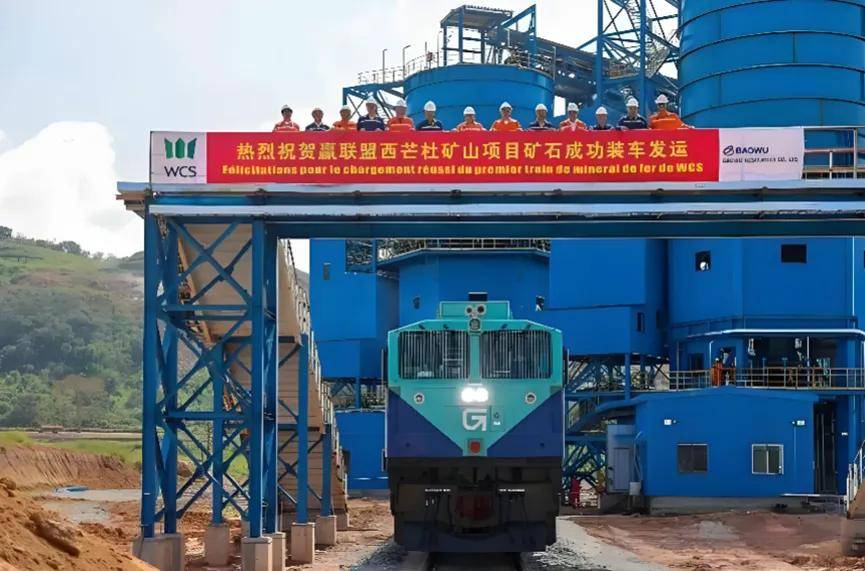
Core Insights - The Simandou iron ore project in Guinea is being developed in two main sections: the northern blocks (1 and 2) by a joint venture between Baowu and WCS, and the southern blocks (3 and 4) by a joint venture between Rio Tinto and Chalco [1][2] - The northern project is expected to reach an annual production of 15 million tons by 2026, with a target of 60 million tons by 2030, while the southern project is projected to produce 4.6 million tons in 2026 and reach full capacity by 2032 [2][3] - The official mining ceremony for the Simandou project is scheduled for November 11, marking a significant milestone in Guinea's mining development [1] Northern Project Details - The northern blocks will have a mining capacity of 60 million tons per year, with a 552 km railway and port system being constructed [1] - The estimated production costs for the northern project are projected to range between $61 and $65 per ton, including infrastructure costs [2] Southern Project Details - The southern blocks will also have a mining capacity of 60 million tons per year, with an estimated annual production of 24 million tons for the company's share [1] - Initial operating costs for the southern project are expected to be higher, starting at $137.19 per ton in 2026 and decreasing to $68.18 per ton by 2030 [2][3] Cost Breakdown - The total production costs for the northern project are expected to decrease from $64.00 per ton in 2026 to $61.83 per ton by 2029, with various components such as mining, transportation, and management fees detailed [3] - The southern project's costs are projected to decline significantly over time, with a notable reduction in operating costs as production ramps up [2][3]