公用事业

Search documents
上半年工企利润数据点评:盈利结构问题仍然存在
Bank of China Securities· 2025-07-29 03:21
Group 1: Profit Trends - In the first half of 2025, the total profit of industrial enterprises decreased by 1.8% year-on-year, amounting to 34,365.0 billion yuan, with the decline rate expanding by 0.7 percentage points compared to January-May[1] - In June 2025, industrial enterprise profits fell by 4.3% year-on-year, but the decline rate narrowed by 4.8 percentage points compared to May[1] - The profit margin for industrial enterprises was 5.2%, an increase of 0.2 percentage points from January-May[1] Group 2: Revenue and Costs - Industrial enterprises' operating revenue grew by 2.5% year-on-year, with a revenue per 100 yuan of assets reaching 73.9 yuan, an increase of 1.0 yuan from January-May[1] - Operating costs increased by 2.8% year-on-year, with the growth rate still outpacing that of operating revenue, indicating ongoing cost pressures on profitability[1] - The average recovery period for accounts receivable was 69.8 days, a decrease of 0.7 days compared to January-May[15] Group 3: Sector Performance - The mining sector's profit share has been declining, with a 30.3% year-on-year decrease in profits, contributing negatively to the overall profit growth of industrial enterprises by 5.3 percentage points[8] - Manufacturing profits increased by 4.5% year-on-year, although the growth rate decreased by 0.9 percentage points compared to January-May, indicating some support for overall profitability[9] - High-tech manufacturing contributed positively to profit growth, adding 1.8 percentage points to the cumulative year-on-year profit growth of industrial enterprises[9] Group 4: Price Factors and Economic Outlook - Price factors are currently the main drag on industrial enterprise profitability, with the Producer Price Index (PPI) for production materials showing a year-on-year decline of 3.2%[5] - The Central Financial and Economic Committee's recent meeting emphasized the need to address low-price competition and improve product quality, which may help boost industrial product prices in the future[2] - Risks include potential overseas recession and geopolitical uncertainties, which could impact the industrial sector's performance[18]
“反内卷”掩映下的商品超级周期
2025-07-29 02:10
Summary of Conference Call Records Industry or Company Involved - The discussion primarily revolves around the **commodity supercycle** and the impact of **anti-involution policies** on the **midstream materials and manufacturing industries**. Core Points and Arguments 1. **Impact of Anti-Involution Policies**: Anti-involution policies may lead to a revaluation of midstream materials and manufacturing industries, similar to the utility price increase trend observed in 2023-2024. Focus on industries with negative ROC minus VAC indicators, such as **coke, rebar, plastics, fiberglass, and photovoltaic equipment** [1][2][5]. 2. **Drivers of Commodity Supercycle**: The commodity supercycle is driven by **de-globalization** and **de-dollarization**. De-globalization restricts factor flow, raising inflation, while de-dollarization leads to increased commodity pricing. Historical parallels are drawn to the 1970s commodity bull market due to similar conditions [3][9]. 3. **Renminbi Exchange Rate**: The Renminbi's exchange rate is highly correlated with market trends. In the medium term, the price gap between China and the US supports Renminbi appreciation, although short-term risks from US debt issuance could pressure the A-share market [1][6]. 4. **Investment Strategy**: It is recommended to follow the **Barbell Strategy**, allocating 80% of investments to safe assets like **gold, banks, resources, and utilities**, and 20% to sectors with potential catalysts such as **domestic computing power, robotics, and Hainan Free Trade Zone** [1][7]. 5. **US Treasury Account and Interest Rates**: The US Treasury General Account (TGA) needs to be replenished quickly, which may lead to a rise in the 10-year US Treasury yield to near or above 5%. This could impact dollar liquidity and put pressure on the A-share market, particularly growth-style stocks [1][8]. 6. **Historical Context of Anti-Involution**: The current anti-involution policy is seen as part of a broader strategy to address economic deflation, with historical precedents in 1999 and 2015-2016. The focus should also be on demand-side policies [5][11]. 7. **Measuring Industry Involution**: The difference between ROIC and WACC serves as a measure of industry involution. Negative values indicate industries that are not creating value, with many midstream manufacturing and materials sectors currently in this state [12]. 8. **Recent Performance of Involved Industries**: Industries with high involution levels, such as **coke, rebar, plastics, fiberglass, and photovoltaic equipment**, have shown significant recent performance improvements, indicating potential investment opportunities [14]. Other Important but Possibly Overlooked Content 1. **Commodity Price Trends**: From July 2022 to the present, gold and silver prices have increased by 100%, while platinum has risen by over 40%. Scarce metals have also seen significant price increases, suggesting a likely upward trend in commodity pricing [10]. 2. **Sector-Specific Insights**: Certain commodities like **alumina and live pigs** have seen price increases not due to anti-involution but rather as part of the broader commodity supercycle, indicating the complexity of market dynamics [15][16]. 3. **Asset Allocation Recommendations**: In the absence of a fundamental reversal in globalization trends, a suggested asset allocation strategy includes 80% in safe assets and 20% in technology and AI sectors, providing a balanced approach to risk management [17].
通用汽车发行6亿美元四年期债券。英国公用事业公司Severn Trent Utilities Finance Plc.供应7亿欧元12年期可持续债券。(彭博)
news flash· 2025-07-28 14:41
Group 1 - General Motors issued a $600 million four-year bond [1] - Severn Trent Utilities Finance Plc issued €700 million twelve-year sustainable bonds [1]

信用业务周报:如何看待近期上游周期品价格快速上涨-20250728
ZHONGTAI SECURITIES· 2025-07-28 14:03
Market Overview - The major market indices mostly rose last week, with the STAR Market 50 index showing the largest weekly increase of 4.63%[20] - The average daily trading volume of the Wind All A index increased to 18,486.97 billion yuan, up from 15,462.51 billion yuan, indicating a high trading activity level[33] - As of July 25, 2025, the Wind All A valuation (PE TTM) was 20.73, an increase of 0.31 from the previous week, reflecting a recovery in valuations across sectors[40] Sector Performance - Among 30 major sectors, 27 sectors experienced gains, with the materials sector leading with an increase of 5.26%, followed by the energy sector at 4.38%[24] - Notable performers included construction materials (up 8.20%), coal (up 7.98%), and steel (up 7.67%), while banking, telecommunications, and utilities sectors saw declines of 2.87%, 0.77%, and 0.27% respectively[30] Policy and Economic Outlook - Recent policies are not indicative of immediate expansion in cyclical commodities, as the current "anti-involution" policies resemble last year's "trade-in" initiatives rather than comprehensive supply-side reforms[12] - The central urban work conference did not introduce additional macroeconomic stimulus policies, suggesting a tightening of fiscal, monetary, and regulatory policies in the future[12] - The geopolitical implications of the Yarlung Tsangpo River hydropower project are emphasized, indicating a focus on energy security and sustainable regional development rather than traditional infrastructure expansion[12] Investment Recommendations - It is advised to focus on technology and military sectors, as well as dividend assets outside the banking system, to navigate the current market conditions[18]
长城基金汪立:主题温度较高,热点轮动加快
Xin Lang Ji Jin· 2025-07-28 09:39
上周A股市场在美股、港股震荡上行的基础上延续上涨态势,整体赚钱效应的结构化特征仍然明显。周 内市场日均成交额约18,487亿元,资金方面微观流动性分化。风格上,整体成长优于价值,小盘跑赢 大盘。行业上,建筑材料、煤炭、钢铁等表现靠前,银行、通信、公用事业等表现靠后。 宏观展望:"反内卷"行业政策逐步落地,关注需求端持续性 国内方面,整体政策关注度仍集中在"反内卷"政策在各行各业开花的阶段。"反内卷"政策的核心在于: 上游抓价格下游抓质量、减少财政出口退税在内的政府补贴、提高公用事业价格。在政策带动下,上游 制造短暂走强,钢铁高炉开工、原铝出货的同比表现均走强,建筑钢材、玻璃的贸易商采购量也明显增 长,预计会对7月整体工业增加值带来提振作用。 从其他经济分项来看,整体景气依旧有韧性。但近两周需求侧受到台风天气影响,线下消费、基建、出 口强度短暂回落。预计7月出口仍能保持一定增速的正增长,但进入到8月份整体出口压力可能会明显增 强。三季度出口能否继续为宏观经济提供支持,将是市场对宏观经济能否从转冷承压预期转向向上修正 预期的关键。另外,地产成交仍然偏弱,市场成交面积增速下降,一线城市韧性相对较强,二线城市相 对偏 ...
6月信用债利差月报 | 信用利差走势分化,长久期低评级信用利差压缩明显
Xin Lang Cai Jing· 2025-07-28 08:50
Credit Bond Yield Performance - In June, overall credit bond yields declined, with short-term credit bond spreads widening while medium to long-term spreads narrowed [1][4] - The AA- rated credit bond spreads mostly narrowed, while other ratings saw mixed results in 1-year and 3-year spreads, indicating a market trend towards longer durations and lower credit quality for yield enhancement [4][10] Industry-Specific Credit Bond Spreads Industrial Bonds - In June, the credit spreads for AAA-rated industrial bonds varied across industries, with the financial holding sector experiencing the largest narrowing of 12.31 basis points, while the textile and apparel sector saw the largest widening of 3.26 basis points [12][13] - The pharmaceutical and biological sector in private placements had the largest narrowing of spreads at 8.83 basis points, while the public utility sector experienced the largest widening of 9.65 basis points [12][13] Local Government Financing Bonds - The credit spreads for local government financing bonds showed a mixed trend, with lower-rated spreads continuing to narrow while mid to high-rated spreads fluctuated upwards [1][4] - In May, most provinces and entities saw a narrowing of credit spreads, with private placements showing a more significant reduction [1][4] Financial Bonds - In June, the credit spreads for bank perpetual bonds exhibited mixed results, with the lowest-rated spreads compressing the most, while the spreads for securities company subordinated bonds and insurance company capital replenishment bonds all declined [1][4]


欧股牛气何来?四大主题解码涨势
智通财经网· 2025-07-28 08:29
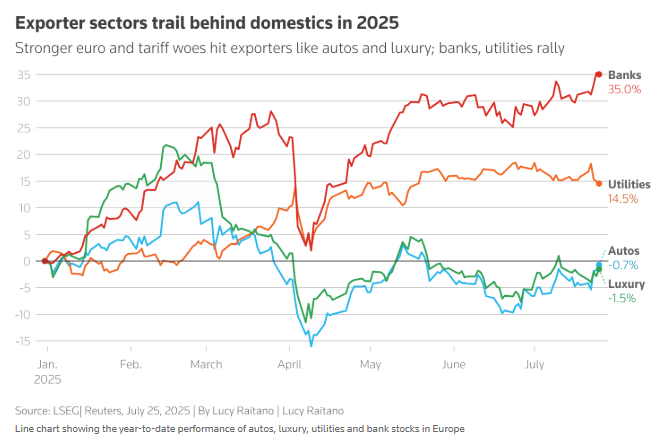
智通财经APP获悉,欧洲股市再次逼近历史高点,似乎已摆脱紧张贸易谈判和汇率逆风的影响,市场波 动性显著下降。而在等待下一个重大催化剂出现之际,投资者正围绕四大关键主题展开布局。 斯托克欧洲600指数指数今年迄今上涨8.4%,略高于标普500指数8.2%的涨幅,此前该指数创下十年来 最强劲的第一季度相对表现。 尽管上周末欧盟与美国达成15%关税的框架协议,但市场对双方避免贸易战的乐观情绪已持续发酵多 时。当前经济数据显示欧洲经济仍具韧性,投资者正密切关注欧洲股市暗流涌动的四大主题。 1) 出口型企业逊色于内需导向板块 欧元走强导致欧元区内需股与出口股表现分化。2025年欧元兑美元升值13.4%,侵蚀出口企业利润,汽 车和耐用消费品等贸易敏感板块表现低迷,而银行、公用事业等内需板块则强势上涨。 虽然美日贸易协定推动斯托克汽车指数上周上涨3%,但年内仍下跌1%,与银行业35%和公用事业15% 的涨幅形成鲜明对比。分析师持续下调欧洲2025年整体盈利预期,但细分来看,欧元区出口企业盈利预 期的下调速度明显快于内需企业。 摩根大通建议客户在非美投资组合中继续超配内需股,巴克莱则警告当前配置差距已达极端水平,反转 风险正 ...
工业盈利仍有压力
CAITONG SECURITIES· 2025-07-28 08:00
Group 1: Industrial Profitability - In June 2025, the total profit of industrial enterprises above designated size decreased by 4.3% year-on-year, with the decline narrowing by 4.8 percentage points compared to May[7] - The profit margin for industrial enterprises in June was down 6.9% year-on-year, contributing a 6.9 percentage point drag on profit growth, although this was an improvement from the 10.2 percentage point drag in May[8] - Industrial production showed resilience with a 6.8% year-on-year increase in industrial added value, outperforming May's 5.8%[8] Group 2: Future Profitability Pressure - The second half of 2025 is expected to see continued pressure on corporate profitability due to potential depletion of U.S. demand from prior "import rush" activities[10] - Tariffs have increased costs for enterprises, impacting profit levels, similar to the trend observed during the last U.S.-China trade friction from 2018 to 2019[10] - Multiple industries are pushing for "anti-involution," which may further compress profit margins in sectors with weak downstream demand[25] Group 3: Resilience in Equipment Manufacturing - Equipment manufacturing has shown relative resilience, with profit margins performing better than other sectors since April 2025[26] - The mining industry has maintained a profit margin of around 31% since April 2025, despite revenue growth remaining negative[26] - Companies that have already expanded overseas or are establishing factories abroad are likely to capture more market share amid trade frictions[27][28]
今日9只A股跌停 煤炭行业跌幅最大
Zheng Quan Shi Bao Wang· 2025-07-28 04:49
Market Overview - The Shanghai Composite Index fell by 0.17% today, with a trading volume of 841.35 million shares and a transaction value of 1,138.73 billion yuan, an increase of 1.39% compared to the previous trading day [1]. Industry Performance - The top-performing sectors included Non-Bank Financials (up 1.11%), Defense and Military (up 1.04%), and Pharmaceutical and Biological (up 0.88%) [1]. - The sectors with the largest declines were Coal (down 2.46%), Steel (down 1.84%), and Beauty and Personal Care (down 1.59%) [2]. Detailed Industry Data - Non-Bank Financials: - Change: +1.11% - Transaction Value: 647.20 billion yuan (up 11.70%) - Leading Stock: Zhongyin Securities (up 6.61%) [1] - Defense and Military: - Change: +1.04% - Transaction Value: 496.34 billion yuan (up 57.68%) - Leading Stock: Xinguang Optoelectronics (up 13.27%) [1] - Pharmaceutical and Biological: - Change: +0.88% - Transaction Value: 986.89 billion yuan (down 13.87%) - Leading Stock: Erkang Pharmaceutical (up 14.89%) [1] - Coal: - Change: -2.46% - Transaction Value: 95.76 billion yuan (down 14.49%) - Leading Stock: Shanxi Coking Coal (down 6.18%) [2] - Steel: - Change: -1.84% - Transaction Value: 129.93 billion yuan (down 18.37%) - Leading Stock: Liugang Co. (down 8.58%) [2] - Beauty and Personal Care: - Change: -1.59% - Transaction Value: 52.80 billion yuan (down 7.19%) - Leading Stock: Baiya Co. (down 7.94%) [2]
投资长跑选手的“攻守道”——访华商润丰混合基金经理胡中原
Shang Hai Zheng Quan Bao· 2025-07-27 13:57
Core Viewpoint - The article discusses the investment strategy of Hu Zhongyuan, a fund manager at Huashang Fund, emphasizing the importance of both offensive and defensive strategies in investment, particularly during market adjustments [4][8]. Group 1: Investment Strategy - Hu Zhongyuan employs a "dual diversification" strategy in product allocation, focusing on industry diversification to reduce portfolio volatility by including both high-growth and stable defensive sectors [5][9]. - The fund managed by Hu Zhongyuan, Huashang Runfeng Flexible Allocation Mixed Fund, has shown impressive long-term performance, with a net value increase of 193.98% over nearly seven years, significantly outperforming the benchmark and the CSI 300 index [5][6]. - The investment framework is based on industry cycles and win rates, selecting industries with upward revenue and profit trends for allocation, while avoiding a preset preference for any specific industry [6][7]. Group 2: Market Adaptation - Hu Zhongyuan has demonstrated a proactive approach to market changes, such as shifting investments from high-valued sectors like liquor and pharmaceuticals to undervalued sectors like coal and pork during market fluctuations [7][10]. - The fund's performance during market downturns has been notable, with a smaller drawdown compared to many peers, attributed to a mix of defensive public utilities and bond assets [10]. Group 3: Market Outlook - The current market is viewed as favorable, with structural opportunities expected due to ongoing policy support, ample liquidity, and evolving industry dynamics [11][12]. - Key factors supporting the A-share market include sustained policy effects, a favorable funding environment, and emerging structural investment opportunities in sectors like artificial intelligence, new consumption, and innovative pharmaceuticals [12][13][14].