
自动驾驶

Search documents
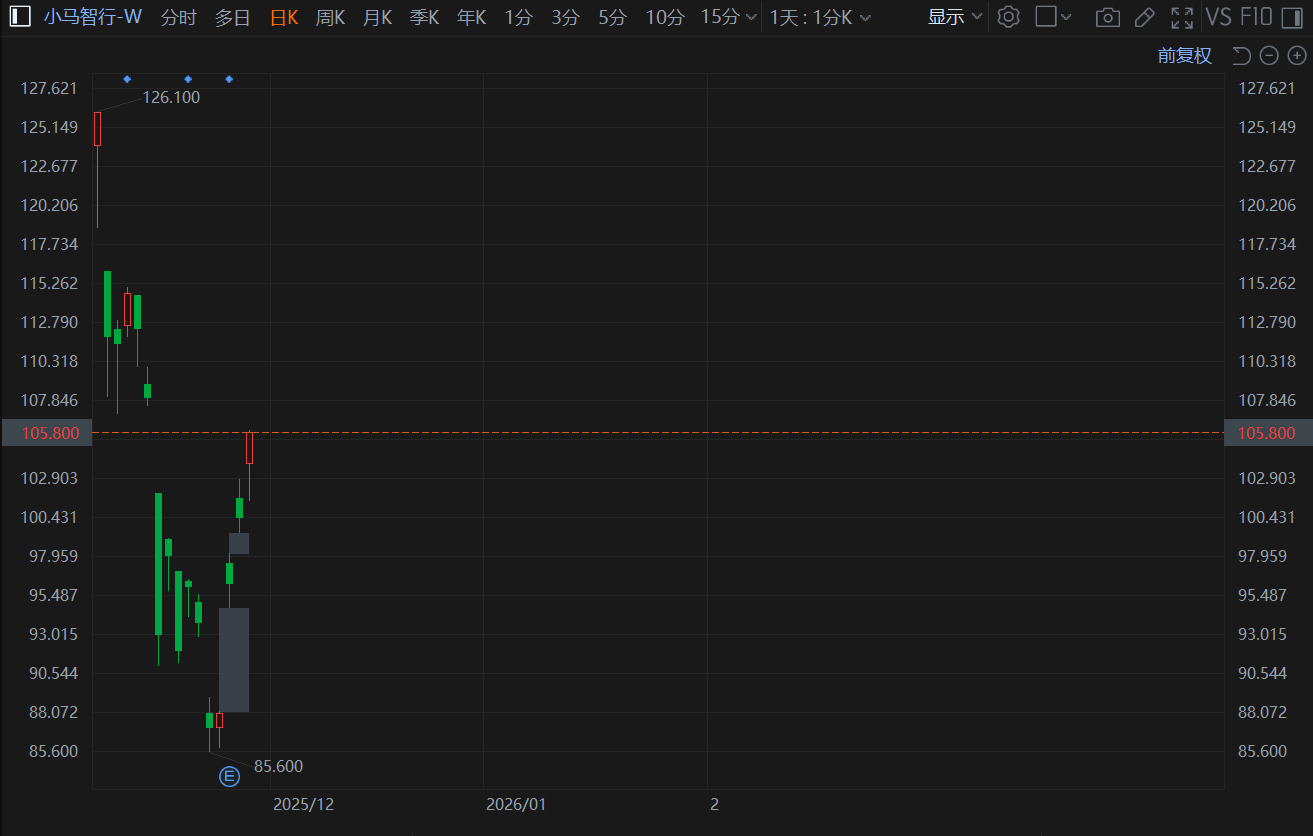
港股异动丨小马智行续涨超5% 3日连涨达20% 多家投行上调公司2026年营收预期
Ge Long Hui· 2025-11-27 03:37
Core Insights - Xiaoma Zhixing-W (2026.HK) has seen a significant stock increase of over 5%, with a total rise of 20% over three days, currently priced at 105.8 HKD and a market capitalization of 45.87 billion HKD [1] Financial Performance - For Q3 2025, Xiaoma Zhixing reported total revenue of 181 million HKD, representing a year-on-year growth of 72%, marking three consecutive quarters of revenue growth [1] - The revenue growth was primarily driven by strong performance in Robotaxi and technology licensing and application revenues [1] - The Robotaxi segment generated revenue of 47.7 million HKD, showing a year-on-year increase of 89.5% [1] Analyst Ratings and Forecasts - Multiple investment banks have raised their revenue forecasts for Xiaoma Zhixing for 2026 [1] - Goldman Sachs analysts highlighted that achieving profitability on a per-vehicle basis is a milestone event for the industry, indicating the economic viability of the Robotaxi business model in specific scenarios [1] - Bank of America has adjusted Xiaoma Zhixing's revenue forecasts for 2025 to 2027 upwards by 5%, 4%, and 9% respectively, initiating a "Buy" rating for Xiaoma Zhixing's H-shares with a target price of 164 HKD, and increasing the target price for its US shares from 20 USD to 21 USD [1]

11月27日国际晨讯丨日韩股市高开 摩根大通:标普明年或将突破8000点
Sou Hu Cai Jing· 2025-11-27 03:05
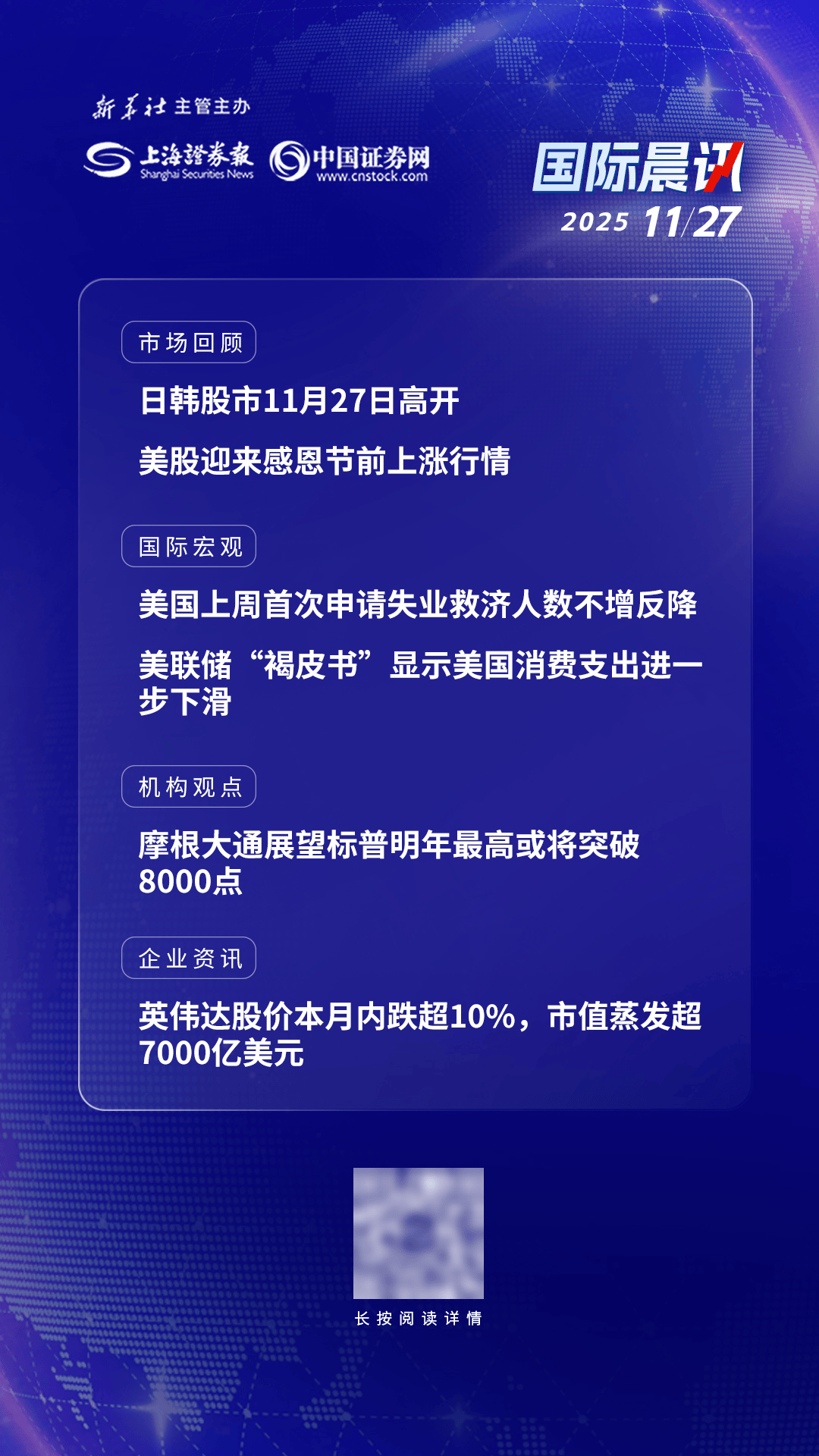
Market Overview - The Nikkei index opened up 0.6% at 49,868.79 points, led by gains in electronics and metal stocks [4] - U.S. stock markets experienced an upward trend ahead of Thanksgiving, with consumer-related retail stocks performing well and technology stocks boosted by optimistic sentiment [4] - Major U.S. indices closed higher: Dow Jones up 0.67% at 47,427.12 points, S&P 500 up 0.69% at 6,812.61 points, and Nasdaq up 0.82% at 23,214.69 points [4] - The UK FTSE 100 index rose 0.85% to 9,691.58 points, while the 10-year UK government bond yield fell by 7.1 basis points to 4.423% [4] International Macro - The number of initial jobless claims in the U.S. unexpectedly decreased to 216,000, the lowest since mid-April, contrary to economists' expectations of an increase [5] - The latest Federal Reserve Beige Book indicates that overall consumer spending has declined, contributing to economic stagnation, with tariff pressures squeezing corporate profits [5] - The UK's Office for Budget Responsibility (OBR) mistakenly released a report revealing a significant increase in the fiscal buffer from £9.9 billion to £22 billion (approximately $29 billion) [5] Institutional Insights - JPMorgan forecasts that the S&P 500 could potentially exceed 8,000 points next year, raising its baseline expectation for the index to 7,500 points [6] - Bank of America analysts predict that the AI data center market will grow approximately fivefold by 2030, reaching around $1.2 trillion from $242 billion this year, with Nvidia expected to remain a market leader despite a potential decrease in market share [6] Corporate News - Nvidia's stock has dropped over 10% this month, resulting in a market capitalization loss of over $700 billion, amid concerns about its AI chip monopoly [7] - Panasonic Energy has signed a multi-year agreement with Amazon's autonomous ride-hailing company Zoox to supply cylindrical lithium-ion batteries for its robot taxi fleet, with deliveries set to begin in early 2026 [7]

港股异动 | 小马智行-W(02026)再涨超3% 第三季度Robotaxi服务同比增长89%...
Xin Lang Cai Jing· 2025-11-27 02:23
来源:智通财经网 消息面上,近日,小马智行-W披露2025年三季度业绩。美银证券指出,小马智行-W第三季收入按年增 长72%至2,540万美元,其中Robotaxi服务按年增长89%;毛利率达18.4%,按年及按季分别提升9.1及2.2 个百分点,因收入结构改善且Robotaxi服务贡献提高。期内研发费用为6,000万美元,按年增长80%,主 要投入于第七代车辆研发及研发人员扩充。非公认会计准则净亏损为5,500万美元,对比去年同期及上 季分别为4,100万美元及4,600万美元。 该行续指,截至11月23日,小马智行Robotaxi车队规模达961辆,管理层有信心在今年底突破1,000辆目 标,并预期2026年底将超过3,000辆。管理层又表示,车辆密度更高将缩短候车时间、提升用户体验, 从而令定价及利用率更高,并预期2026年Robotaxi收入增长将进一步加速,受稳健订单及营运效率提升 推动。 小马智行-W(02026)再涨超3%,截至发稿,涨3.59%,报104港元,成交额1643.87万港元。 ...
小马智行-W再涨超3% 第三季度Robotaxi服务同比增长89% 车队有望年底突破1000辆目标
Zhi Tong Cai Jing· 2025-11-27 02:18
该行续指,截至11月23日,小马智行Robotaxi车队规模达961辆,管理层有信心在今年底突破1,000辆目 标,并预期2026年底将超过3,000辆。管理层又表示,车辆密度更高将缩短候车时间、提升用户体验, 从而令定价及利用率更高,并预期2026年Robotaxi收入增长将进一步加速,受稳健订单及营运效率提升 推动。 消息面上,近日,小马智行-W披露2025年三季度业绩。美银证券指出,小马智行-W第三季收入按年增 长72%至2,540万美元,其中Robotaxi服务按年增长89%;毛利率达18.4%,按年及按季分别提升9.1及2.2 个百分点,因收入结构改善且Robotaxi服务贡献提高。期内研发费用为6,000万美元,按年增长80%,主 要投入于第七代车辆研发及研发人员扩充。非公认会计准则净亏损为5,500万美元,对比去年同期及上 季分别为4,100万美元及4,600万美元。 小马智行-W(02026)再涨超3%,截至发稿,涨3.59%,报104港元,成交额1643.87万港元。 ...
港股异动 | 小马智行-W(02026)再涨超3% 第三季度Robotaxi服务同比增长89% 车队有望年底突破1000辆目标
智通财经网· 2025-11-27 02:15
智通财经APP获悉,小马智行-W(02026)再涨超3%,截至发稿,涨3.59%,报104港元,成交额1643.87万 港元。 消息面上,近日,小马智行-W披露2025年三季度业绩。美银证券指出,小马智行-W第三季收入按年增 长72%至2,540万美元,其中Robotaxi服务按年增长89%;毛利率达18.4%,按年及按季分别提升9.1及2.2 个百分点,因收入结构改善且Robotaxi服务贡献提高。期内研发费用为6,000万美元,按年增长80%,主 要投入于第七代车辆研发及研发人员扩充。非公认会计准则净亏损为5,500万美元,对比去年同期及上 季分别为4,100万美元及4,600万美元。 该行续指,截至11月23日,小马智行Robotaxi车队规模达961辆,管理层有信心在今年底突破1,000辆目 标,并预期2026年底将超过3,000辆。管理层又表示,车辆密度更高将缩短候车时间、提升用户体验, 从而令定价及利用率更高,并预期2026年Robotaxi收入增长将进一步加速,受稳健订单及营运效率提升 推动。 ...
小马智行:第三季度营收同比增长72%
Guo Ji Jin Rong Bao· 2025-11-27 01:44
Group 1 - The core point of the article highlights that Xiaoma Zhixing reported a significant increase in revenue and a notable loss in the third quarter of 2025 compared to the previous year [1][3] - In Q3 2025, the company achieved a revenue of $25.4 million, representing a 72% year-over-year growth, surpassing market expectations of $22.8 million [3] - The gross profit for Q3 2025 was reported at $4.67 million, indicating positive operational performance despite the losses [3] Group 2 - The non-GAAP basic and diluted loss per share for Q3 2025 was $0.14 (RMB 1.00), a significant decrease from $3.50 in Q3 2024 [1][3] - The net loss for Q3 2025 was $55 million, compared to a loss of $41.4 million in Q3 2024, reflecting ongoing challenges in profitability [3] - Xiaoma Zhixing announced that it expects to exceed its fleet expansion target, growing to over 3,000 vehicles by 2025 [1]
毫末智行突然原地解散!宇宙第一正式下线
自动驾驶之心· 2025-11-27 00:04
Core Insights - The article discusses the recent dissolution of a self-driving technology company, Haomo Technology, which has faced significant operational challenges and staff turnover [2][3]. Company Overview - Haomo Technology was established on November 29, 2019, as a subsidiary of Great Wall Motors, focusing on autonomous driving systems. The core team includes talents from Great Wall Motors and tech companies like Baidu and Huawei [6]. - The company previously made rapid advancements, launching its first last-mile delivery vehicle, "Xiao Mo Tuo," in November 2020, and introduced the MANA data intelligence system in December 2021, which has accumulated over 620,000 hours of learning time by 2023 [6][8]. Recent Developments - In 2023, Haomo Technology has seen a mass exodus of key personnel, including the departure of the chairman and several vice presidents, leading to concerns about its operational stability [5]. - The company's official communications have ceased since June 2023, with the last update being a holiday poster on October 1 [6]. Market Impact - Following the announcement of the company's closure, users of Haomo's products expressed concerns and dissatisfaction regarding their experience with the products [11].

闭环训练终于补上了!AD-R1:世界模型端到端闭环强化学习新框架(澳门大学&理想等)
自动驾驶之心· 2025-11-27 00:04
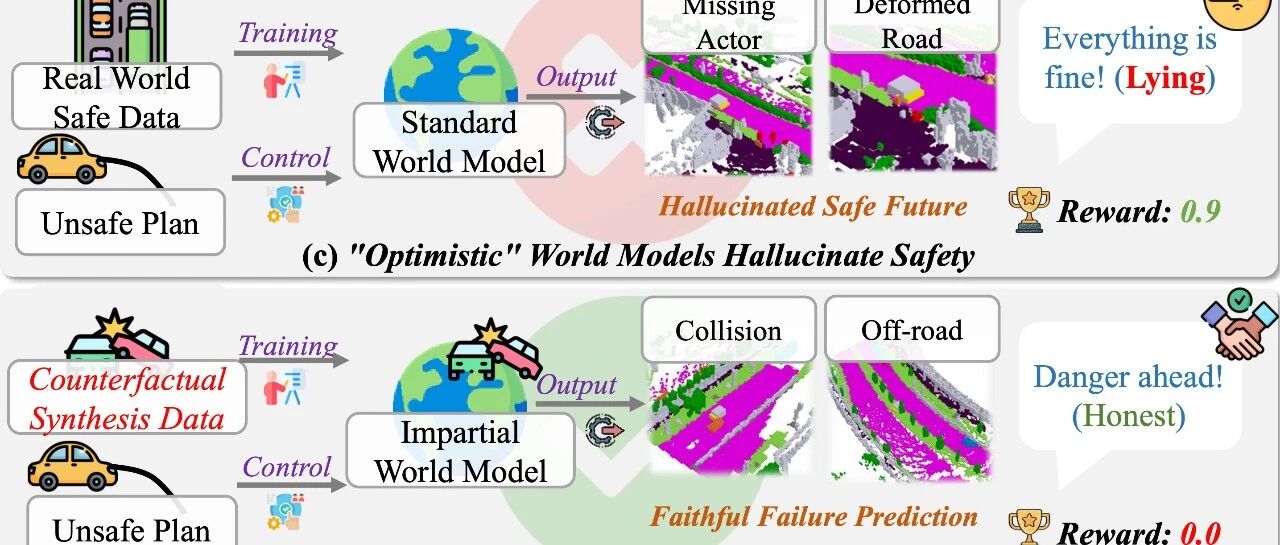
Core Insights - The article discusses the advancements in autonomous driving through the introduction of the AD-R1 framework, which utilizes an Impartial World Model to address the "optimistic bias" found in traditional world models [2][3][57] - The framework allows for closed-loop reinforcement learning, enabling autonomous vehicles to learn from imagined failures, thereby improving safety and decision-making capabilities [9][57] Group 1: Background and Challenges - End-to-end autonomous driving has transformed the industry, but challenges remain, particularly with long-tail event failures due to distribution shifts [6] - Traditional reinforcement learning methods rely on external simulators, which have limitations such as simulation-to-reality gaps and lack of interactivity [6][9] - The need for a paradigm shift towards learning 3D/4D world models as high-fidelity generative simulators is emphasized [6] Group 2: Optimizing World Models - The AD-R1 framework introduces a new approach to mitigate the optimistic bias in world models, which often fail to predict negative outcomes [2][7] - The Impartial World Model (IWM) is designed to accurately reflect the consequences of both safe and unsafe behaviors, enhancing the reliability of predictions [3][10] - A counterfactual synthesis pipeline is implemented to generate a diverse training dataset that includes reasonable collision and lane deviation scenarios [3][10] Group 3: Experimental Results - The IWM significantly outperforms traditional models in risk prediction tasks, demonstrating its ability to accurately foresee failures [47][48] - The application of the AD-R1 framework leads to notable improvements in safety and performance metrics across various baseline models, with absolute increases in planning decision metrics (PDMS) of 1.7% and 1.1% [49] - Ablation studies reveal that the introduction of counterfactual synthesis and model-level optimizations are critical for enhancing causal fidelity and overall performance [51][52] Group 4: Future Directions - Future research may focus on generating counterfactual failure samples from unlabeled data to reduce reliance on high-precision annotations [57] - Expanding the framework to more complex multi-agent interaction scenarios could further enhance the robustness of autonomous driving systems in long-tail events [57]
即将开课!面向量产的端到端小班课,上岸高阶算法岗位~
自动驾驶之心· 2025-11-27 00:04
Core Viewpoint - The article emphasizes the importance of end-to-end production in the automotive industry, highlighting the scarcity of qualified talent and the need for comprehensive training programs to address various challenges in this field [1][3]. Group 1: Course Overview - The course is designed to cover essential algorithms related to end-to-end production, including one-stage and two-stage frameworks, reinforcement learning applications, and trajectory optimization [3][9]. - It aims to provide practical experience and insights into production challenges, focusing on real-world applications and expert guidance [3][6]. Group 2: Course Structure - The course consists of eight chapters, each addressing different aspects of end-to-end production, such as task overview, algorithm frameworks, navigation information applications, and trajectory output optimization [9][10][11][12][13][14][15][16]. - The final chapter will share production experiences from various perspectives, including data, models, and strategies for system enhancement [16]. Group 3: Target Audience and Requirements - The course is aimed at advanced learners with a background in autonomous driving, reinforcement learning, and programming, although those with weaker foundations can still participate [17][18]. - Participants are required to have access to a GPU with recommended specifications and familiarity with relevant algorithms and programming languages [18].
特斯拉高管辟谣“供应链去中国化”;北京“十五五”规划:稳步提高新能源汽车比例 | 汽车早参
Mei Ri Jing Ji Xin Wen· 2025-11-26 22:39
11月26日,特斯拉全球副总裁陶琳在社交平台发文称,无论是美国、中国还是欧洲,Tesla全球各生产 基地的供应商选择都采用同样严格、客观的标准,完全基于质量、总成本、技术能力成熟度以及长期供 货连续性。供应商的原产国或地理来源不构成排除性标准。 | 2025年11月27日星期四 | NO.1 六部门:加快布局新领域新赛道,聚焦智能网联新能源汽车 11月26日消息,工业和信息化部等六部门印发《关于增强消费品供需适配性进一步促进消费的实施方 案》,其中提出,加快布局新领域新赛道。聚焦智能网联新能源汽车、智能家居、消费电子、现代纺 织、食品、绿色建材等重点行业,开展双百典型创新应用专项活动,打造百个标志性产品、百家创新企 业和一批可体验可推广的新产品首用场景样板。 点评:六部门发布的方案明确指出将加快布局智能网联新能源汽车等新领域,显示出国家对未来产业结 构的重视。这将刺激相关企业在新能源汽车、智能家居和绿色建材等领域的投资与创新,有助于提升长 远竞争力。 NO.2 特斯拉高管辟谣"供应链去中国化" 点评:北京市"十五五"规划强调了在"双碳"目标下推进新能源汽车发展的战略,这无疑将为相关企业提 供广阔的发展空间。随 ...