
信托

Search documents
3.6万亿巨雷,比恒大更猛,中植系背后15万中产家庭被套牢!
Sou Hu Cai Jing· 2025-07-14 04:53
Core Viewpoint - The sudden bankruptcy of Zhongzhi Group, once the largest private financial group in China, has raised significant concerns in the financial industry, with implications that may surpass the previous Evergrande crisis [3][8]. Group 1: Company Overview - Zhongzhi Group was established in 1995 and initially profited from the timber business before diversifying into various sectors including mining, clothing, catering, and cement [4]. - The group entered the real estate market in 1997 and later shifted focus to the more lucrative financial sector, engaging in equity acquisitions of small and medium enterprises and wealth management [4]. Group 2: Financial Structure and Impact - Zhongzhi Group controlled or held stakes in six licensed financial institutions and had nine publicly listed companies under its control, making it a significant player in the financial industry [6]. - The group managed assets that peaked at 3.6 trillion, surpassing Evergrande's scale, but is now facing liabilities exceeding 400 billion, leading to a severe insolvency situation [3][6]. Group 3: Reasons for Bankruptcy - The group's financial troubles were exacerbated by poor investment decisions, including significant losses from investments in problematic stocks like LeEco and Kangde Xin, and the death of its founder in 2021, which destabilized the organization [11]. - Zhongzhi Group's aggressive investments in the real estate sector during a downturn, particularly from 2021 onwards, resulted in substantial financial losses [12]. - High-yield financial products offered by its wealth management companies attracted investors with promised returns of 10%-12%, but the inability to meet these obligations has led to significant losses for investors [14]. Group 4: Investor Impact - The bankruptcy has affected approximately 150,000 high-net-worth individuals, with total claims reaching 230 billion, and many investors facing losses of over 3 million each [8][14]. - The likelihood of recovering investments post-bankruptcy is extremely low, as remaining assets will first cover employee wages and debts to banks and creditors before any potential returns to investors [14].

罕见!交易所4个席位,第9次拍卖!什么情况?
券商中国· 2025-07-12 08:07
Core Viewpoint - The auction of four trading seats on the Shenzhen Stock Exchange has been held for the ninth time, with a starting price of 295,500 yuan, but previous auctions have all failed to attract bidders [1][2]. Group 1: Auction Details - The four trading seats, originally belonging to a trust company, are being auctioned due to asset disposal, with the starting price reduced from an initial 600,000 yuan [1][2]. - The auction has seen no bidders so far, with only a few hundred spectators present [4]. - The trading seats are currently under the name of Zhuhai Zhongye Trust Investment Co., Ltd., and the auction is a result of a court ruling from 2009 [5]. Group 2: Historical Context - These trading seats have been auctioned eight times previously, all resulting in failure to sell, with the starting price decreasing over time [2][7]. - The first auction occurred on August 24, 2020, with a starting price of 600,000 yuan, and subsequent auctions saw prices drop to 295,500 yuan by the ninth auction [7]. - The lack of interest in these trading seats is attributed to the fact that many brokerages already possess numerous trading seats, making these additional seats less appealing [2][7]. Group 3: Eligibility and Regulations - According to the Shenzhen Stock Exchange's seat management rules, trading seats can only be transferred among members, primarily brokerages and securities companies [6]. - Bidders must verify their eligibility to acquire trading seats, as failure to meet the qualifications could result in legal liabilities [5][6]. - The auction process requires a formal agreement and application to the exchange, with a standard purchase fee of 600,000 yuan for a trading seat [6].

金融监管总局“7号令”出台:金融产品严禁“操纵业绩”、“不当展示”
财联社· 2025-07-12 06:28
Core Viewpoint - The newly implemented "Regulations on the Appropriateness Management of Financial Institution Products" (referred to as "Regulation No. 7") aims to enhance the transparency and integrity of financial product sales, particularly those with uncertain returns and potential principal loss, by prohibiting misleading practices in product promotion and sales [1][4][5]. Group 1: Overview of Regulation No. 7 - Regulation No. 7 was officially released after a three-and-a-half-month consultation period, introducing stricter guidelines for financial institutions regarding the promotion and sale of investment products [1][2]. - The regulation specifically targets investment-type products, including asset management products and other financial products, which are primarily regulated by the former China Banking and Insurance Regulatory Commission [2][3]. Group 2: Prohibited Practices - Financial institutions are now prohibited from misleading or inducing customers to purchase products through performance manipulation or improper presentation [4][6]. - The regulation addresses practices such as obscuring product nature, confusing product categories, exaggerating product advantages, and selectively displaying performance data [6]. Group 3: Performance Disclosure and Management - The regulation emphasizes the need for clear performance disclosure, aligning with previous guidelines issued by the National Financial Regulatory Administration regarding asset management product information disclosure [7][8]. - The phenomenon of "new product ranking," where newly launched financial products exhibit inflated returns to attract investors, is highlighted as a concern that the regulation aims to mitigate [9]. Group 4: Investor Classification and Risk Assessment - Regulation No. 7 mandates the classification of investment products by risk level and requires an assessment of investors' risk tolerance, distinguishing between professional and ordinary investors [10][14]. - The regulation specifies that only products rated below an investor's risk level can be purchased, ensuring that investments align with the investor's risk capacity [14][15]. Group 5: Special Considerations for High-Age Clients - Financial institutions are required to exercise special care when dealing with clients aged 65 and above, implementing stricter operational procedures for high-risk product sales [18][19]. Group 6: Risk Assessment Frequency and Validity - The regulation standardizes the validity period for risk tolerance assessments to twelve months, limiting the frequency of assessments to prevent excessive evaluations aimed at selling high-risk products [20].

建元信托: 关于修订《公司章程》并撤销监事会的公告
Zheng Quan Zhi Xing· 2025-07-11 16:13
Core Viewpoint - The announcement details the resolutions passed by the board of directors of Jianyuan Trust Co., Ltd. regarding amendments to the company's articles of association, the dissolution of the supervisory board, and the establishment of a risk control and audit committee to assume the supervisory responsibilities [2][3]. Summary by Relevant Sections Amendments to Articles of Association - The company plans to revise its articles of association and related rules, including the rules for board meetings and shareholder meetings, in compliance with relevant laws and regulations [2][3]. - The amendments require approval from the shareholders' meeting and must be approved by the Shanghai Regulatory Bureau of the National Financial Supervisory Administration before taking effect [2][3]. Dissolution of the Supervisory Board - The supervisory board will be dissolved following the approval of the revised articles of association, with its responsibilities transferred to the risk control and audit committee [3][4]. - The supervisory board will continue to fulfill its duties until the new articles are approved [3]. Authorization and Adjustments - The board of directors is authorized to make necessary adjustments to the revised articles based on regulatory feedback and to handle the registration and filing with relevant authorities [3][4]. - The board will also adjust the rules for board meetings and shareholder meetings according to the approved articles [3]. Governance Structure - The company will establish a party committee to oversee major decisions and ensure alignment with the party's directives, reflecting the integration of corporate governance with party leadership [4][5]. - The party committee will play a crucial role in discussing and deciding on significant operational matters [19][20]. Shareholder Rights and Responsibilities - Shareholders holding more than 5% of the company's shares will have specific rights and responsibilities, including the ability to request meetings and participate in decision-making processes [21][22]. - The company will maintain a shareholder register as proof of ownership, ensuring that all shareholders have equal rights and obligations [21][22].

《金融机构产品适当性管理办法》印发
Zheng Quan Shi Bao· 2025-07-11 15:09
Core Viewpoint - The Financial Regulatory Bureau has issued the "Measures for the Appropriateness Management of Financial Institution Products," which aims to enhance consumer protection and ensure that financial products are sold appropriately to suitable clients [1] Group 1: Regulatory Framework - The new measures require financial institutions to understand both the products and the clients, ensuring that suitable products are sold through appropriate channels [1] - The measures will take effect on February 1, 2026, to ensure a smooth implementation of the policy [1] Group 2: Product Scope - The measures apply to investment products with uncertain returns that may lead to principal loss, as well as insurance products [2] - Specific investment products include wealth management products, asset management trust products, insurance asset management products, non-principal guaranteed structured deposits, and derivatives sold to clients [2] Group 3: Third-Party Oversight - Financial institutions are required to strengthen oversight of third-party partners, ensuring compliance in marketing practices [3] - The measures prohibit misleading or inducing clients to purchase products through performance manipulation or improper presentation [3] Group 4: Investor Classification - The measures classify investors into professional and ordinary categories based on their risk tolerance and the nature of the products [4] - Professional investors include various financial institutions and funds, while ordinary investors must undergo risk assessments before purchasing products [5] Group 5: Industry Self-Regulation - Industry self-regulatory organizations are mandated to establish and improve self-regulatory norms for appropriateness management [6] - The Financial Regulatory Bureau will guide these organizations in enhancing the appropriateness management standards within the industry [6] Group 6: Consumer Awareness - There is an emphasis on cultivating financial consumers' risk awareness to protect their legitimate rights and interests [7]
《金融机构产品适当性管理办法》印发
证券时报· 2025-07-11 14:58
Core Viewpoint - The Financial Regulatory Administration has issued the "Measures for the Appropriateness Management of Financial Institution Products," aimed at enhancing consumer protection and ensuring that financial products are sold appropriately to suitable clients [2][4]. Group 1: Product and Client Understanding - Financial institutions are required to understand both the products they offer and the clients they serve, ensuring that suitable products are sold through appropriate channels [2][4]. - The measures differentiate between investment-type products and insurance products, establishing specific appropriateness rules for each category [2][4]. Group 2: Scope of Applicability - The measures apply to investment-type products with uncertain returns that may lead to principal loss, including wealth management products, asset management trust products, and non-principal guaranteed structured deposits [4][10]. - Insurance products covered include property insurance and life insurance [4]. Group 3: Third-Party Oversight - Financial institutions must strengthen oversight of third-party partners involved in marketing, ensuring compliance with legal and regulatory standards [7][8]. Group 4: Professional Investor Definition - The measures define professional investors and ordinary investors, with specific requirements for risk assessment and product suitability [10][12]. - Professional investors include various financial institutions and funds, while ordinary investors must undergo thorough risk assessments before purchasing products [10][12]. Group 5: Industry Self-Regulation - Industry self-regulatory organizations are tasked with establishing norms for appropriateness management and overseeing financial institutions' compliance with these measures [14].

新加坡开出1.5亿反洗钱罚单,金融机构收紧第一道防线
2 1 Shi Ji Jing Ji Bao Dao· 2025-07-11 12:17
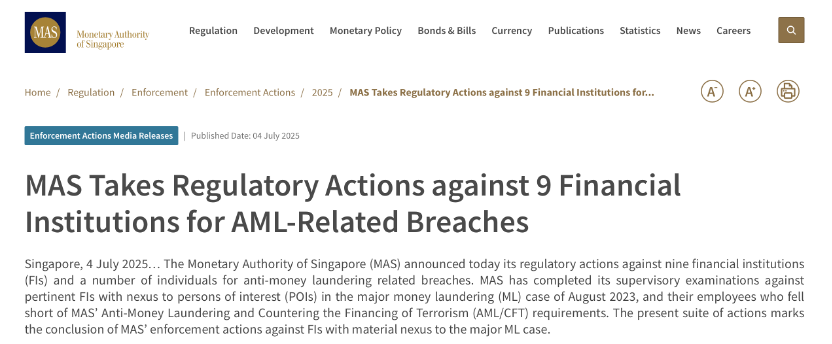
21世纪经济报道记者 郭聪聪 北京报道 MAS 处罚公告 近日,新加坡金融管理局(MAS)对9家金融机构开出总额高达2745万新元(约合人民币1.54亿元)的反洗钱罚单,创 下该国史上罚单金额第二高纪录,受罚机构涵盖银行、资本市场服务供应商及信托公司等多个金融领域。 在巨额罚单之外,此前MAS已围绕反洗钱展开了一系列监管行动,包括对家族办公室提出更严格的要求、提高数字货 币平台的牌照发放标准等。 德恒律师事务所合伙人、新加坡办公室执行主任闫泽娟在接受本报记者采访时表示,MAS全面升级监管要求之后,对 银行等金融机构产生了巨大影响。以私人银行开户为例,机构在KYC(Know Your Customer,简称KYC)环节对客户 的资金规模和资金来源有了更高的要求,部分私人银行也会要求提供高出准入门槛的资金证明。开户时间也从之前的 一个月,延长到两到三个月。 重罚落地:瑞信、大华银行领最高罚单 从MAS近期公告的金融机构的处罚结果来看:9家金融机构因违反反洗钱与反恐融资条例,被合计罚款 2745万新元, 按7月11日汇率折算约合人民币1.54亿元。 从受罚机构名单来看,此次涉事主体覆盖广泛,涉及银行、资本市场服务供 ...
十万元级成主力军,慈善信托正在摆脱“高门槛”标签|2025中国经济半年报
Sou Hu Cai Jing· 2025-07-11 12:07
Core Insights - The charity trust market in China has shown significant growth in the first half of 2025, with 198 new registrations and a total scale of 358 million yuan, indicating a stable increase in both quantity and scale [2][3] - Factors contributing to this growth include policy benefits, upgraded public demand, and the empowerment of financial institutions [2][6] - The structure of charity trusts is evolving, with a notable shift from high thresholds to more accessible participation for small and medium enterprises and grassroots organizations [3][4] Market Structure - The majority of new charity trusts are in the 100,000 yuan category, accounting for 45% of the total, followed by 1 million yuan (29%) and 10,000 yuan (17%) [3] - The distribution of trust durations shows a preference for medium to short-term trusts, with 89 trusts having no fixed duration and 57 trusts set for 1-5 years [4][5] - The focus areas for charity trusts are concentrated in education, rural revitalization, and healthcare, with 42, 23, and 9 trusts respectively [4][5] Regional Activity - Active regions for charity trust registrations include Zhejiang, Beijing, Jiangsu, Shandong, and Shaanxi, with Zhejiang leading in both the number of registrations (58) and total scale (41.646 million yuan) [5][6] - The Ningbo, Beijing, Hangzhou, Jinan, and Nanjing civil affairs bureaus have the highest registration numbers, indicating strong local governance support [5][6] Regulatory Environment - The revised Charity Law emphasizes charity trusts as a form of public trust, enhancing their legal standing and support within the industry [7][9] - The introduction of new regulations categorizing charity trusts alongside asset service and management trusts has solidified their importance in the trust industry [7][9] - Recent pilot programs for equity charity trust registration in cities like Hangzhou and Beijing are expected to facilitate the growth of charity trusts [8][9] Future Outlook - The charity trust sector is anticipated to continue its stable development, bolstered by policy refinements and the expansion of trust property registration trials [9] - Challenges remain, including the need for tax incentives, public awareness of trust distinctions, and improving project execution capabilities [9]

新加坡金管局(MAS)对9家金融机构及个人采取反洗钱监管措施
制裁名单· 2025-07-11 08:25
Core Viewpoint - The article highlights the inadequate enforcement of Anti-Money Laundering and Counter Financing of Terrorism (AML/CFT) policies among financial institutions in Singapore, leading to significant penalties and regulatory scrutiny [1][8]. Group 1: Penalties and Institutions - A total of 9 financial institutions, including banks and capital market service providers, were fined a combined amount of 27.45 million Singapore dollars for various AML/CFT violations [5]. - The penalties imposed on specific institutions include: - Credit Suisse Singapore Branch (CSSB): 5.8 million SGD - United Overseas Bank (UOB): 5.6 million SGD - UBS Singapore Branch (UBSS): 3 million SGD - Citibank Singapore: 2.6 million SGD - Julius Baer Singapore Branch (BJBS): 2.4 million SGD - LGT Bank Singapore (LGTS): 1 million SGD - UOB Kay Hian Securities (UOBKH): 2.85 million SGD - Blue Ocean Investment (BOIPL): 2.4 million SGD - Trident Trust Company (TTCSPL): 1.8 million SGD [2]. Group 2: Major Violations - Five institutions failed to effectively implement risk rating policies for customer risk assessments [6]. - All nine institutions did not adequately verify the legitimacy of clients' sources of wealth [6]. - Eight institutions exhibited insufficient scrutiny of suspicious transactions [6]. - Two institutions did not promptly take risk mitigation measures following suspicious transaction reports (STRs) [6]. - Four executives from Blue Ocean Investment (BOIPL) faced industry bans of 3 to 6 years for failing to ensure effective execution of AML/CFT policies [6]. Group 3: Regulatory Response - The Monetary Authority of Singapore (MAS) emphasized the need for financial institutions to enhance their AML/CFT measures to align with industry best practices [8]. - MAS warned of severe penalties for serious violations to maintain the integrity of Singapore's financial system [8].

昆仑信托董事长的这份建议,获得监管部门答复
Zheng Quan Shi Bao Wang· 2025-07-11 06:35
Core Viewpoint - The Ningbo Financial Regulatory Bureau has responded to a proposal regarding the development of special needs trusts in Ningbo, emphasizing its positive significance for helping special difficulty groups [1] Summary by Relevant Sections Proposal Aspects - The proposal by Wang Zhengrong includes six key aspects aimed at promoting special needs trusts [2][3] - Encourage multi-party participation from government departments, NGOs, trust companies, law firms, and community service organizations to build a service network for special needs trusts [2] - Increase awareness and understanding of special needs trusts among government departments, especially in civil affairs and judicial sectors, as well as the general public [2] - Establish a regular communication and coordination mechanism among civil affairs, finance, and judicial departments [3] - Recommend the city government to introduce supportive policies for special needs trusts, including tax incentives or financial subsidies for families transferring real estate to trust accounts [3] - Develop a comprehensive assessment mechanism to accurately identify eligible difficult groups, ensuring fairness and effectiveness of subsidy policies [3] - Organize professional training for government officials, financial institutions, social workers, and legal professionals to enhance their understanding and practical skills related to special needs trusts [3] Ongoing Efforts and Future Plans - The Ningbo Financial Regulatory Bureau is committed to enhancing financial services for special difficulty groups and will continue to encourage trust companies to focus on charitable trusts [4] - The bureau will work with civil affairs and other departments to establish a daily communication mechanism and actively participate in the revision of the Ningbo Charity Promotion Regulations to support the development of charitable trusts [4] - The Ningbo Financial Regulatory Bureau will promote the exploration and innovation in the charitable trust sector, ensuring that any new tax policies for special needs trusts are communicated effectively [5][6]