
房地产投资信托

Search documents
Getty Realty (GTY) - 2025 Q3 - Earnings Call Transcript
2025-10-23 13:32
Financial Data and Key Metrics Changes - Getty Realty reported over 10% year-over-year growth in annualized base rent and a 5.1% increase in quarterly AFFO per share for Q3 2025 [5][6] - AFFO per share for Q3 2025 was $0.62, a 5.1% increase compared to Q3 2024, and for the nine months ended September 30, AFFO per share was $1.80, up 3.5% year-over-year [18][19] - The company increased its full-year 2025 AFFO per share guidance to a range of $2.42-$2.43 from the previous guidance of $2.40-$2.41 [22] Business Line Data and Key Metrics Changes - The company invested over $235 million year-to-date, exceeding its full-year activity in 2024, with a focus on drive-through QSR segment, acquiring more than 25 properties [7][8] - The leased portfolio included 1,156 net-leased properties with an occupancy rate of 99.8% and a weighted average lease term of 9.9 years [14] - The trailing 12-month tenant rent coverage ratio was consistent at 2.6x, reflecting steady performance from the convenience store portfolio [7][14] Market Data and Key Metrics Changes - 61% of annualized base rent comes from the top 50 MSAs, and 77% from the top 100 MSAs, indicating a strong market presence [14] - The company has diversified its tenant base by transacting with 10 new tenants in 2025 [8] Company Strategy and Development Direction - Getty Realty is focused on acquiring well-located convenience and automotive retail properties leased to growing regional and national operators [11] - The company aims to leverage its underwriting expertise and real estate selection to support investment decisions and mitigate credit risks [11] - The board approved a 3.2% increase in the recurring quarterly dividend to $0.485 per share, marking the 12th consecutive year of dividend growth [12] Management's Comments on Operating Environment and Future Outlook - Management expressed excitement about the platform built over the years, highlighting the ability to deliver strong financial results amid market disruptions [11] - The company remains focused on scaling its operations and retaining capital for growth while balancing shareholder returns through dividends [22] Other Important Information - The company has a committed investment pipeline of over $75 million under contract, which can be funded without raising additional capital [8][21] - The weighted average cost of debt was 4.5%, with no debt maturities until 2028, indicating a strong balance sheet [19][20] Q&A Session Summary Question: Thoughts on the health of the middle to lower-end consumer regarding drive-through QSRs - Management noted gaining momentum in the quick service restaurant sector, which aligns with macroeconomic pressures and consumer preferences [25] Question: Details on environmental expense adjustments - Management clarified that adjustments were due to alleviated risks at legacy sites, resulting in the removal of certain reserves [26] Question: Timeline for engagement with Now & Forever acquisition - The acquisition process took less than six months, with varying timelines for different transactions based on relationship building [28][29] Question: Funding plan for upcoming transactions - Management discussed typical funding sources, including forward equity and revolver availability, to manage leverage [30][31] Question: Sources of debt and pricing - Management indicated that the private placement market would likely be the best source for new debt, with current pricing in the high fives [35] Question: Dividend increase rationale - The board's decision to retain more cash internally was to support growth and scale the business while still aligning dividend growth with earnings [36] Question: Sourcing future travel center transactions - Management emphasized relationship building and market presence as key to sourcing future acquisitions in the travel center sector [40][41] Question: Update on bad debt - Management reported no significant rent collection issues this year, maintaining a typical bad debt level [43] Question: Tenant health and lease substitutions - Management noted it is too early to assess requests for asset substitutions in master leases, expecting most properties to remain long-term [48] Question: Underwriting differences for travel centers - Management highlighted that travel centers have a different risk profile, with a focus on total value and broader service offerings [52] Question: Impact of cap rate discussions - Management indicated no significant movement in cap rates recently, suggesting a longer-term shift may be needed to see impacts [58] Question: Car wash industry performance - Management reported positive trends in car wash rent coverage, with new builds stabilizing ahead of schedule [61][62]

This Monster 14%-Yielding Dividend Stock Is Thriving These Days
Yahoo Finance· 2025-10-22 12:16
Core Viewpoint - AGNC Investment is thriving despite a high dividend yield, which often signals underlying company hardships. The recent third-quarter financial results demonstrate strong performance and a positive outlook for the company [1][2]. Financial Performance - AGNC Investment generated $0.78 per share of comprehensive net income in the third quarter, covering its monthly dividend payments of $0.12 per share, totaling $0.36 for the period [4]. - The company reported a $0.47 per share increase in tangible net book value, a 6% increase from the second quarter [4]. - The total economic return on tangible common equity was 10.6% for the period, a significant improvement from a $0.13 per share comprehensive loss and a negative 1% economic return in the previous quarter [5]. Market Conditions - The turnaround in performance was driven by the Federal Reserve's policy shift, which included lowering the federal funds rate and signaling further cuts. This led to improved financial market performance and investor sentiment [6]. - Agency mortgage-backed securities (MBS) outperformed U.S. Treasuries for five consecutive months, marking the best performance since 2013 [6]. Future Outlook - The company is well-positioned to continue its strong performance, supported by macroeconomic dynamics favorable to Agency MBS [7]. - Factors contributing to this optimistic outlook include manageable supply and growing demand for MBS as interest rates fall, positioning AGNC Investment to generate attractive risk-adjusted returns [8].

REITs 周度观察(20251013-20251017):二级市场价格显著回调,市场交投热情有所下降-20251018
EBSCN· 2025-10-18 11:09
Report Industry Investment Rating No investment rating for the industry is provided in the report. Core Viewpoints From October 13 - 17, 2025, the secondary - market prices of publicly - listed REITs in China continued to decline, and the trading enthusiasm in the market decreased compared to the previous period. Only new infrastructure - type REITs showed an increase in price this week. There were also significant differences in trading volume, turnover, and net inflow of main funds among different underlying asset types and individual REITs [1][2]. Summary by Directory Secondary Market Price Trends - **At the large - asset level**: The weighted REITs index closed at 181.3, with a weekly return of - 1.42%. Compared with other mainstream large - asset classes, the return ranking from high to low was: gold > US stocks > pure bonds > REITs > A - shares > convertible bonds > crude oil [1][11]. - **At the underlying - asset level**: Both equity - type and franchise - type REITs' secondary - market prices declined. Only new infrastructure - type REITs rose this week. The top three underlying asset types in terms of return were new infrastructure, ecological and environmental protection, and municipal facilities [17][19]. - **At the single - REIT level**: Among the 75 REITs, 7 rose and 68 fell. The top three in terms of increase were China Merchants Expressway REIT, Huatai - PineBridge Jiuzhoutong Pharmaceutical REIT, and Harvest China Power Construction Clean Energy REIT [24]. Transaction Volume and Turnover Rate - **At the underlying - asset level**: The total trading volume of REITs this week was 2.07 billion yuan. The water - conservancy facilities - type REITs had the highest average daily turnover rate, with an average of 0.92%. The top three in terms of trading volume were transportation infrastructure, consumer infrastructure, and affordable rental housing [26]. - **At the single - REIT level**: The performance of individual REITs in terms of trading volume and turnover rate continued to vary. The top three in terms of trading volume were CCB Zhongguancun REIT, CICC Xiamen Anju REIT, and China Asset Management Huarun Youchao REIT. The top three in terms of trading value were China Asset Management Kaide Commercial REIT, China Asset Management Huarun Commercial REIT, and CICC Xiamen Anju REIT [28]. Main - Fund Net Inflow and Block - Trading Situation - **Main - fund net - inflow situation**: The total net inflow of main funds this week was - 3.87 million yuan, indicating a decline in market trading enthusiasm. The top three underlying asset types in terms of net inflow were consumer infrastructure, affordable housing, and energy. The top three individual REITs in terms of net inflow were China Asset Management Kaide Commercial REIT, CICC Yinli Consumer REIT, and China Asset Management Huarun Youchao REIT [32]. - **Block - trading situation**: The total block - trading volume this week was 85.76 million yuan, an increase from the previous period. The highest single - day block - trading volume occurred on October 16, 2025, which was 34.8 million yuan. The top three individual REITs in terms of block - trading volume were Huaan Bailian Consumer REIT, Red - Earth Innovation Shenzhen Anju REIT, and AVIC Jingneng Photovoltaic REIT [33]. Primary Market Listed Projects As of October 17, 2025, there were 75 publicly - listed REITs in China, with a total issuance scale of 196.619 billion yuan. The transportation infrastructure - type REITs had the largest issuance scale, reaching 68.771 billion yuan, followed by the park infrastructure - type REITs with 31.835 billion yuan. No new REITs were listed this week [39][40]. Projects to be Listed There were 19 REITs in the pending - listing state, including 12 initial - offering REITs and 7 REITs for expansion. This week, the project status of E Fund Guangxi Beitou Expressway Closed - end Infrastructure Securities Investment Fund was updated to "declared"; the project status of China Asset Management Huarun Youchao Rental Housing Closed - end Infrastructure Securities Investment Fund (expansion) was updated to "feedback received"; the project status of China Asset Management Huarun Commercial Asset Closed - end Infrastructure Securities Investment Fund (expansion) was updated to "accepted" [43].
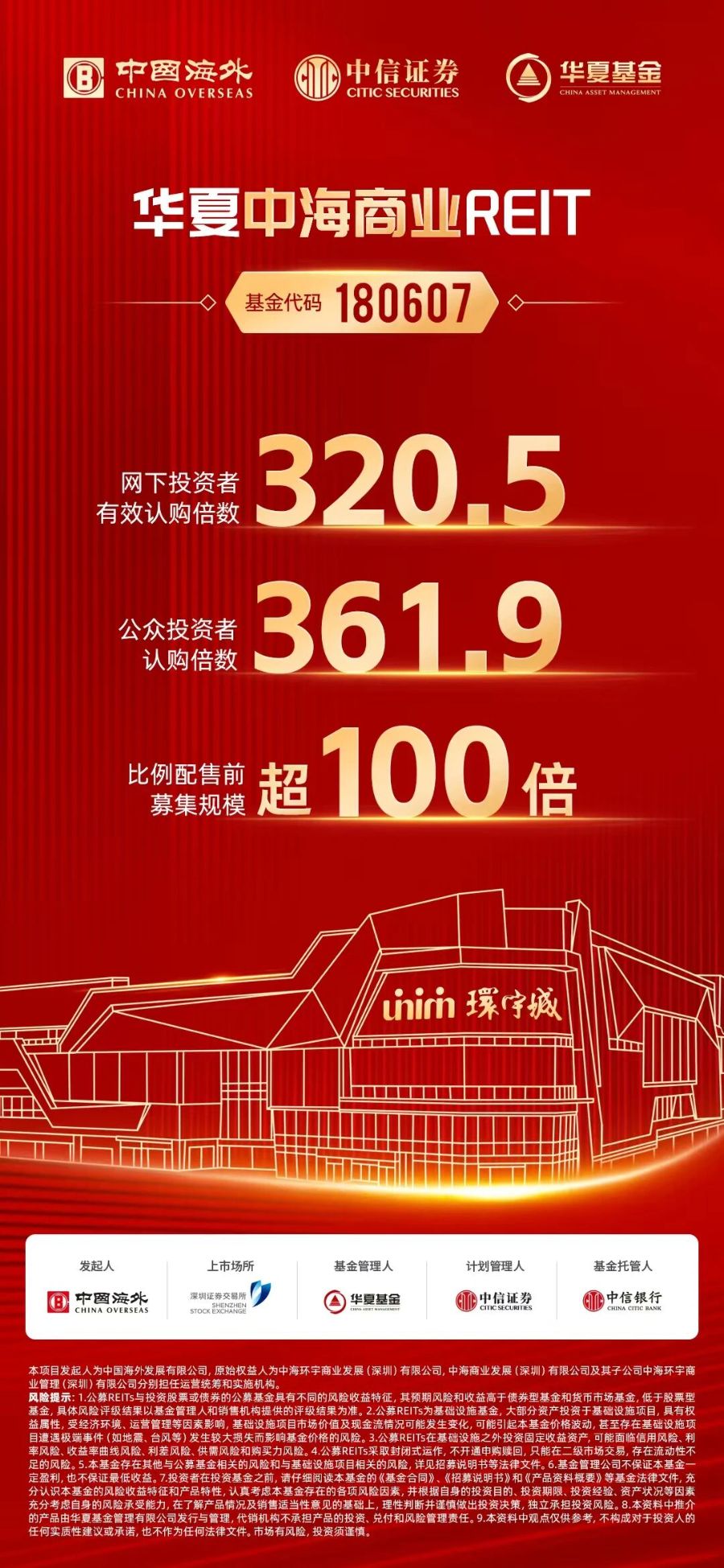
华夏中海商业REIT超购百倍,消费REITs缘何受追捧?
2 1 Shi Ji Jing Ji Bao Dao· 2025-10-17 13:56
Core Insights - The public offering of REITs, particularly consumer REITs, has seen a significant surge in investor interest, with 华夏中海商业REIT achieving a subscription amount of nearly 160 billion yuan, reflecting a subscription multiple of 361.9 times for public investors and 320.5 times for institutional investors [1][4][5] Subscription Performance - 华夏中海商业REIT's public offering was oversubscribed, leading to an early closure of the subscription period on October 13, 2023, due to demand exceeding the initial fundraising cap [5] - The total subscription amount for 华夏中海商业REIT reached 159.3 billion yuan, which is 100.5 times its intended fundraising scale [1][5] - In September, 华夏凯德商业REIT also experienced strong demand, with a subscription multiple of 535.2 times for public investors and 252.6 times for institutional investors, raising over 309.1 billion yuan against a target of 2.2872 billion yuan [4][5] Performance of Consumer REITs - Consumer REITs have shown impressive returns, with an average increase of 35.02% in the first half of the year, and 嘉实物美消费REIT leading with a 50.35% net value increase [6] - The operational performance of underlying assets has been strong, with 华夏华润商业REIT reporting a revenue of 363 million yuan, up 35.7% year-on-year, and 中金印力消费REIT achieving a rental collection rate of 99.86% [6] Operational Efficiency - Many successful consumer REITs are operated by leading companies with strong operational capabilities, contributing to their attractiveness to investors [6][8] - 华夏中海商业REIT's underlying asset, 映月湖环宇城, has a rental area of 63,900 square meters and a projected revenue of 137 million yuan for 2024, with a high occupancy rate of 97.9% [7] Creditworthiness and Compliance - The success of consumer REITs in the capital market is attributed to their strong compliance and creditworthiness, primarily driven by state-owned enterprises and leading private companies [8][9] - 华夏中海商业REIT, initiated by 中海地产, benefits from the company's comprehensive asset management capabilities, enhancing its long-term operational stability [8] Future Growth Potential - The potential for expansion in consumer REITs is significant, as large enterprises often have quality assets that can be leveraged for further fundraising [8][9] - 华夏华润商业REIT has recently initiated a secondary fundraising effort, indicating ongoing growth and investment opportunities in the sector [9]

Tritax Big Box REIT plc (TTBXF) M&A Call Transcript
Seeking Alpha· 2025-10-15 12:46
Core Viewpoint - Tritax Big Box has announced a portfolio acquisition, necessitating a prompt presentation to the market due to a leak over the weekend [1]. Group 1 - The company has had to accelerate the announcement process significantly due to the information leak [1]. - The team worked through the night to prepare the details for the market [1].

阳光房地产基金三季度物业组合的租用率为89.2%
Zhi Tong Cai Jing· 2025-10-15 09:31
Core Viewpoint - Sunshine Real Estate Fund (00435) reported a stable occupancy rate of 89.2% for its property portfolio as of September 30, 2025, with a notable decline in renewal rents by 9.0% during the review quarter [1] Group 1: Occupancy Rates - The occupancy rates for office and retail properties were maintained at 89.7% and 88.2% respectively [1] - The occupancy rate for the Daxin Financial Center was stable at 90.6%, with current rent at HKD 36.1 per square foot [1] - Strand 50 in Sheung Wan saw an improvement in occupancy to 85.5%, while the occupancy rate for the Yunshan Building decreased to 80.2% due to transitional vacancies from tenant relocations [1] - In Kowloon, the occupancy rate for Fengyi Center increased to 96.4%, indicating its popularity as a beauty service hub [1] Group 2: Rental Rates - The overall current rent for the property portfolio is HKD 43.0 per square foot [1] - The retail property Upstream Center Shopping Mall achieved an occupancy rate of 87.8% with a current rent of HKD 104.1 per square foot [1] - The rental rate for New Town Plaza Phase 1 remained unchanged at an occupancy rate of 87.1%, with a current rent of HKD 53.2 per square foot [1]
香港证监会推出全新专线 以支持房地产基金市场发展
Zheng Quan Ri Bao· 2025-10-13 23:30
Core Viewpoint - The Hong Kong Securities and Futures Commission (SFC) has launched a "Real Estate Fund Special Line" to facilitate the public offering of new Real Estate Investment Trusts (REITs), aiming to promote the development of the REIT market in Hong Kong [1][2]. Group 1: Regulatory Changes - The new one-stop special line will allow local and international REIT applicants to consult the SFC confidentially, enhancing their preparation and efficiency for listing [1]. - The SFC has streamlined the approval process and submission requirements for REITs in response to the latest developments in the Hong Kong Stock Exchange's listing rules and market practices [1]. - Generally, the SFC expects to make decisions on new REIT approval applications within four weeks after acceptance under the simplified procedure [1]. Group 2: Market Context - Currently, there are 11 listed REITs in Hong Kong, characterized by high concentration, with Link REIT accounting for over 70% of the total market capitalization, primarily investing in traditional commercial properties [1]. - The investor structure of most REITs is dominated by issuers and strategic placement investors, which marginally reduces market liquidity [1]. Group 3: Future Implications - The introduction of the "Real Estate Fund Special Line" reflects Hong Kong's commitment to long-term development of the REIT market, enhancing regulatory transparency and efficiency, thereby increasing Hong Kong's attractiveness as a fundraising and investment hub [2]. - This policy is expected to attract more international real estate funds, enriching the market ecosystem and providing new financing channels for mainland real estate companies, helping to alleviate funding pressures [2].
Expect one more move higher in the S&P into year-end, says Strategas' Chris Verrone
Youtube· 2025-10-13 13:14
Market Overview - The market has shown signs of fatigue over the past three to four weeks, with only about 50% of stocks above their 50-day average, indicating a lack of momentum [3] - Despite recent volatility, the market is expected to maintain support levels around 6,400 to 6,450, with a potential move towards 7,000 by year-end [4] Economic Indicators - Cyclical stocks are outperforming defensive stocks, and credit conditions remain benign, suggesting a generally healthy economic environment [3][8] - The recent market sell-off was triggered by concerns over potential trade tensions with China, particularly the announcement of 100% tariffs effective November 1st [6] Sector Performance - Healthcare has begun to show positive trends, raising questions about whether this will extend to other defensive sectors like staples and REITs [5] - Consumer stocks are expected to respond positively to lower oil prices and interest rates, but there is uncertainty about their performance heading into 2026 [11] Regulatory Environment - A significant deregulatory push across various industries, including banking and energy, is noted, which may impact market dynamics [12] - The performance of financial stocks, particularly money center banks, is crucial for the overall market outlook, as they have been leading for the past two years [13]

美股前瞻 | 三大股指期货齐涨,财报季开幕
智通财经网· 2025-10-13 12:35
Market Overview - US stock index futures are all up, with Dow futures rising by 0.77%, S&P 500 futures up by 1.14%, and Nasdaq futures increasing by 1.69% [1] - European indices show mixed results, with Germany's DAX up by 0.21%, UK's FTSE 100 down by 0.06%, France's CAC40 up by 0.23%, and the Euro Stoxx 50 up by 0.54% [2][3] - WTI crude oil prices increased by 1.26% to $59.64 per barrel, while Brent crude rose by 1.13% to $63.44 per barrel [3][4] Earnings Season Insights - The upcoming earnings season is critical for the US market, with major banks like JPMorgan, Goldman Sachs, Morgan Stanley, Bank of America, Citigroup, and Wells Fargo expected to report strong Q3 results due to a recovery in investment banking and resilient economic conditions [5] - The options market indicates that stock prices of S&P 500 companies are expected to fluctuate by an average of 4.7% post-earnings announcements, reflecting heightened volatility [6] Bull Market Analysis - The current bull market in the US stock market has reached its three-year anniversary, with the S&P 500 index rising by 83% since October 12, 2022, adding approximately $28 trillion in market value [7] - Historical data suggests that for bull markets to sustain momentum, they need to broaden their gains beyond a few sectors [7] Strategic Moves in Defense Sector - The US Department of Defense plans to invest up to $1 billion in key minerals to enhance strategic reserves, marking one of the largest expansions of strategic material reserves in years [8] Trade and Investment Strategies - Amid rising US-China trade tensions, Wall Street strategists suggest that investors should consider undervalued defensive value stocks in the Chinese market as a new safe haven, alongside traditional assets like gold and US Treasuries [9] Oil Market Outlook - OPEC maintains its global oil demand growth forecast and anticipates a significant narrowing of supply gaps by 2026, as OPEC+ accelerates production increases [10] Company-Specific Developments - Oracle's upcoming AI World Conference is seen as a pivotal moment for the company to validate its substantial market cap increase of approximately $370 billion this year, driven by its cloud computing business [11][12] - Tritax Big Box REIT is acquiring a £1 billion portfolio of UK warehouse assets from Blackstone, with part of the payment made in shares, indicating a strategic move in the real estate sector [12] - Marathon Digital Holdings (MARA) has made a significant investment of $46.29 million to acquire 400 bitcoins, reflecting confidence in the cryptocurrency market despite recent volatility [13] - Samsung Electronics is expected to report its highest quarterly profit in three years, driven by rising memory chip prices due to increased server demand [14]

REITs巨头Tritax10亿英镑收购黑石(BX.US)英国仓储资产,将以9%股权支付部分对价
智通财经网· 2025-10-13 09:19
Group 1 - Blackstone has agreed to sell a portfolio of UK warehouse assets valued at £1 billion (approximately $1.3 billion) to Tritax Big Box REIT, which will result in Blackstone acquiring a minority stake in the owner [1] - Tritax will pay £632 million in cash, funded by a £650 million loan, and issue £375 million worth of new shares to Blackstone, giving Blackstone approximately 9% equity in Tritax [1] - The share issuance price of 161 pence represents a 13.5% premium over Tritax's closing price last Friday, but is below the reported EPRA net asset value of 188.17 pence per share as of June [1] Group 2 - The UK REIT market is experiencing low trading activity, with share prices consistently below reported asset values, providing Blackstone with stable transaction opportunities [2] - Blackstone's European Chairman, James Separa, indicated confidence in Tritax's long-term strategy and prospects by opting to hold equity in the company [2] - Tritax's loan-to-value ratio will increase from 31% to 35% as a result of this transaction, and the company plans to sell approximately £300 million in assets over the next 18 months to manage this ratio [2]
