机械设备

Search documents
2026年3月A股及港股月度金股组合:节后表现值得期待-20260227
EBSCN· 2026-02-27 10:22
Overall Research - The A-share market showed a mixed performance in February, with major indices mostly rising, particularly the CSI 1000 which increased by 2.9%, while the Sci-Tech 50 saw a decline of 1.6% [1] - The Hong Kong stock market experienced a pullback in February, with the Hang Seng Index falling by 3.7% and the Hang Seng Technology Index dropping by 10.6% [1] - The report anticipates a seasonal rebound in market trading activity post-Chinese New Year, setting a positive foundation for future market performance [1] A-share Insights - The report suggests focusing on growth and cyclical sectors, with growth benefiting from sustained industry enthusiasm and increased risk appetite among investors during the spring market [2] - Key sectors to watch include humanoid robots and the AI industry chain, which are expected to see significant catalytic events [2] - Cyclical sectors are anticipated to benefit from strong commodity prices and supportive policies, with recommendations to focus on resource products and offline service sectors [2] Hong Kong Stock Insights - The Hong Kong market is expected to remain volatile, with strong expectations for recovery in the spring, but concerns about earnings realization and foreign capital inflow persist [3] - Major internet companies are experiencing slower-than-expected profit recovery, which is impacting the overall economic environment [3] - The report recommends a "barbell strategy" for portfolio allocation, combining high-dividend defensive sectors with growth sectors such as semiconductor equipment and AI computing [3] - The report highlights the potential for a structural market recovery driven by domestic capital inflow and policy support [3] A-share Recommended Stocks - The recommended stocks for March 2026 include: - Zhongji Xuchuang (中际旭创) - Communication - Keda Xunfei (科大讯飞) - Computer - Shenghong Shares (盛弘股份) - Power Equipment - Jereh Group (杰瑞股份) - Machinery - Nanjing Bank (南京银行) - Banking - Hualing Steel (华菱钢铁) - Steel - Chuanheng Shares (川恒股份) - Basic Chemicals - China Jushi (中国巨石) - Building Materials - Sun Paper (太阳纸业) - Light Industry Manufacturing - Haier Smart Home (海尔智家) - Home Appliances [3][6] Hong Kong Recommended Stocks - The recommended stocks for March 2026 include: - Hon Teng Precision (鸿腾精密) - Communication - Huiju Technology (汇聚科技) - Power Equipment - Sinopec Oilfield Service (中石化油服) - Oil and Petrochemicals [4][7]





源达调研策略周报
Xin Lang Cai Jing· 2026-02-27 10:07
Industry Research Highlights - The most researched industries this week (2026/2/23-2026/2/27) include electronics, machinery, automotive, and light manufacturing, with electronics and light manufacturing seeing increased attention compared to the week before the Spring Festival, likely benefiting from export recovery or domestic demand policy expectations [5][20] - Over the past 30 days (2026/1/28-2026/2/27), the most researched industries were machinery, electronics, pharmaceutical biology, and basic chemicals, with a notable increase in the number of research institutions focusing on electronics and machinery [5][21] Company Research Highlights - The companies with the highest number of institutional research visits in the past week include Jerry Holdings, Tin Industry Co., and BOE Technology Group, with Jerry Holdings receiving 14 visits and 22 ratings from institutions [6][24] - Over the past 30 days, the most researched companies include Dazhu Laser, Jerry Holdings, and Hangzhou Bank, with Ninebot, JinkoSolar, and Zhongji Xuchuang also receiving significant attention [2][25] Key Company Insights 1. **Jerry Holdings** - Jerry Holdings is transitioning into a diversified technology-driven industrial group, expanding its core growth areas from traditional oil and gas equipment to gas turbine power generation, focusing on data centers, industrial energy, and new power systems, with over 3.4 billion yuan in gas turbine generator orders from North America [3][18] - The company has established long-term partnerships with Siemens, Baker Hughes, and Kawasaki Heavy Industries, and is enhancing its capabilities in power generation, storage, and distribution [10][29] - Jerry Holdings has completed capacity construction for electric drive/turbine fracturing equipment and gas turbine power generation equipment in North America, with ongoing expansion in Dubai [30][29] 2. **Tin Industry Co.** - Tin Industry Co. is the only A-share listed company with a complete tin industry chain, holding the largest global reserves of tin and indium, with a production capacity of 80,000 tons/year for tin smelting and 12,500 tons/year for cathode copper [11][31] - The company achieved significant revenue and net profit growth in the first three quarters of 2025, with revenues of 34.42 billion yuan and a net profit of 1.745 billion yuan, marking a year-on-year increase of 17.81% and 35.99%, respectively [14][32] - The global tin market is currently characterized by a tight supply-demand balance, with strong demand from emerging sectors such as renewable energy and semiconductor packaging, providing long-term opportunities for the company [18][32]

87位头部“公奔私”基金经理最新观点、动向出炉!
Sou Hu Cai Jing· 2026-02-27 09:27
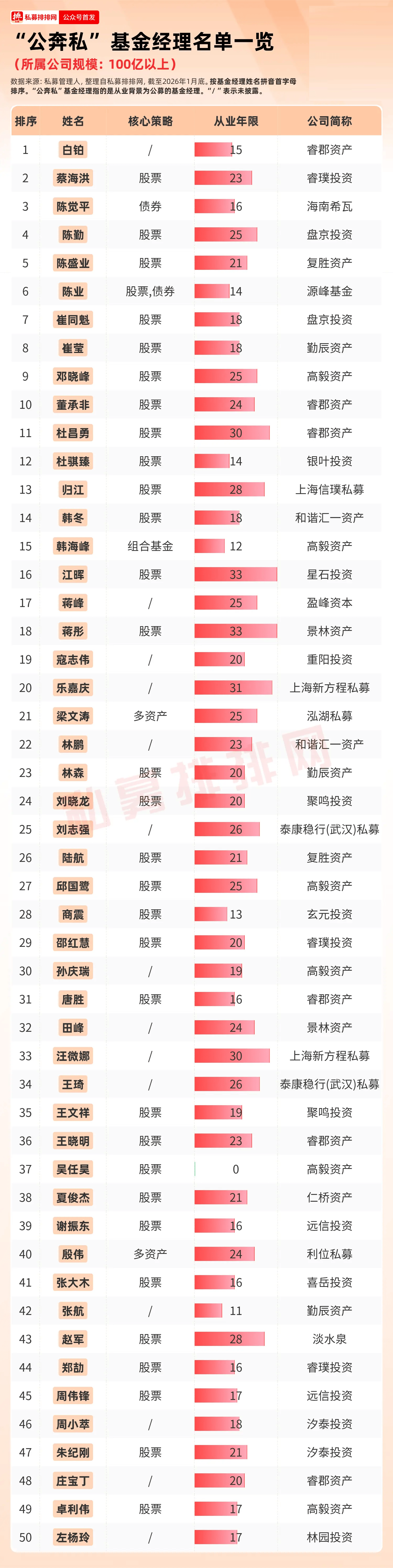
Core Insights - The trend of public fund managers transitioning to private equity ("公奔私") has become a significant faction within the private equity industry, driven by personal career advancement and changes in platform dynamics [1] - As of January 2026, there are 859 public fund managers who have transitioned to private equity, with 87 of them (10.13%) being from leading private equity firms [1] Group 1: Billion-Level Private Equity Managers - There are 50 "公奔私" fund managers under billion-level private equity firms, with the majority (31) focusing on stock strategies [2] - Among these managers, 29 have at least 20 years of experience, and 5 have over 30 years, including notable figures from various firms [2] - High Yi Asset and Rui Jun Asset each have 6 "公奔私" fund managers, while Qin Chen Asset and Rui Pu Investment have 3 each [2] Group 2: High Yi Asset Insights - High Yi Asset is a well-known private equity firm established in 2013, with a strong founding team [8] - The firm has 6 fund managers who previously held significant positions in public funds, including founder Qiu Guolu and CIO Deng Xiaofeng [8] - Deng Xiaofeng's investment in Zijin Mining is highlighted as a successful long-term case, with the stock price increasing approximately 12 times from around 3 yuan to 37.78 yuan by February 2026 [8] Group 3: Research and Performance - In January 2026, High Yi Asset conducted research on 24 A-share stocks, with 17 showing price increases, the highest being Wangsu Science and Technology with over 60% growth [9] - Jinglin Asset also has a strong presence of former public fund managers, with notable figures like Jiang Tong, who has over 30 years of experience [11] - In January 2026, 5 out of 8 stocks researched by Jinglin Asset saw price increases of over 10% [11] Group 4: Insights from Other Managers - In the准百亿 private equity sector, there are 37 "公奔私" fund managers, with 18 focusing on stock strategies [14] - Notable managers include Yuan Wei from Hua'an Hexin and Li Bei from Banxia Investment, both of whom have extensive experience in the industry [19] - Li Bei has expressed a shift in investment focus, predicting a significant opportunity in the real estate sector within the next six months [19]

银河期货股指期货月报-20260227
Yin He Qi Huo· 2026-02-27 09:16
Report Industry Investment Rating - Not provided in the report Core Viewpoints - In February 2026, the A-share market continued to oscillate upward with differentiated index performance. The CSI 500 and CSI 1000 indices were strong, while the SSE 50 index was weak. The price increase theme became an important main line in the A-share market, and the stock index is expected to maintain an oscillating upward trend in March [3][4][9]. - The price increase theme is driven by improved product supply - demand relations and abundant social funds. The abundant social funds are an important driving force for the overall price increase, and "price increase" may be an important main line in the stock market this year [28][30][34]. - The two sessions in 2026 are expected to have a positive impact on the A-share market. Historically, the stock index performance around the two sessions has been relatively positive, and the CSI 500 and CSI 1000 indices have performed better [35]. Summary by Directory 1. First Part: Preface Summary 1.1 Market Review - In February, the A-share market continued to oscillate upward with differentiated index performance. The SSE 50 index was affected by the large - financial sector and performed poorly around the Spring Festival, while the CSI 500 and CSI 1000 indices were strong due to the active performance of small - and medium - cap stocks. The futures - spot basis of stock index futures widened significantly compared with the previous month, and the trading volume and open interest decreased significantly around the Spring Festival [3]. 1.2 Market Outlook - The price increase theme has become an important main line in the A-share market. Due to improved product supply - demand relations and abundant social funds, it is expected to continue to have an important impact on the market. Historically, the stock index performance around the two sessions has been relatively positive, and the CSI 500 and CSI 1000 indices have performed better. Therefore, the stock index is expected to maintain an oscillating upward trend in March [4]. 1.3 Strategy Recommendation - Unilateral: Oscillate upward. - Arbitrage: Long IM/IC2609 contracts + Short ETFs. - Options: Bull spread strategy [5]. 2. Second Part: January Market Review 2.1 Stock Market - Index Performance Differentiated - In February, the A-share market continued to oscillate upward. The SSE 50 index closed with a negative monthly line, the CSI 300 index rose steadily, and the CSI 500 and CSI 1000 indices accelerated their rise after the Spring Festival. As of February 26, the monthly increase of the CSI 300 index was 0.44%, the SSE 50 index fell 1.02%, the CSI 500 index rose 2.23%, and the CSI 1000 index rose 2.86%. Non - metallic materials, machinery and equipment, and national defense and military industry sectors led the gains, while insurance, media and Internet, social services, and agricultural products sectors led the decline [9][12]. 2.2 Stock Index Futures - Widened Basis and Shrinking Trading Volume - In February, the basis of stock index futures widened significantly compared with the previous month. The average monthly basis of the IF current - month contract was a 4 - point discount, the IH current - month contract had an average monthly premium of 0.99 points, the IC current - month contract had an average monthly discount of 2.67 points, and the IM current - month contract had an average monthly discount of 2.9 points. The trading volume and open interest of stock index futures decreased overall. The average daily trading volume of IM, IC, IF, and IH decreased by 18.3%, 17.5%, 27.5%, and 19% respectively compared with the previous month; the average daily open interest of IM, IC, and IF decreased by 0.6%, 5.8%, and 4.6% respectively, while the average daily open interest of IH increased by 5.6%. The increase in the basis made the cost of short - position roll - over of stock index futures increase again. The net short - position of each variety fluctuated with the market, and the net short - position of the top five and top ten seats of each variety increased on average compared with the previous month, with IH having a significant increase in positions [15][19][24]. 3. Third Part: Future Outlook and Investment Strategy 3.1 The Price Increase Theme is Driven by Abundant Funds - Recently, the price increase theme has become an important main line in the A-share market, spreading across various industries. The price increase is not only a reflection of the improvement in product prosperity and industry performance but also the result of abundant funds and speculation. Social funds are abundant, with the M1 year - on - year growth rate in January 2026 being 4.9% (previous value 3.8%), the M2 year - on - year growth rate being 9.0% (previous value 8.5%), and the new social financing being 7.2 trillion yuan, a year - on - year increase of 165.4 billion yuan. The narrowing of the M2 - M1 gap may indicate abundant funds again. The appreciation of the RMB against the US dollar is beneficial to the stock market, and if the upward trend of the RMB exchange rate continues, it may bring liquidity to the stock and commodity markets. "Price increase" may be an important main line in the stock market this year [28][30][34]. 3.2 Policy Expectations are High - The Two Sessions in 2026 are expected to have an impact on the A-share market. Historically, the market performance around the Two Sessions has been relatively positive, with more disturbances during the meetings and increased market volatility. The CSI 1000 and CSI 500 indices have a higher probability of rising and larger increases. Benefiting from positive policy expectations, abundant liquidity, the AI technological revolution, and energy demand, the "steady and progressive" trend of the stock index is expected to continue. The sectors benefiting from the policy expectations of the Two Sessions are mainly in scientific and technological innovation and consumption promotion, and the CSI 1000 and CSI 500 indices with higher technological content will benefit more [35][36]. 3.3 Future Strategy - The price increase theme will continue to have an important impact on the market. The stock index is expected to maintain an oscillating upward trend in March, and the CSI 500 and CSI 1000 indices will perform better [37].
地平线机器人-W:HSD将在2026年明显放量,L3落地在即提升智驾需求,建议“买进”-20260227
CSC SECURITIES (HK) LTD· 2026-02-27 08:24
Investment Rating - The report assigns a "Buy" rating for the company, indicating a potential upside of 15% to 35% [4][11]. Core Insights - The company is expected to see significant growth in HSD (High-level Driving System) in 2026, with the demand for Level 3 (L3) autonomous driving solutions anticipated to increase, suggesting a strong market opportunity [7][9]. - The company has a robust product portfolio that includes multiple solutions for mid to high-level autonomous driving, actively expanding its partnerships with automotive manufacturers [7][9]. - The report forecasts net profits for the company to reach -57.7 million RMB in 2025, -29 million RMB in 2026, 2 million RMB in 2027, and 21 million RMB in 2028, with corresponding EPS of -0.39, -0.20, 0.01, and 0.14 RMB respectively [9][10]. Summary by Sections Company Overview - The company operates in the machinery and equipment industry, with a current H-share price of 8.16 HKD as of February 26, 2026, and a market capitalization of 0 billion [3]. Recent Ratings - The last rating update was on June 24, 2025, with a closing price of 6.37 HKD and a "Buy" recommendation [4]. Financial Projections - The projected net profit for 2024 is 2,347 million RMB, with subsequent years showing a decline into losses before returning to profitability in 2027 and 2028 [10]. - Revenue from product sales is expected to grow from 2,384 million RMB in 2024 to 18,543 million RMB in 2028, indicating a strong upward trend in sales [12]. Market Trends - The report highlights that the penetration rate of vehicles equipped with urban NOA (Navigation on Autopilot) reached 15.1% in 2025, up by 5.6 percentage points from 2024, reflecting a growing acceptance of advanced driving technologies [9]. - The commercial rollout of L3 autonomous driving technology is expected to accelerate, with a projected market size for autonomous driving chips exceeding 100 billion RMB [9].
地平线机器人-W(09660):HSD将在2026年明显放量,L3落地在即提升智驾需求,建议“买进”
CSC SECURITIES (HK) LTD· 2026-02-27 08:20
Investment Rating - The report assigns a "Buy" rating for the company, indicating a potential upside of 15% to 35% [4][11]. Core Insights - The company is expected to see significant growth in HSD (High-level Smart Driving) in 2026, with the launch of L3 autonomous driving technology enhancing demand for smart driving solutions. The report suggests a "Buy" recommendation based on these developments [7][9]. - The company has a strong product portfolio that includes multiple solutions for mid to high-level smart driving, actively expanding its customer base among automotive manufacturers and providing development services based on its chips [7][9]. - The report anticipates a rapid increase in high-level NOA (Navigation on Autopilot) demand, projecting over 50% growth in the next two years, with the smart driving chip market expected to exceed 100 billion [9]. Financial Summary - The company’s projected net profits for 2025, 2026, 2027, and 2028 are estimated at -57.7 billion, -29.2 billion, 2 billion, and 21 billion respectively, with corresponding EPS of -0.39, -0.2, 0.01, and 0.14 [9][10]. - Revenue from product sales is expected to grow from 2.384 billion in 2024 to 18.543 billion by 2028, with a significant increase in sales costs and R&D expenses over the same period [12]. - The projected P/S ratios for 2026, 2027, and 2028 are 19, 9.7, and 6.5 respectively, indicating a favorable valuation trend as the company moves towards profitability [9][10].
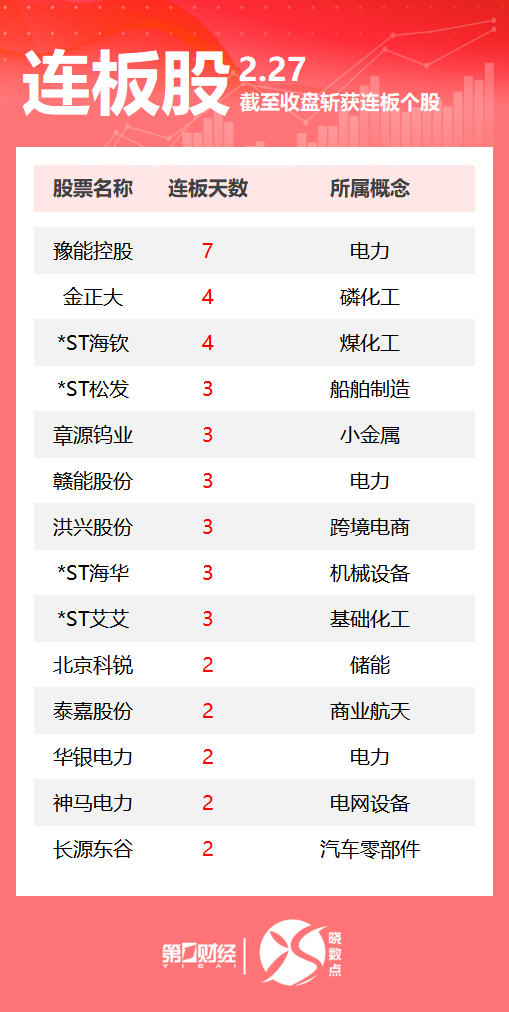
连板股追踪丨A股今日共92只个股涨停 这只电力股7连板
Di Yi Cai Jing· 2026-02-27 07:33
Group 1 - The A-share market saw a total of 92 stocks hitting the daily limit up on February 27, with notable performances from various sectors [1][2] - Yunnan Energy Holdings achieved a remarkable 7 consecutive limit-up days, leading the electric power sector [1][2] - Jinzhengdai from the phosphate chemical sector recorded 4 consecutive limit-up days, indicating strong market interest [1][2] Group 2 - Other notable stocks include *ST Haijin and *ST Songfa, both achieving 4 consecutive limit-up days in the coal chemical and shipbuilding sectors respectively [2] - Zhangyuan Tungsten from the small metals sector marked 3 consecutive limit-up days, reflecting positive market sentiment [1][2] - Additional stocks with 3 consecutive limit-up days include Ganneng Co., Yangmi Co., and *ST Haifei, spanning across electric power, cross-border e-commerce, and machinery equipment sectors [2]


中寰股份2月26日获融资买入77.73万元,融资余额976.33万元
Xin Lang Cai Jing· 2026-02-27 04:46
Group 1 - The core viewpoint of the news highlights the trading performance and financial metrics of Zhonghuan Co., indicating a slight decline in stock price and significant financing activity [1] - On February 26, Zhonghuan Co. experienced a stock price drop of 0.60%, with a trading volume of 7.45 million yuan and a net financing purchase of 777,300 yuan [1] - As of February 26, the total financing and securities balance for Zhonghuan Co. was 9.76 million yuan, representing 0.82% of its market capitalization, which is above the 90th percentile of the past year [1] Group 2 - As of September 30, the number of shareholders for Zhonghuan Co. was 5,330, a decrease of 8.67% from the previous period, while the average circulating shares per person increased by 9.33% to 18,539 shares [2] - For the period from January to September 2025, Zhonghuan Co. reported a revenue of 168 million yuan, a year-on-year decrease of 6.18%, and a net profit attributable to shareholders of 24.76 million yuan, down 23.83% year-on-year [2] Group 3 - Zhonghuan Co. has distributed a total of 109 million yuan in dividends since its A-share listing, with 82.84 million yuan distributed over the past three years [3] - As of September 30, 2025, the top ten circulating shareholders of Zhonghuan Co. saw the exit of the fund "Crea Jinhe North Certificate 50 Index Enhanced A" from the list [3]
资金行为研究双周报:担保比例提至高位,资金调仓节奏加快
ZHONGTAI SECURITIES· 2026-02-27 04:20
Market Overview - Institutional funds are experiencing a turbulent outflow from the ChiNext Index and the Wind All A Index, while retail funds are steadily net inflowing into both indices[5] - After February 9, the outflow momentum of institutional funds from the ChiNext Index and Wind All A Index has intensified, showing a fluctuating outflow trend[5] Market Capitalization and Valuation Style - Small-cap indices are seeing synchronized accumulation of funds from both institutions and retail investors, while the outflow of institutional funds from high-valuation indices has slowed down[11] - As of February 11, institutional funds have shown a marginal narrowing in outflow from high-valuation indices, while retail funds have significantly net inflowed into these indices[11] Industry Style - Institutional behavior shows significant differentiation, with increased attention on cyclical manufacturing; net inflow into this sector turned positive after February 24[19] - Institutional funds have shown a fluctuating outflow from the technology sector, with a notable shift from net inflow to outflow after February 11[19] Sector Analysis - In the upstream resources sector, institutional funds are seeing reduced outflow momentum in non-ferrous metals, while basic chemicals are experiencing net inflows from both institutions and retail investors[24] - The downstream consumer staples sector shows no significant inflow momentum from institutional funds, while the discretionary consumer sector is experiencing notable outflows, particularly in light industry manufacturing and home appliances[44] Leverage Fund Situation - As of February 25, the total margin financing and securities lending balance is approximately 2.65 trillion yuan, reflecting a slight decrease from the previous period[73] - The average guarantee ratio in the market has risen to 295.71%, positioning it at the 99.3 percentile over the past decade, indicating a historically high level[73]
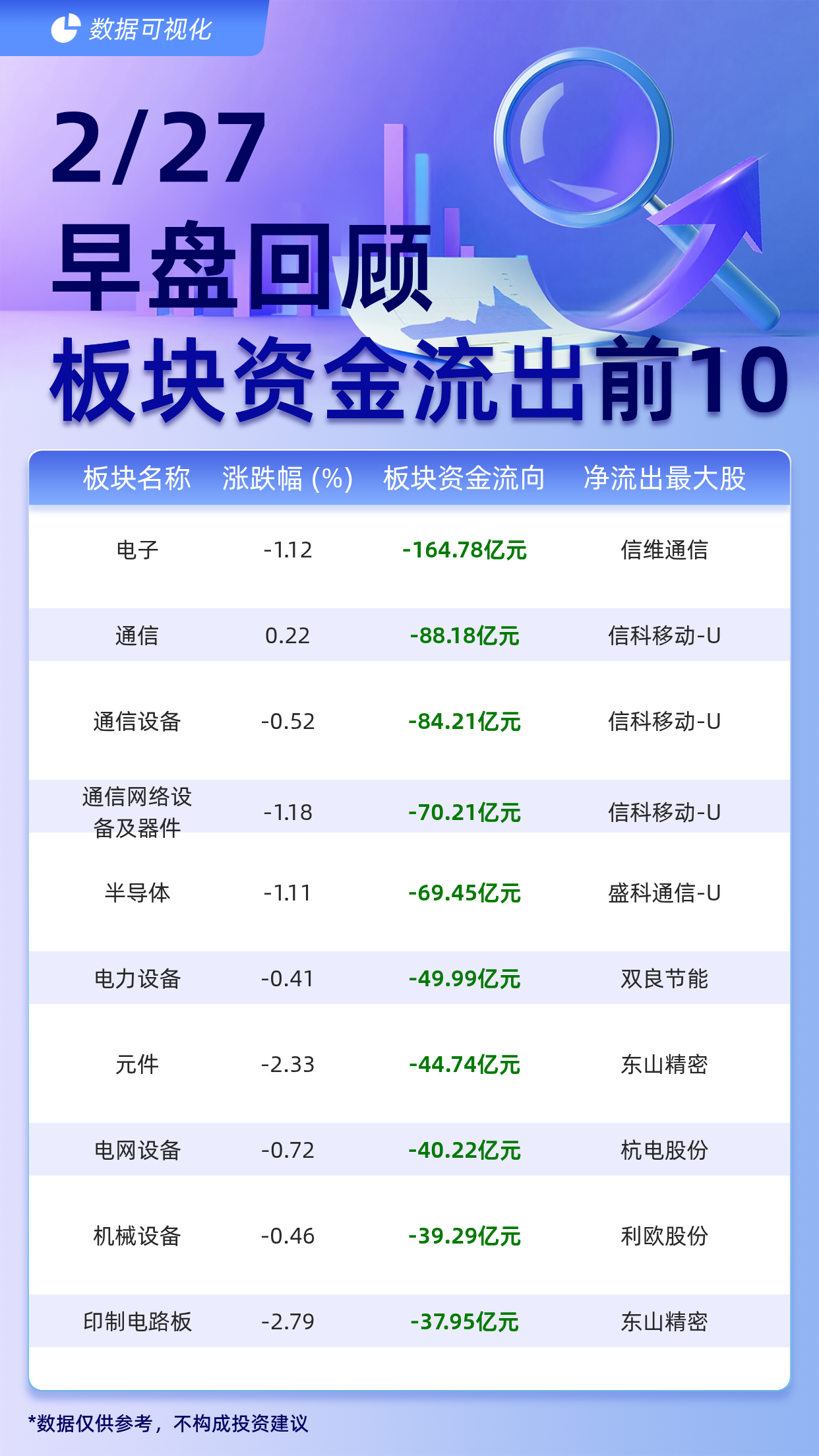
主力板块资金流出前10:电子流出164.78亿元、通信流出88.18亿元
Jin Rong Jie· 2026-02-27 03:51
Group 1 - The main market experienced a net outflow of 29.449 billion yuan in principal funds as of February 27 [1] - The top ten sectors with the largest fund outflows included Electronics (-16.478 billion yuan), Communications (-8.818 billion yuan), and Semiconductor (-6.945 billion yuan) [1] - The sector with the highest net outflow was Electronics, with a decline of 1.12% [2] Group 2 - The Communication sector saw a slight increase of 0.22% but still experienced a net outflow of 8.818 billion yuan [2] - The Communication Equipment sector had a net outflow of 8.421 billion yuan, with a decline of 0.52% [2] - The Power Equipment sector recorded a net outflow of 4.999 billion yuan, with a decrease of 0.41% [3] Group 3 - The Components sector faced a significant decline of 2.33% with a net outflow of 4.474 billion yuan [3] - The Grid Equipment sector had a net outflow of 4.022 billion yuan, reflecting a decrease of 0.72% [3] - The Printed Circuit Board sector experienced the largest decline of 2.79% with a net outflow of 3.795 billion yuan [3]