
金属冶炼

Search documents
银河期货每日早盘观察-20251201
Yin He Qi Huo· 2025-12-01 03:31
期 货 眼 ·日 迹 每日早盘观察 银河期货研究所 2025 年 12 月 1 日 0 / 48 研究所 期货眼·日迹 | 钢材:钢价区间震荡,成本存在支撑 13 | | --- | | 双焦:震荡运行 可逢低轻仓试多远月合约 13 | | 铁矿:偏空思路对待 14 | | 铁合金:减产趋势下价格底部震荡 15 | | 金银:12 月降息再成基准情景 金银维持偏强走势 17 | | --- | | 铂钯:铂钯价格上周五小幅回调,今晨注意跳空高开风险 18 | | 铜:美铜高升水,非美地区供应担忧加剧 18 | | 氧化铝:减产难落地 氧化铝持续承压 19 | | 电解铝:宏微观共振 铝价偏强运行 20 | | 铸造铝合金:铝合金随铝价偏强运行 21 | | 锌:宽幅震荡 22 | | 铅:关注冶炼成本支撑有效性 23 | | --- | | 镍:减产刺激镍价反弹 库存压制高度 24 | | 不锈钢:供需两弱 等待宏观刺激 25 | | 工业硅:区间震荡,短期多单及时兑现收益 25 | | 多晶硅:短期偏强,但有回落风险 26 | | 碳酸锂:长线回调充分买入 26 | | 锡:刚果(金)矿端供应扰动,锡价冲高 ...
A股开盘速递 | 指数高开高走!金属板块集体拉升 白银有色(601212.SH)多股涨停
智通财经网· 2025-12-01 02:00
盘面上,商业航天概念股集体拉升,乾照光电创新高,雷科防务、顺灏股份、银河电子2连板,通宇通 讯涨停,航天发展、利君股份、达华智能跟涨;影视板块走强,中国电影涨停录得2连板,上海电影、幸 福蓝海、横店影视、奥飞娱乐、博纳影业涨幅靠前;白银、铜等金属板块集体活跃,兴业银锡、白银有 色涨超7%,盛达资源、湖南白银、江西铜业等股纷纷高开;固态电池概念股冲高,海科新源盘中创新 高,道明光学涨停,天华新能涨超15%。 跌幅方面,互联网电商、多元金融、机场航运等股跌幅居前。 展望后市,中信证券认为,市场呈现出低波慢牛的特征,未来需要内需的重大变化打开市场高度,在超 预期的变化出现前,配置上建议延续资源/传统制造业定价权的重估以及企业出海两个方向。 热门板块 1、影视板块走强 影视板块走强,中国电影涨停录得2连板,上海电影、幸福蓝海、横店影视、奥飞娱乐、博纳影业涨幅 靠前。 市场三大指数高开高走。截至9:43,上证指数涨0.23%,深证成指涨0.66%,创业板指涨0.54%。 1、中信证券:市场呈现出低波慢牛的特征,需要内需的变化打开高度 中信证券认为,市场呈现出低波慢牛的特征,主要宽基的波动率有所下降,回撤以及夏普比率亦好 ...

宏观金融类:文字早评2025/12/01-20251201
Wu Kuang Qi Huo· 2025-12-01 01:47
1. Report's Industry Investment Rating No relevant content provided. 2. Core Viewpoints of the Report - In the short - term, the market rotation has accelerated, and the risk appetite has decreased. However, policy support for the capital market remains unchanged, and technology and growth are still the main market trends. Index investment should focus on buying on dips in the medium - to - long - term [4]. - In the fourth quarter, the bond market supply - demand pattern may improve, but it will maintain a volatile trend under the background of weak domestic demand recovery and improved inflation expectations. Attention should be paid to the impact of stock - bond linkage and liquidity [7]. - For most commodities, the market situation is complex. Some are expected to strengthen due to factors such as supply disturbances and cost support, while others may face pressure due to factors such as over - supply and weak demand. It is necessary to pay attention to macro - events and industry fundamentals [41][42] 3. Summary by Directory 3.1 Macro - financial Category 3.1.1 Stock Index - **Market Information**: In November, the manufacturing PMI was 49.2%, and the non - manufacturing business activity index was 49.5%. The National Space Administration established the Commercial Space Department. The central bank continued to ban virtual currencies. Metal prices soared on Friday, with silver and copper hitting record highs [2]. - **Strategy Viewpoint**: The market rotation has accelerated, and the risk appetite has decreased. The policy support for the capital market remains unchanged, and the index should be bought on dips in the medium - to - long - term [4]. 3.1.2 Treasury Bonds - **Market Information**: On Friday, the main contracts of TL, T, TF, and TS had different changes. In November, the manufacturing PMI improved, and the non - manufacturing business activity index declined. Japan revised its bond issuance plan. The central bank conducted a 7 - day reverse repurchase operation on Friday, with a net withdrawal of funds [5]. - **Strategy Viewpoint**: In November, the manufacturing PMI data showed an overall improvement in manufacturing sentiment, but the service industry was weak. The social financing growth rate may remain weak at the end of the year. The bond market is expected to maintain a volatile trend in the fourth quarter, and attention should be paid to stock - bond linkage and liquidity [7]. 3.1.3 Precious Metals - **Market Information**: Shanghai gold and silver futures rose. COMEX gold and silver also had certain prices. Silver has entered the accelerated peak - hitting stage, and its technical trend conforms to the characteristics of previous second - stage rises. The current overseas position and inventory levels are not in a state of "delivery difficulties" [8]. - **Strategy Viewpoint**: The silver price is in an accelerated rise, and attention should be paid to the pressure level of 14,500 yuan/kg. If the price weakens during the day, profits should be taken in time. It is risky to open new long positions or short at high prices. Shanghai gold is at the end of a triangular convergence breakthrough pattern, and it is recommended to buy on dips [9]. 3.2 Non - ferrous Metals Category 3.2.1 Copper - **Market Information**: Concerns about smelting production cuts led copper prices to break through historical highs. LME copper inventory increased, and domestic futures exchange inventory decreased. The domestic spot import was at a loss, and the refined - scrap price difference widened [11]. - **Strategy Viewpoint**: Geopolitical factors still exist, but the market focuses on the Fed's interest rate meeting. The supply of copper raw materials is tight, and the expectation of smelting production cuts drives copper prices to rise. The downstream operating rate is stable and strong, so copper prices are expected to continue to strengthen [12]. 3.2.2 Aluminum - **Market Information**: Aluminum prices rebounded on Friday. The inventory of domestic and LME aluminum ingots continued to decline. The aluminum rod processing fee continued to decline, and the trading was average [13]. - **Strategy Viewpoint**: The inventory of domestic and LME aluminum ingots is at a relatively low level. Coupled with supply disturbances, stable downstream operating rates, and rising copper prices, the center of gravity of aluminum prices is expected to rise further [14]. 3.2.3 Zinc - **Market Information**: The Shanghai zinc index rose slightly. The LME zinc price fell. The domestic social zinc inventory decreased slightly, but the total inventory increased after considering the in - transit and factory inventories. The zinc import was at a loss [15]. - **Strategy Viewpoint**: The visible inventory of zinc ore has increased, but the zinc concentrate TC has continued to decline, and the zinc smelting profit is under pressure. The downstream operating rate has declined marginally. The current situation of the zinc industry is not in resonance with the strong macro - sentiment, so zinc prices are expected to fluctuate widely in the short - term [16]. 3.2.4 Lead - **Market Information**: The Shanghai lead index rose. The LME lead price also rose. The domestic social lead inventory decreased slightly. The refined - scrap price difference was at par [17]. - **Strategy Viewpoint**: The visible inventory of lead ore has increased, the primary smelting operating rate has declined, and the secondary smelting operating rate has continued to rise. The downstream battery enterprise operating rate has increased marginally, and the visible inventory of domestic lead ingots has decreased. In the Fed's interest - rate cut cycle, the sentiment of the non - ferrous metals industry is relatively positive, so lead prices are expected to be strong in the short - term [17]. 3.2.5 Nickel - **Market Information**: Nickel prices fluctuated narrowly on Friday. The spot price premiums of different brands were stable, and the nickel ore price was stable, while the nickel iron price continued to decline [18]. - **Strategy Viewpoint**: The oversupply pressure of nickel is still large, but with the stabilization of nickel iron prices and the warming of the macro - atmosphere, nickel prices may turn to a volatile trend in the short - term. Attention should be paid to the trends of nickel iron and ore prices [19]. 3.2.6 Tin - **Market Information**: The Shanghai tin main contract price rose. The inventory of the futures exchange increased, and the LME tin inventory also increased. The supply of tin concentrate has been slightly relieved, but the conflict in Congo (Kinshasa) has affected transportation. The demand in traditional fields is weak, but emerging fields provide long - term support. The social inventory has decreased [21]. - **Strategy Viewpoint**: Although the demand in the tin market is weak in the short - term, the supply disturbance is the decisive factor for short - term prices. Therefore, tin prices are likely to fluctuate strongly. It is recommended to wait and see [22]. 3.2.7 Lithium Carbonate - **Market Information**: The spot price of lithium carbonate decreased, while the futures price increased. The price of Australian lithium concentrate increased [23]. - **Strategy Viewpoint**: The improvement of fundamentals boosts the bullish sentiment, but there are differences in future demand expectations. The change of the mining permit of Jiaxiawo Mine is a short - term positive for the spot but a long - term negative for supply. It is recommended to wait and see or use options, and pay attention to the cell production schedule in the first quarter and the atmosphere of the equity market [23]. 3.2.8 Alumina - **Market Information**: The alumina index rose. The domestic spot price was at a premium to the futures. The overseas price fell, and the import window was opened. The futures inventory increased [24]. - **Strategy Viewpoint**: The overseas ore shipment will gradually recover, and the alumina smelting capacity is in an over - supply situation. However, the current price is close to the cost line of most manufacturers, and the expectation of production cuts has increased. It is recommended to wait and see in the short - term [26]. 3.2.9 Stainless Steel - **Market Information**: The stainless steel main contract price fell. The spot prices in different markets were stable or decreased. The raw material prices were stable, and the futures and social inventories decreased [27]. - **Strategy Viewpoint**: The steel mill production is at a high level, the demand has improved marginally, but the cost pressure has squeezed the profit, and the inventory pressure is still significant. The market lacks a clear upward momentum, so stainless steel prices are expected to fluctuate widely in the short - term [27]. 3.2.10 Cast Aluminum Alloy - **Market Information**: The price of cast aluminum alloy rebounded. The trading volume decreased slightly, and the inventory increased. The downstream demand was mainly for rigid needs [28]. - **Strategy Viewpoint**: The cost of cast aluminum alloy is relatively stable, and there are policy disturbances on the supply side. The demand is relatively average, so the price is expected to follow the trend of aluminum prices in the short - term [29]. 3.3 Black Building Materials Category 3.3.1 Steel - **Market Information**: The prices of rebar and hot - rolled coil futures rose. The spot prices in different regions were stable or increased [31]. - **Strategy Viewpoint**: The commodity market adjusted on Friday, and the prices of steel products fluctuated. The supply and demand of rebar decreased, and the inventory continued to decline. The output of hot - rolled coil increased, and the inventory decreased slightly. The anti - dumping tax imposed by South Korea on Chinese steel will affect exports. The demand for steel has entered the off - season, so attention should be paid to the actual progress of production cuts and important meetings [32]. 3.3.2 Iron Ore - **Market Information**: The iron ore main contract price fell. The spot price was at a premium to the futures, and the port inventory increased [33]. - **Strategy Viewpoint**: The overseas iron ore shipment decreased, the demand weakened, the number of blast furnace overhauls increased, and the steel mill profitability was at a low level. The overall inventory of iron ore is still high, but there are structural contradictions, and the spot has certain support. Iron ore prices are expected to operate within an oscillatory range [34]. 3.3.3 Glass and Soda Ash - **Market Information**: The glass main contract price rose, the inventory decreased, and the trading volume of long and short positions decreased. The soda ash main contract price rose slightly, the inventory decreased, and the trading volume of long and short positions also decreased [36][38]. - **Strategy Viewpoint**: For glass, the supply has shrunk, the market sentiment has improved briefly, but the overall trading is still light, and the price is expected to fluctuate widely. It is recommended to try shorting at high prices. For soda ash, the industry operating rate has increased slightly, the inventory has decreased slightly, the price is stable, but it is still recommended to be bearish in the short - term [37][38]. 3.3.4 Manganese Silicon and Ferrosilicon - **Market Information**: The manganese silicon main contract price fell slightly, and the ferrosilicon main contract price was flat. The prices of the two in the spot market were stable, and the spot was at a premium to the futures [39]. - **Strategy Viewpoint**: The market sentiment has improved. The black - building materials sector is still in a weak state, but there is no need to be overly pessimistic. For manganese silicon, the fundamentals are not ideal, and there are no major contradictions. For ferrosilicon, the supply - demand fundamentals have no obvious contradictions, and the operability is low [41][42]. 3.3.5 Industrial Silicon and Polysilicon - **Industrial Silicon** - **Market Information**: The industrial silicon futures main contract price rose slightly. The spot price was stable, and the trading volume decreased [43]. - **Strategy Viewpoint**: The short - term trading volume of industrial silicon has decreased, and the trend has become dull. The production has continued to decline, the demand from the polysilicon sector has weakened, and the overall supply - demand pattern is weak. The price is easily affected by the sentiment of other new - energy varieties [44]. - **Polysilicon** - **Market Information**: The polysilicon futures main contract price rose. The spot prices of different types were stable, and the futures was at a premium to the spot [45][46]. - **Strategy Viewpoint**: The production of polysilicon is expected to decline in December, the downstream silicon wafer production is expected to decrease, and the inventory pressure is difficult to relieve. The spot price is stable, and there are risks in the near - month contract due to delivery games. Attention should be paid to the final implementation of the platform company [47]. 3.4 Energy and Chemicals Category 3.4.1 Rubber - **Market Information**: The rubber price rebounded. The flood in the Thai rubber - producing area receded, and the exchange inventory was low. The tire factory operating rate was weak, and the inventory increased [49][50]. - **Strategy Viewpoint**: It is recommended to adopt a neutral strategy, wait and see, or conduct short - term trading. A partial position can be established for the hedging strategy of buying RU2601 and selling RU2609 [52]. 3.4.2 Crude Oil - **Market Information**: The INE crude oil futures price rose, and the prices of related refined oil products also rose. The gasoline and diesel inventories in Singapore decreased, while the fuel oil inventory increased [53]. - **Strategy Viewpoint**: Although the geopolitical premium has disappeared, the OPEC supply has not increased significantly. It is not advisable to be overly bearish on oil prices in the short - term. A range - trading strategy is maintained, and it is recommended to wait and see in the short - term [54]. 3.4.3 Methanol - **Market Information**: The methanol spot and futures prices rose, the basis was negative, and the 1 - 5 spread increased [55]. - **Strategy Viewpoint**: The potential positive factors of Iranian plant shutdowns have been realized, the market has stopped falling and stabilized, and the market expectation has changed. The supply is expected to remain high, and the market is expected to turn to an oscillatory adjustment after the positive factors are realized. It is recommended to wait and see on a single - side trading and pay attention to the positive spread arbitrage opportunity [55]. 3.4.4 Urea - **Market Information**: The urea spot and futures prices rose, the basis was negative, and the 1 - 5 spread was negative [56]. - **Strategy Viewpoint**: The urea price is expected to gradually emerge from the bottom range. The supply is at a relatively high level, the demand has improved, and the inventory has decreased. The price has support from export policies and costs, so it is recommended to consider buying at low prices [57]. 3.4.5 Pure Benzene and Styrene - **Market Information**: The pure benzene spot and futures prices were stable, the basis decreased. The styrene spot price fell, the futures price rose, and the basis weakened [58]. - **Strategy Viewpoint**: The non - integrated profit of styrene is neutral to low, and the valuation has a large upward - repair space. The supply of pure benzene is still wide, the styrene operating rate is rising, and the inventory is accumulating. When the inventory reversal point occurs, the non - integrated profit of styrene can be long [59]. 3.4.6 PVC - **Market Information**: The PVC futures price rose, the spot price rose, the basis was negative, and the 1 - 5 spread was negative. The production cost increased, the operating rate increased, and the inventory increased [60]. - **Strategy Viewpoint**: The enterprise profit is at a low level, the supply is high, the demand is weak, and the export cannot digest the excess capacity. It is recommended to short at high prices in the medium - term [61][62]. 3.4.7 Ethylene Glycol - **Market Information**: The ethylene glycol futures price rose, the spot price fell, the basis decreased, and the 1 - 5 spread decreased. The supply load increased, the downstream load increased slightly, and the port inventory was stable [63]. - **Strategy Viewpoint**: The domestic supply is expected to decrease in December, the import volume will decrease slightly, and the port inventory accumulation may slow down. In the medium - term, the supply - demand pattern is still weak, and it is recommended to short at high prices [64]. 3.4.8 PTA - **Market Information**: The PTA futures price rose, the spot price rose, the basis was negative, and the 1 - 5 spread was negative. The PTA operating rate increased, the downstream load increased slightly, and the inventory decreased [65]. - **Strategy Viewpoint**: The unexpected maintenance of PTA is expected to decrease. The downstream polyester fiber inventory and profit pressure are low, but the bottle - chip load is difficult to increase. The PTA processing fee has limited upward space, and the PX has a risk of a slight valuation correction [66]. 3.4.9 p - Xylene - **Market Information**: The p - xylene futures price rose, the spot price rose, the basis was negative, and the 1 - 3 spread was negative. The p - xylene operating rate decreased, the downstream PTA operating rate increased, the import volume increased, and the inventory increased [67]. - **Strategy Viewpoint**: The p - xylene load is high, the downstream PTA operating rate is low, and the PX inventory is expected to accumulate slightly in November. The valuation is at a neutral level, and there is a risk of a slight valuation correction [68]. 3.4.10 Polyethylene (PE) - **Market Information**: The PE futures price rose, the spot price was stable, the basis weakened, the upstream operating rate decreased slightly, the inventory decreased, and the downstream operating rate increased slightly [69]. - **Strategy Viewpoint**: The OPEC+ plan to suspend production growth may support oil prices. The PE valuation has limited downward space, but the high number of warehouse receipts suppresses the price. The supply is limited, the inventory is decreasing, and it is recommended to short the LL1 - 5 spread at high prices
美联储降息预期快速回温,金属价格震荡上行:有色金属行业周报(20251124-20251128)-20251130
Huachuang Securities· 2025-11-30 09:44
Investment Rating - The report maintains a "Buy" recommendation for the non-ferrous metals sector, driven by rising expectations of interest rate cuts by the Federal Reserve, leading to a rebound in metal prices [2]. Core Views - The report highlights three main industry perspectives: 1. The expectation of interest rate cuts by the Federal Reserve is likely to benefit both base and precious metals, leading to price increases [6]. 2. Silver prices have reached historical highs due to low inventory levels and rising demand, supported by the Fed's dovish stance [6]. 3. Ongoing supply disruptions in copper mining are expected to lead to reduced smelting capacity and higher copper prices [6]. Summary by Sections Industry Overview - The non-ferrous metals sector includes 126 listed companies with a total market capitalization of approximately 457.86 billion yuan, representing 3.86% of the overall market [3]. - Recent performance metrics show a 67.3% increase in absolute performance over the past year, with a relative performance increase of 50.4% [4]. Key Events and Impacts - The Federal Reserve's recent meeting indicated a significant division among officials regarding future rate cuts, with market expectations for a 25 basis point cut in December rising to 86.4% [6]. - Silver prices surged to 12,727 yuan per kilogram, marking a 9% increase from the previous week, attributed to low inventory levels and strong demand [6]. - Copper smelting capacity is projected to face reductions due to ongoing supply disruptions, with expectations of a decrease in processing fees, which may support higher copper prices [6]. Company Insights - Yunnan Aluminum Co. plans to acquire stakes in several subsidiaries for 2.267 billion yuan, increasing its electrolytic aluminum capacity by 154,500 tons [8]. - Tianshan Aluminum has initiated a green low-carbon efficiency improvement project, expected to enhance its annual production capacity to 1.4 million tons [8]. - China Hongqiao has completed a share placement, raising approximately 11.49 billion HKD for project development and debt repayment, indicating strong confidence in future growth [10]. Stock Recommendations - The report recommends focusing on precious metals and copper-aluminum sectors, highlighting companies such as Zijin Mining, Jinchuan Group, and China Hongqiao as key investment opportunities [11].



锡周报:短期供给扰动,预计锡价偏强震荡-20251129
Wu Kuang Qi Huo· 2025-11-29 11:56
短期供给扰动,预计 锡价偏强震荡 锡周报 2025/11/29 刘显杰(联系人) 0755-23375125 liuxianjie@wkqh.cn 交易咨询号:Z0015924 从业资格号:F03130746 吴坤金(有色金属组) 从业资格号:F3036210 CONTENTS 目录 01 周度评估及策略推荐 04 供给端 02 期现市场 周度评估及策略推荐 ◆ 成本端:10月国内进口锡精矿增量明显,原料端供应紧缺略有缓解。但短期刚果(金)冲突恶化,对锡矿运输造成扰动,市场担忧情绪有所 升温。根据中国海关公布的数据,10月锡矿砂及其精矿进口量11632实物吨(折合约4938金属吨),同比下降15.74%,环比增加43.36%。其 中从缅甸的进口量为2367吨(折合约861金属吨),同比下降43.64%,环比增加1.50%;除缅甸外10月从其他国家合计进口量为9266吨(折合 约4077金属吨),同比下降5.90%,环比增加57.05%。 ◆ 供给端:缅甸佤邦锡矿复产进度缓慢,出口量维持低位,云南地区冶炼企业原材料紧张现象仍存,短期开工率持稳,但进一步上行动力不足。 江西地区则因废料显著减少,粗锡供应不足,精锡 ...
金属普涨 期铜再创历史新高 因供应紧张和美元走软【11月28日LME收盘】
Wen Hua Cai Jing· 2025-11-29 00:27
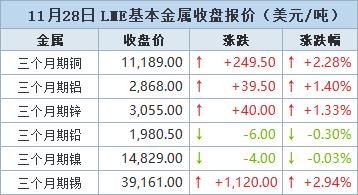
Core Insights - The London Metal Exchange (LME) copper futures reached a historic high of over $11,200 per ton due to tightening metal supplies outside the U.S. and a weakening dollar [1][4]. Group 1: Copper Market Dynamics - On November 28, LME three-month copper rose by $249.5, or 2.28%, closing at $11,189.0 per ton, with an intraday peak of $11,210.50 [1][2]. - The increase in copper prices is attributed to refined copper inflows into the U.S., leading to supply tightness in other regions, supported by a favorable macroeconomic environment [4]. - The premium for copper from Chile's state-owned Codelco to U.S. customers reached a historic high, exceeding $500 per ton above LME prices, reflecting supply-demand fundamentals [5]. Group 2: Currency and Economic Factors - The weakening of the dollar, driven by market expectations of potential interest rate cuts by the Federal Reserve, has made dollar-denominated metals more affordable for holders of other currencies [5]. - The LME three-month tin price increased by $1,120, or 2.94%, reaching $39,161.0 per ton, amid concerns over supply disruptions from the Democratic Republic of the Congo [5]. Group 3: LME Fee Adjustments - The LME announced a revision of its fee structure, reducing customer trading and settlement fees by 7.4%-8.5%, effective January 1, 2026, with trading fee adjustments starting March 1, 2026 [6].

11月27日LME金属库存及注销仓单数据
Wen Hua Cai Jing· 2025-11-28 09:30
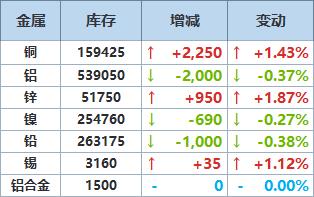
Group 1 - The overall inventory levels for various metals show mixed trends, with copper and zinc experiencing increases, while aluminum and lead show declines [1][2][4][5][9]. - Copper inventory increased by 2,250 tons, reaching a total of 159,425 tons, reflecting a 1.43% rise [1][4]. - Zinc inventory rose by 950 tons to 51,750 tons, marking a 1.87% increase [1][9]. Group 2 - Aluminum inventory decreased by 2,000 tons to 539,050 tons, a decline of 0.37% [1][5]. - Lead inventory data indicates a stable situation with no significant changes reported [6]. - Tin inventory increased by 35 tons to 3,160 tons, reflecting a 1.12% rise [1][11]. Group 3 - The registered warehouse stocks for copper increased by 8.23% to 6,575 tons, while the cancellation rate for aluminum stocks was reported at 9.92% [2][5]. - The cancellation rate for zinc stocks was 10.58%, indicating a stable demand [2][9]. - The registered stocks for tin showed a cancellation rate of 11.39%, suggesting a healthy turnover [2][11].
云南国科希望供应链有限责任公司成立 注册资本100万人民币
Sou Hu Cai Jing· 2025-11-28 07:47
Core Viewpoint - Yunnan Guoke Hope Supply Chain Co., Ltd. has been established with a registered capital of 1 million RMB, focusing on various metal and technology-related services [1] Group 1: Company Overview - The legal representative of Yunnan Guoke Hope Supply Chain Co., Ltd. is Pang Haopeng [1] - The company has a registered capital of 1 million RMB [1] Group 2: Business Scope - The company engages in the sale of non-ferrous metal alloys and precious metal smelting (excluding rare earths, radioactive minerals, and tungsten) [1] - It is involved in the manufacturing of metal materials, mineral processing, and sales of metallurgical equipment [1] - The company also focuses on the smelting of rare earth metals and offers information technology consulting services [1] - Additional services include technology development, consulting, transfer, promotion, and import-export activities [1] - The company sells chemical products (excluding licensed chemical products) and produces and sells magnetic materials and rare earth functional materials [1]
金融期货早评-20251128
Nan Hua Qi Huo· 2025-11-28 05:23
1. Report Industry Investment Ratings - Not provided in the content 2. Core Views of the Report - **Overall Economic Situation**: Overseas, the US employment data shows significant differentiation, and the Fed officials' recent statements strengthen the expectation of a December interest rate cut. Domestically, the economic fundamentals are cooling marginally, and the market's expectation of policy intensification is rising [2]. - **Renminbi Exchange Rate**: The on - shore RMB against the US dollar is expected to show a "sideways bottoming, slowly declining central tendency" trend. In the short term, the appreciation rhythm may slow down, but the overall appreciation trend remains unchanged [3]. - **Stock Index**: The stock index is expected to have a narrow - range sideways movement in the short term due to weak fundamentals and lack of new positive factors [4]. - **Treasury Bonds**: The medium - term view is to hold long positions, and new long positions can be gradually established at low prices [5]. - **Container Shipping to Europe**: The container shipping to Europe futures is expected to be sideways and weak in the short term, with geopolitical expectations dominating the market sentiment [7]. - **Precious Metals**: In the medium - to - long term, the price of precious metals will continue to rise. In the short term, pay attention to the December Fed interest rate cut expectation and the 60 - day moving average. Dips are considered opportunities to increase long positions [10]. - **Copper**: The futures price is expected to move upwards if it breaks through 87,000. Downstream enterprises in need can buy futures for hedging [12]. - **Aluminum Industry Chain**: Aluminum is expected to have a high - level sideways movement; alumina is expected to be weak; cast aluminum alloy is expected to have a high - level sideways movement [13]. - **Zinc**: Zinc is expected to have a strong sideways movement in the short term due to stalemate fundamentals [14]. - **Nickel and Stainless Steel**: They are expected to continue their wide - range sideways movement, with limited improvement in fundamentals [15]. - **Tin**: Tin is expected to have a high - level sideways movement. It is not recommended to short in the short term [17]. - **Lithium Carbonate**: In the short term, be cautious about chasing high prices near 100,000 yuan/ton. In the medium - to - long term, seize the opportunity to build long positions after dips [19]. - **Industrial Silicon and Polysilicon**: Industrial silicon is expected to have a sideways movement in the short term and has long - term value for position building at low prices. Polysilicon should pay attention to position risks [21]. - **Lead**: Lead is expected to move sideways between 16,800 - 17,100 yuan/ton [24]. - **Rebar and Hot - Rolled Coil**: They are expected to move within a range, with rebar between 2,900 - 3,200 yuan/ton and hot - rolled coil between 3,100 - 3,400 yuan/ton [26]. - **Iron Ore**: Iron ore is currently strong, but it is recommended to wait for the basis to repair and then consider shorting at high prices [28]. - **Coking Coal and Coke**: Coking coal has limited downward space and has long - term multi - allocation potential for the far - month contract. For coke, it is not recommended to blindly short [29]. - **Silicon Iron and Silicon Manganese**: They are expected to be sideways and weak due to high inventory and weak demand [31]. - **LPG**: The domestic LPG is relatively strong, and the short - term arrival is expected to remain low [32]. - **PTA - PX**: The PX - PTA may decline after the previous speculation funds leave. The TA01 contract has a large pressure above 4,800 yuan, and the processing fee should be operated within the 200 - 290 range [35]. - **MEG - Bottle Chip**: Maintain the idea of shorting at high prices. Consider shorting or selling call options above 3,900 yuan for the 01 contract [37]. - **PP**: PP is expected to maintain a low - level sideways movement due to weak spot prices and lack of upward drivers [39]. - **PE**: PE is expected to continue its supply - strong and demand - weak situation, and a put - option strategy can be considered [42]. - **Pure Benzene and Styrene**: Pay attention to the actual transaction of US - South Korea pure benzene and the domestic large - factory maintenance plan [44]. - **Fuel Oil**: The high - sulfur fuel oil cracking is expected to decline in the future, while the low - sulfur fuel oil cracking has an upward drive [45][47]. - **Asphalt**: Asphalt is expected to move sideways in the short term. Pay attention to the winter storage policy [49]. - **Rubber and 20 - Rubber**: The rubber system is expected to maintain a wide - range sideways movement, with light - colored rubber relatively stronger [51]. - **Glass, Soda Ash, and Caustic Soda**: Soda ash is expected to be weak; glass 01 contract will follow the reality, and pay attention to the cold - repair situation; caustic soda has weak supply - demand fundamentals [52][53][54]. - **Pulp and Offset Paper**: They are expected to maintain a sideways or sideways - weak movement in the short term [56]. - **Log**: The log market is expected to be sideways and weak. Consider shorting at high prices and 01 - 03 reverse - spread opportunities [57]. - **Propylene**: Propylene is under the weak pressure of PP, and the domestic supply remains loose [59]. 3. Summaries by Relevant Catalogs Financial Futures - **Macro**: The profit of domestic industrial enterprises is declining marginally. The US employment data is differentiated, and the Fed's December interest rate cut expectation is strengthened [1][2]. - **Renminbi Exchange Rate**: The on - shore RMB against the US dollar closed at 7.0806, down 4 points. The mid - price appreciated to the highest level since October 14, 2024. It is expected to show a "sideways bottoming, slowly declining central tendency" trend [3]. - **Stock Index**: The stock index rose and then fell, with shrinking trading volume. It is expected to have a narrow - range sideways movement in the short term [4]. - **Treasury Bonds**: The treasury bonds were sideways on Thursday. It is recommended to hold long positions in the medium term and gradually build new long positions at low prices [4][5]. - **Container Shipping to Europe**: The container shipping to Europe futures was narrowly sideways. It is expected to be sideways and weak in the short term, with geopolitical expectations dominating the market sentiment [5][7]. Commodities Non - Ferrous Metals - **Precious Metals**: Platinum and palladium rose and then fell, while gold and silver maintained a sideways movement. The Fed's December interest rate cut expectation is high. It is expected that the price of precious metals will rise in the medium - to - long term [8][10]. - **Copper**: The INE copper price rose sharply. The global copper market is expected to be in short supply in 2026. The futures price is expected to move upwards if it breaks through 87,000 [11][12]. - **Aluminum Industry Chain**: Aluminum is expected to have a high - level sideways movement; alumina is expected to be weak; cast aluminum alloy is expected to have a high - level sideways movement [13][14]. - **Zinc**: Zinc is expected to have a strong sideways movement in the short term due to stalemate fundamentals [14]. - **Nickel and Stainless Steel**: They are expected to continue their wide - range sideways movement, with limited improvement in fundamentals [15][16]. - **Tin**: Tin is expected to have a high - level sideways movement. It is not recommended to short in the short term [17]. - **Lithium Carbonate**: The futures price fell. It is recommended to be cautious about chasing high prices near 100,000 yuan/ton in the short term and seize the opportunity to build long positions after dips in the medium - to - long term [18][19]. - **Industrial Silicon and Polysilicon**: Industrial silicon is expected to have a sideways movement in the short term and has long - term value for position building at low prices. Polysilicon should pay attention to position risks [19][21]. - **Lead**: Lead is expected to move sideways between 16,800 - 17,100 yuan/ton [24]. Ferrous Metals - **Rebar and Hot - Rolled Coil**: They are expected to move within a range, with rebar between 2,900 - 3,200 yuan/ton and hot - rolled coil between 3,100 - 3,400 yuan/ton [25][26]. - **Iron Ore**: Iron ore is currently strong, but it is recommended to wait for the basis to repair and then consider shorting at high prices [28]. - **Coking Coal and Coke**: Coking coal has limited downward space and has long - term multi - allocation potential for the far - month contract. For coke, it is not recommended to blindly short [29][30]. - **Silicon Iron and Silicon Manganese**: They are expected to be sideways and weak due to high inventory and weak demand [31]. Energy and Chemicals - **LPG**: The domestic LPG is relatively strong, and the short - term arrival is expected to remain low [32]. - **PTA - PX**: The PX - PTA may decline after the previous speculation funds leave. The TA01 contract has a large pressure above 4,800 yuan, and the processing fee should be operated within the 200 - 290 range [35]. - **MEG - Bottle Chip**: Maintain the idea of shorting at high prices. Consider shorting or selling call options above 3,900 yuan for the 01 contract [37]. - **PP**: PP is expected to maintain a low - level sideways movement due to weak spot prices and lack of upward drivers [39]. - **PE**: PE is expected to continue its supply - strong and demand - weak situation, and a put - option strategy can be considered [42]. - **Pure Benzene and Styrene**: Pay attention to the actual transaction of US - South Korea pure benzene and the domestic large - factory maintenance plan [44]. - **Fuel Oil**: The high - sulfur fuel oil cracking is expected to decline in the future, while the low - sulfur fuel oil cracking has an upward drive [45][47]. - **Asphalt**: Asphalt is expected to move sideways in the short term. Pay attention to the winter storage policy [49]. - **Rubber and 20 - Rubber**: The rubber system is expected to maintain a wide - range sideways movement, with light - colored rubber relatively stronger [51]. - **Glass, Soda Ash, and Caustic Soda**: Soda ash is expected to be weak; glass 01 contract will follow the reality, and pay attention to the cold - repair situation; caustic soda has weak supply - demand fundamentals [52][53][54]. - **Pulp and Offset Paper**: They are expected to maintain a sideways or sideways - weak movement in the short term [56]. - **Log**: The log market is expected to be sideways and weak. Consider shorting at high prices and 01 - 03 reverse - spread opportunities [57]. - **Propylene**: Propylene is under the weak pressure of PP, and the domestic supply remains loose [59].
首席点评:感恩节外盘休市
Shen Yin Wan Guo Qi Huo· 2025-11-28 01:43
Report Summary 1. Report Industry Investment Rating | Variety | Rating | | --- | --- | | (IH) Index Futures | Bullish | | Index Futures (IF) | Bullish | | Index Futures (IC) | Bullish | | Index Futures (IM) | Bullish | | Treasury Bonds (TL) | Bullish | | Treasury Bonds (T) | Bullish | | Crude Oil | Bearish | | Methanol | Bearish | | Rubber | Bullish | | Rebar | Bullish | | Hot Rolled Coil | Bullish | | Iron Ore | Bullish | | Coking Coal | Bearish | | Coke | Bearish | | Manganese Silicon | Bearish | | Ferrosilicon | Bearish | | Copper | Bullish | | Aluminum | Bullish | | Lithium Carbonate | Bullish | | Apple | Bearish | | Corn | Bullish | | Soda Ash | Bearish | | Glass | Bearish | | Container Shipping to Europe | Bearish | [5] 2. Core Views - The 14th Five-Year Plan still focuses on technological self-reliance, and the technology sector is expected to be a long-term direction. The market style may return to balance, but large-cap value may dominate in the short term. In the face of economic pressure, incremental policies are expected to be introduced, and a long-term and steady bull market is expected to continue [2][11]. - For coking coal and coke, the short-term market may correct, and attention should be paid to changes in coking coal supply and hot metal production [2][20]. - The downward trend of crude oil is difficult to reverse, although the SC night session rose 1.46%. The market has mixed expectations for the restart of the Ukraine peace process [3][13]. 3. Summary by Catalog 3.1 Daily Main News - **International News**: Russian President Putin stated that the US delegation will visit Moscow next week. Russia generally agrees to use the US list for resolving the Ukraine issue as the basis for future negotiations. If the Ukrainian armed forces withdraw, Russia will stop military operations; otherwise, it will use military means [1][6]. - **Domestic News**: Premier Li Qiang chaired an executive meeting of the State Council, which focused on promoting high-quality development, advancing provincial-level overall planning of basic medical insurance, and reviewing relevant regulations [7]. - **Industry News**: The National Development and Reform Commission is promoting the expansion of infrastructure REITs to urban renewal facilities, hotels, stadiums, and commercial office facilities. It also warned about the risks in the humanoid robot industry [8]. 3.2 Daily Returns of Overseas Markets | Variety | Unit | 11/26 | 11/27 | Change | Change Rate | | --- | --- | --- | --- | --- | --- | | S&P 500 | Points | 6,812.61 | 6,812.61 | 0.00 | 0.00% | | European STOXX50 | Points | 4,798.02 | 4,788.10 | -9.92 | -0.21% | | FTSE China A50 Futures | Points | 15,063.00 | 15,068.00 | 5.00 | 0.03% | | US Dollar Index | Points | 99.59 | 99.55 | -0.04 | -0.04% | | ICE Brent Crude Oil Continuous | USD/Barrel | 63.07 | 63.39 | 0.32 | 0.51% | | London Gold Spot | USD/Ounce | 4,162.57 | 4,156.88 | -5.68 | -0.14% | | London Silver | USD/Ounce | 53.33 | 53.37 | 0.05 | 0.09% | | LME Aluminum | USD/Ton | 2,864.00 | 2,831.50 | -32.50 | -1.13% | | LME Copper | USD/Ton | 10,953.00 | 10,930.00 | -23.00 | -0.21% | | LME Zinc | USD/Ton | 3,055.00 | 3,022.00 | -33.00 | -1.08% | | LME Nickel | USD/Ton | 14,845.00 | 14,840.00 | -5.00 | -0.03% | | ICE No. 11 Sugar | Cents/Pound | 15.12 | 15.12 | 0 | 0.00% | | ICE No. 2 Cotton | Cents/Pound | 64.61 | 64.61 | 0.00 | 0.00% | | CBOT Soybeans | Cents/Bushel | 1,132.25 | 1,132.25 | 0.00 | 0.00% | | CBOT Soybean Meal Current Month Continuous | USD/Short Ton | 320.70 | 320.70 | 0.00 | 0.00% | | CBOT Soybean Oil Current Month Continuous | Cents/Pound | 51.05 | 51.05 | 0.00 | 0.00% | | CBOT Wheat Current Month Continuous | Cents/Bushel | 541.00 | 541.00 | 0.00 | 0.00% | | CBOT Corn Current Month Continuous | Cents/Bushel | 446.25 | 446.25 | 0.00 | 0.00% | [10] 3.3 Morning Comments on Major Varieties - **Financial**: Index futures may continue the long-term bull market, and treasury bond futures may weaken due to policy expectations and market risk preferences [11][12]. - **Energy and Chemicals**: Crude oil's downward trend is hard to change; methanol may oscillate weakly; rubber is expected to oscillate; polyolefins are weak but have low valuations; glass and soda ash are in the process of inventory digestion [13][14][15][16][17]. - **Metals**: Copper prices may be supported in the long term due to potential supply shortages; zinc prices may fluctuate within a range [18][19]. - **Black Metals**: Coking coal and coke may correct in the short term [20]. - **Agricultural Products**: Protein meal and oils are expected to be strong in the short term; sugar is expected to oscillate; cotton is expected to maintain an oscillating trend; container shipping to Europe may see its 02 contract center decline [21][22][23][24][25][26].