
航空运输

Search documents
线上购机票频现座位被“锁定” 新标准将规范航班预留座位行为
Yang Guang Wang· 2026-01-31 05:08
Core Viewpoint - The introduction of the draft standard for seat reservation rules by the China Air Transport Association aims to regulate the practice of seat locking by airlines, addressing consumer concerns regarding seat selection and enhancing transparency in the airline industry [1][2]. Group 1: Issues with Current Practices - Many passengers have reported that certain seats are locked during online booking, particularly desirable seats in the economy class, leading to limited free selection options [1][2]. - A report from the Jiangsu Consumer Protection Committee highlighted four main issues: the prevalence of seat locking, excessive locking of quality seats, opaque unlocking mechanisms that effectively charge fees, and unfair contract terms that infringe on consumer rights [2][4]. Group 2: Proposed Standards and Regulations - The draft standard specifies that for domestic flights, free seat selection must be at least 70% of the total economy class seats for flights with 160 seats or fewer, and up to 80% for larger aircraft [2][3]. - The standard also mandates that airlines must clearly inform passengers about the types of reserved seats, the release timing of these seats, and the criteria for free and paid seat selection [4]. Group 3: Industry Perspectives - Industry experts believe that the draft standard will better protect passenger rights and improve the market mechanism within civil aviation services [3][4]. - The standard encourages airlines to enhance service quality while allowing for a certain proportion of paid seat selection, thus balancing consumer needs with airline operational requirements [3][4]. Group 4: Consumer Rights and Transparency - The draft emphasizes the importance of transparency in the airline industry, shifting from "black box" competition to clearer options for consumers [2][4]. - It is noted that the selection service is considered an ancillary service rather than a basic transportation service, reflecting the need for diverse and personalized offerings in air travel [4][5].
民航局:全力以赴做好春运各项保障工作 规范市场价格
Xin Lang Cai Jing· 2026-01-31 04:02
会议强调,要压实工作责任,全力以赴做好春运各项保障工作。落实岁末年初及冬季运行各项安全工作 要求,聚焦关键保障环节,加强隐患排查整治和监督检查,全力确保航空安全;提供春节特色服务,加 强重点群体保障,做好不正常航班处置,规范市场价格,优化旅客出行体验;加强市场动态监测,优化 春运航班安排;配齐配强值班力量,妥善处置突发事件,做好一线员工关心关爱。 会议指出,各单位各部门要提高政治站位,认真落实党中央、国务院决策部署,深刻认识做好民航春运 工作的重要性,准确把握行业安全形势和航空运输市场特点,对春运保障工作进行再梳理、再完善,统 筹抓好各项部署落实。 据中国民航局,1月30日,民航局召开2026年民航春运保障视频部署会,深入学习贯彻习近平总书记关 于春运和安全生产工作的重要指示批示精神,动员部署2026年民航春运工作。民航局副局长马兵出席会 议并讲话。 ...
1月制造业PMI回落至49.3% 超3成企业反映利润下降
Di Yi Cai Jing· 2026-01-31 03:43
Group 1: Manufacturing Sector Overview - In January, the manufacturing PMI fell to 49.3%, a decrease of 0.8 percentage points from the previous month, indicating fluctuations in manufacturing operations [4][5] - The new orders index for January was 49.2%, down 1.6 percentage points, reflecting a tightening of market demand due to seasonal factors and changes in export environments [4][5] - The production index remained in the expansion zone at 50.6%, despite a decline of 1.1 percentage points, suggesting continued overall expansion in manufacturing production [5] Group 2: Price Levels and Economic Conditions - The purchasing price index for raw materials rose to 56.1%, and the factory price index increased to 50.6%, marking the first time in nearly 20 months that the factory price index exceeded the critical point [5] - The proportion of manufacturing enterprises reporting insufficient market demand decreased to 54.9%, down 9.4 percentage points, indicating a stabilization in market demand [5] - Analysts suggest that the overall economic climate is affected by seasonal fluctuations, high previous month bases, and ongoing adjustments in the real estate market [6] Group 3: Non-Manufacturing Sector Insights - The non-manufacturing business activity index for January was 49.4%, a decline of 0.8 percentage points, primarily due to a decrease in the construction sector [9] - The service sector showed relative stability, with the service business activity index slightly declining by 0.2 percentage points, remaining around 49.5% [10] - The business activity expectation index for the service sector rose to 57.1%, indicating an optimistic outlook, particularly for consumption-related services during the upcoming Spring Festival [10]

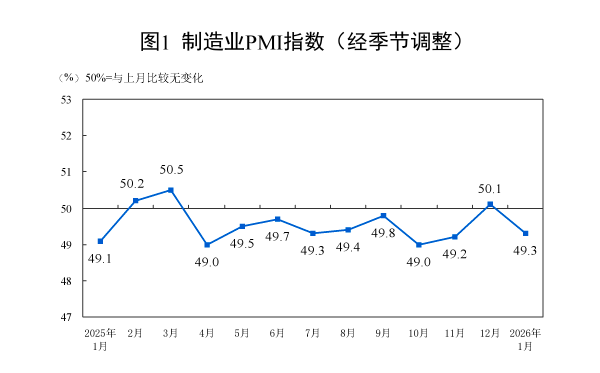
1月制造业PMI回落至49.3%,超3成企业反映利润下降
Di Yi Cai Jing· 2026-01-31 03:39
Core Viewpoint - The manufacturing sector in China is experiencing a decline in economic activity, as indicated by the drop in the Purchasing Managers' Index (PMI) below the growth threshold, reflecting insufficient market demand and the need for stronger economic recovery measures [1][4][6]. Manufacturing Sector - The manufacturing PMI for January is reported at 49.3%, a decrease of 0.8 percentage points from the previous month, indicating fluctuations in manufacturing operations [4]. - New orders index fell to 49.2%, down 1.6 percentage points, suggesting a tightening of market demand [4]. - The production index remains in the expansion zone at 50.6%, but has decreased by 1.1 percentage points, indicating a slowdown in manufacturing production growth [5]. - The prices of raw materials and finished products are rising, with the raw material purchase price index at 56.1% and the factory price index at 50.6%, marking the first time in nearly 20 months that the factory price index has risen above the critical point [5][6]. - Over 34% of manufacturing companies reported a decline in profits, highlighting concerns regarding profitability amid rising raw material costs [6]. Non-Manufacturing Sector - The non-manufacturing business activity index is at 49.4%, down 0.8 percentage points, with the construction sector experiencing a significant decline [9]. - The service sector remains relatively stable, with a slight decrease in the service business activity index to around 49.5% [10]. - The service industry shows optimistic expectations, with a business activity expectation index of 57.1%, indicating a positive outlook for the upcoming Spring Festival consumption [10].
“轻装行”、全程陪护、AI巡检 服务升级“组合拳”就位 护航旅客平安返乡
Yang Shi Wang· 2026-01-31 02:44
央视网消息:2026年春运将于2月2日启动至3月13日结束,共计40天。应对即将到来的客流高峰,各地都有哪些措施和服务保障旅客出行? 春运期间,长三角铁路预计发送旅客将历史性突破1亿人次。其中,铁路杭州站预计发送1128万人次,同比增长3.8%。节前客流高峰将出现在 2月13日,也就是腊月二十六,单日发送旅客量将达到41万人次。 铁路服务升级 全力应对春运 面对即将到来的春运客流,云南省内多个车站提前升级服务、增加运力。其中,保山站春运期间计划每日开行11对列车,串联昆明、大理、丽 江、香格里拉等热门旅游地,预计日均发送旅客1.8万人次。 民航方面,春运期间,浙江全省机场预计运送旅客超1060万人次,同比增长5.4%,高出全国平均增幅2.2个百分点。 针对大客流,杭州机场增派引导问询及志愿者岗位,为行动不便、行李较多、怀抱儿童的旅客提供全程陪护及优先通道。 春节假期期间,公路出行同样将迎来高峰。杭州辖区日均流量预计达100.4万辆次,单日最高可能突破140万辆次。为此,当地交警部门将开展 为期40天的春运交通安全保障服务,运用AI巡检等手段保障道路安全畅通。 作为2026年春运重点便民服务举措,杭州、宁波、金 ...
海南空管将启用9条临时航线
Hai Nan Ri Bao· 2026-01-31 02:20
海南日报全媒体记者近日从民航海南空管分局获悉,为适配海南自贸港全岛封关后航班量增长需 求,应对今年春运出行高峰,海南X291—X299等9条临时航线空域方案近日已获民航局空管局正式批 复。 此次9条临时航线投用,不仅能释放海南区域航班运行活力、提升运行效率,更将为春运筑牢航空 安全防线,满足群众便捷安全出行需求,为海南自贸港航空运输高质量发展注入新动力。(海南日报全 媒体记者邵长春 通讯员施显健 陈启雳 唐茜) 海南空管将启用9条临时航线 据悉,9条临时航线的落地启用,是民航海南空管分局优化空域资源的重要举措。为确保航线在春 运期间发挥实效,民航海南空管分局高度重视,从统筹规划、多方协同、强化培训等多维度推进筹备工 作,全力保障航空运输安全高效,满足群众出行需求。 适配自贸港封关后航班量增长需求 为筑牢安全防线,民航海南空管分局聚焦管制人员能力提升与风险防控,一方面围绕临时航线相关 文件开展理论宣贯和模拟机实操培训,提升管制指挥水平;另一方面组织业务骨干剖析运行风险点,发 布针对性安全提示,提前制定完善的防控预案。 该批航线将于2月2日起同步春运启动运行,相比原有航路,总计可缩短航程1053公里。航线投用 后 ...
交通运输部表示:今年将完成100个前瞻性科技创新平台布局
Zhong Guo Zheng Quan Bao· 2026-01-31 01:48
Group 1 - The core viewpoint of the articles indicates that the Ministry of Transport of China is focused on maintaining stable growth in transportation economics, with significant investments in technology innovation platforms and infrastructure development by 2026 [1][3] - In 2025, the transportation production is expected to grow, with operating freight volume, port cargo throughput, and inter-regional passenger flow all showing increases. Port foreign trade container throughput is projected to grow by nearly 10% year-on-year [1] - The inter-regional passenger flow is expected to reach 66.86 billion person-times in 2025, representing a year-on-year increase of 3.5%. Rail and civil aviation passenger volumes are projected to grow by 6.7% and 5.5% respectively, while road passenger flow is expected to increase by 3.3% [1] - The fixed asset investment in transportation is anticipated to exceed 3.6 trillion yuan in 2025, with railways receiving 901.5 billion yuan, and road and waterway investments exceeding 2.6 trillion yuan, while civil aviation is expected to receive 120 billion yuan [1] Group 2 - As the Spring Festival approaches, the Ministry of Transport is enhancing capacity service guarantees, with an expected historical high of 380 million trips made by new energy vehicles during the Spring Festival travel period [2] - The Ministry has developed a charging guarantee plan for busy highway service areas during the Spring Festival, aiming to increase charging parking spaces and install high-power fast charging equipment [2] - The Ministry has initiated the "2026 Service Area Quality Upgrade Action," planning to add over 10,000 charging guns in service areas by 2026, with more than a quarter being high-power charging guns to facilitate new energy vehicle charging [2] Group 3 - The Central Science and Technology Committee has emphasized the importance of building and managing technology innovation platforms, with plans to complete the layout of 100 forward-looking technology innovation platforms by 2026 [3] - The first batch of 40 platform construction guidelines has been released, and the application process for platform construction has officially started [3] - New platforms will focus on road engineering, water transport engineering, transportation equipment, and intelligent and integrated fields, aiming to bridge the gap between basic research and industrial application [3]
交通运输经济运行总体平稳
Jing Ji Ri Bao· 2026-01-31 01:10
Core Insights - The overall operation of China's transportation economy in 2025 is stable with progress, achieving a total of 66.86 billion person trips, a year-on-year increase of 3.5% [1] Transportation Modes - In terms of transportation modes, railway and civil aviation passenger volumes increased by 6.7% and 5.5% respectively, while road passenger flow grew by 3.3%, and waterway passenger volume remained stable year-on-year [1] Freight Volume - In 2025, the total operating freight volume reached 5.87 billion tons, marking a year-on-year growth of 3.2%. The freight volumes for railway, road, waterway, and civil aviation increased by 2%, 3.4%, 3.2%, and 13.3% respectively [1] - The express delivery business volume reached 199 billion items, reflecting a year-on-year increase of 13.7% [1] Port Operations - The total cargo throughput at ports was 1.834 billion tons, with a year-on-year growth of 4.2%. The throughput for domestic and foreign trade increased by 4% and 4.7% respectively [1] - The container throughput reached 35 million TEUs, a year-on-year increase of 6.8%, with domestic and foreign trade container throughput growing by 2.4% and 9.8% respectively [1] Investment in Transportation - The scale of transportation investment remains high, with an expected completion of over 3.6 trillion yuan in fixed asset investment for 2025. This includes an estimated investment of 901.5 billion yuan for railways, over 2.6 trillion yuan for roads and waterways, and 120 billion yuan for civil aviation [1]
国际航协:2025年全球航空 货运需求创历史新高
Xin Lang Cai Jing· 2026-01-30 16:39
Core Insights - The International Air Transport Association (IATA) forecasts a 3.4% increase in global air cargo demand in 2025 compared to the previous year, reaching a historical high, with international demand growing by 4.2% [1] - Global air cargo capacity is expected to rise by 3.7% in 2025, with international capacity increasing by 5.1% [1] - The Asia-Pacific region is projected to have the strongest air cargo demand growth at 8.4%, while North America is the only region expected to see a decline in demand, with a decrease of 1.3% [1] - IATA's Director General Willie Walsh noted that despite challenges such as increased tariffs in the U.S. and ongoing policy uncertainties, global air cargo remains robust, driven by e-commerce [1] - For 2026, a slowdown in global cargo demand growth is anticipated, with an expected increase of 2.4%, influenced by trade and geopolitical dynamics [1] - Additionally, global air passenger demand is projected to grow by 5.3% in 2025, with total passenger capacity increasing by 5.2%, achieving a record load factor of 83.6%, up by 0.1 percentage points year-on-year [1]
来海南游玩如何顺畅出行?
Xin Lang Cai Jing· 2026-01-30 16:38
Group 1 - The 2026 Spring Festival travel season will officially start on February 2, coinciding with a 9-day extended holiday and new tax exemption policies, leading to increased interest in winter tourism in Hainan [1] - The expected passenger flow in Hainan's civil aviation is projected to surpass historical levels, with the top five popular routes being Beijing to Sanya, Shanghai to Sanya, Beijing to Haikou, Shanghai to Haikou, and Chengdu to Sanya [2] - Major source cities for travelers to Hainan include Beijing, Shanghai, Chengdu, Shenzhen, and Hangzhou, with notable increases in route popularity from cities like Chongqing, Harbin, and Xi'an [2] Group 2 - Hainan's three major airports—Haikou Meilan Airport, Sanya Phoenix Airport, and Qionghai Boao Airport—are strategically located to cover the entire island, facilitating efficient transportation through high-speed rail, highways, and rental cars [2] - The circular high-speed rail connects the entire island, with both Haikou Meilan and Sanya Phoenix airports having high-speed rail stations, while Qionghai Boao Airport is quickly accessible via road to Qionghai Station [3] - The main highways in Hainan, such as the Ring Island Expressway and Central Line Expressway, connect the three airports, allowing for flexible travel arrangements by car or long-distance buses [4] Group 3 - Rental car services are available through platforms like eHi Car Rental, allowing for "one location rental, different location return" services at Haikou Meilan, Sanya Phoenix, and Qionghai Boao airports, enabling travelers to plan multi-destination trips [4]