经济回升

Search documents
研究所晨会观点精萃-20260325
Dong Hai Qi Huo· 2026-03-25 01:50
1. Report Industry Investment Rating No relevant content provided. 2. Core Viewpoints of the Report - Affected by the easing of the Middle - East situation, global risk appetite continues to recover. In the short term, the domestic economy is better than expected, but due to the intertwined geopolitical news in the Middle - East, the stock index fluctuates weakly in the short term and the volatility intensifies. After the US released signals of easing and cease - fire, the domestic stock index market recovered. Attention should be paid to the changes in the Middle - East geopolitical situation, the implementation of policies after the Two Sessions, and the changes in market sentiment [2][3]. - Different asset classes have different trends. The stock index fluctuates weakly in the short term, and short - term cautious waiting is recommended; treasury bonds fluctuate in the short term, and cautious waiting is recommended; the black commodity sector rebounds in the short term, and short - term cautious waiting is recommended; the non - ferrous sector fluctuates weakly in the short term, and short - term cautious waiting is recommended; the energy and chemical sector fluctuates greatly in the short term, and cautious long - positions are recommended; precious metals fluctuate greatly and rebound in the short term, and short - term cautious waiting is recommended [2]. 3. Summary According to Relevant Catalogs 3.1 Macro - finance - Overseas: Affected by new rumors of a cease - fire between the US and Iran, international oil prices declined in the short term, and the US dollar index and US bond yields declined but remained at relatively high levels. Global risk appetite increased overall. - Domestic: From January to February, China's economy rebounded beyond expectations, exports far exceeded expectations, and inflation continued to recover. The overall economic and inflation situation was better than expected. The government work report put forward the main expected development goals and fiscal and monetary policies for 2026, with the overall goals and policy intensity lower than in 2025 [2]. 3.2 Stock Index - Driven by sectors such as military equipment, electricity, and trade, the domestic stock market rebounded significantly. In the short term, due to the intertwined geopolitical news in the Middle - East, the stock index fluctuates weakly and the volatility intensifies. After the US released signals of easing and cease - fire, the domestic stock index market recovered. Short - term cautious waiting is recommended [3]. 3.3 Precious Metals - The precious metals market rebounded on Tuesday night. The main contract of Shanghai gold closed at 982.90 yuan/gram, up 0.37%; the main contract of Shanghai silver closed at 17,245 yuan/kilogram, up 1.93%. Spot gold ended a nine - day losing streak and rose 1.54% to 4,474.31 US dollars/ounce; spot silver rose 2.8% to 71.05 US dollars/ounce. Short - term cautious waiting is recommended [4]. 3.4 Black Metals - **Steel**: On Tuesday, the domestic steel futures and spot markets fluctuated weakly, and the trading volume was at a low level. The real demand is still weak, the steel inventory has peaked and declined, but the growth rate of the apparent consumption of the five major varieties has slowed down. After the important meeting, the output of the five major varieties of steel increased by 188,500 tons week - on - week, and the hot - metal output increased by nearly 69,000 tons. In the short term, the steel market will still follow the cost, and attention should be paid to the price adjustment risk after the cost drops [5][6]. - **Iron Ore**: On Tuesday, the futures and spot prices of iron ore rebounded slightly. The rebound in crude oil prices boosted the ore price. The demand for iron ore is still resilient, and the problem of short - term supply - demand mismatch is gradually alleviated. It is expected that the room for further price increase of ore is limited, and attention should be paid to the short - term adjustment risk after the energy price weakens [6]. - **Silicon Manganese/Silicon Iron**: On Tuesday, the spot prices of silicon iron and silicon manganese rebounded; the futures prices showed a differentiated trend, with silicon iron being slightly stronger. The rebound in energy prices still supports the ferroalloy prices. The spot price of manganese ore remains firm. The disk prices of silicon iron and silicon manganese are recommended to be treated with a bullish - biased shock mindset [7]. 3.5 Non - ferrous Metals and New Energy - **Copper**: The market focus is on the Middle - East situation. The spot TC of copper is close to - 70 US dollars/ton, a new low. By - product revenues such as sulfuric acid and precious metals make up for the smelting profit. The refined copper production growth rate is at a high level. The core contradiction lies in the mine end, and the copper mine is generally considered to be in short supply, but the probability of extreme shortage is not high. The domestic and foreign inventories continue to accumulate, and the downstream replenished stocks intensively at low prices [8]. - **Aluminum**: On Tuesday, the risk appetite recovered, and Shanghai aluminum rebounded. The easing of the Middle - East situation is actually bearish for aluminum, and the supply of aluminum in the Middle - East will increase, so the rebound strength of aluminum is weaker than that of other non - ferrous metals. The LME aluminum has fallen near the rising trend line. The year - on - year increase in domestic primary aluminum production from January to February is relatively large, and the pattern of "domestic weakness and foreign strength" may change temporarily [9]. - **Zinc**: The zinc ore processing fees in the southern and northern regions of China have changed. The domestic smelting capacity is still expanding, and the by - product revenues make up for the losses. The overseas smelting plants will resume production in 2026. The demand is not optimistic, and the domestic zinc ingot inventory has decreased seasonally [9]. - **Lead**: From January to February, the imports of refined lead and crude lead in China increased significantly. The domestic production of primary lead and secondary lead has recovered seasonally. The demand peak season has passed, and it is gradually entering the off - season. The domestic social inventory of primary lead has decreased [10]. - **Nickel**: The core contradiction lies in the mine end. The RKAB quota in Indonesia in 2026 has dropped significantly to 260 million wet tons, and there is still room for improvement, but the decline compared with 2025 is basically a foregone conclusion. The supply of MHP is at risk of decline. The nickel price has support below, but the upside space is limited by high domestic and foreign inventories [11]. - **Tin**: The imports of tin ore from Myanmar and other sources have increased. The demand is not good overall, and the industry is significantly differentiated. The social inventory of tin ingots has decreased, while the LME inventory has increased [12]. - **Lithium Carbonate**: On Tuesday, the main contract of lithium carbonate rose 6.11%. The supply and demand of lithium carbonate are both strong, and the social inventory is continuously decreasing. It is expected to fluctuate in the support range, and long - positions can be established at low prices [13]. - **Industrial Silicon**: On Tuesday, the main contract of industrial silicon rose 0.17%. Under the situation of weak supply and demand, over - capacity, and high - level inventory accumulation, industrial silicon is priced close to the cost. Attention should be paid to the cost support below, and range - bound operations are recommended [13]. - **Polysilicon**: On Tuesday, the main contract of polysilicon fell 3.17%. The polysilicon inventory continues to accumulate at a high level, and the spot price is falling. It is expected that the price will fluctuate weakly, and short - positions should be held cautiously or profits should be taken in a timely manner [14][15]. 3.6 Energy and Chemicals - **Methanol**: The methanol spot price index is 2676.38, up 32.04. The supply has tightened, and the supply - demand fundamentals have been repaired. The methanol price is still firm, but attention should be paid to the marginal changes brought about by geopolitical easing and downstream negative feedback [16]. - **PP**: The domestic polypropylene parking rate has increased, the upstream supply has shrunk, and the downstream demand has increased. The spot market shows signs of tightness, and it is expected that the market will maintain a strong pattern. The biggest uncertainty lies in the navigation situation in the Strait of Hormuz [16]. - **LLDPE**: The supply has decreased, the demand has increased, and the inventory has been depleted rapidly. It is expected that polyethylene will continue to run strongly, and geopolitical dynamics are the key variables affecting external supply [17]. - **Urea**: The supply has decreased slightly, and the demand shows a pattern of "weak agricultural demand and strong industrial demand". The policy guides the market, and the urea price is expected to maintain a narrow - range fluctuation [18]. 3.7 Agricultural Products - **US Soybeans**: The stability of Sino - US soybean trade relations has been disturbed, and the export and sales data of high - priced US soybeans have deteriorated. The US biodiesel policy will be finalized soon, and the trading sentiment of US soybean oil is cautious [20]. - **Soybean and Rapeseed Meal**: The inventory of soybeans and soybean meal is decreasing rapidly, supporting the soybean meal basis. The supply of rapeseed meal is increasing, and it will adjust with soybean meal in the short term [20]. - **Soybean and Rapeseed Oil**: The domestic soybean oil inventory is decreasing rapidly, supporting the basis. The supply of rapeseed oil may increase, and it will be under pressure with soybean and palm oil [21]. - **Palm Oil**: The international crude oil is oscillating at a high level, and the support for vegetable oils from crude oil risk has weakened. The export of Malaysian palm oil has increased, and the production has decreased. The domestic palm oil import is slow, and the market trading is light [21]. - **Corn**: The corn price is adjusting within a narrow range. The sales progress of corn in the production areas has slowed down, and the inventory in ports and deep - processing enterprises is low. The acceptance of high - priced corn by downstream feed enterprises has decreased, and the possible rice bran auction in early April may have a negative impact on the corn price [22]. - **Pigs**: The pig production capacity is in the pain period of adjustment, the demand is improving marginally but is still in the off - season. The industry's production capacity reduction expectation is increasing. It is expected that the short - term futures and spot prices may continue to fall, and there are still risks in the futures market [22].
1月制造业PMI回落至49.3% 超3成企业反映利润下降
Di Yi Cai Jing· 2026-01-31 03:43
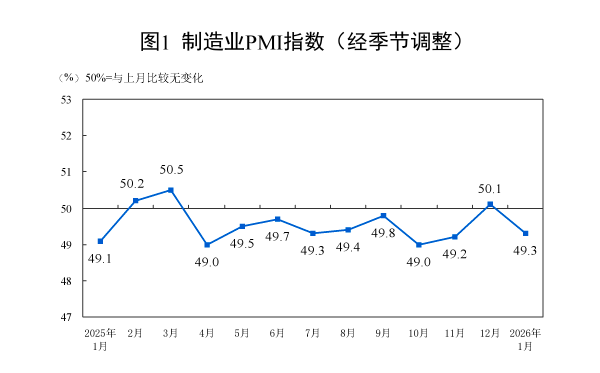
Group 1: Manufacturing Sector Overview - In January, the manufacturing PMI fell to 49.3%, a decrease of 0.8 percentage points from the previous month, indicating fluctuations in manufacturing operations [4][5] - The new orders index for January was 49.2%, down 1.6 percentage points, reflecting a tightening of market demand due to seasonal factors and changes in export environments [4][5] - The production index remained in the expansion zone at 50.6%, despite a decline of 1.1 percentage points, suggesting continued overall expansion in manufacturing production [5] Group 2: Price Levels and Economic Conditions - The purchasing price index for raw materials rose to 56.1%, and the factory price index increased to 50.6%, marking the first time in nearly 20 months that the factory price index exceeded the critical point [5] - The proportion of manufacturing enterprises reporting insufficient market demand decreased to 54.9%, down 9.4 percentage points, indicating a stabilization in market demand [5] - Analysts suggest that the overall economic climate is affected by seasonal fluctuations, high previous month bases, and ongoing adjustments in the real estate market [6] Group 3: Non-Manufacturing Sector Insights - The non-manufacturing business activity index for January was 49.4%, a decline of 0.8 percentage points, primarily due to a decrease in the construction sector [9] - The service sector showed relative stability, with the service business activity index slightly declining by 0.2 percentage points, remaining around 49.5% [10] - The business activity expectation index for the service sector rose to 57.1%, indicating an optimistic outlook, particularly for consumption-related services during the upcoming Spring Festival [10]

1月制造业PMI回落至49.3%,超3成企业反映利润下降
Di Yi Cai Jing· 2026-01-31 03:39
Core Viewpoint - The manufacturing sector in China is experiencing a decline in economic activity, as indicated by the drop in the Purchasing Managers' Index (PMI) below the growth threshold, reflecting insufficient market demand and the need for stronger economic recovery measures [1][4][6]. Manufacturing Sector - The manufacturing PMI for January is reported at 49.3%, a decrease of 0.8 percentage points from the previous month, indicating fluctuations in manufacturing operations [4]. - New orders index fell to 49.2%, down 1.6 percentage points, suggesting a tightening of market demand [4]. - The production index remains in the expansion zone at 50.6%, but has decreased by 1.1 percentage points, indicating a slowdown in manufacturing production growth [5]. - The prices of raw materials and finished products are rising, with the raw material purchase price index at 56.1% and the factory price index at 50.6%, marking the first time in nearly 20 months that the factory price index has risen above the critical point [5][6]. - Over 34% of manufacturing companies reported a decline in profits, highlighting concerns regarding profitability amid rising raw material costs [6]. Non-Manufacturing Sector - The non-manufacturing business activity index is at 49.4%, down 0.8 percentage points, with the construction sector experiencing a significant decline [9]. - The service sector remains relatively stable, with a slight decrease in the service business activity index to around 49.5% [10]. - The service industry shows optimistic expectations, with a business activity expectation index of 57.1%, indicating a positive outlook for the upcoming Spring Festival consumption [10].
扩内需促消费政策显效 物价回暖,经济“体温”回升
Sou Hu Cai Jing· 2026-01-12 03:24
Core Insights - The Consumer Price Index (CPI) in December 2025 increased by 0.2% month-on-month and 0.8% year-on-year, while the core CPI, excluding food and energy, rose by 1.2% year-on-year [2] - The Producer Price Index (PPI) rose by 0.2% month-on-month but decreased by 1.9% year-on-year, with a decline of 2.6% for the entire year of 2025 [2] - Analysts predict a moderate recovery in overall prices in 2026, supported by proactive macroeconomic policies and the development of new economic drivers [2] CPI Analysis - The year-on-year increase in CPI in December 2025 was the highest since August 2023, driven primarily by rising vegetable and fruit prices due to adverse weather conditions, as well as the effects of year-end consumption promotion policies [2][3] - Specific price increases included fresh vegetables and fruits, which rose by 18.2% and 4.4% respectively, contributing approximately 0.16 percentage points to the CPI increase [3] - The prices of household appliances and vehicles also saw a month-on-month increase, exceeding market expectations [2] PPI Analysis - The PPI's year-on-year decline narrowed by 0.3 percentage points in December 2025, influenced by rising raw material prices and the effects of policies aimed at reducing excessive competition [4] - The PPI experienced a continuous month-on-month increase for three consecutive months, indicating a potential stabilization in industrial prices [4] - For 2025, the PPI's year-on-year decline was 2.6%, which is a larger drop compared to the previous year, attributed to insufficient external demand and ongoing economic structural adjustments [4] Future Outlook - Experts anticipate that the CPI will see a moderate increase in 2026, potentially around 1.2%, as the effects of growth-stimulating and consumption-promoting policies take hold [7] - The PPI is expected to enter a recovery phase in 2026, with a projected year-on-year decline narrowing to around 0.5%, although a return to positive growth may take longer [4][5] - Measures to ensure the supply and price stability of essential goods are being implemented, with local governments actively working to maintain market stability [6]

2026年债务限额提前批定了!多地启动项目储备工作
Zhong Guo Jing Ying Bao· 2025-11-08 11:24
Core Viewpoint - The issuance of local government bonds in 2025 is expected to continue with an "early and strong support" approach, with over 9 trillion yuan issued in the first ten months of the year, marking a year-on-year increase of approximately 23% [1] Group 1: Bond Issuance Trends - In October, local governments disclosed bond issuance plans totaling 540.6 billion yuan, with 68% (367.8 billion yuan) being new special bonds, indicating a significant push towards year-end issuance [1] - As of the end of September, a total of 85.457 trillion yuan in local government bonds had been issued, comprising 43.615 trillion yuan in new bonds and 41.842 trillion yuan in refinancing bonds [1] Group 2: Allocation of Funds - From January to September, new special bonds were primarily allocated to four key areas: municipal and industrial park infrastructure (27.7%), transportation infrastructure (18.2%), land reserves (14.2%), and affordable housing projects (12.0%) [2] - The issuance plans for October show a focus on supporting infrastructure projects, with increased backing for the real estate sector through the acquisition of existing properties for affordable housing [2] Group 3: Future Bond Issuance - The Ministry of Finance plans to advance the issuance of the 2026 local government debt limit to ensure funding for major projects and support economic recovery [3] - The Ministry will allocate up to 60% of the new debt limit for the following year in the fourth quarter of the current year, facilitating the construction funding needs for key projects in early 2026 [3] - Local governments are already initiating project reserve work for 2026, focusing on forward-looking sectors such as new energy and new infrastructure [3] Group 4: Recommendations for Local Governments - Experts suggest that local governments should proactively plan for next year's projects to align with the upcoming early issuance of the 2026 debt limit, ensuring effective cross-year coordination [4]
强化大局意识、主动作为、整体推进!上海市委季度工作会议举行,陈吉宁作工作点评
Di Yi Cai Jing· 2025-10-09 12:16
Core Insights - The Shanghai Municipal Committee emphasizes the need to consolidate economic recovery momentum through policy and reform effects, aiming to achieve annual economic and social development goals [1][5] Group 1: Economic Development - Shanghai's economic recovery is supported by various district initiatives, with significant improvements in employment rates and reductions in complaints [1][2] - The city aims to enhance consumer spending and investment, leveraging events like the Import Expo to stimulate economic activity [4][5] - The focus is on maintaining stable employment, businesses, and market expectations while ensuring effective policy implementation [6] Group 2: District Initiatives - Multiple districts, including Putuo and Hongkou, report significant growth in retail sales and investment, with Hongkou leading in social consumption and green industry scale [2][3] - Yangpu district promotes innovative practices in community management and infrastructure projects, achieving high fixed asset investment growth [2][3] - Fengxian district addresses local governance issues and leads in cosmetic product registrations, while also completing housing projects ahead of schedule [3] Group 3: Governance and Policy Implementation - The city government is focused on improving the efficiency of public services and enhancing the legal framework for citizen engagement [4] - The emphasis is on collaborative governance and proactive measures to address social issues and enhance public safety [5][6] - The administration is committed to high-level reforms and strategic planning for the upcoming "15th Five-Year Plan" [6]
市场分析:新能源金融领涨,A股小幅上行
Zhongyuan Securities· 2025-09-17 09:41
Market Overview - On September 17, the A-share market opened lower but experienced a slight upward trend, with the Shanghai Composite Index finding support around 3849 points[2] - The Shanghai Composite Index closed at 3876.34 points, up 0.37%, while the Shenzhen Component Index rose 1.16% to 13215.446 points[7] - Total trading volume for both markets reached 24,032 billion yuan, above the median of the past three years[3] Sector Performance - Strong performers included multi-financial, optical optoelectronics, photovoltaic equipment, and battery sectors, while precious metals, commercial retail, fertilizers, and tourism sectors lagged[3] - Over 50% of stocks in the two markets saw gains, with multi-financial and wind power equipment leading the increases[7] Valuation Metrics - The average price-to-earnings (P/E) ratios for the Shanghai Composite and ChiNext indices are 15.73 times and 49.46 times, respectively, above the median levels of the past three years, indicating a suitable environment for medium to long-term investments[3][14] Policy and Economic Outlook - The State Council has emphasized the need to consolidate the economic recovery, with multiple favorable policies in place to support the market[3] - The monetary policy is expected to maintain a "moderately loose" stance, focusing on structural policies[3] Investment Recommendations - Investors are advised to remain cautious and avoid blind chasing of high prices, while looking for opportunities in sectors like multi-financial, optical optoelectronics, photovoltaic equipment, and batteries[3][14] - Continuous net inflows of global funds into the A-share market and a shift of household savings towards capital markets are creating a sustained source of incremental funds[3]

市场分析:汽车游戏行业领涨,A股小幅震荡
Zhongyuan Securities· 2025-09-15 14:31
Investment Rating - The industry is rated as "stronger than the market," indicating an expected increase of over 10% in the industry index relative to the CSI 300 index over the next six months [16]. Core Viewpoints - The A-share market experienced slight fluctuations with notable performance in the automotive, gaming, agriculture, and coal sectors, while jewelry, precious metals, insurance, and aerospace sectors lagged [2][3]. - The average price-to-earnings ratios for the Shanghai Composite Index and the ChiNext Index are 15.78 times and 48.51 times, respectively, which are above the median levels of the past three years, suggesting a favorable environment for medium to long-term investments [3][15]. - The total trading volume on the two exchanges reached 23,034 billion, indicating a strong market activity level [3][15]. - Government policies are expected to support economic recovery, with a focus on consumer promotion and real estate stabilization, providing a solid foundation for the market [3][15]. - Global capital is flowing into the A-share market, with domestic savings shifting towards capital markets, creating a continuous source of incremental funds [3][15]. - The market is anticipated to present new investment opportunities amid fluctuations, with a recommendation to focus on sectors such as automotive, gaming, energy metals, and healthcare services [3][15]. Summary by Sections A-share Market Overview - On September 15, the A-share market faced resistance after an initial rise, with the Shanghai Composite Index encountering resistance around 3,879 points [8]. - The Shanghai Composite Index closed at 3,860.50 points, down 0.26%, while the ChiNext Index rose by 1.51% [9][10]. - Over 60% of stocks declined, with the gaming, agriculture, automotive, and coal sectors showing the most significant gains [8][10]. Future Market Outlook and Investment Recommendations - The market is expected to maintain a steady upward trend in the short term, with a focus on monitoring policy, capital flow, and external market changes [3][15]. - Short-term investment opportunities are recommended in the automotive, gaming, energy metals, and healthcare sectors [3][15].
“电风扇”行情愈演愈烈,布局创业板ETF天弘(159977)、科创综指ETF天弘(589860)及中证A500ETF天弘(159360)等优质宽基指数
Xin Lang Cai Jing· 2025-09-01 07:48
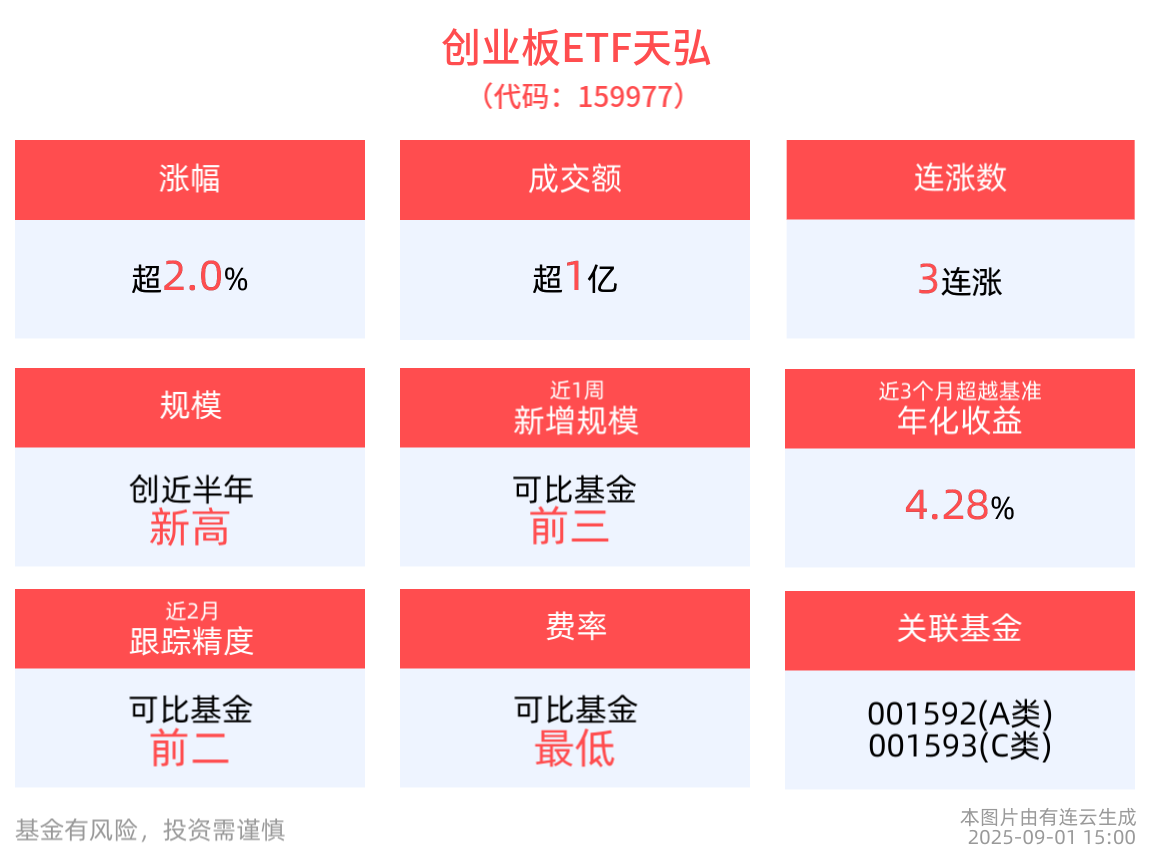
Core Insights - The Tianhong ChiNext ETF (code: 159977) has seen a 2.06% increase, marking three consecutive days of gains with a trading volume of 113 million yuan [6] - The Tianhong Sci-Tech Index ETF (code: 589860) rose by 1.90%, with a turnover rate of 12.1% and a trading volume of 49.59 million yuan, indicating active market participation [6] - The Tianhong CSI A500 ETF (code: 159360) increased by 0.50%, also achieving three consecutive days of gains, with a turnover rate of 3.54% and a trading volume of 63.59 million yuan [6] Fund Performance - As of September 1, 2025, the Tianhong ChiNext ETF (159977) reached a new high in scale at 9.655 billion yuan, the highest in the past six months [7] - The Tianhong ChiNext ETF encompasses four high-growth sectors: pharmaceuticals, new energy, computing power, and brokerage, with a valuation at the 38.36th percentile of its ten-year history, indicating it is undervalued compared to broad-based indices [7] - The Tianhong Sci-Tech Index ETF covers 97% of the Sci-Tech board's market value, focusing on hard technology and balancing investments in semiconductors, artificial intelligence, and biomedicine, with over 80% in strategic emerging industries [7] Economic Indicators - According to the National Bureau of Statistics, the manufacturing PMI, non-manufacturing business activity index, and comprehensive PMI output index for August were 49.4%, 50.3%, and 50.5%, respectively, showing a slight increase from the previous month [7] - Analysts suggest that the economic indicators reflect positive changes in China's economy, with expectations for continued release of domestic demand potential in September and the fourth quarter [7] Market Outlook - Huatai Securities indicates that the extension of short-term tariff exemptions and expectations of Federal Reserve rate cuts may improve risk appetite, with a shift towards fundamentals expected in the medium term [8] - China Galaxy Securities anticipates that the market will maintain a high central tendency, with active trading and supportive policies driving market conditions, while structural allocation opportunities should be monitored [8]