
汽车制造业

Search documents
长源东谷2025年第三季度净利润为1.1亿元,同比增长84.08%
Ju Chao Zi Xun· 2025-10-21 03:48
Core Viewpoint - The company, Xiangyang Changyuan Donggu Industrial Co., Ltd., reported significant growth in revenue and profit for the third quarter of 2025, driven by increased sales and cost expense dilution [2]. Financial Performance - For the first three quarters, the company achieved operating revenue of 1.648 billion yuan, a year-on-year increase of 29.75% [2][3]. - The total profit reached 309 million yuan, reflecting an 84.12% year-on-year growth [2][3]. - The net profit attributable to shareholders was 274 million yuan, with a year-on-year increase of 76.71% [2][3]. - The net profit excluding non-recurring gains and losses was 251 million yuan, up 64.74% year-on-year [2][3]. - Basic earnings per share were 0.85 yuan, representing a 77.13% increase compared to the previous year [2][3]. - The weighted average return on equity was 9.86%, an increase of 3.77 percentage points from the same period last year [2][3]. Quarterly Performance - In the third quarter of 2025, the company reported operating revenue of 612 million yuan, a year-on-year increase of 23.84% [2][3]. - The net profit attributable to shareholders for the third quarter was 110 million yuan, showing an 84.08% year-on-year growth [2][3]. Cash Flow and Assets - The net cash flow from operating activities for the first three quarters was 281 million yuan, a decrease of 15.98% year-on-year [5]. - As of the end of the reporting period, total assets amounted to 5.780 billion yuan, a 13.70% increase from the previous year [5]. - Shareholders' equity reached 2.896 billion yuan, up 7.92% from the end of the previous year [5]. Non-Recurring Gains and Losses - The total non-recurring gains and losses for the first three quarters amounted to 23.25 million yuan, primarily consisting of government subsidies of 23.27 million yuan [4].


9月经济数据点评:基数上升拖累GDP同比,4季度仍有政策支撑
Western Securities· 2025-10-21 02:30
Economic Growth - Q3 GDP growth slowed to 4.8% YoY, down from 5.2% in Q2, impacted by a high base effect from last year[1] - Nominal GDP growth in Q3 was 3.7%, further declining from 3.9% in Q2, marking a new low for 2023[1] - Q3 GDP deflator decreased by 1%, a smaller decline compared to the 0.2 percentage points drop in Q2[1] Industrial Production - In September, industrial value-added increased by 6.5% YoY, significantly up from 5.2% in August[2] - Seasonally adjusted MoM growth in industrial production reached 0.64%, the highest since March[2] - Automotive manufacturing value-added surged by 16% YoY, improving by 7.6 percentage points from August[2] Retail and Consumption - Retail sales growth fell to 3% YoY in September, down from 3.4% in August[2] - Consumer confidence index rose to 89.2, continuing an upward trend since Q4 of last year[3] - Per capita disposable income grew by 4.5% YoY, while per capita consumption expenditure increased by 3.4%, both lower than Q2 growth rates[3] Investment Trends - Fixed asset investment declined by 7.1% YoY in September, consistent with August's decline[3] - Infrastructure investment dropped by 8%, while real estate development investment fell by 21.3%, widening the decline from the previous month[3] - Cumulative fixed asset investment for the first three quarters showed a 0.5% YoY decrease, indicating negative growth[3] Real Estate Market - In September, the sales area of commercial housing decreased by 10.5% YoY, close to August's decline[3] - New residential prices in 70 large and medium cities fell by 0.4% MoM, a larger drop than in August[3] - Overall, real estate demand remains weak, with sales revenue down by 11.8% YoY[3]
2025年三季度全国煤炭开采和洗选业产能利用率为68.9%
Guo Jia Tong Ji Ju· 2025-10-21 02:20
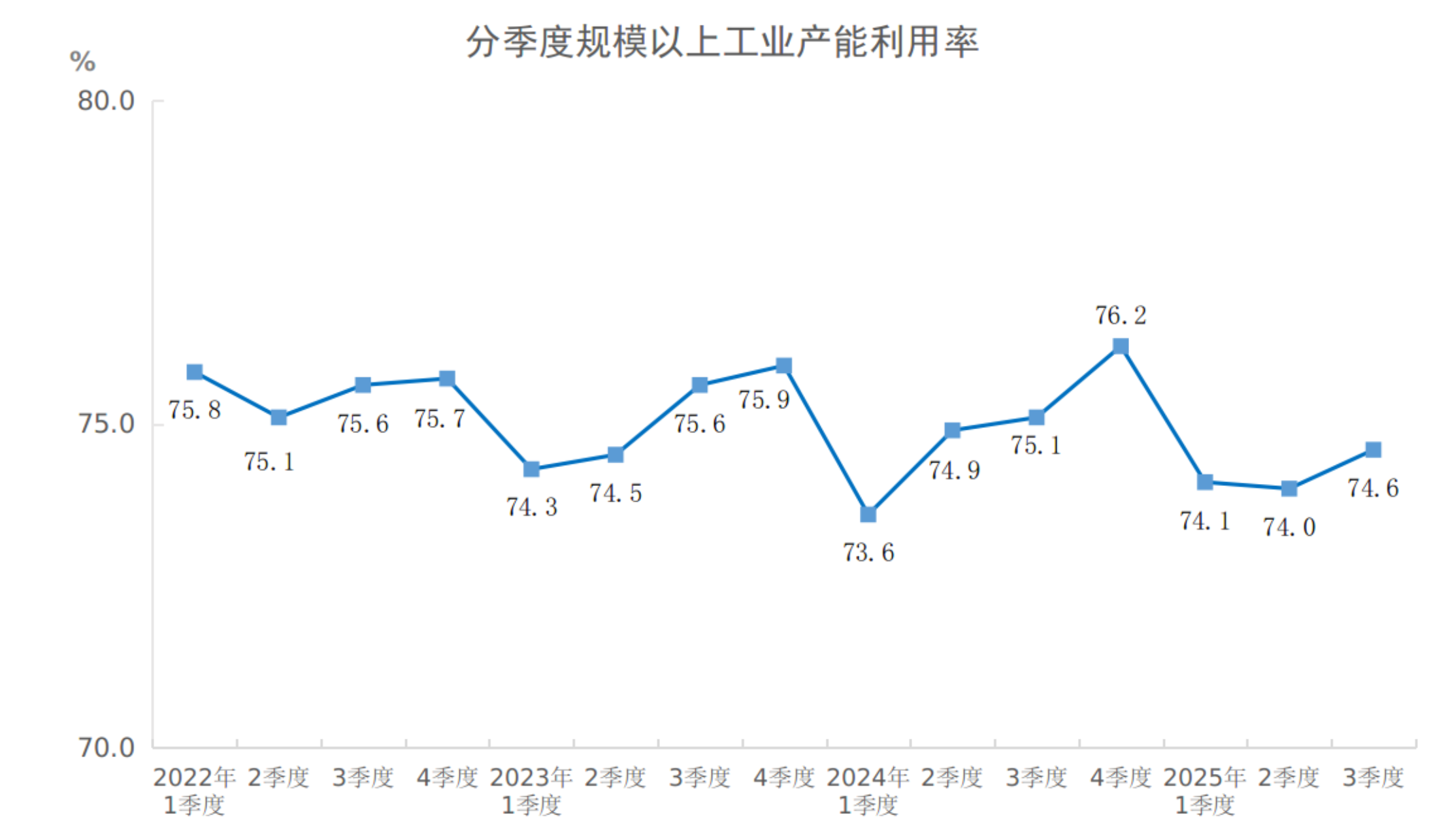
Core Insights - The overall industrial capacity utilization rate for Q3 2025 is reported at 74.6%, showing a decrease of 0.5 percentage points compared to the same period last year [2] - The mining industry has a capacity utilization rate of 72.5%, down by 2.1 percentage points year-on-year [2] - The manufacturing sector's capacity utilization rate stands at 74.8%, reflecting a decline of 0.4 percentage points from the previous year [3] Industry Breakdown - Mining Industry: Capacity utilization at 72.5%, down 2.1 percentage points from last year [2] - Manufacturing Sector: Capacity utilization at 74.8%, down 0.4 percentage points year-on-year [3] - Electricity, Heat, Gas, and Water Production and Supply: Capacity utilization at 74.3%, unchanged from the previous year [3] Specific Industries - Coal Mining and Washing: 68.9%, down 3.8 percentage points [3] - Food Manufacturing: 70.1%, down 0.6 percentage points [3] - Textile Industry: 77.2%, down 0.7 percentage points [3] - Chemical Raw Materials and Products: 72.5%, down 3.5 percentage points [3] - Non-Metallic Mineral Products: 62.0%, up 0.3 percentage points [3] - Black Metal Smelting and Rolling: 80.1%, up 2.7 percentage points [3] - Non-Ferrous Metal Smelting and Rolling: 77.8%, down 0.6 percentage points [3] - General Equipment Manufacturing: 78.9%, up 0.2 percentage points [3] - Specialized Equipment Manufacturing: 75.5%, down 0.3 percentage points [3] - Automobile Manufacturing: 73.3%, up 0.1 percentage points [3] - Electrical Machinery and Equipment Manufacturing: 74.9%, down 0.7 percentage points [3] - Computer, Communication, and Other Electronic Equipment Manufacturing: 79.0%, up 1.1 percentage points [3]
纵横G700上市32.99万元起,尹同跃称要实现豪华越野平权
Xin Jing Bao· 2025-10-21 00:48
Core Viewpoint - Chery aims to break the long-standing dominance of international brands in the luxury off-road vehicle market and establish a presence for Chinese automotive brands in this segment [1] Company Summary - Chery Automobile Co., Ltd. has launched the Zongheng G700 globally, offering four variants with an official price range of 329,900 to 414,900 yuan, and a limited-time promotional price starting at 304,900 yuan [1] - The Zongheng G700 successfully crossed the Yangtze River in 22 minutes, demonstrating stability in challenging water conditions [1] - The vehicle is equipped with Huawei's Qiankun Intelligent Driving ADS 4 assistance system, featuring 27 perception components throughout the vehicle [1]
崔东树:1—9月汽车消费额同比增1% 车市需要有持续政策支持
智通财经网· 2025-10-20 22:37
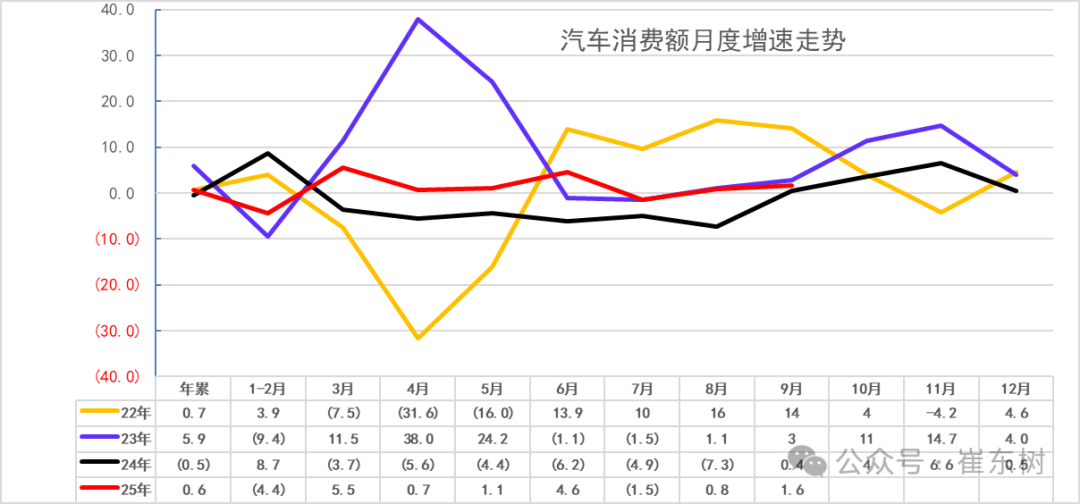
Core Insights - The automotive industry in China is experiencing a strong recovery, driven by the implementation of vehicle replacement policies and a significant increase in new energy vehicle production [1][2][5] Group 1: Automotive Consumption - In September 2025, the total retail sales of consumer goods reached 41,971 billion yuan, with automotive consumption accounting for 4,711 billion yuan, a year-on-year increase of 2% [1][28] - From January to September 2025, total retail sales of consumer goods amounted to 365,877 billion yuan, growing by 4.5%, while automotive consumption reached 35,923 billion yuan, a year-on-year increase of 1% [1][28] - Since the decline of the real estate market in 2021, automotive consumption has risen from 3.94 trillion yuan in 2020 to 5.03 trillion yuan in 2024, indicating a recovery from previous stagnation [5][26] Group 2: Automotive Production - In September 2025, automotive production reached 3.23 million units, a year-on-year increase of 14%, with new energy vehicles accounting for 1.58 million units produced, up 20% [1][19] - From January to September 2025, total automotive production was 24.05 million units, an 11% increase year-on-year, with new energy vehicles at 1.096 million units, a 30% increase [1][19] - The penetration rate of new energy vehicles in September 2025 reached 49%, up from 46% in the same period last year [1][19] Group 3: Investment Trends - In the first nine months of 2025, automotive investment grew by 19.2%, significantly outpacing the overall industrial investment growth of 6.4% [21][22] - The automotive investment in 2025 is at its highest level in six years, indicating a strong recovery in the sector [22] Group 4: Economic Context - The external environment remains complex, with challenges such as unilateralism and protectionism impacting supply chains, while domestic economic recovery is still fragile [2] - The automotive industry is expected to face significant pressure in 2026, necessitating long-term supportive policies to sustain growth [2][26]
中美经济暗战2025!美国GDP冲上30万亿美元,中国增速翻倍反超
Sou Hu Cai Jing· 2025-10-20 14:48
Economic Overview - The US GDP has surpassed $30 trillion, with a nominal GDP of $30.48 trillion and an annualized growth rate of 3.84% in the first half of the year, driven primarily by consumer spending [2] - China's nominal GDP stands at $19.23 trillion, with a purchasing power parity (PPP) adjusted GDP of $40.72 trillion, accounting for 19.68% of the global economy, significantly higher than the US's 14.65% [3] - The US economy grew by 2.1% in the first half of the year, while China's GDP growth rate was 4.8%, nearly double that of the US [3][5] Consumer Spending and Retail - In the US, personal consumption expenditures increased by 4.5% in the first half of the year, but the savings rate dropped to 3.8%, indicating financial strain on consumers [5] - China's retail sales rose by 6.2%, with significant growth in dining and tourism sectors, reflecting a recovery in domestic demand [3][6] Trade and Exports - The US trade deficit expanded to $1.1 trillion, driven by high demand for imported energy and consumer goods [2] - China's total export value in the first half of the year was $2.45 trillion, with a growth rate of 5.9%, and a notable 18% increase in electric vehicle exports [3][6] Manufacturing and Investment - In the US, manufacturing purchasing managers' index rose from 48.7 to 50.9, while corporate equipment spending increased by 6.3% [2] - China's industrial output grew by 6.4%, with high-tech manufacturing increasing by 9.5%, indicating a strong focus on technology investments [3][6] Inflation and Costs - The US is experiencing inflationary pressures, with food prices expected to rise by 3% and gasoline prices increasing from $3.5 to $4.0 per gallon [5] - China's chip self-sufficiency rate improved from 45% to 50%, and the country leads in global market share for new energy batteries, exceeding 70% [3][6] Financial Markets and Economic Projections - The US stock market rose by 12% in the first half of the year, but volatility increased by 15%, indicating underlying market instability [8] - The IMF projects a slowdown in US growth to 2.1% in 2026, while China's growth is expected to decelerate to 4.0%, but its PPP advantage remains strong [9][11] Global Economic Dynamics - The competition between the US and China is reshaping global economic dynamics, with China contributing significantly to global growth and the US facing challenges to its financial dominance [11] - The trade war has led to a redirection of Chinese exports towards Southeast Asia, Europe, and the Middle East, mitigating the impact of US tariffs [9][11]
前三季度GDP同比增长5.2%! 专家:完成全年5%左右的目标概率较大
Mei Ri Jing Ji Xin Wen· 2025-10-20 14:36
Economic Overview - The GDP for the first three quarters reached 10,150.36 billion yuan, with a year-on-year growth of 5.2% [1] - The GDP growth rate for the third quarter was 4.8%, a decrease of 0.4 percentage points from the second quarter [1] - Despite the slowdown, the economic growth rate remains higher than that of most major economies, with the total economic output in the third quarter exceeding 35.5 trillion yuan [1] Growth Drivers - High-tech manufacturing and other sectors showed rapid growth, contributing to the overall GDP increase of 39,679 million yuan, which is 1,368 million yuan more than the previous year [2] - The external trade environment has been challenging, yet export growth has increased, supported by domestic policies aimed at stabilizing growth [2][5] - Analysts predict that the central bank may implement new interest rate cuts and that housing support policies will be enhanced, potentially leading to a GDP growth of around 4.7% in the fourth quarter [2] Industrial Production - In September, the industrial added value for large-scale enterprises grew by 6.5% year-on-year, with a month-on-month increase of 0.64% [4] - The manufacturing Purchasing Managers' Index (PMI) rose to 49.8, indicating a slight improvement in manufacturing activity [4] - The automotive manufacturing sector saw a significant increase, with a year-on-year growth of 16.0% in September, driven by strong export performance [4] Sector Performance - For the first three quarters, the industrial added value increased by 6.2%, outpacing the GDP growth rate [5] - The manufacturing sector grew by 6.8%, while mining and utilities sectors grew by 5.8% and 2.0%, respectively [4] - A majority of industrial sectors experienced growth, with 90.2% of the 41 major industrial categories reporting an increase in added value [4]
焦点访谈 | 多维度解析中国经济三季报:格局稳、势头进、特性韧
Yang Shi Wang· 2025-10-20 13:27
Economic Growth - China's GDP for the first three quarters grew by 5.2% year-on-year, with a total of 101,503.6 billion yuan [1][2] - Quarterly growth rates were 5.4% in Q1, 5.2% in Q2, and 4.8% in Q3, indicating a steady economic performance despite external pressures [1][2] Industrial Performance - Industrial profits for large-scale enterprises shifted from a 1.7% decline in the first seven months to a 0.9% increase by August, marking a significant turnaround [3][5] - Key sectors driving this recovery include raw materials manufacturing and equipment manufacturing, highlighting strong market demand for high-tech products [5][9] Manufacturing and Innovation - High-tech manufacturing value added increased by 9.6% year-on-year in the first three quarters, with notable growth in 3D printing equipment (40.5%), industrial robots (29.8%), and new energy vehicles (29.7%) [9][11] - The rapid growth of server production, which surged by 86.2% in August, underscores the importance of digital economy infrastructure [9][11] Investment Trends - Manufacturing investment grew by 4.0%, outpacing overall investment, with significant contributions from traditional industry upgrades and high-end equipment investments [13][14] - Private enterprises are increasingly investing in innovation and emerging industries, despite a slowdown in overall private investment [13][14] Consumer Behavior - Retail sales of consumer goods increased by 4.5% year-on-year, with a notable shift towards consumption upgrades driven by policies promoting product replacement [14][16] - Service retail sales grew by 5.2%, indicating a robust demand for service-oriented consumption [16] Trade Performance - China's goods trade reached 33.61 trillion yuan in the first three quarters, with a 4% year-on-year increase, and exports grew by 7.1% [20][22] - The export of industrial robots rose by 54.9%, reflecting an improvement in the structure and value of exports [22]
从“国民神车”到6年亏250亿元,众泰汽车进入“无主”状态
Bei Ke Cai Jing· 2025-10-20 12:59
Core Viewpoint - Zotye Auto, once a popular car brand in China, is now facing severe survival challenges, including a significant loss of control by its major shareholder and continuous financial losses over the years [1][2][3]. Financial Performance - Zotye Auto has reported cumulative losses of 250.93 billion yuan over six years, with annual losses of 10 billion, 9.37 billion, 9.20 billion, 7.06 billion, 103.4 billion, and 111.9 billion yuan from 2019 to 2024 [1][5]. - In the first half of 2025, the company recorded a net loss of 1.48 billion yuan [9]. Shareholder Changes - The company's major shareholder, Jiangsu Deep Commerce Holding Group, lost all its shares due to a judicial auction, resulting in Zotye Auto entering a "no controlling shareholder" status [1][3][4]. - The shares, originally held by Jiangsu Deep Commerce, were auctioned off but went unsold, leading to their transfer to a creditor, which indicates a lack of market confidence in Zotye's future [3][4]. Operational Challenges - Despite having production capabilities of 300,000 vehicles per year and some remaining overseas business, Zotye Auto is struggling with financing difficulties and the risk of bankruptcy [2][11]. - The company has not produced any vehicles in 2024, with only 14 units sold, indicating a critical operational decline [8]. Historical Context - Founded in 2003, Zotye Auto initially gained popularity by offering low-cost vehicles that imitated luxury car designs, achieving peak sales of 333,100 units in 2016 [6][7]. - However, quality issues and a decline in sales led to significant financial troubles, with sales dropping to 116,400 units in 2019 and subsequent bankruptcy proceedings for several subsidiaries [7][8]. Future Prospects - Zotye Auto is exploring asset revitalization and restructuring options to secure funding for resuming operations, but the current credit system remains unstable [10]. - The company is also pursuing international orders, including a recent shipment of 14 vehicles to Algeria and plans for further market development in countries like Iran and Ethiopia [12][13].

前三季度固投增速小幅回调,资金向民生保障和高技术产业倾斜
2 1 Shi Ji Jing Ji Bao Dao· 2025-10-20 09:41
Core Insights - The National Bureau of Statistics reported a slight decline in fixed asset investment in the first three quarters of the year, with a year-on-year decrease of 0.5%, while investment excluding real estate development grew by 3.0% [1][2] - Investment in high-tech sectors continues to rise, reflecting strong government support for innovation-driven development strategies, with significant growth in information services, aerospace, and computer manufacturing [1][5] Investment Trends - Fixed asset investment reached 371,535 billion yuan, with the first industry investment growing by 4.6%, the second industry by 6.3%, and the third industry declining by 4.3% [2][3] - Notable increases in specific sectors include forestry investment up by 40.0%, aquaculture by 12.9%, and food manufacturing by 10.8%, indicating a trend towards consumer upgrades [2][3] Infrastructure and Private Investment - Infrastructure investment grew by 1.1%, contributing 0.2 percentage points to overall investment growth, with private investment in infrastructure rising to 20.0% of total infrastructure investment [2][6] - Significant growth in private investment was observed in water management (42.4%) and air transport (24.4%) [2] Policy Impact and Economic Structure - The effects of policy measures, such as the promotion of large-scale equipment updates, have led to a notable increase in equipment investment, which grew by 14.0% year-on-year [3][6] - The decline in third industry investment suggests ongoing adjustments in the service sector, with potential for future growth driven by digital economy developments [3][5] High-Quality Development and Innovation - Investment in high-tech industries is leading overall investment trends, with industrial investment growing by 6.4% and high-tech service investment by 6.1% [5][6] - The World Intellectual Property Organization's report indicates that China is expected to enter the top ten in global innovation indices by 2025, highlighting the country's advancements in technology and innovation [5]